
If your one-year-old suddenly refuses to sleep, wakes up screaming at 2 AM, or fights every nap, you are almost certainly in the middle of a 12-month sleep regression. This is a temporary disruption in sleep driven by rapid developmental change, not a sign that anything is broken. The first thing to do tonight: hold your existing routine exactly as it is and resist the urge to introduce new soothing habits that could outlast the regression itself.
Here is what you need to know right now:
- The 12-month sleep regression is developmentally normal and typically resolves within 2–6 weeks.
- It is driven by milestones like walking, language bursts, and a surge in separation anxiety, all hitting at once.
- Keeping your bedtime routine consistent is the single most protective step you can take.
- If sleep disruption stretches beyond 6–8 weeks or is paired with poor weight gain or breathing concerns, contact your pediatrician.
You are not doing anything wrong. Your child is growing fast, and their brain is working overtime.
Key Takeaways
The 12-month sleep regression is a temporary, developmentally driven disruption that most children move through in 2–6 weeks when routines stay consistent and new sleep associations are avoided.
| Point | Details |
|---|---|
| Hold your routine tonight | Keep the existing bedtime sequence unchanged; consistency is the most protective step. |
| Track for 7 days first | Log wake times, naps, night wakings, and new skills before making schedule changes. |
| Expect 2–6 weeks | Most regressions at this age resolve within this window with steady routines. |
| Call the pediatrician if needed | Seek medical input if disruption exceeds 6–8 weeks or is paired with growth or breathing concerns. |
| Mellow Kids guides this phase | The 11–14 month program offers age-tailored schedules, tracking, and milestone-aware sleep strategies. |
Table of Contents
- How does the 12-month sleep regression change your baby's sleep?
- What causes sleep disruptions at the one-year mark?
- What are the signs of a 12-month sleep regression?
- How long does the 12-month sleep regression last?
- Practical strategies to help your one-year-old sleep better
- Is this a true regression or just a schedule change?
- When should you call your pediatrician?
- Taking care of yourself when you are running on empty
- Mellow Kids: age-specific support for the 12-month phase
- Sources
How does the 12-month sleep regression change your baby's sleep?
Around the one-year mark, sleep goes through a genuine structural shift. Understanding what is developmentally expected helps you separate normal change from a true regression.
Total sleep needs at this age
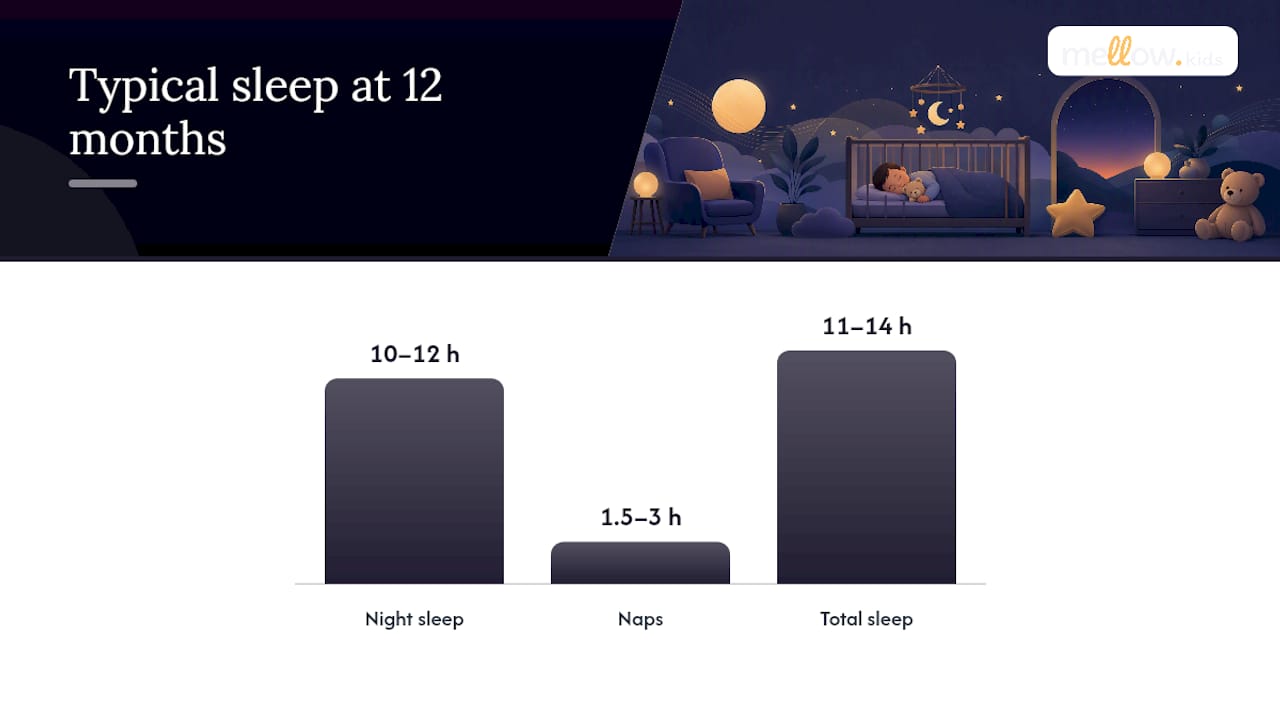
According to the Sleep Foundation, children aged 12–24 months typically need about 11 to 14 hours of total sleep across a 24-hour period. Most of that comes at night, with one or two daytime naps making up the rest. How sleep supports this growth is worth understanding: adequate rest at this stage directly fuels brain development and physical growth.
Night sleep vs. naps at 12 months
Most one-year-olds sleep roughly 10–12 hours overnight and take one to two naps totaling 1.5–3 hours during the day. The AAP's research on infant sleep development confirms that there is significant natural variation in how individual children consolidate nighttime sleep, so one child sleeping through and another waking twice can both be within normal range.
What a typical nap schedule looks like
| Age | Morning nap | Afternoon nap | Night sleep | Total |
|---|---|---|---|---|
| 11–12 months (2 naps) | 9:00–10:00 AM | 1:00–2:30 PM | 7:00 PM–6:30 AM | 11–14 hours |
| 12 months (transitioning) | Skipped or short | 12:30–2:30 PM | 7:00 PM–6:30 AM | 11–14 hours |
Around 12 months, many children begin showing signs of readiness to drop from two naps to one. This transition is not always clean, and the overlap between a nap transition and a developmental regression is one reason this age feels so chaotic.
- Wake windows at 12 months are typically 3–4 hours between sleep periods.
- Overtiredness from missed naps compounds night waking.
- Some children temporarily need an earlier bedtime during the transition.
What causes sleep disruptions at the one-year mark?
The 12-month regression rarely has a single cause. More often, several factors collide at once, which is why the disruption can feel so sudden and intense.
Developmental milestones
Your child's brain is processing an enormous amount right now. Walking, pulling to stand, first words, and object permanence all emerge around this age. According to the CDC's developmental milestones for one-year-olds, children at 12 months are typically beginning to take steps, use simple gestures, and understand that objects exist even when out of sight. That last skill, object permanence, is directly linked to separation anxiety at bedtime. Research on infant sleep consolidation confirms that new cognitive and motor skills frequently disrupt established sleep patterns as the brain integrates them.

Separation anxiety
This peaks sharply around 9–18 months. When your child understands you exist but cannot see you, they want you back, urgently, at 3 AM. The American Academy of Pediatrics notes that separation anxiety at this age is a healthy sign of secure attachment, not a behavioral problem. It does, however, make independent resettling much harder.

Nap transition pressure
Many children begin resisting the morning nap around 12 months, but they are not yet ready to drop it entirely. This in-between state creates overtiredness that spills into night sleep, producing more wakings and earlier rising.

Teething
Molars often begin erupting around 12–14 months. MedlinePlus notes that teething can cause localized discomfort that disrupts sleep, though the degree varies significantly between children. If your child is drooling heavily, chewing on everything, and running a low-grade temperature, teething is likely a contributing factor.
Illness and vaccines
The 12-month well-child visit typically includes several vaccines. Post-vaccine fussiness and mild fever can disrupt sleep for several days. Any concurrent illness, even a mild cold, adds to the disruption.
Learned sleep associations
If your child already relies on nursing, rocking, or a pacifier to fall asleep, they will call for that same support every time they surface between sleep cycles at night, which happens naturally every 45–90 minutes.
Pro Tip: Before adding any new intervention, spend two days listing what changed in the past two weeks: new skills, illness, schedule shifts, travel, or caregiver changes. Multiple overlapping triggers are common, and knowing which ones apply helps you prioritize the right response rather than trying to fix everything at once.
What are the signs of a 12-month sleep regression?
Not every rough night is a regression. The pattern matters more than any single bad night.
Common symptoms to watch for:
- More frequent night wakings than your child's recent baseline, often 2–4 times per night
- Difficulty resettling without parental help after waking
- Bedtime protests that are new or more intense than before
- Resistance to naps or naps that are suddenly shorter
- Increased clinginess and separation distress during the day
- Overtired behavior in the late afternoon despite napping
How symptoms show up across the day
Daytime signs are often as telling as nighttime ones. A child in a regression may seem tired but fight sleep, take a short nap and wake up cranky, or cling to you more than usual during play. At night, the wakings tend to happen in the first half of the night as well as the early morning hours.
Most regressions at this age produce a noticeable change from the child's recent sleep baseline within a few days. If your child was sleeping well for several weeks and then suddenly is not, a regression is a likely explanation. If sleep has been inconsistent for months, a schedule or association issue may be the bigger driver.
How long does the 12-month sleep regression last?
Most children move through this phase in 2–6 weeks, though the exact timeline depends on several factors. Some families see improvement in 10–14 days with consistent routines; others navigate a longer stretch, particularly when multiple causes are active at the same time.
What shortens a regression:
- Keeping bedtime and wake times consistent
- Avoiding new sleep associations introduced during the regression
- Addressing any underlying pain (teething, illness) promptly
- Maintaining age-appropriate wake windows
What prolongs it:
- Inconsistent responses to night wakings
- Introducing new soothing habits (nursing to sleep, bringing the child into the parental bed) that then need to be undone
- Ongoing illness or unmanaged teething pain
- A nap transition that is happening too fast or too slow for the child
According to expert commentary from Romper, pediatric sleep specialists consistently frame this regression as temporary and emphasize that preserving existing sleep habits is more effective than introducing new ones. The regression does not reset your child's sleep permanently. With steady routines, most children return to their prior sleep baseline.
Practical strategies to help your one-year-old sleep better
These steps are organized by urgency: what to do tonight, what to adjust over the next week, and when to pause and reassess.
Tonight:
- Run your usual bedtime routine without changes. Predictability is the anchor.
- Keep the sequence short: bath, pajamas, one book, song, and into the crib awake.
- If your child wakes and cries, wait 2–3 minutes before responding to give them a chance to resettle.
- When you do go in, keep the interaction brief, calm, and low-stimulation: a reassuring pat, a quiet "I'm here," and leave.
- Avoid nursing or rocking to full sleep if that was not already part of your routine.
Over the next 7 days:
- Audit wake windows. At 12 months, most children need 3–3.5 hours of wake time between sleep periods. Adjust nap timing if your child is going down overtired or undertired.
- Protect the afternoon nap even if the morning nap is being skipped. One solid nap is better than two short, fragmented ones.
- Move bedtime 15–20 minutes earlier if naps are short or skipped. Overtiredness makes night waking worse, not better.
- Increase physical activity and outdoor time during the day. Research indexed on PubMed links daytime physical activity to more consolidated night sleep in infants and toddlers.
Sample bedtime routine (30–40 minutes):
A reliable toddler bedtime routine does not need to be elaborate. Try this sequence:
- 6:30 PM: Bath or warm washcloth wipe-down
- 6:45 PM: Pajamas, sleep sack, dim lights
- 6:50 PM: One short book, quiet song or white noise on
- 7:00 PM: Into crib awake, brief goodnight, leave the room
Should you continue sleep training during a regression?
Yes, with adjustments. A regression is not a reason to abandon sleep training entirely, but it is a reason to soften your approach temporarily. If you were using a graduated extinction method, it is reasonable to offer slightly more check-ins during the regression peak. Once symptoms ease, return to your baseline approach. Introducing a completely new sleep training method in the middle of a regression tends to be harder on everyone and produces inconsistent results.
Pro Tip: The most common mistake parents make during a regression is adding a new soothing behavior, like nursing to sleep or co-sleeping, that they then need to undo once the regression passes. If you would not want to do it every night for the next six months, try not to start it now. A brief, consistent response is kinder in the long run than an inconsistent one.
Is this a true regression or just a schedule change?
These two things feel identical from the inside but call for different responses. A regression is a temporary disruption caused by developmental change; a schedule shift is a sign that your child's sleep needs have genuinely changed and the current schedule no longer fits.
The clearest way to tell them apart is to track for 7 days before making any major changes. This connection between milestones and sleep patterns is well documented, and a short audit usually reveals which driver is dominant.
Run this 7-day audit:
- Record wake time, nap start/end, bedtime, and night wakings each day.
- Note any new skills practiced that day (cruising, standing, new words).
- Flag any illness, teething symptoms, or schedule disruptions.
- Check whether the child seems overtired at nap time or bedtime (rubbing eyes, fussing, yawning).
- Note whether the child resettles independently after waking or requires intervention.
Sample 7-day tracking log:
If the log shows consistent morning nap refusal but solid afternoon naps and improving nights, your child may be ready to transition to one nap. If night wakings are frequent regardless of nap pattern and new skills are appearing daily, a developmental regression is the more likely explanation.
When should you call your pediatrician?
Most 12-month sleep disruptions are developmental and resolve on their own. Some situations warrant a call to your child's doctor.
Contact your pediatrician if you notice:
- Sleep disruption lasting longer than 6–8 weeks with no improvement
- Poor weight gain or a drop in appetite alongside sleep changes
- Snoring, gasping, or pauses in breathing during sleep
- Signs of persistent pain that are not explained by teething (arching, inconsolable crying)
- Fever lasting more than a few days or recurring fevers
- Regression in developmental skills your child had already achieved
- Your own safety is at risk due to severe sleep deprivation
When you go to the appointment, bring your 7-day sleep log, a note on feeding changes, any fever history, and a list of recent vaccines. MedlinePlus guidance on sleep problems recommends documenting the pattern clearly so the clinician can distinguish a behavioral sleep issue from a medical one. When in doubt, call. Pediatricians would always rather hear from you early.
Taking care of yourself when you are running on empty
Your child's sleep regression is also your sleep regression. Protecting your own wellbeing is not a luxury during this phase; it is a safety issue.
Practical steps that actually help:
- Sleep in shifts if you have a partner. One person handles wakings before 2 AM, the other takes the early morning stretch.
- Nap when the child naps, even for 20 minutes. Short naps reduce cortisol and improve alertness more than most parents expect.
- Ask for help explicitly. A grandparent, friend, or neighbor who takes the baby for two hours on a weekend afternoon can give you a recovery window that changes the whole week.
- Lower the bar on everything else. This phase is temporary. The laundry can wait.
- Avoid caffeine after 2 PM, even when you are desperate. It fragments your own sleep during the windows you do get.
Pro Tip: If you are the sole caregiver and cannot share night duties, try "sleep banking" on days when the child naps longer than usual. Go to bed 30–45 minutes earlier those nights to partially offset the debt. It is not a full solution, but it reduces the cumulative toll.
For broader support during this stretch, Mellow's parenting and wellbeing resources offer practical guidance on managing the mental load alongside the sleep disruption.
What this phase actually asks of you
Sleep regressions at 12 months are one of the more disorienting phases of early parenting because they arrive just when many families feel like they have finally figured things out. The 8–10 month stretch is behind you, your child seemed to be settling, and then everything shifts again. That timing is genuinely hard.
What the evidence consistently shows is that parents who hold their routines steady and resist the pull to introduce new soothing behaviors come out of this phase faster and with fewer new habits to undo. That is easier to say than to do at 3 AM. But the research on sleep regressions across early childhood supports it clearly: consistency is the most protective factor, not perfection.
The regression will pass. Your child is not broken, and neither is your approach. This is what development looks like from the inside.
Mellow Kids: age-specific support for the 12-month phase
The 12-month regression is exactly the kind of moment where generic sleep advice falls short. What your child needs at 11–14 months is different from what worked at 6 months, and different again from what will work at 18 months.
Mellow's 11–14 month program is built around this specific developmental window. The app gives you age-tailored sleep schedules, a 7-day tracking tool that mirrors the audit in this article, milestone-aware prompts that flag when a regression is likely before it hits, and evidence-based strategies matched to your child's temperament. Instead of searching for answers at 3 AM, you get a clear plan waiting for you. Download the Mellow Kids app and start with a free trial to see how the guidance maps to your child's current stage.
Sources
These are the primary sources cited in this article, along with a few additional resources worth bookmarking.
- Sleep Foundation: 12-month infant sleep regression
- NCBI PMC article on infant sleep consolidation
- Pediatrics (AAP): Uninterrupted infant sleep development
- Healthychildren
This article provides general information for educational purposes and is not a substitute for professional medical advice. If you have concerns about your child's health, sleep, or development, consult your pediatrician or a qualified healthcare provider.