

A temporary milk-supply dip around three months is usually normal. Most of the time, what feels like a drop is actually your body shifting from hormone-driven overproduction to a more precise, demand-driven system. Check the objective signs below, try focused nursing or pumping steps for 48–72 hours, and contact an IBCLC or pediatrician if any red flags appear.
Quick check: is your baby getting enough right now?
- Six or more wet diapers in 24 hours
- Steady weight gain on the pediatric growth curve
- Audible swallowing during feeds
- Calm and alert between feedings
Your 48–72 hour watch plan:
- Nurse on demand frequently throughout the day and night.
- Add skin-to-skin time before and between feeds to support let-down.
- Hold off on introducing new formula unless a red flag appears.
When to seek help right away: Contact your pediatrician the same day if your baby has fewer than 6 wet diapers, shows signs of dehydration (dry mouth, sunken fontanelle, unusual lethargy), is losing weight, or is persistently vomiting. Call an IBCLC for non-urgent but persistent supply concerns.
Table of Contents
- Why does milk supply change around 3 months?
- How do you know if your supply has actually dropped?
- What should you do right now if you're breastfeeding?
- How can pumping help you maintain and assess supply?
- When should you consider supplementation or combo-feeding?
- When should you get professional help?
- Why softer breasts at 3 months are usually a good sign
- Key Takeaways
- A calm note for parents who are worried
- Mellow can help you track what matters most
- Trusted sources and further reading
Why does milk supply change around 3 months?
Around two months, your body naturally transitions from producing milk based on postpartum hormones to producing it based on actual demand. UNICEF explains that breasts feel less full as production becomes more precisely matched to your baby's needs. This is supply regulation, and it is a sign of an efficient, mature system, not a failure.
Several things tend to converge at this stage, which is why the shift can feel alarming:
- Supply regulation: The body calibrates down from early overproduction.
- Growth spurt: Your baby wants to feed more, which can temporarily outpace supply.
- Distracted nursing: Babies become more alert and easily pull off, shortening effective feed time.
- Dropped night feeds: Reducing nighttime nursing removes key prolactin-stimulating sessions.
- Return to work: Pumping sessions may replace direct nursing, changing the demand signal.
- Hormonal birth control: Estrogen-containing contraceptives can suppress milk production.
- Illness or medication: Maternal infections, thyroid issues, or certain medications can affect output.
- Pump-related issues: A worn valve or wrong flange size can lower pump yield without any change in actual supply.
Because supply is demand-driven, anything that reduces stimulation or effective milk removal can trigger a real dip. That is exactly why nursing frequency and breast stimulation are the first levers to pull.
Pro Tip: If you recently started a new birth control method or noticed a supply change after an illness, mention both to your IBCLC or OB. Hormonal and medical causes are often overlooked and are very fixable.
How do you know if your supply has actually dropped?
Feelings are unreliable here. Softer breasts, less leaking, and lower pump numbers are all common after supply regulates, and none of them alone confirm a true milk-supply challenge. What matters are the objective measures.
Reliable indicators to track
| Indicator | What to look for | Why it matters |
|---|---|---|
| Wet diapers | 6 or more per 24 hours | Most reliable daily sign of adequate hydration and intake |
| Weight gain | Following the pediatric growth curve | Best overall measure of sufficient caloric intake |
| Audible swallowing | Heard during active nursing | Confirms milk transfer is happening |
| Feeding frequency | 8–10 effective feeds per 24 hours | Ensures demand signal stays strong |
| Behavior between feeds | Calm and alert, not persistently inconsolable | Distinguishes hunger from developmental fussiness |
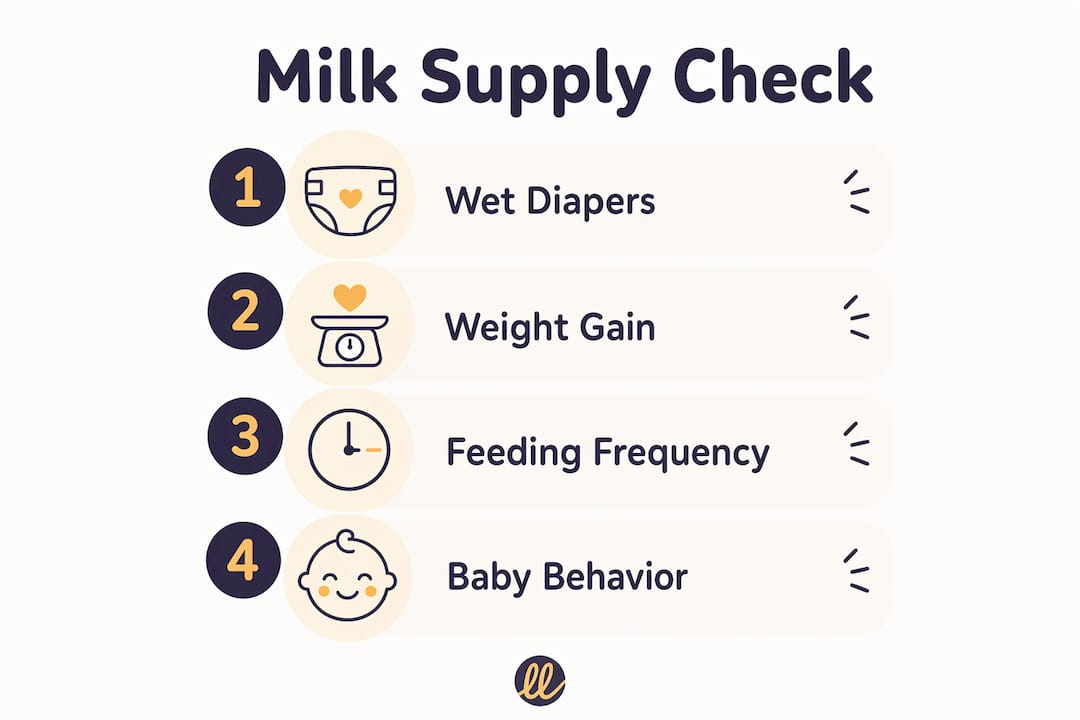
Pediatric resources consistently emphasize checking your baby's growth curve and diaper output rather than breast fullness or pump volume. Pump output is particularly misleading: a falling pump yield often reflects mechanical or technique problems rather than a biological supply loss.
Fussiness at 3 months is often developmental, not hunger-driven. Tracking feeds, diapers, and weight helps you distinguish the two with confidence rather than guessing.
Red flags that suggest true low supply
- Fewer than 6 wet diapers per day
- Weight loss or failure to regain birth weight
- Baby consistently inconsolable after full feeds
- Fewer than 8 feeds per 24 hours over several days
- Signs of dehydration: dry mouth, no tears, sunken fontanelle
If you see any of these, a weighted feed by an IBCLC (baby weighed before and after nursing) gives definitive information about actual milk transfer and is the gold standard for confirming intake concerns.
What should you do right now if you're breastfeeding?
Increase effective milk removal for 48–72 hours before drawing any conclusions. More frequent, effective emptying is the most direct way to signal your body to produce more.
- Nurse on demand, every 1.5–3 hours. Don't wait for hunger cues if your baby is sleepy. Gently wake and offer the breast. Learning to read newborn hunger cues helps you catch early feeding windows before your baby gets frustrated.
- Try cluster feeding in the evening. Offering the breast every 45–60 minutes for a 2–3 hour window in the evening mimics a growth-spurt pattern and boosts the demand signal.
- Use breast compressions. While your baby is nursing, gently compress the breast to push more milk toward the nipple. This increases the fat content of the feed and keeps a sleepy baby actively swallowing.
- Check latch and positioning. A shallow latch reduces effective transfer even during a long feed. If you hear clicking, see lip tucking, or feel pain, reposition before continuing.
- Add skin-to-skin time. Holding your baby chest-to-chest, especially before feeds, supports oxytocin release and let-down. Even 10–15 minutes before a feed can make a difference.
- Restore or protect night feeds. Dropping night feedings removes important prolactin-stimulating sessions at exactly the moment supply is regulating. If you recently cut a night feed, consider restoring it for the next few days.
- Minimize distractions during feeds. A dim, quiet room helps your baby stay focused and reduces distracted nursing. Putting away screens and reducing noise can noticeably lengthen effective feed time.
Pro Tip: If your baby keeps pulling off and fussing mid-feed, try switching sides as soon as active swallowing slows rather than waiting for a full side. The movement and change in flow can re-engage a distracted nurser.
When to schedule an IBCLC visit: if diaper output or weight gain doesn't improve within 48–72 hours of these steps, book an appointment. Bring your weight record, a feeding log covering the last 48 hours, and notes on any recent changes (birth control, illness, schedule shifts).

How can pumping help you maintain and assess supply?
Pump output is a tool, not a verdict. Babies transfer roughly 20–30% more milk per session than pumps typically collect, so a lower pump yield does not automatically mean supply has dropped. That said, structured pumping can actively protect and rebuild supply when used correctly.

Power-pumping protocol
Power pumping mimics cluster feeding and can stimulate a supply increase within a few days:
- Pump for 20 minutes, rest 10 minutes, pump 10 minutes, rest 10 minutes, pump 10 minutes.
- Do this once per day, ideally in the morning when prolactin levels are naturally higher.
- Continue for 3–5 consecutive days and track diaper output, not just pump volume.
If possible, a 24-hour nurse-in (staying skin-to-skin and nursing on demand all day) is even more effective than power pumping alone because it uses the baby's natural suckling pattern.
Pump maintenance checklist
Pump equipment issues are a surprisingly common cause of reduced output that gets mistaken for supply loss. Before assuming your supply has changed, check:
- Flange fit: The nipple should move freely without rubbing the tunnel walls. Most people need a smaller flange than the one that comes in the box.
- Valves and membranes: Inspect for small tears or warping. Replace every 4–8 weeks with regular use.
- Suction settings: Higher is not always better. Find the highest comfortable setting, not the maximum.
- Hands-on pumping: Gently massaging the breast during pumping and compressing toward the nipple can increase output by a meaningful amount.
Statistic to keep in mind: Babies typically transfer 20–30% more milk per session than pumps collect. A falling pump number is often a pump problem, not a supply problem.
Pro Tip: If you're exclusively pumping, try adding one extra session in the early morning (around 2–4 AM) for one week. That window has the highest prolactin levels of the day and can meaningfully increase daily output.
When should you consider supplementation or combo-feeding?
Supplementing immediately during a perceived 3-month dip is one of the most common ways a real supply problem gets created. When formula fills your baby's stomach, the demand signal to your breast drops, and milk production decreases in response. That cycle can be hard to reverse.
The safer sequence when objective indicators are borderline:
- Watch and reassess first. Give the 48–72 hour nursing plan a genuine try before adding formula.
- Use expressed breastmilk before formula. If supplementation is needed, your own pumped milk preserves the nutritional and immunological benefits.
- Consider donor milk. If your own supply is genuinely insufficient and formula feels premature, pasteurized donor milk from a milk bank is a safe option. Discuss it with your pediatrician.
- Use paced bottle feeding if you do supplement. Hold the bottle horizontally, pause every few sucks, and let your baby control the pace. This prevents bottle preference and keeps breastfeeding viable.
- Keep stimulation high. Always offer the breast first, then supplement. Continue pumping to replace any feeds given by bottle so your body still receives the demand signal.
Clinical guidance is clear: avoid immediate supplementation during the 3-month window unless objective indicators, such as poor weight gain or fewer than 6 wet diapers, genuinely support it. If they do, supplement with a plan to taper as supply recovers, and loop in your IBCLC.
When should you get professional help?
Some situations need a professional, not a watch-and-wait plan. Knowing which provider to call saves time and gets you the right support faster.
Call your pediatrician the same day if:
- Fewer than 6 wet diapers in 24 hours
- Any weight loss after the initial newborn period
- Signs of dehydration: dry mouth, no tears, sunken fontanelle, unusual lethargy
- Persistent vomiting after feeds
- Baby is difficult to wake or unusually limp
Contact an IBCLC for:
- Persistent supply concerns that don't improve after 48–72 hours of increased nursing
- Latch pain or difficulty that is affecting feed duration
- Uncertainty about whether pump output reflects true supply
- Help designing a safe supplementation and tapering plan
- A weighted feed to confirm actual milk transfer
See your primary care provider or OB if:
- You recently started hormonal birth control and noticed a supply change
- You have symptoms of mastitis (fever, breast redness, flu-like aches) or a breast infection
- You have a history of thyroid issues or have new symptoms (fatigue, hair loss, temperature sensitivity)
- Maternal health factors like hepatitis, diabetes, or recent illness are in the picture
What to bring to any appointment: weight history from your pediatrician, a 48-hour feeding and diaper log, notes on recent schedule changes, your current medications and contraceptive start date, and photos of latch if you have them.
Why softer breasts at 3 months are usually a good sign
The single most reassuring fact about a 3 month nursing issue is this: softer breasts are usually evidence of an efficient, mature supply, not a failing one.
UNICEF notes that the convergence of supply regulation, a growth spurt, and distracted nursing creates what lactation specialists call the "3-month breastfeeding crisis," a transient period lasting days to a few weeks. The body has simply stopped overproducing and started making exactly what your baby needs, when they need it.
"Breasts feel less full as production becomes more precisely matched to baby demand — and this is often mistaken for supply loss." — UNICEF
Societal expectations about "full" breasts contribute to this misinterpretation. A breast that no longer feels engorged between feeds is doing its job well. Less leaking is the same story: your body has calibrated its let-down response.
The practical implication is that a 48–72 hour monitoring window, not immediate supplementation, is the evidence-backed first response. Track feeds, wet diapers, and weight. If you have access to a baby scale, one weighted feed with an IBCLC gives you definitive data. If everything looks normal on those objective measures, you can breathe.
Pro Tip: Log feeds, diapers, and sleep in a consistent format for 48 hours before any IBCLC or pediatric appointment. Clinicians can make much faster, more accurate assessments when they have a written pattern rather than a verbal summary. Mellow's tracking tools are built exactly for this.
Key Takeaways
A 3 month milk supply drop is most often supply regulation, not supply loss. Objective measures, not breast fullness or pump output, are what actually tell you whether your baby is getting enough.
| Point | Details |
|---|---|
| Supply regulation is normal | Around 8 weeks, hormone-driven overproduction shifts to demand-driven production; softer breasts are expected. |
| Use objective measures | Six or more wet diapers per day and steady weight gain are the most reliable signs of adequate intake. |
| Act before supplementing | Try 48–72 hours of increased nursing frequency, skin-to-skin, and breast compressions before adding formula. |
| Pump output can mislead | Babies transfer 20–30% more milk per session than pumps collect; check equipment before assuming supply has dropped. |
| Mellow supports your tracking | Mellow's feed, diaper, and sleep logs help you build the 48-hour record clinicians need to assess supply accurately. |
A calm note for parents who are worried
Parental stress around feeding is real, and it makes sense. When you're not sure your baby is getting enough, everything feels urgent. The good news is that most parents in this situation are dealing with a normal physiological shift, not a supply crisis.
The short plan is simple: watch the objective signs for 48–72 hours, nurse or pump more frequently, and reach out to an IBCLC or your pediatrician if the red flags appear. You don't have to figure this out alone, and you don't have to act on fear. Log what you see, trust the data, and take the next small step.
Mellow can help you track what matters most
When you're watching your baby's feeds and diapers closely, having a clear log makes all the difference, especially when you need to share that information with a clinician. The Mellow Kids app lets you record feeds, diaper output, and sleep patterns in one place, and generates the kind of organized summary that helps an IBCLC or pediatrician assess your situation quickly and accurately.

Parents who come to appointments with 48 hours of logged data get faster, more targeted guidance than those relying on memory alone. If you're in the middle of a milk supply challenge right now, start logging today and bring that record to your next visit. Mellow also offers age-specific guidance for the 5–7 month stage when you're ready to plan ahead.
Trusted sources and further reading
These resources are used by pediatricians, IBCLCs, and lactation researchers across the United States. Each one is worth bookmarking.
- WIC Breastfeeding Support — Low Milk Supply: Plain-language guidance from the USDA's WIC program, including how to build supply and when to contact a breastfeeding specialist. Free support is available to WIC-enrolled families.
- HealthyChildren.org — Low Breast Milk Supply: The American Academy of Pediatrics' parent-facing resource on assessing and addressing supply concerns, including pump troubleshooting.
- UNICEF — The 3-Month Breastfeeding Crisis: Explains the physiology of supply regulation and why the 3-month window is a common but manageable transition.
- Office on Women's Health — Common Breastfeeding Challenges: Covers maternal health factors (thyroid, medication, infection) that can affect supply and when to seek medical evaluation.
- Academy of Breastfeeding Medicine (ABM): Publishes clinical protocols used by IBCLCs and physicians. Search "ABM Protocol" for evidence-based guidance on supplementation, low supply, and pumping.
- Finding a local IBCLC: Search the International Lactation Consultant Association (ILCA) directory at ilca.org to find a certified lactation consultant near you. Bring your feeding and diaper log to the first appointment.
This article is general information, not medical advice. For concerns about your baby's weight, hydration, or your own health, confirm current guidance with your pediatrician, IBCLC, or a qualified healthcare provider.