

Most 3-month-olds need 14–17 hours of sleep across a full day, split between 3–5 daytime naps and a longer overnight stretch. Your working plan tonight: keep wake windows to 1–2 hours, aim for 4–5 naps, and finish the last one by around 6:00 PM so bedtime lands somewhere between 6:30 PM and 8:00 PM.
Here's what that looks like in numbers:
- Total sleep in 24 hours: a typical range
- Night sleep: usually several hours with some feeds
- Daytime naps: multiple naps of varying lengths
- Wake windows: about 1–2 hours, shorter in the morning, slightly longer later in the day
- Last nap: finish by early evening
- Bedtime: early to moderately early evening
Three things you can do right now: cap the last nap before 6:00 PM, start a short 10-minute wind-down before bed (dim lights, a feed, a song), and watch your baby's tired cues rather than the clock.
Table of Contents
- How much sleep does a 3-month-old actually need?
- What are typical wake windows and nap lengths at 3 months?
- Sample 3-month-old schedules: 4-nap and 5-nap daily timelines
- What should bedtime and night sleep look like at 3 months?
- Why does sleep often change around 3 months?
- How to improve naps and nights: practical steps you can try this week
- Safe sleep basics and when to call your pediatrician
- Key Takeaways
- Sleep schedules are a starting point, not a verdict
- Mellow helps you build a schedule that actually fits your baby
- Useful sources and further reading
How much sleep does a 3-month-old actually need?
The 14–17 hour range is the standard guidance for this age, and it comes from both pediatric sleep research and clinical practice. That said, some babies sleep closer to 13 hours and others push toward 18, and both can be perfectly healthy. The range is a guide, not a hard rule.
How those hours split matters as much as the total:
- Night sleep — usually covers a substantial portion of total sleep, though waking for feeds remains common.
- Daytime sleep — fills the remaining sleep need across multiple naps.
The American Academy of Pediatrics (AAP) and HealthyChildren.org are the clinical standard for infant sleep guidance in the U.S. Their recommendations, alongside peer-reviewed infant sleep research, consistently show that sleep at this age is still fragmented and highly variable. Expecting a perfectly consolidated night at 3 months is setting yourself up for unnecessary worry.
A note on individuality: Sleep charts are averages. Your baby's alertness, feeding patterns, and growth are better indicators of whether they're getting enough sleep than any chart.
What are typical wake windows and nap lengths at 3 months?
Wake windows are the stretches of time your baby stays awake between sleeps. At 3 months, these typically last about 1–2 hours and may vary through the day.
How wake windows shift through the day:
- Morning: The first wake window tends to be shorter as babies tire quickly.
- Midday: Wake windows lengthen gradually.
- Afternoon/evening: The final wake window before bedtime is longest, helping build sleep pressure.
What to expect from nap lengths:
- Many naps are relatively short because sleep cycles are still maturing.
- Some babies have one or two longer naps, often earlier in the day.
- Short naps are developmentally normal at this age, with gradual improvement as sleep cycles mature later.
Pro Tip: Watch your baby's tired cues (eye rubbing, yawning, staring blankly, fussing) rather than counting minutes to the second. The clock is a starting point, not a rulebook.
Sample 3-month-old schedules: 4-nap and 5-nap daily timelines
Two patterns work well at this age. A 5-nap day suits babies who wake early or take mostly short naps. A 4-nap day works better for babies who manage at least one longer nap of 60–90 minutes. Neither is "more advanced" than the other.
5-nap day (short-nap variant)
| Time | Activity |
|---|---|
| 6:00 AM | Wake + feed |
| 8:00 AM | Nap 1 (30–45 min) |
| — | Wake + play |
| 10:00 AM | Feed + Nap 2 (30–45 min) |
| 11:00 AM | Wake + play |
| 12:30 PM | Feed + Nap 3 (30–45 min) |
| 1:30 PM | Wake + play |
| 3:00 PM | Feed + Nap 4 (30–45 min) |
| 4:00 PM | Wake + play |
| 5:15 PM | Nap 5 (20–30 min catnap) |
| 5:45 PM | Wake |
| 6:30 PM | Feed + bedtime routine |
| 6:30 PM | Bed |

4-nap day (long-nap variant)
| Time | Activity |
|---|---|
| 6:00 AM | Wake + feed |
| 8:30 AM | Nap 1 (60–90 min) |
| 10:00 AM | Wake + feed + play |
| 11:30 AM | Nap 2 (60–90 min) |
| 1:00 PM | Wake + feed + play |
| 2:30 PM | Nap 3 (45–60 min) |
| 3:30 PM | Wake + play |
| 5:00 PM | Nap 4 (30–45 min catnap) |
| 5:45 PM | Wake |
| 6:30 PM | Feed + bedtime routine |
| — | Bed |
Schedule comparison at a glance
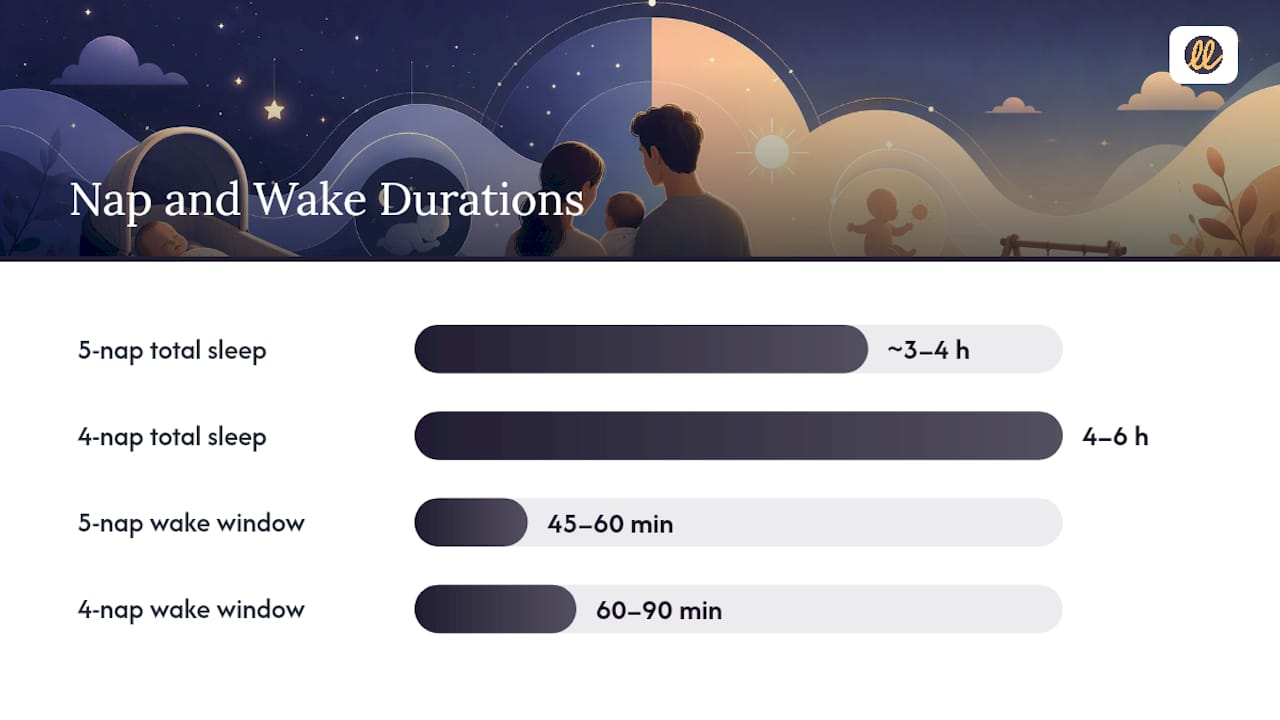
| Pattern | Total nap sleep | Wake windows | Bedtime |
|---|---|---|---|
| 5-nap (short naps) | ~3–4 hours | 45–60 min | 6:30 PM |
| 4-nap (longer naps) | 4–6 hours | 60–90 min | 6:30–8:00 PM |
BabyCenter's guidance consistently recommends finishing the last nap by around 6:00 PM to protect bedtime sleep pressure. Both sample schedules above honor that cutoff.
The last nap of the day is a catnap, not a full sleep. Its job is to take the edge off overtiredness without pushing bedtime too late. Aim for 20–30 minutes, ending by 5:45–6:00 PM.
Adapting for early and late risers:
- If your baby wakes at 6:00 AM, shift every block 60 minutes earlier. Bedtime may land closer to 6:30 PM.
- If your baby wakes at 8:00 AM, shift blocks later. Bedtime may push to 8:00–8:30 PM.
When to move from 5 naps to 4: Watch for your baby consistently resisting the fifth nap, taking longer to fall asleep for it, or waking earlier in the morning. Most babies make this shift somewhere between 3 and 4 months.
Pro Tip: Don't force the transition. If your baby still needs that fifth catnap to get through to bedtime without melting down, keep it. Dropping it too early leads to overtiredness, which makes nights worse, not better.
What should bedtime and night sleep look like at 3 months?
Bedtime for a 3-month-old typically falls in the early to moderately early evening, depending on nap timing and wake window length. An earlier bedtime is not a sign of bad parenting; it's often exactly what a tired baby needs.
At this age, some babies begin sleeping longer stretches overnight, which feels like a miracle when it happens. But many still wake every 3–4 hours for feeds, and that's completely normal. Full "sleeping through the night" is not a realistic expectation at 3 months, and comparing your baby to someone else's is rarely helpful.
What a typical night looks like:
- Bedtime: 6:30–8:00 PM
- First long stretch: 4–6 hours (sometimes 6–8 hours for babies who are consolidating well)
- Overnight feeds: 1–3, depending on the baby and feeding method
- Morning wake: 6:00–8:00 AM
A simple bedtime routine you can start tonight:
- Give the last feed of the evening (breast or bottle).
- Move to a dim, quiet room.
- Change into a sleep sack or swaddle.
- Sing one short song or read one board book.
- Place baby down drowsy but awake (or fully asleep if that's where you are right now).
The whole routine can take 10–15 minutes. Consistency matters more than length.
Pro Tip: If your baby falls asleep during the bedtime feed, that's okay at 3 months. Drowsy-but-awake is the goal, but it's a skill that develops over time. Don't stress if you're not there yet.
Why does sleep often change around 3 months?
Three months is one of the most common times parents notice a sudden shift in sleep, and it's not random. Several things happen at once.
Circadian rhythm maturation: Before about 3 months, babies don't have a fully developed internal clock. Around this age, the circadian system begins to consolidate, which is why day/night patterns start to emerge. Peer-reviewed sleep research documents this shift in sleep-cycle maturation as a key driver of the changes parents notice.
Sleep-cycle lengthening: Newborn sleep cycles are short and heavily weighted toward active (REM) sleep. At around 3 months, cycles begin to lengthen and include more quiet sleep, which can temporarily cause more frequent partial arousals between cycles.
Developmental leaps and growth spurts: Increased alertness, new motor awareness, and growth spurts can all temporarily disrupt sleep. A baby who was sleeping well at 10 weeks may suddenly seem harder to settle at 12–13 weeks.
Feeding changes: If you're breastfeeding, milk supply and feeding efficiency change around this time. Bottle-fed babies may also shift their intake patterns. Both can affect how long a baby sleeps between feeds overnight.
When to contact your pediatrician:
- Your baby is not gaining weight appropriately.
- Breathing seems labored, noisy, or irregular during sleep.
- Your baby has a fever above 100.4°F (38°C).
- Your baby is unusually difficult to rouse or seems persistently lethargic.
- You notice any sudden, dramatic change in feeding or behavior alongside the sleep disruption.
Most sleep changes at 3 months are developmental and temporary. But trust your instincts. If something feels off, call your pediatrician.
How to improve naps and nights: practical steps you can try this week
Small, consistent changes tend to work better than overhauling everything at once. Here's a realistic sequence to follow over the next 1–2 weeks.
Step 1: Build a short, repeatable routine
Use the eat-play-sleep pattern for every nap: feed after waking (not before sleeping), play during the wake window, then wind down and sleep. This decouples feeding from sleep onset, which matters more as your baby gets older.
Step 3: Time feeds strategically
Offer a full feed at the start of each wake window rather than a snack. A well-fed baby has more capacity to sleep longer. For nights, a "dream feed" around 10:00–11:00 PM (feeding a drowsy baby before you go to bed) can sometimes extend the first overnight stretch.
Safe sleep basics and when to call your pediatrician
Safe sleep isn't optional, and the rules are simple. The AAP's safe sleep guidance is the clinical standard for U.S. pediatric practice.
Core safe sleep rules:
- Always place your baby on their back to sleep, for every sleep.
- Use a firm, flat sleep surface (crib, bassinet, or play yard with a firm mattress).
- Keep the sleep area free of loose bedding, pillows, bumpers, and stuffed animals.
- Room-share (but not bed-share) for at least the first 6 months, ideally the first year.
- Avoid overheating: dress your baby in one more layer than you'd wear in the same room.
- No smoking in the home or near the baby.
For a deeper look at safe sleep from birth onward, Mellow's safe sleep for newborns guide covers the full AAP framework in plain language.
Always place your baby on their back on a firm, flat surface for every sleep. This single practice is the most effective way to reduce the risk of sleep-related infant death.
When to call your pediatrician (non-urgent but important):
- Your baby seems consistently difficult to wake or unusually sleepy across multiple days.
- Weight gain has slowed or feeding has become difficult.
- You're concerned about the number of wet diapers (fewer than 6 per day can signal dehydration).
- Sleep disruption is severe and not improving after 2–3 weeks.
Call immediately or go to the ER if:
- Your baby stops breathing or turns blue.
- Your baby has a fever above 100.4°F (38°C) at this age.
- Your baby is limp, unresponsive, or extremely difficult to rouse.
Peer-reviewed infant sleep research supports the AAP framework as the evidence base for these recommendations. When in doubt, call your pediatrician. That's what they're there for.
This article is general information, not medical advice. Always confirm current guidance and any health concerns with your baby's pediatrician.
Key Takeaways
A 3-month-old's sleep schedule works best when you anchor it to consistent wake windows of 1–2 hours, a last-nap cutoff by 6:00 PM, and a bedtime between 6:30 PM and 8:00 PM.
| Point | Details |
|---|---|
| Total sleep target | Most 3-month-olds need 14–17 hours across 24 hours, split between naps and night sleep. |
| Wake windows | Keep wake windows to 1–2 hours; shorter in the morning, slightly longer toward evening. |
| Last-nap cutoff | Finish the last nap by ~6:00 PM to build enough sleep pressure for a solid bedtime. |
| Bedtime window | Aim for bedtime between 6:30 PM and 8:00 PM, depending on the nap pattern and wake time. |
| Red flags | Contact your pediatrician for fever above 100.4°F, poor weight gain, or breathing concerns. |
| Mellow | Mellow's sleep tools and personalized guidance help parents track wake windows, naps, and developmental changes week by week. |
Sleep schedules are a starting point, not a verdict
Here's something most sleep guides won't say plainly: the schedule is a hypothesis, not a prescription. You try a wake window, you watch what happens, and you adjust. That's not failure. That's parenting at 3 months.
What I find parents underestimate most is how much the environment shapes sleep at this age. The schedule gets all the attention, but a room that's too bright, too warm, or too quiet (yes, too quiet) can undo a perfectly timed nap in minutes. Before you change the schedule, check the room.
The other thing worth saying: short naps are not a sign that you're doing something wrong. At 3 months, sleep cycles are still maturing. A 30-minute nap is biologically appropriate. The babies who suddenly start taking 90-minute naps at 4 or 5 months aren't doing so because their parents found the perfect schedule. They're doing it because their nervous systems caught up. Your job right now is to create the conditions for that to happen, not to force it.
Give yourself credit for showing up and paying attention. That's already most of the work.
Mellow helps you build a schedule that actually fits your baby
Every baby is different, and a generic schedule only gets you so far. Mellow gives parents of newborns to 2-year-olds something more useful: personalized guidance that adjusts as your baby grows, with sleep tools built around your child's actual patterns rather than a one-size chart.

With Mellow, you can track wake windows, naps, and feeds in real time, get proactive nudges before developmental changes hit (like the 4-month sleep shift), and access evidence-based strategies for common sleep challenges like short naps, early rising, and frequent night wakings. When the 3-month routine stops working, Mellow helps you understand why and what to try next, before the exhaustion sets in.
Ready to stop guessing and start working with your baby's natural rhythms? Download the Mellow app and get personalized sleep guidance starting today.
Useful sources and further reading
The claims in this article draw on pediatric clinical standards and peer-reviewed sleep research. These are the primary sources:
- BabyCenter — Baby sleep basics: 3 to 6 months
- HealthyChildren.org — A parent's guide to safe sleep
- PubMed — sleep development literature
- Journal of Clinical Sleep Medicine — infant sleep research
- Healthline — 3-Month-Old Sleep Schedule: Samples, Tips, and More
- What to Expect — 3-Month-Old Sleep Schedule
These sources are starting points. For questions specific to your baby's health, weight gain, or development, your pediatrician is always the right first call.