

If your 5-month-old is gassy at night, start here: hold baby upright and burp, then do bicycle legs and a gentle tummy massage, then try a warm bath or an upright calming hold. In that order. Most episodes settle within several minutes when you work through these steps calmly and consistently.
What to try right now, in order:
- Hold upright and burp. Sit baby on your lap, lean them slightly forward with chin supported, and pat the back firmly for 2–3 minutes. Don't stop just because you don't hear a burp.
- Bicycle legs. Lay baby on their back, hold their ankles, and gently pedal their legs toward their belly in slow, circular motions for 1–2 minutes.
- Tummy massage. Using two fingers, make slow clockwise circles on baby's belly, just below the navel. Follow the direction of digestion.
- Warm bath or upright hold. A few minutes in warm water relaxes abdominal muscles. If a bath isn't practical at 2 AM, hold baby upright against your chest and sway gently.
When to call the pediatrician immediately: fever of 100.4°F or higher, persistent vomiting, blood in the stool, inconsolable crying lasting more than two hours, or signs of poor weight gain. These symptoms go beyond routine gas and need same-day evaluation.
Babies pass gas 13–21 times daily, so what you're seeing is almost certainly normal. The problem at night isn't that your baby suddenly produces more gas. It's that less movement and a horizontal position make that gas harder to shift.
Table of Contents
- Why is your 5-month-old so gassy at night?
- How do you know if it's gas and not reflux, colic, or illness?
- What are the fastest ways to relieve gas pain at night?
- How can you prevent gas from building up during evening feeds?
- What sleep positions are safe when your baby is gassy?
- When should you call the pediatrician about nighttime gas?
- What does the evidence say about pacing feeds and burping?
- Key Takeaways
- Gas at night is hard — here's what actually matters
- How Mellow can help you track and reduce nighttime gas
- Useful sources
Why is your 5-month-old so gassy at night?
Gas itself isn't the villain. The real issue is a combination of immature digestion, swallowed air during feeds, and the simple physics of lying down.

During the day, movement helps gas travel through the intestines and out. At night, baby lies still for hours. Air that would have passed quietly during an afternoon nap gets trapped in loops of intestine, building pressure and causing pain. Lying flat also shifts gas from the stomach into the small intestine faster, which can feel uncomfortable before the gut has a chance to process it.
At five months, the digestive system is still maturing. Gut bacteria are actively colonizing and changing, which produces fermentation gases as a byproduct. This is completely normal, but it does mean the gut is doing a lot of work overnight. Gas discomfort often peaks around six weeks and improves substantially by three months for most infants, though some babies need help for longer — and five months is still within that window for many families.
The key insight: Nighttime gas in infants is frequently related to air ingestion during feeding. Evaluating the feeding setup and pacing often provides more benefit than immediately changing the parent's diet.
Swallowed air during evening feeds is the single biggest contributor. A fast-flow nipple, a shallow latch, or a hungry baby who gulps can send significant amounts of air into the stomach. That air has to go somewhere, and overnight is when it makes itself known.
How do you know if it's gas and not reflux, colic, or illness?
Not every nighttime cry is gas. This table gives you a quick way to compare what you're seeing.
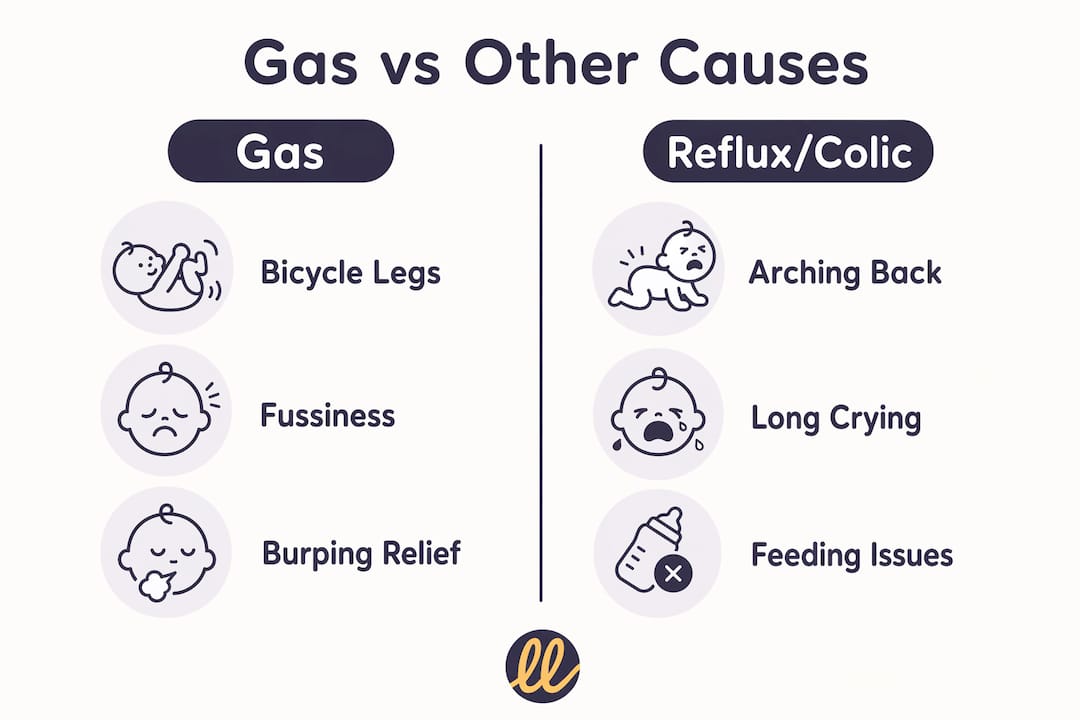
| Symptom / Pattern | Gas | Reflux | Colic | Illness |
|---|---|---|---|---|
| Timing | After feeds; worse at night | During or shortly after feeds | Same time daily (often evening) | Any time; no pattern |
| Duration | Brief episodes, settles with movement | Ongoing; may worsen lying flat | Crying 3+ hours, 3+ days/week | Persistent; doesn't resolve |
| Physical signs | Bloated belly, pulling legs up, passing gas | Arching back, spitting up frequently | Clenched fists, red face, inconsolable | Fever, lethargy, vomiting, rash |
| Response to comfort | Usually settles with burping or movement | Partial relief; recurs quickly | Minimal response to soothing | Variable; often worsens |
| Feeding behavior | Normal appetite | May refuse feeds or cry during them | Normal between episodes | Reduced intake, unusual behavior |
Red flags that mean call the doctor today:
- Fever of 100.4°F or higher in a baby under 6 months
- Vomiting (not just spitting up) that is forceful or frequent
- Blood or mucus in the stool
- Baby is not gaining weight or has fewer wet diapers than usual
- Crying that is inconsolable and lasts more than two hours
Quick self-check questions for 2 AM:
- Is baby feeding normally and producing wet diapers? (Yes = likely not illness)
- Does the discomfort come in waves and ease after passing gas? (Yes = likely gas)
- Is baby arching their back and spitting up frequently? (Yes = consider reflux)
- Has crying been going on for more than three hours with no relief? (Yes = call the pediatric nurse line)
What are the fastest ways to relieve gas pain at night?
Work through these in order. Each step builds on the last, and most babies respond before you reach step four.
-
Hold upright and burp (2–3 minutes). Sit baby on your lap with their chin resting on your hand, body leaning slightly forward. Pat firmly between the shoulder blades. Many parents stop too soon because they don't hear a burp, but holding baby upright for 15–20 minutes after a feed uses gravity to move trapped air before it reaches the intestines.
-
Bicycle legs (1–2 minutes). Lay baby on their back on a firm surface. Hold both ankles and gently pedal their legs in a cycling motion, bringing each knee toward the belly alternately. This compresses the abdomen and helps move gas along.
-
Knees-to-chest. From the same position, bring both knees up to the belly simultaneously and hold for 5–10 seconds, then release. Repeat 4–5 times. This is especially effective for lower intestinal gas.
-
Clockwise tummy massage. With two warm fingers, trace slow circles on baby's belly in a clockwise direction (following the path of the large intestine). Start below the navel and work outward. Gentle, consistent pressure works better than deep pressure.
-
Warm bath. A few minutes in comfortably warm water relaxes the abdominal muscles and often prompts a gas release within minutes. Keep the room warm and have a towel ready.
-
Upright calming hold. If nothing else is working, hold baby chest-to-chest, their belly against yours, and sway or walk slowly. The warmth and gentle pressure on their abdomen can ease discomfort while you both calm down.
Safety reminders for nighttime care:
- Always keep one hand on baby during floor exercises.
- Room temperature should be 68–72°F; don't overdress baby for a bath.
- Never prop a bottle or leave baby unattended with a pacifier in a position meant to relieve gas.
A note on gas drops: Simethicone (found in products like Mylicon) breaks up gas bubbles but works best when given preventively rather than after pain has already started. Once baby is in active discomfort, drops rarely reverse the episode quickly. Talk to your pediatrician before making gas drops part of a regular routine.
How can you prevent gas from building up during evening feeds?
Prevention beats rescue every time. The changes below address the root cause: swallowed air during feeding.
For bottle-fed babies:
-
Use a slow-flow nipple. A fast flow forces baby to gulp, swallowing air with every ounce. Switching to a slower-flow nipple or a vented bottle reduces air ingestion significantly. If milk drips steadily from the nipple when you hold it upside down, the flow is likely too fast.
-
Pace the feed. Hold the bottle horizontally (nearly flat) rather than tipped up. This slows the flow and lets baby control the pace. Pause every ounce and take the bottle away for 20–30 seconds.
-
Burp mid-feed and at the end. Experts recommend pausing to burp halfway through or after each ounce for gassy infants. For a 5-month-old, that means multiple burp breaks per feed.
-
Keep baby's head higher than their stomach. A semi-upright angle (about 45 degrees) during the feed reduces air swallowing and helps milk flow toward the stomach rather than pooling.
-
Hold upright for 20 minutes after the feed. Gravity does the work. Don't rush to put baby down.
For breastfed babies:
-
Check the latch. A shallow latch means baby is taking in air with every suck. Baby's lips should flange outward and their chin should touch the breast. A lactation consultant can assess this in one session and often resolves persistent gas issues that weeks of home troubleshooting haven't fixed.
-
Burp when switching breasts. This is the natural pause point and the most effective moment to release swallowed air.
-
Offer one breast fully before switching. Letting baby finish the hindmilk on one side reduces the chance of an oversupply-related fast letdown, which can cause gulping.
Sample burping schedule by feed type:
| Feed type | When to burp | How long to try |
|---|---|---|
| Bottle (per ounce) | After every 1–2 oz | 2–3 minutes per break |
| Bottle (mid-feed) | Halfway through the bottle | 2–3 minutes |
| Breastfed | When switching breasts | 1–2 minutes |
| Both (end of feed) | After the last ounce or breast | 3–5 minutes |

Pro Tip: Simethicone gas drops are more effective when given preventively, such as before the evening feed, rather than after discomfort starts. Once a baby is in active pain, the drops rarely reverse the episode quickly. Ask your pediatrician whether scheduled dosing makes sense for your baby before starting a regular routine.
If gas is a consistent problem despite these changes, a lactation consultant or your pediatrician can evaluate whether oversupply, a tongue tie, or a formula sensitivity is contributing. Come to that visit with a two-day log of feed times, ounces, burp frequency, and night wake times. For families managing simultaneous feeds, this guide to burping techniques covers positioning strategies that also apply to single-baby households.
What sleep positions are safe when your baby is gassy?
The short answer: baby sleeps on their back, every time, even when gassy. No exceptions.
The American Academy of Pediatrics is unambiguous on this point. Back sleeping is the safest position for all infants until their first birthday, regardless of gas, reflux, or any other digestive discomfort. Stomach sleeping increases the risk of sudden infant death syndrome (SIDS), and that risk does not go away because a baby is uncomfortable.
AAP safe-sleep rule: Always place baby on their back on a firm, flat surface with no loose bedding, pillows, or positioners. This applies every night, every nap, even when gas is the reason baby woke up.
What you can do while baby is awake and supervised:
- Upright hold after feeds. Hold baby chest-to-chest for 20–30 minutes before putting them down. This is the most effective pre-sleep gas strategy.
- Belly-on-lap. Drape baby face-down across your lap and gently rub their back. The light pressure on the abdomen often helps gas move. Stay present and attentive the entire time.
- Supervised tummy time. Tummy time during awake periods aids digestion and helps gas pass. Even 5–10 minutes before the evening bath can make a difference overnight. For ideas on building daytime routines that support nighttime sleep, Mellow's guide on daycare and sleep challenges covers how movement during the day affects nighttime rest.
What to avoid:
- Propping the bottle or leaving baby semi-reclined in a bouncer to sleep.
- Using sleep positioners, wedges, or rolled blankets under the mattress.
- Placing baby on their side or stomach because it "seems to help" the gas. It increases risk without reliably resolving the discomfort.
The Sleep Foundation notes that lying down encourages air to pass deeper into the digestive system, which can worsen gassiness. The answer isn't a different sleep position; it's releasing the gas before baby goes down.
When should you call the pediatrician about nighttime gas?
Most nighttime gas resolves on its own or with the techniques above. But some symptoms need a call the same day, and a few need urgent care.
Call or go to urgent care immediately if you see:
- Fever of 100.4°F or higher (any fever in a baby under 3 months is an emergency)
- Forceful or projectile vomiting
- Blood or dark mucus in the stool
- Inconsolable crying lasting more than two hours with no response to comfort
- Baby appears lethargic, unusually pale, or difficult to wake
Watch over 24–48 hours and call if it continues:
- Fewer wet diapers than usual (fewer than 6 per day at this age)
- Refusing multiple feeds in a row
- Belly that looks visibly swollen or feels hard to the touch
- Gas that doesn't improve at all with the relief techniques above
Reassurance: Gas discomfort often peaks around six weeks and improves substantially by three months for most infants. At five months, many babies are past the worst of it, but some continue to need support. If gas is consistently interrupting sleep or feeding, that's a reasonable reason to bring it up at your next well-child visit, even without red-flag symptoms.
A pediatric nurse line (most practices have one available after hours) is a good first call when you're unsure. You don't have to wait until morning if something feels off.
What does the evidence say about pacing feeds and burping?
Pacing feeds and frequent burping are the two interventions with the clearest clinical backing for reducing infant gas. The mechanism is straightforward: less swallowed air means less intestinal gas, which means fewer night wake episodes driven by discomfort.
Dr. Sniderman at the Cleveland Clinic recommends pausing to burp halfway through feeds and more frequently for infants who are especially gassy. This proactive approach reduces trapped air before it becomes intestinal gas — and before it reaches the intestines where it's much harder to move.
The AAP recommends burping during and after feeds, adjusting bottle flow, and increasing supervised tummy time as practical first-line interventions. These aren't complicated, but they require consistency over several days to see a real difference. One night of pacing feeds won't reset a pattern that's been building for weeks.
A simple two-week tracking checklist:
- Log each feed: time, ounces or minutes, number of burp breaks, and whether baby burped.
- Note night wake times and whether gas seemed to be the cause (pulling legs up, passing gas, settling after movement).
- After one week, look for patterns: Are the worst nights linked to specific feeds? Is baby gassier after evening feeds than morning ones?
- Share the log with your pediatrician if the pattern isn't improving.
This kind of tracking turns a frustrating guessing game into something you can actually act on. Mellow's sleep and development app includes feeding and diaper tracking tools built for exactly this kind of pattern-spotting, so you're not keeping notes on your phone's notes app at 3 AM.
For parents who want to understand how nighttime gas intersects with broader sleep pattern changes at five months, developmental wakefulness can sometimes look a lot like gas discomfort. Knowing the difference helps you respond more effectively.
This article reflects general pediatric guidance and is not a substitute for advice from your child's own healthcare provider. Always confirm current recommendations with your pediatrician for your baby's specific situation.
Key Takeaways
Nighttime gas in a 5-month-old is almost always manageable with consistent burping, pacing feeds, and a few bedside relief techniques — and it typically improves on its own as digestion matures.
| Point | Details |
|---|---|
| Start with burping and movement | Hold upright to burp, then try bicycle legs and tummy massage before anything else. |
| Gas is normal at this age | Babies commonly pass gas 13–21 times daily; nighttime discomfort usually reflects swallowed air, not illness. |
| Prevention beats rescue | Pacing feeds and burping mid-feed reduce swallowed air and cut down gassy nights over time. |
| Back sleep is non-negotiable | Baby sleeps on their back every time, even when gassy; use upright holds before bed instead. |
| Mellow tracks the patterns | The Mellow app's feeding and sleep logs help you spot which feeds drive the worst nights. |
Gas at night is hard — here's what actually matters
There's a version of this problem that parents often describe: they've read everything, tried everything, and still feel like they're missing something. What they're usually missing isn't a technique. It's consistency and timing.
The techniques in this article work. Bicycle legs, pacing feeds, burping mid-feed — these are not folk remedies. They're what pediatric clinicians recommend because they address the actual mechanism: swallowed air that hasn't been released before baby lies down. The reason they sometimes feel ineffective is that parents try them reactively, at 2 AM when baby is already in pain, rather than building them into the pre-sleep routine every single night.
Gas drops are a good example of this gap. Parents reach for them when baby is screaming. But the clinical evidence suggests they work best preventively, before the evening feed, not after discomfort has already peaked. That's a meaningful shift in how you use the same product.
The other thing worth saying plainly: at five months, some gas is just going to happen. The gut is still developing. The goal isn't zero gas nights. It's reducing the frequency and severity enough that everyone gets more sleep. That's a realistic, achievable target — and most families get there within a week or two of consistent changes.
How Mellow can help you track and reduce nighttime gas
Figuring out what's driving your baby's gassy nights is much easier when you can see the pattern across several days, not just the one terrible night you remember most vividly.

The Mellow app gives parents of newborns through 2-year-olds a simple way to log feeds, burps, diaper changes, and night wake times in one place. Over a week, those logs reveal which evening feeds consistently precede the worst nights, which burping changes are actually making a difference, and when it might be time to loop in your pediatrician. Mellow's mini-guides include step-by-step nighttime soothing routines built around pediatric guidance, so you're not piecing together advice from a dozen different sources at midnight. Download the app or grab a mini-guide to start tracking tonight.
Useful sources
These are the primary sources referenced throughout this article. Each one is from a recognized medical institution or pediatric authority.
- Children's Hospital of Philadelphia (CHOP) — How to Help a Newborn with Gas: Covers gas timeline, when to seek care, and practical relief techniques from a leading pediatric hospital.
- Cleveland Clinic — How to Relieve Baby Gas: Includes expert guidance on pacing feeds, burping frequency, and the preventive use of simethicone.
- AAP HealthyChildren.org — Gas Relief for Babies: The American Academy of Pediatrics' practical recommendations on burping, bottle flow, and tummy time.
- WebMD — Infant Gas: Treating and Preventing Baby Gas: Covers causes, frequency norms (13–21 times daily), and feeding adjustments for bottle and breastfed babies.
- Banner Health — Signs Your Baby Has Gas and Tips to Treat It: Practical tips including the link between prolonged crying and increased air swallowing.
- Sleep Foundation — Best Sleeping Position for a Gassy Baby: Evidence-based guidance on safe sleep positions and why back sleeping remains the recommendation even for gassy infants.
- AAP — Safe Sleep Guidelines (Pediatrics, 2022): The updated AAP policy statement on safe infant sleep environments.
Online sources are a helpful starting point, but always confirm guidance with your own pediatrician, especially for symptoms that fall outside the typical gas pattern.