
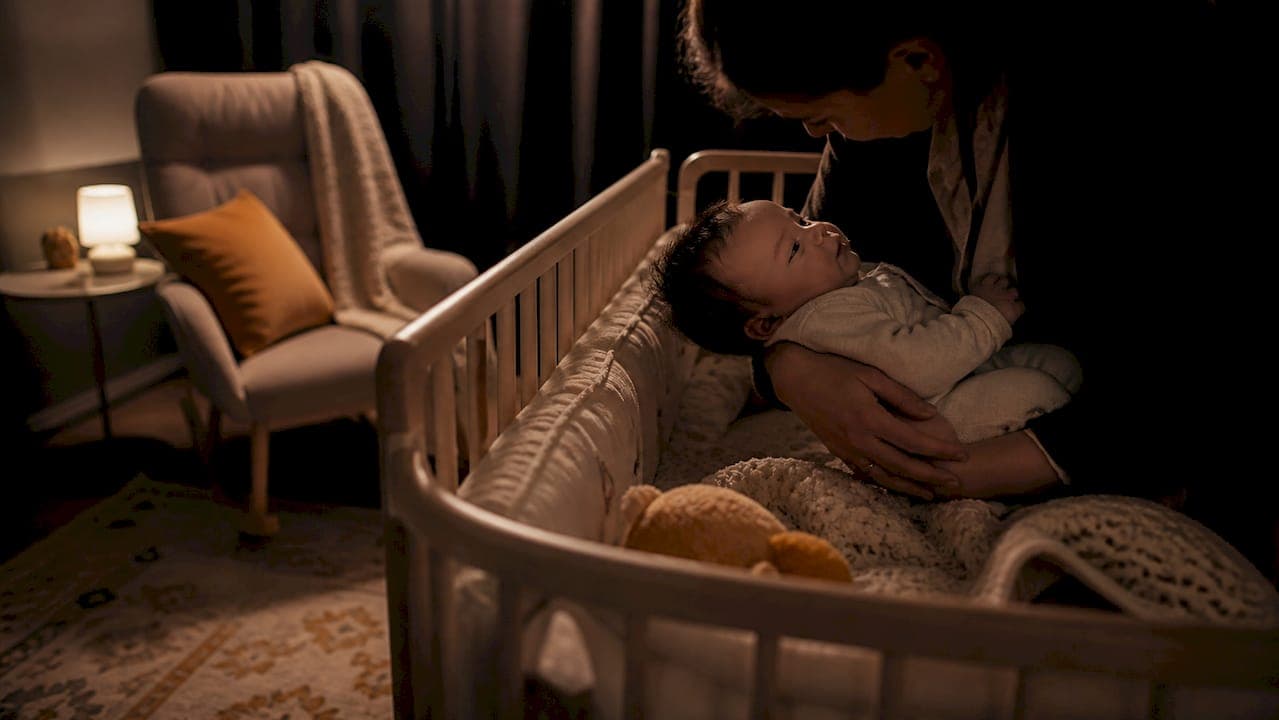
The 8-month sleep regression is a temporary, development-driven disruption in your baby's sleep that is triggered by cognitive leaps, new mobility, separation anxiety, and nap schedule shifts. If your baby was sleeping reasonably well and has suddenly started waking more at night, fighting bedtime, or refusing naps, this is almost certainly why. The good news: it passes, and there are specific things you can do right now.
Try these three steps tonight:
- Keep your bedtime routine consistent. Same order, same timing, same cues. A predictable sequence (bath, feed, song, sleep) signals safety and helps your baby's nervous system settle, even when development is stirring things up.
- Put your baby down sleepy but awake. This is the single most important habit to protect during a regression. It builds the self-settling skill your baby needs to reconnect sleep cycles independently, which is what reduces night wakings over time.
- Check for discomfort or unmet needs first. Teething pain, hunger from a growth spurt, or a stuffy nose can all amplify a regression. Rule these out before assuming the waking is purely behavioral.
Not every baby goes through this phase with the same intensity. Some parents barely notice it; others feel like they've gone back to the newborn weeks. Either experience is normal, according to the Sleep Foundation. Mellow Kids is built specifically to help you navigate moments like this one, with age-targeted guidance and tools that track what's actually changing.
Key Takeaways
The 8-month sleep regression is a temporary, development-driven phase that usually lasts a few weeks and responds well to consistent routines, one small change at a time, and age-appropriate soothing.
| Point | Details |
|---|---|
| Duration is usually 3–6 weeks | Most babies show improvement within this window when routines stay consistent. |
| Nap transition is a key driver | Babies ready to drop to two naps often show worse night sleep until the schedule catches up. |
| Avoid new sleep props | Introducing prolonged rocking or feeding to sleep during regression can extend disruption beyond the typical window. |
| Contact your pediatrician for red flags | Fever, breathing issues, poor weight gain, or no improvement after 6–8 weeks warrant a call. |
| Mellow Kids offers age-specific tools | The 8–10 months section provides tailored schedules and tracking for this exact stage. |
Table of Contents
- What does the 8-month sleep regression actually mean?
- Why does the 8-month regression happen?
- How long does the 8-month sleep regression last?
- How are naps affected, and how do you manage the 3-to-2 transition?
- Practical strategies to try tonight and over the next 2–6 weeks
- Two sample schedules you can try this week
- When should you contact your pediatrician?
- Why this guidance is evidence-informed
- What parents often get wrong about sleep regressions
- Mellow Kids can help you through this regression
- Sources
What does the 8-month sleep regression actually mean?
The term "8-month sleep regression" refers to a temporary setback in sleep quality that often appears between 7 and 10 months, coinciding with a cluster of major developmental changes. It's not a disorder or a sign that something has gone wrong. Sleep regressions are, in a real sense, evidence that your baby's brain is doing exactly what it should.
Most babies this age need 12–16 total hours of sleep across a 24-hour period, typically split between nighttime sleep and two or three daytime naps. A regression disrupts that pattern without changing the underlying need. Your baby still requires the same amount of rest; they're just having a harder time getting there.
One thing worth knowing: not every baby experiences a noticeable regression at this age. Healthline notes that sleep is highly individual, and some babies move through developmental milestones with minimal disruption. If your baby seems fine, you don't need to borrow trouble. If they're not, understanding what's driving it makes a real difference in how you respond.
Why does the 8-month regression happen?
Several things tend to collide around this age, and often more than one is happening at the same time. Identifying the most likely driver helps you choose the right response rather than guessing.
The most common causes:
- Nap schedule shift (3 naps to 2). Many babies are developmentally ready to drop their third nap around 7–9 months. When the schedule hasn't caught up with that readiness, overtiredness or undertiredness can disrupt nighttime sleep.
- Separation anxiety. This is one of the most significant contributors at this age. Around 8 months, babies develop a clearer understanding of object permanence — they know you exist when you leave the room, and they want you back. BabyCenter notes that separation anxiety commonly intensifies around this age and can increase night wakings considerably.
- Teething. Lower lateral incisors often emerge between 7 and 10 months. Teething discomfort tends to be worse at night when there are fewer distractions, and it can cause frequent, hard-to-settle wakings.
- Increased mobility and skill practice. Crawling, pulling to stand, and cruising are all happening around now. Babies often practice these skills mentally during sleep, which can cause more frequent arousals. You may notice your baby standing in the crib at 2 AM, unable to get back down.
- Overstimulation. A busy, stimulating day without enough wind-down time can make it harder for your baby to settle. The developing brain is processing a lot.
- Illness. A cold, ear infection, or other illness can look exactly like a regression. Always rule this out first, especially if the disruption came on suddenly and is accompanied by other symptoms.
- Hunger or feeding changes. If your baby has recently started solids or is going through a growth spurt, caloric needs may have shifted. A baby who isn't getting enough calories during the day will wake more at night to compensate.
How to tell them apart: Separation anxiety tends to produce crying that calms quickly when you appear and escalates when you leave. Teething usually involves drooling, gum rubbing, and fussiness that's worse in the late evening. A nap-timing issue often shows up as a baby who fights the third nap but then can't make it to bedtime without melting down. Illness brings other physical signs: fever, congestion, pulling at ears, or changes in feeding. When multiple causes overlap, address the most obvious one first and track whether it helps.
You can read more about how developmental milestones affect sleep patterns at different ages on the Mellow Kids blog.
How long does the 8-month sleep regression last?
Most families see improvement within 3–6 weeks, though some regressions resolve faster and a few stretch longer. Healthline cites this range as the most commonly reported window, with individual variation on both ends. A regression that clears up in 10 days is just as valid as one that takes five weeks.
Typical duration: 3–6 weeks. Most babies show meaningful improvement in night wakings and nap consolidation within this window when parents maintain consistent routines and avoid introducing new sleep props.
Signs you're moving in the right direction:
- Naps are becoming more consolidated (longer stretches, less fighting at the start)
- Night wakings are fewer or shorter in duration
- Your baby settles back to sleep more quickly after a waking
- Fussing episodes at bedtime are getting shorter
When to reconsider whether this is a typical regression:
If sleep continues to deteriorate after six weeks with no improvement despite consistent routines, or if your baby shows signs of poor weight gain, persistent fever, breathing irregularities, or refusal to eat, the problem is likely not a developmental regression. The PMC research on developmental aspects of infant sleep supports the view that while sleep disruptions tied to developmental change are expected, persistent or worsening patterns warrant clinical assessment.
How are naps affected, and how do you manage the 3-to-2 transition?
The nap shift is often the piece parents miss. A baby who is developmentally ready to drop to two naps but is still being offered three will frequently have trouble at bedtime and wake more at night — not because of anxiety or teething, but because the sleep pressure isn't building correctly.
Signs your baby may be ready to drop the third nap:
- Consistently waking later in the morning (7 AM or later), making the third nap fall too close to bedtime
- The mid-day nap is getting shorter or harder to initiate
- Your baby fights the third nap for 30+ minutes or skips it entirely
- Bedtime has become a battle even when the third nap happened
Once you see two or three of these signs consistently for at least a week, it's worth testing a two-nap structure.
Two approaches to the transition:
| Approach | How it works | Best for |
|---|---|---|
| Fast switch | Drop the third nap immediately; shift bedtime 30 minutes earlier to compensate for the lost sleep | Babies who are clearly ready and already skipping the third nap regularly |
| Gradual shift | Cap the third nap at 20–30 minutes, then shorten it by 5–10 minutes every few days until it disappears | Babies who still seem to need some rest but are showing readiness signs |

Both approaches work. The fast switch tends to produce a few rough days followed by a cleaner adjustment. The gradual shift is gentler but takes longer to stabilize. Choose based on your baby's temperament and your own capacity for a few difficult nights.
Protecting nighttime sleep during the transition: Keep nap windows consistent (same start times each day, within 20–30 minutes). A dark room and white noise help signal sleep time and reduce stimulation. Avoid letting the first nap run too long, as this can push the second nap late and compress the gap before bedtime. A 2.5–3 hour wake window before bedtime is a reasonable target for most babies at this age.
Practical strategies to try tonight and over the next 2–6 weeks
The most effective approach is stepwise: try the lowest-effort, highest-impact changes first, give them 3–7 days to work, and only escalate if they don't.
Step 1: Start tonight
- Run your bedtime routine at the same time, in the same order. Consistency is the single most supported strategy in pediatric sleep guidance, backed by AAP research on behavioral interventions for infant sleep problems.
- Put your baby down sleepy but awake, even if they protest. This is harder during a regression, but it's the foundation of independent settling.
- Check for and address physical discomfort before assuming the waking is behavioral.
Step 2: Test over 3–7 days
- Adjust nap timing if you suspect the 3-to-2 transition is overdue.
- Move bedtime 15–30 minutes earlier if your baby is overtired by evening. Overtiredness raises cortisol and makes settling harder, not easier.
- Add a brief check-in response to night wakings (go in, reassure calmly, leave) rather than immediately feeding or rocking to sleep — unless hunger is clearly the cause.
Step 3: If first-line steps haven't helped after 2 weeks
- Consider a more structured approach to sleep training, using a method that fits your parenting philosophy. The AAP supports behavioral interventions as appropriate non-pharmacologic first-line strategies for infant sleep problems.
- Consult your pediatrician to rule out medical contributors.
Soothing by cause:
- Separation anxiety: Respond promptly but briefly. Keep your voice calm and your visit short. Practice brief separations during the day (peek-a-boo, leaving the room and returning) so your baby builds confidence that you come back. Avoid prolonged, stimulating nighttime interactions.
- Teething: Offer a chilled (not frozen) teething ring before bed. Ask your pediatrician about appropriate pain relief options for your baby's age and weight.
- Nap-timing issues: Shift nap windows by 15-minute increments rather than making large changes all at once.
Feeding and solids timing: If your baby is newly on solids, try offering a more substantial dinner earlier in the evening (around 5–5:30 PM) so digestion isn't interfering with sleep. A small milk feed as part of the bedtime routine is fine, but avoid feeding all the way to sleep if you're working on independent settling. Log what you offer and when, and note whether night wakings change.
Tracking changes: Keep a simple sleep log for 5–7 days before making any change, and continue it for 5–7 days after. Note wake time, nap start and end times, bedtime, and any night wakings. This gives you real data rather than a feeling, which makes it much easier to see whether a strategy is working.
Pro Tip: If your baby was settling independently before the regression, don't introduce prolonged rocking or feeding to sleep as a nightly fix. The Sleep Foundation notes that parents who reintroduce these associations during a regression often see short-term relief but longer-term dependency — which extends the disruption well beyond the typical 3–6 week window.
For a deeper look at managing sleep regressions across different ages, the Mellow Kids blog covers the full pattern from newborn through toddlerhood.
Two sample schedules you can try this week
These are starting-point templates, not rigid prescriptions. Adjust wake windows by 15–30 minutes based on your baby's cues.
Sample 3-nap day (babies not yet ready to transition)
| Time | Activity |
|---|---|
| 7 AM | Wake, milk feed |
| around 9 AM | Nap 1 (about 45 minutes) |
| 11:30 AM | Milk feed, solids |
| around noon to 12:45 PM | Nap 2 (about 45 minutes) |
| mid-afternoon | Milk feed |
| between 3:30 and 4 PM | Nap 3 (30 min max) |
| 5:30 PM | Solids dinner |
| 6:30 PM | Begin bedtime routine |
| 7 PM | Asleep |
Sample 2-nap day (babies ready to consolidate)
| Time | Activity |
|---|---|
| 7 AM | Wake, milk feed |
| between 9:30 and 11 AM | Nap 1 (up to 90 min) |
| around noon | Milk feed, solids |
| between 2 and 3:30 PM | Nap 2 (up to 90 min) |
| around 5 PM | Solids dinner |
| around 6 PM | Begin bedtime routine |
| 6:30–7 PM | Asleep |
7-day trial plan: On Day 1, pick one schedule and run it as written. Days 2–3, note what's working and what isn't in your sleep log. Days 4–5, make one small adjustment (shift a nap by 15 minutes, move bedtime 15 minutes earlier or later). Days 6–7, assess: are night wakings fewer? Is your baby settling faster? If yes, stay the course. If not, revisit the cause list in Section 3 and consider whether a different driver needs addressing.
Small bedtime shifts matter more than parents expect. Moving bedtime 15–20 minutes earlier when your baby is overtired can reduce night wakings within two or three nights. Track it before dismissing it.
When should you contact your pediatrician?
Most sleep regressions don't need medical attention. But some situations do, and it's worth knowing the difference clearly.
Contact your pediatrician if your baby shows any of these:
- Fever above 100.4°F (38°C) that accompanies the sleep disruption
- Signs of an ear infection: pulling at ears, unusual crying, fluid from the ear
- Breathing irregularities during sleep: pauses, labored breathing, or loud snoring
- Persistent refusal to eat or a noticeable drop in wet diapers
- Poor weight gain or weight loss
- A regression that shows no improvement after 6–8 weeks of consistent routines
- Developmental regression in other areas (loss of skills previously gained)
MedlinePlus provides medically reviewed guidance on infant sleep and the clinical signs that warrant a call to your provider.
What to bring to the appointment:
Your sleep log is genuinely useful here. Bring 5–7 days of notes covering wake times, nap times, night wakings, feeding amounts and timing, and any other symptoms. Note when the disruption started and whether anything changed around that time (travel, illness, new caregiver, starting solids). This gives your pediatrician a clear picture rather than a general "she's not sleeping."
Your pediatrician may suggest a feeding evaluation if weight gain is a concern, a referral to a pediatric sleep specialist for persistent problems, or a medical exam to rule out ear infections or reflux. These referrals are not common for typical regressions, but they're the right next step when the pattern doesn't fit.
Why this guidance is evidence-informed
The recommendations throughout this article draw on a consistent evidence base. Developmental research, including peer-reviewed work on infant sleep patterns, links the sleep disruptions seen around 8 months directly to neurological and motor development. These aren't arbitrary phases; they reflect real changes in how the brain organizes sleep cycles.
The stepwise behavioral approach recommended here aligns with how pediatric clinicians approach infant sleep problems. The American Academy of Pediatrics supports behavioral interventions as appropriate first-line strategies, and its guidance on safe sleep practices underpins the advice to put babies down sleepy but awake and to avoid sleep props that create dependency.
Mellow Kids translates this evidence into practical tools: age-targeted sleep schedules for the 8–10 month window, milestone-aware guidance that anticipates changes before they hit, and simple tracking features that help you see whether a strategy is working. The goal isn't to give you more to read. It's to give you fewer decisions to make at 3 AM.
What parents often get wrong about sleep regressions
The most common mistake isn't what you'd expect. It's not ignoring the regression or being too rigid. It's overreacting to it.
When a baby who was sleeping well suddenly isn't, the instinct is to do something significant: overhaul the schedule, try a new sleep method, bring the baby into the bed, or abandon sleep training entirely. Some of those choices are fine in context. The problem is making several large changes at once, which makes it impossible to know what helped and what didn't.
The parents who navigate regressions most effectively tend to make one small change, track it for five days, and then decide. They treat it like a low-stakes experiment rather than a crisis. That framing matters because it keeps the emotional temperature lower, which in turn makes it easier to respond consistently to their baby.
There's also a tendency to assume that a regression means sleep training has failed. It hasn't. A regression is a temporary disruption in a developing system. The skills your baby built before the regression are still there. They'll resurface once the developmental surge settles, especially if you haven't introduced habits that undermine them.
Your own sleep matters here too. Parental exhaustion is real, and it affects how consistently you can respond to your baby. If you're running on empty, rotating night duty with a partner or support person, even for a few nights, can make a meaningful difference in your capacity to hold the routine steady.
Mellow Kids can help you through this regression
The 8-month regression is exactly the kind of moment Mellow Kids was built for. Rather than searching for generic advice at 2 AM, you get age-specific guidance that already accounts for where your baby is developmentally, what's likely driving the disruption, and what to try first.

The 8–10 months section of the Mellow Kids app gives you tailored sleep schedules for both the 3-nap and 2-nap stages, milestone-aware tips that anticipate the nap transition before it becomes a problem, and a simple tracking tool so you can see whether a change is actually working. You don't have to guess. You can run the 7-day schedule experiment inside the app and watch the data tell you what your baby needs.
If you're in the thick of the regression right now, start with the sleep challenges hub for immediate troubleshooting, or go straight to the 8–10 months page to get a schedule built for this exact stage. A free trial gets you in the door.
Sources
These are the sources that informed this article, plus a few additional resources worth bookmarking:
- Sleep Foundation — 8-Month Infant Sleep Regression
- Healthline — The 8-Month Sleep Regression: What You Should Know
- BabyCenter — 8‑Month Sleep Regression: Signs, causes, and how long it lasts
- PMC article — developmental aspects of infant sleep (NCBI PMC)
- AAP Pediatrics — Behavioral Interventions for Infant Sleep Problems
- MedlinePlus — Infant sleep and related clinical guidance
This article is for general informational purposes only and is not a substitute for professional medical advice. If you have concerns about your baby's health, sleep, or development, consult your pediatrician or a qualified healthcare provider.