
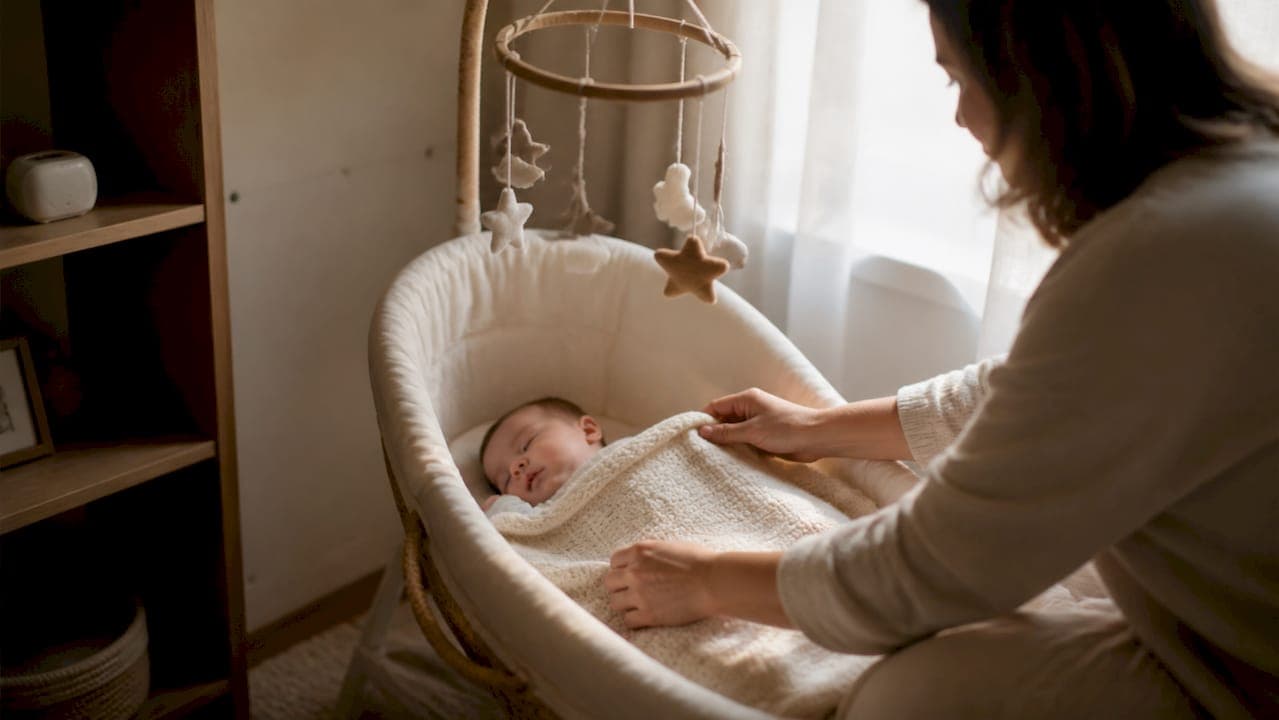
A healthy baby sleep schedule matches your child's total daily sleep needs and age-appropriate wake windows with predictable naps and a consistent bedtime routine. The single best place to start is not a rigid clock but your baby's own sleepy cues, matched to the wake-window ranges for their age.
Here is what a workable infant sleep schedule covers:
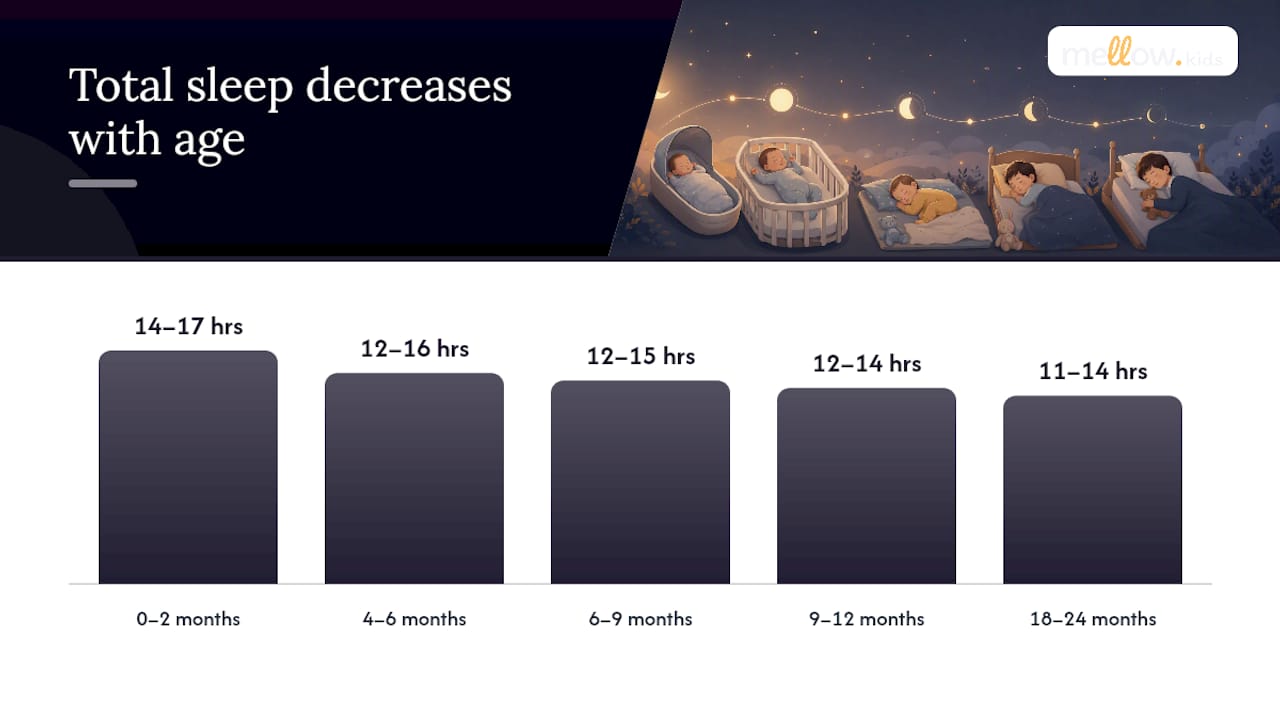
- Total sleep per 24 hours: ranges from roughly 14–17 hours for newborns down to 11–14 hours for toddlers, depending on age
- Number and length of naps: newborns may nap 4–5 times a day; by 18 months most babies are down to one nap
- Wake windows: the awake stretch between sleep periods, which grows from 45–90 minutes in early infancy to 4–6 hours by 18 months
- Bedtime range: most babies sleep best with a bedtime between 6:30 PM and 8:00 PM, earlier for younger infants
Pro Tip: Watch for sleepy cues, such as eye rubbing, yawning, or a glazed look, and start your wind-down routine before your baby hits the overtired window. An overtired baby is harder to settle and often wakes more at night, not less.
Night waking is biologically normal for infants through the first year. The goal is helping your baby develop self-soothing skills, not eliminating all wakings. If night waking is paired with fever, poor weight gain, or labored breathing, contact your pediatrician.
Key Takeaways
Age-appropriate wake windows, a consistent bedtime routine, and safe-sleep practices are the three pillars every effective baby sleep schedule is built on.
| Point | Details |
|---|---|
| Match wake windows to age | Wake windows grow from 45–60 minutes for newborns to 4–6 hours for toddlers; using the right range prevents overtiredness. |
| Keep bedtime consistent | Most babies sleep best with a bedtime between 6:30 PM and 8:00 PM, anchored by a short, predictable routine. |
| Practice "drowsy but awake" | Placing your baby in the crib while still slightly awake teaches self-soothing and reduces night wakings over time. |
| Follow AAP safe-sleep basics | Back to sleep, firm surface, no loose bedding, and room-sharing (not bed-sharing) for at least the first 6 months. |
| Use Mellow for personalized plans | Mellow Kids provides age-matched schedules, milestone alerts, and sleep-challenge guidance that adapts as your baby grows. |
Table of Contents
- What does a baby sleep schedule look like at each age?
- How do you build a bedtime and nap routine that actually works?
- How do you handle night wakings, short naps, and sleep regressions?
- What are the AAP's safe-sleep guidelines for babies?
- Printable sample schedules you can use right now
- How were these schedules built, and who reviewed them?
- What parents often get wrong about sleep schedules
- Mellow Kids can help you build a schedule that fits your baby
- Sources
What does a baby sleep schedule look like at each age?
Peer-reviewed evidence supports gradual sleep consolidation across the first year and using developmentally appropriate wake windows rather than rigid early schedules. The age brackets below reflect that evidence, drawing on guidance from Stanford Children's Health, MedlinePlus, and the AAP.
Newborn: 0–2 months
Newborns sleep in short, fragmented segments and commonly wake every 2–3 hours to feed. Their sleep is heavily REM-based and not yet organized around a day/night rhythm.
- Total sleep: 14–17 hours per 24 hours
- Naps: 4–5 per day, 30 minutes to 3 hours each
- Wake windows: short awake periods between sleeps typical for newborns
- Night stretch: 2–3 hours between feeds
Sample day: Wake/feed ~7:00 AM → nap by 8:00 AM → feed/wake ~10:00 AM → nap by 11:00 AM → repeat through the day → bedtime 8:00–10:00 PM (flexible at this stage)
Focus on patterns rather than strict times. Your baby's circadian rhythm is still forming.
2–4 months
Social smiling and increased alertness start to emerge, and sleep begins consolidating slightly. Some babies start stretching their longest nighttime stretch to 4–6 hours.
- Total sleep: 14–16 hours
- Naps: 3–4 per day
- Wake windows: awake stretches of about an hour to somewhat longer
- Night stretch: 4–6 hours (variable)
Sample day: Wake ~7:00 AM → nap 8:30 AM (45–60 min) → nap 11:00 AM (60–90 min) → nap 1:30 PM → catnap ~4:00 PM → bedtime 7:30–8:30 PM
4–6 months
By 4 months, some infants can sleep 8–9 hours at a stretch. Sleep cycles begin to mature, and this is often when parents notice the "4-month sleep regression" as the brain reorganizes sleep architecture.
- Total sleep: a typical sleep duration range for infants 4–6 months old
- Naps: multiple naps per day
- Wake windows: awake periods lengthening to about one and a half to a few hours
- Night stretch: 6–9 hours
Sample day: Wake ~6:30–7:00 AM → nap 8:30 AM (45–90 min) → nap 12:00 PM (1–1.5 hrs) → catnap 3:30 PM (30–45 min) → bedtime 7:00–7:30 PM
Transition tip: The 4-month regression is real and temporary. Stick to your routine and avoid creating new sleep associations you will need to undo later.
6–9 months
Babies don't develop adult-like sleep cycles until around 6 months, so this is when longer, more predictable nights become genuinely possible. Many babies drop the third nap around 7–8 months.
- Total sleep: typical sleep duration for infants 6–9 months old
- Naps: 2 per day (morning and afternoon)
- Wake windows: 2–3 hours
- Night stretch: 8–10 hours (many babies can go without a night feed by 9 months)
Sample day: Wake ~6:30–7:00 AM → nap 9:00 AM (1–1.5 hrs) → nap 1:00 PM (1–1.5 hrs) → bedtime 6:30–7:30 PM
9–12 months
By 9 months, many infants can sleep 8–10 hours without feeding. Separation anxiety often peaks around 9–10 months, which can temporarily disrupt sleep even in babies who had been sleeping well.
- Total sleep: 12–14 hours
- Naps: 2 per day
- Wake windows: awake periods extending a few hours
- Night stretch: 9–11 hours
Sample day: Wake ~6:30–7:00 AM → nap 9:30 AM (1–1.5 hrs) → nap 1:30 PM (1–1.5 hrs) → bedtime 7:00–7:30 PM
12–18 months
The transition from two naps to one typically happens between 13 and 18 months. Resist dropping the second nap too early; most babies aren't ready before 14–15 months.
- Total sleep: 11–14 hours
- Naps: 1–2 per day
- Wake windows: awake periods lengthening to several hours
- Night stretch: 10–12 hours
Sample day (two naps): Wake ~6:30 AM → nap 9:30 AM (1 hr) → nap 2:00 PM (1 hr) → bedtime 7:00 PM Sample day (one nap): Wake ~6:30 AM → nap 12:00 PM (1.5–2 hrs) → bedtime 7:00–7:30 PM
Transition tip: When dropping to one nap, move bedtime 30 minutes earlier for 2–4 weeks to compensate for lost daytime sleep.
18–24 months
Most toddlers are firmly on one nap by 18 months. Developmental leaps, language bursts, and growing independence can all temporarily disrupt sleep.
- Total sleep: 11–14 hours
- Naps: 1 per day (1–2 hours)
- Wake windows: 4–6 hours
- Night stretch: 10–12 hours
Sample day: Wake ~6:30–7:00 AM → nap 12:00–12:30 PM (1–2 hrs) → bedtime 7:00–7:30 PM
| Age | Total Sleep | Naps/Day | Wake Window | Typical Night Stretch |
|---|---|---|---|---|
| 0–2 months | 14–17 hrs | 4–5 | 45–60 min | 2–3 hrs |
| 2–4 months | 14–16 hrs | 3–4 | 60–90 min | 4–6 hrs |
| 4–6 months | 12–16 hrs | 3 | 1.5–2 hrs | 6–9 hrs |
| 6–9 months | 12–15 hrs | 2 | 2–3 hrs | 8–10 hrs |
| 9–12 months | 12–14 hrs | 2 | 2–3 hrs | 9–11 hrs |
| 12–18 months | 11–14 hrs | 1–2 | 3–5 hrs | 10–12 hrs |
| 18–24 months | 11–14 hrs | 1 | 4–6 hrs | 10–12 hrs |
How do you build a bedtime and nap routine that actually works?
Consistent, short bedtime routines reduce separation anxiety and provide reliable sleep cues that help babies wind down before sleep. The routine itself matters less than its predictability.
A simple nap and bedtime sequence
- Dim the lights 10–15 minutes before sleep time to signal the shift from active to quiet.
- Change the diaper and put on sleep clothes or a sleep sack.
- Feed (breast or bottle), but aim to finish feeding before the final drowsy stage so the feed is not the last thing your baby remembers before sleep.
- One quiet activity: a short song, a board book, or gentle rocking for 3–5 minutes.
- Place your baby in the crib drowsy but awake. This is the core skill for teaching independent sleep.
- Use a consistent verbal cue ("It's sleep time, I love you") and leave the room.
The whole routine should run 15–20 minutes for naps and 20–30 minutes for bedtime. Longer is not better; it can actually increase stimulation.
The "drowsy but awake" approach
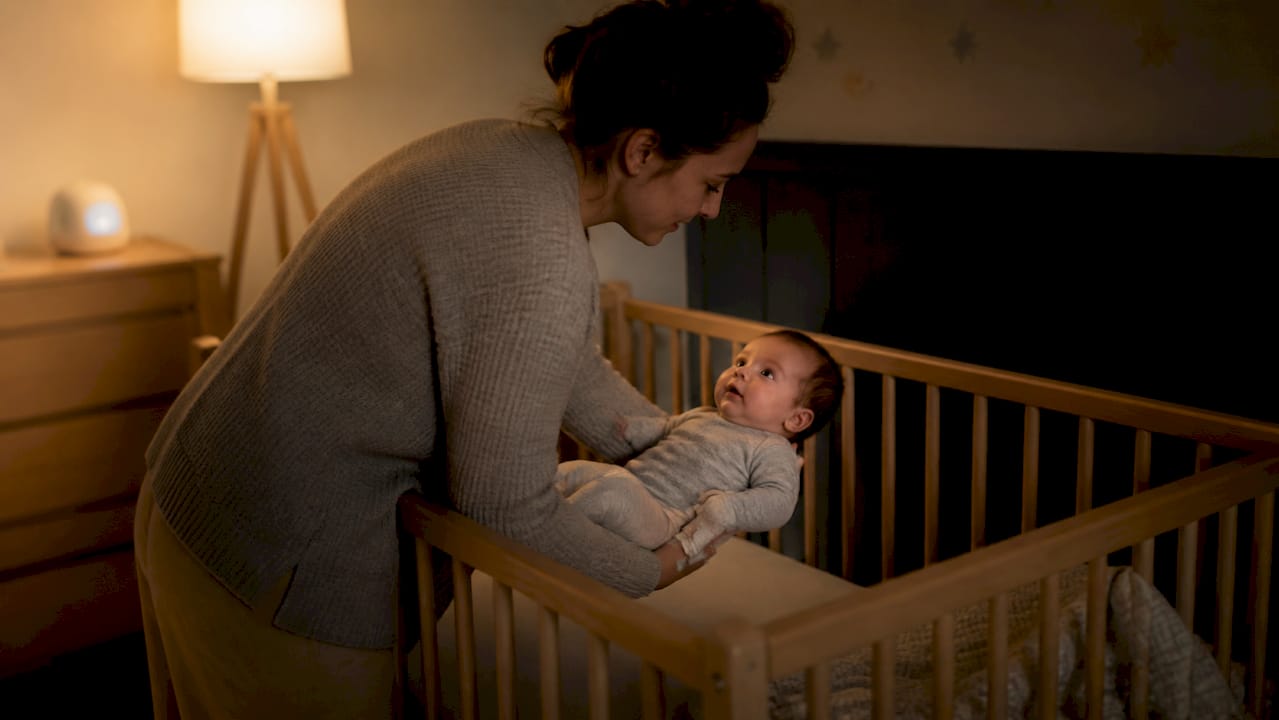
Placing your baby in the crib while still slightly awake, rather than fully asleep, teaches them to fall asleep in the same environment they will wake up in during the night. When they surface between sleep cycles, they can resettle without needing you to recreate the original conditions. This is a learnable skill, and it takes consistent practice over days, not one perfect night.
Room conditions that support sleep
- Temperature: 68–72°F is the range most pediatric guidance recommends
- Light: as dark as possible for nighttime sleep; dim but not pitch-black for naps is fine
- White noise: a steady, low-volume sound machine placed away from the crib can mask household noise and extend nap length
- Last feed timing: aim to finish the feed 5–10 minutes before placing your baby down so drowsiness, not fullness, is the sleep cue
Pro Tip: If your baby consistently falls asleep while feeding, try moving the feed to the beginning of the routine rather than the end. It breaks the feed-to-sleep association gradually and without tears.
How do you handle night wakings, short naps, and sleep regressions?
Many common sleep disruptions have predictable causes and stepwise responses. Before changing your entire routine, spend 3–5 days observing the pattern.
Common issues and quick fixes
- Night wakings (after 6 months): Check that wake windows are not too short or too long. An overtired baby wakes more, not less. Try adjusting bedtime 15–30 minutes earlier.
- Short naps (under 30 minutes): Often a sign of an undertired or overtired baby. Extend the wake window by 10–15 minutes and watch for sleepy cues more closely. Waiting a few moments before intervening when your baby stirs gives them a chance to resettle into deeper sleep.
- Early rising (before 6:00 AM): Usually caused by an overtired baby or a bedtime that is too late. Try moving bedtime 15–20 minutes earlier, not later.
- Nap resistance: Common during nap transitions. If your baby fights the second nap for more than a week, they may be ready to drop it, but confirm with a few days of data before committing.
- Sleep regressions (4 months, 8–10 months, 12 months, 18 months): These are temporary. Regressions often respond to small routine adjustments rather than drastic changes. Hold your routine steady and give it 2–3 weeks.
- Teething: Offer appropriate comfort (a chilled teether before bed, a brief check-in at night) without creating new sleep associations. Most teething disruptions last 3–5 days per tooth.
A simple decision flow
- Has anything changed in the last 1–2 weeks (travel, illness, new caregiver)? If yes, give it 5–7 days to normalize.
- Are wake windows age-appropriate? If not, adjust by 10–15 minutes and observe for 3 days.
- Is the bedtime routine consistent? If not, tighten it before changing anything else.
- Is the disruption lasting more than 2–3 weeks with no improvement? Time to call your pediatrician.
Rebuilding short naps takes patience. The most effective approach is to extend wake windows slightly, darken the room, add white noise, and practice the "drowsy but awake" placement consistently for at least 5–7 days before concluding it is not working.
When to call your pediatrician
Contact your child's doctor if you notice:
- Fever alongside sleep disruption
- Poor weight gain or feeding refusal
- Persistent snoring, gasping, or pauses in breathing during sleep (possible sleep apnea)
- Extreme difficulty settling that does not improve with routine adjustments over 2–3 weeks
- Developmental regression alongside sleep changes
For a deeper look at sleep challenges by type, including night wakings, short naps, and early rising, Mellow's resource library covers each with age-specific guidance.
What are the AAP's safe-sleep guidelines for babies?
Safe sleep is not optional, and the American Academy of Pediatrics provides the clearest, most current guidance for reducing SIDS risk and keeping babies safe during every sleep period.
The AAP recommends that babies sleep on their back, on a firm, flat surface, in their own sleep space, for every sleep until age 1.
Safe-sleep checklist
- Back to sleep: always place your baby on their back for every nap and every nighttime sleep
- Firm, flat surface: use a firm crib, bassinet, or play yard mattress with a fitted sheet; no soft mattresses, inclined sleepers, or bouncers for unsupervised sleep
- No loose bedding: remove pillows, blankets, bumpers, and stuffed animals from the sleep space
- Room-sharing, not bed-sharing: the AAP recommends sharing a room (not a bed) for at least the first 6 months, ideally the first year
- Avoid overheating: dress your baby in one more layer than you would wear; feel the back of their neck, not their hands, to check temperature
- No smoking exposure: keep your baby's sleep environment smoke-free at all times
- Pacifier use: offering a pacifier at sleep time is associated with reduced SIDS risk; do not force it if your baby refuses
For a full walkthrough of safe sleep for newborns, including room setup and swaddle guidance, Mellow's dedicated guide covers each step.
Printable sample schedules you can use right now
These tables are designed to be copied, printed, or saved as a one-page reference. To create a printable PDF, paste the table into Google Docs or Microsoft Word, set margins to narrow, and print to PDF. Track your baby's actual patterns for 3–7 days before making big adjustments to any schedule.
Newborn: 0–8 weeks
| Time | Activity |
|---|---|
| 7:00 AM | Wake and feed |
| 8:00–9:30 AM | Nap 1 |
| 9:30 AM | Wake and feed |
| 10:30–12:00 PM | Nap 2 |
| 12:00 PM | Wake and feed |
| 1:00–2:30 PM | Nap 3 |
| 2:30 PM | Wake and feed |
| 3:30–5:00 PM | Nap 4 |
| 5:00 PM | Wake and feed |
| 6:00–7:30 PM | Catnap (optional) |
| 8:00–10:00 PM | Bedtime (flexible) |
2–4 months
| Time | Activity |
|---|---|
| 7:00 AM | Wake and feed |
| 8:30–9:30 AM | Nap 1 (60 min) |
| 11:00 AM–12:30 PM | Nap 2 (90 min) |
| 2:00–3:00 PM | Nap 3 (60 min) |
| 4:30–5:00 PM | Catnap (30 min) |
| 7:30–8:00 PM | Bedtime |
4–9 months
| Time | Activity |
|---|---|
| 6:30–7:00 AM | Wake |
| 9:00–10:00 AM | Nap 1 (60–90 min) |
| 1:00–2:30 PM | Nap 2 (60–90 min) |
| 3:30–4:00 PM | Catnap (30 min); drop by 7–8 months |
| 7:00–7:30 PM | Bedtime |
9–18 months
| Time | Activity |
|---|---|
| 6:30–7:00 AM | Wake |
| 9:30–11:00 AM | Nap 1 (60–90 min, drop by 15–18 months) |
| 1:30–3:00 PM | Nap 2 / single nap (60–90 min) |
| 7:00–7:30 PM | Bedtime |
Customization tips
- Breastfed babies often need slightly shorter wake windows in early months because breast milk digests faster, meaning hunger cues arrive sooner.
- Formula-fed babies may stretch wake windows slightly longer, but follow your baby's cues rather than the clock alone.
- Early risers: if your baby wakes before 6:00 AM, treat it as a night waking for 2–3 weeks (minimal stimulation, no bright lights) before accepting it as the new wake time.
- Temperament: high-need or sensitive babies often need shorter wake windows and a quieter pre-sleep environment. Easygoing babies may tolerate slightly longer stretches without overtiredness.
- Travel: keep the routine sequence the same even when times shift. Consistency in the order of steps matters more than the exact clock time. Mellow's guide on traveling with a baby covers time-zone adjustments in detail.
How were these schedules built, and who reviewed them?
The age ranges, wake windows, and total sleep figures in this article come from pediatric authorities and peer-reviewed sleep literature. No schedule here was invented from anecdote.
Primary sources used:
- AAP / HealthyChildren.org: age-based sleep norms and safe-sleep recommendations
- Mayo Clinic: normalization of night waking and guidance on avoiding overtiredness
- Stanford Medicine Children's Health: sleep-cycle development and total sleep ranges by age
- MedlinePlus (NIH): nap counts, night-feeding timelines, and bedtime habit guidance
- Children's Hospital of Philadelphia (CHOP): newborn sleep fragmentation and REM patterns
- NCBI / PMC (peer-reviewed): evidence base for gradual sleep consolidation and wake-window approaches
Sleep patterns change significantly with development, and the schedules above are designed to move with your baby rather than stay fixed. Parents who want to read the underlying clinical guidance will find direct links in the Useful Sources section below.
The schedules in this article are general educational guidance, not a substitute for advice from your child's pediatrician. Always confirm significant sleep or health concerns with a qualified medical professional.
This article was written by Mauricio Vargas and reflects the evidence-based approach Mellow uses to build its age-specific guidance. The content aligns with AAP, Mayo Clinic, Stanford Children's, MedlinePlus, CHOP, and peer-reviewed literature cited throughout.
What parents often get wrong about sleep schedules
Most parents come to sleep schedules looking for the right time to put their baby down. The clock matters less than they think. What actually drives better sleep is the wake window, the consistent routine sequence, and the environment, in that order.
Here is the part most guides skip: the "drowsy but awake" instruction sounds simple, but it is genuinely hard to execute when you are exhausted and your baby is crying. The temptation to nurse or rock to full sleep is real, and doing it occasionally will not ruin your child's sleep. The problem is consistency. A baby who sometimes falls asleep at the breast and sometimes in the crib learns that the rules are negotiable, and they will test that every night.
The other thing worth saying plainly: not every baby follows these schedules on the expected timeline. Some 9-month-olds still wake twice a night. Some 6-month-olds sleep 10 hours straight. Both can be completely normal. The ranges in this article reflect what pediatric research describes as typical, not what your baby is obligated to do. If your child is growing well, feeding well, and seems rested during wake windows, the schedule is probably working even if it does not match the sample exactly.
What I find parents underestimate most is the power of the pre-sleep environment. Darkness, white noise, and a cool room do more heavy lifting than any specific routine step. Get those three right, and the rest of the routine becomes much easier to execute.
Mellow Kids can help you build a schedule that fits your baby
Knowing the right wake windows is one thing. Applying them to your specific baby, on your specific schedule, with your specific temperament, is another challenge entirely.

Mellow is built for exactly this gap. The app gives you personalized daily sleep plans matched to your baby's age and developmental stage, milestone-aware alerts that flag upcoming sleep changes before they catch you off guard, and feeding and diaper tracking that ties into your sleep patterns. Rather than handing you a generic chart and wishing you luck, Mellow adjusts as your baby grows, so the guidance you get at 4 months looks different from what you see at 9 months or 14 months.
Parents dealing with active sleep challenges such as frequent night wakings, short naps, or early rising will find stage-specific troubleshooting built into the app. And if you are approaching a nap transition or a major developmental leap, Mellow flags it ahead of time so you are not caught off guard at 2:00 AM wondering what changed.
Start with the free version of the Mellow Kids app to explore personalized schedules and milestone tracking for your baby's current stage.
Sources
The following pediatric and clinical references informed the schedules and guidance in this article. Each is freely accessible and worth bookmarking.
- Baby sleep — Mayo Clinic
- Bedtime routine for babies — Cleveland Clinic
- Bedtime habits for infants and children: MedlinePlus Medical Encyclopedia
- Infant Sleep - Stanford Medicine Children's Health
- Newborn-Sleep Patterns | Children's Hospital of Philadelphia
- PMC9109407