
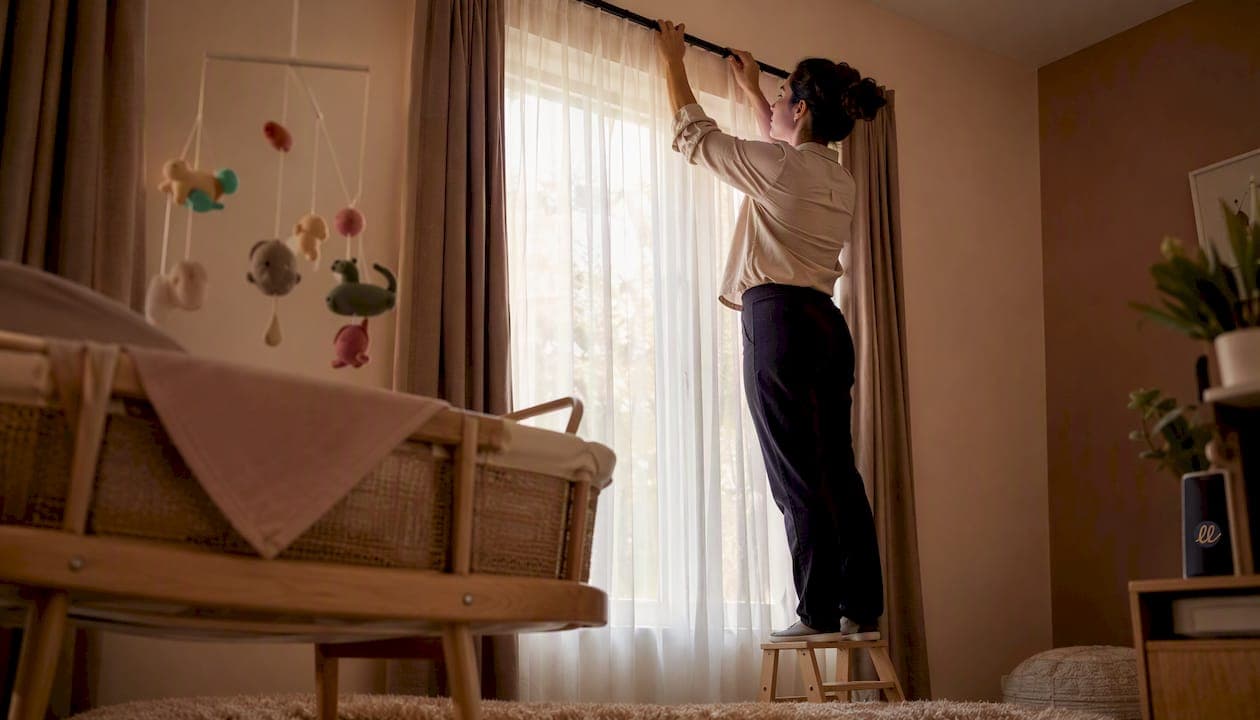
For a nursery, cordless motorized or cordless sealed-track shades are the safest and most effective choice, combining near-zero cord hazard with the darkness that infant sleep research supports. Achieving total blackout is not reliably possible with rod-hung curtains, and many real-world installations remain only 'room-darkening' due to edge leakage. If those aren't possible, properly installed cordless cellular shades are the next best option. Standard rod-hung blackout curtains can work, but they almost always leave edge gaps that let in enough light to affect a baby's melatonin. The CPSC's Go Cordless guidance is clear: corded window coverings are among the top household strangulation hazards for young children, and in a review pool of numerous product reviews, many parents specifically named child safety as their primary reason for choosing motorized or cordless options.
Quick shortlist by parent need:
- Total blackout (overnight sleep): Cordless motorized sealed-track shade
- Best balance of safety + performance: Cordless cellular/honeycomb shade, outside-mounted
- Budget-friendly: Cordless roller shade with outside mount and side channels
- Portable/temporary (renters, travel): Suction-mounted blackout panel supplemented with adhesive edge strips
- Best insulation: Cordless cellular (honeycomb) shade
- Easiest install: Cordless roller shade
| Treatment Type | Safety | Light Performance (installed) | Insulation | Install Complexity |
|---|---|---|---|---|
| Motorized sealed-track shade | Best (no cord) | Very dark (minimal edge leakage) | Good | Moderate–high |
| Cordless cellular shade | Excellent | Very dark (some edge leak possible) | Excellent | Moderate |
| Cordless roller shade | Excellent | Dark (edge leak without channels) | Low–moderate | Low |
| Cordless Roman shade | Good | Dark (fabric-dependent) | Low | Moderate |
| Rod-hung blackout curtains | Varies (avoid corded) | Room-darkening in practice | Low | Low |
Table of Contents
- What's the best window treatment for each nursery use case?
- Why nursery windows need a different checklist than the rest of your home
- What safety standards should you follow for nursery window treatments?
- How do cordless nursery treatment types compare?
- What does "blackout" actually mean on a curtain label?
- How to measure and install nursery shades to avoid light gaps
- How dark does a nursery actually need to be?
- What to check before you buy nursery blackout curtains
- How to match treatment types to your specific nursery needs
- How blackout choices fit into a Mellow Kids sleep plan
- What's the final recommendation for nursery blackout curtains?
- How to clean and maintain nursery blackout curtains
- What materials hold up best in a nursery environment?
- How blackout curtains affect nursery room temperature and energy efficiency
- How to pair blackout curtains with other window treatments for better light control
- What do customer reviews say about nursery blackout curtain reliability?
- Key Takeaways
- The case for treating this as an installation problem, not a shopping problem
- Mellow helps you track whether your blackout upgrade is actually working
- Useful sources and primary references
What's the best window treatment for each nursery use case?
| Use Case | Recommended Type | Safety Level | Installed Light Performance | Install Complexity |
|---|---|---|---|---|
| Night sleep (infant) | Motorized sealed-track shade | Motorized (no cord) | Very dark (minimal edge leakage) | Moderate–high |
| Daytime naps | Cordless cellular or roller shade | Cordless | Very dark | Low–moderate |
| Nursery aesthetic priority | Cordless Roman shade or blackout curtain panel | Cordless | Room-darkening to dark | Moderate |
| Renter/temporary | Suction-mounted blackout panel + adhesive strips | Cordless | Dark (gaps possible) | Very low |
| Energy-conscious | Cordless cellular (honeycomb) shade | Cordless | Very dark | Moderate |
| Toddler room | Cordless roller or cellular shade | Cordless | Very dark | Low |
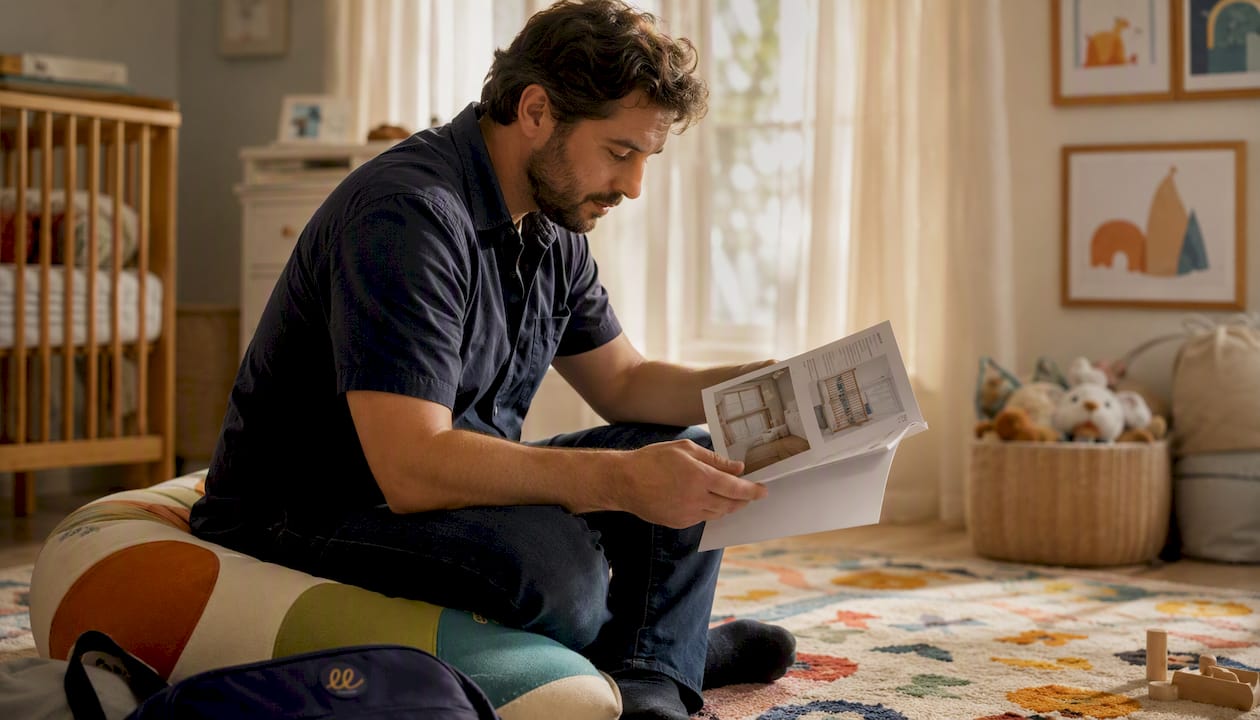
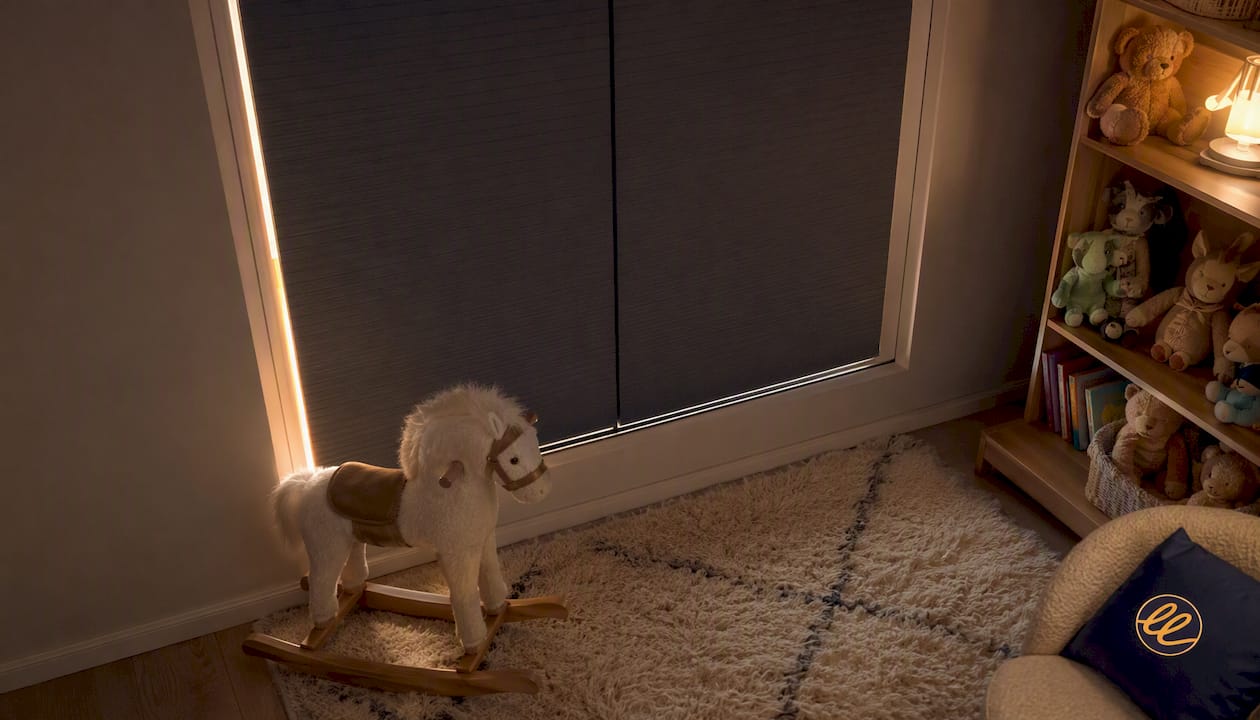
When a sealed-track or motorized solution is available and your budget allows, choose it over curtains. Rod-hung panels, even with blackout-rated fabric, consistently produce measurable light leakage at the edges and center seam that can be enough to suppress infant melatonin.
Why nursery windows need a different checklist than the rest of your home
Standard home curtains are chosen for aesthetics and privacy. In a nursery, those priorities shift. Infants suppress melatonin at far lower light levels than adults, meaning a thin strip of light around a curtain rod can genuinely interfere with sleep quality. The relationship between light exposure and pediatric sleep is well-documented: even low-level light during sleep periods can delay sleep onset and reduce sleep duration in young children.
Beyond light sensitivity, cords are a documented strangulation hazard. The CPSC identifies corded window coverings as one of the top hazards in children's rooms, which is why the safety checklist for a nursery starts with cord elimination, not fabric grade.
The four most common light-leak failure points in typical home curtains:
- Rod gap at the top: Space between the curtain rod and the wall or ceiling lets light spill in above the panel.
- Side gaps: Panels that don't extend past the window frame allow light to wrap around the edges.
- Center seam: Two-panel curtain sets almost always have a gap at the center where panels meet.
- Hem gap at the bottom: Curtains that don't reach the floor or sill leave a bright strip of light at the base.
None of these are fabric problems. They are installation problems, and no amount of blackout-rated weave fixes them if the mounting strategy doesn't address them.
What safety standards should you follow for nursery window treatments?
The baseline rule is simple: no exposed loop cords, no dangling pull cords, and no long trailing fabric within a child's reach. CPSC's Go Cordless guidance recommends cordless or motorized window coverings for any room where children sleep or play.
Actionable safety rules before you buy or install anything:
- Choose cordless lift mechanisms: spring-loaded, tension-based, or motorized only.
- If you already own corded blinds, retrofit with a cord wind-up or cord shortener as a temporary measure, but replace them as soon as possible.
- Mount hardware securely into wall studs or use appropriate anchors; a falling shade or curtain rod is a separate hazard.
- Keep any long fabric panels from pooling on the floor where a toddler can grab and pull.
- Anchor drapery hardware at both ends and the center for wider windows.
- Look for GREENGUARD Gold or OEKO-TEX Standard 100 certifications on the fabric. GREENGUARD Gold means the product has been tested for chemical emissions and meets strict indoor air quality standards. OEKO-TEX Standard 100 certifies that every component of the fabric has been tested for harmful substances. Both matter in a room where a baby breathes all night.
Pro Tip: If you can't install a sealed-track or motorized shade right away, use adhesive-backed hook-and-loop (Velcro) tape around the window frame perimeter and attach a cordless blackout panel to it. This closes edge gaps temporarily and keeps the panel flat against the wall without any cord hazard.
How do cordless nursery treatment types compare?
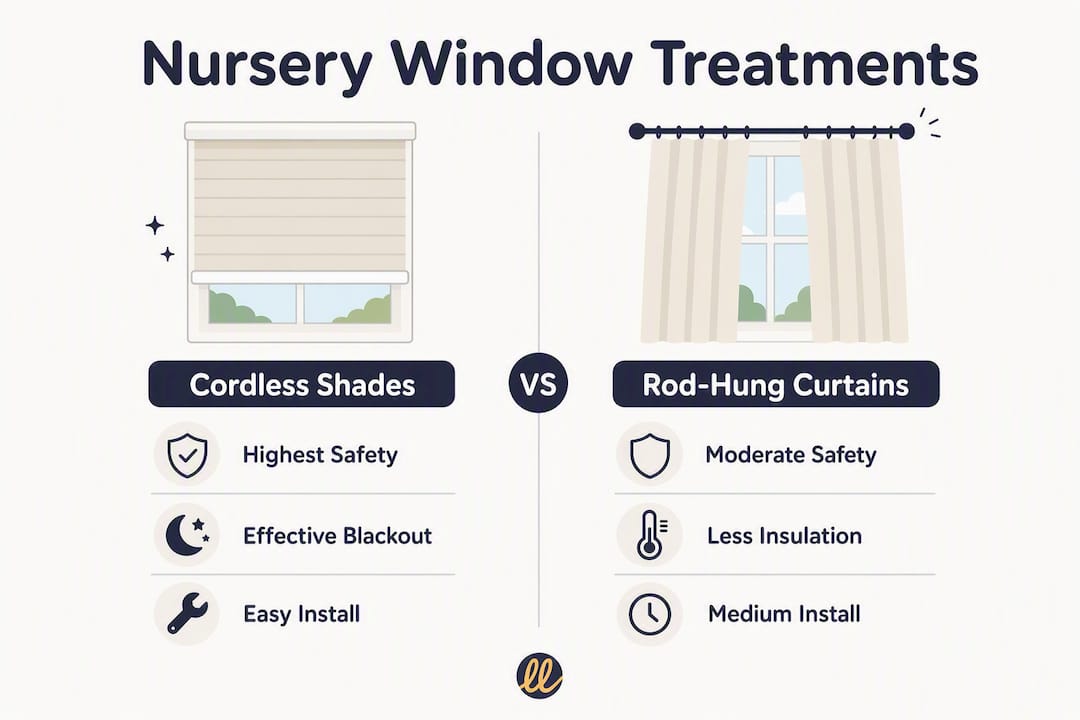
Sealed-track motorized shades deliver the best combination of true blackout and zero cord hazard. Cordless cellular shades offer excellent insulation and very good darkness at a lower price point. Rod-hung blackout curtains are the most common choice but the least reliable for achieving near-0 lux because of structural edge gaps.
| Treatment Type | Safety | Installed Light Performance | Insulation Value | Install Complexity | Typical Price Range |
|---|---|---|---|---|---|
| Motorized sealed-track shade | Best | Near-0 lux | Good | High | $$$$ |
| Cordless cellular (honeycomb) | Excellent | Very dark | Excellent | Moderate | $$–$$$ |
| Cordless roller shade | Excellent | Dark (side channels improve this) | Low–moderate | Low | $–$$ |
| Cordless Roman shade | Good | Dark (fabric-dependent) | Low | Moderate | $$–$$$ |
| Rod-hung blackout curtains (cordless) | Good (if cordless) | Room-darkening in practice | Low | Low | $–$$ |
When each type makes sense:
- Motorized sealed-track: Best for parents prioritizing total darkness and long-term use; ideal for newborns and light-sensitive infants.
- Cordless cellular: Best for parents who want strong insulation alongside darkness; good for climates with temperature swings.
- Cordless roller: Best for renters or parents on a budget who can add side channels or outside-mount for better coverage.
- Cordless Roman: Best when nursery aesthetics matter and the room gets moderate natural light; less reliable for total blackout.
- Rod-hung blackout curtains: Best as a supplementary layer over an existing shade, not as a standalone solution.
Pro Tip: If you're choosing between a sealed-track shade and an upgraded curtain installation, go sealed-track whenever the window frame allows it. A sealed headbox and side channels eliminate the structural gaps that no curtain rod setup can fully close.
What does "blackout" actually mean on a curtain label?
"Blackout" on a product label describes the fabric, not the installed result. A fabric rated 100% blackout blocks light through its weave, but once it's hung on a rod, light enters through every gap around it. Consumer guidance consistently notes that "room-darkening" and "blackout" are not interchangeable in real-world performance, and many retail blackout curtains fall into the room-darkening category once installed.
Key terms to know:
- Room-darkening: — Reduces light significantly but does not eliminate it. Often 85–99% light reduction through the fabric.
Trusted product-testing outlets have found that many accessible retail blackout curtains darken a room substantially but still allow measurable light leakage under real-world conditions, particularly around edges and at the rod.
Pro Tip: Test your installed curtains or shades at nap time using a free lux meter app on your phone (search "lux meter" in your app store). Hold the phone at crib level and face the window. If you can read the screen clearly without the screen's own light, the room is not dark enough for a light-sensitive infant.
How to measure and install nursery shades to avoid light gaps
Correct measurement and a sealed mounting strategy matter more than fabric grade for achieving near-0 lux. A perfectly rated blackout fabric hung on an undersized rod with two inches of gap on each side will let in more light than a mid-grade shade installed with proper overlap and outside mounting.
Step-by-step measurement guide:
- Decide on inside mount vs. outside mount. Inside mount fits within the window frame and looks cleaner, but requires precise measurement and often leaves side gaps. Outside mount covers the frame entirely and is more forgiving for light control.
- For inside-mounted shades, measure the width of the window opening at the top, middle, and bottom. Use the narrowest measurement. Industry installation guidance commonly calls for a roughly 2-inch overlap on each side to reduce side light leakage.
- For outside-mounted shades or curtains, add at least 3–4 inches beyond the window frame on each side, and mount the hardware as close to the ceiling as practical to eliminate the top gap.
- Measure height from the mounting point to the sill (inside) or floor (outside), and add 2–3 inches at the bottom for overlap.
- For two-panel curtains, choose panels wide enough that each panel extends well past the window edge when closed, with a generous overlap at the center.
Common installation mistakes that cause leaks:
- Mounting the rod too close to the window frame, leaving a gap at the top where light enters above the panel.
- Ordering panels that are exactly window-width, leaving no side overlap.
- Using a single panel instead of two, creating a center seam gap.
- Choosing inside mount on a window with a shallow frame, forcing the shade to sit forward and leave side gaps.
Pro Tip: Renters who can't drill: adhesive-backed Velcro strips applied to the window frame perimeter hold a cordless blackout panel flat against the wall with no hardware. High-holding suction cup mounts work for lighter panels. Neither is as reliable as a sealed track, but both significantly reduce edge gaps compared to a rod-hung curtain.
For more on how mounting decisions interact with room design, the kids room carpentry design guide covers sealed-track and valance installation considerations worth reviewing before you commit to a mounting approach.
How dark does a nursery actually need to be?
Aim for very dark conditions for overnight infant sleep and for naps in babies who show light sensitivity. While true 0 lux is idealized, most installations achieve only partial room-darkening, and even light-sensitive infants benefit from reducing light as much as practically possible. That said, total darkness is not universally optimal for every child at every age. Sleep researchers note that a small amount of ambient light can help preserve circadian rhythm in some pediatric cases, particularly as children move past the newborn stage.
Infants suppress melatonin at much lower light levels than adults. Achieving the darkness that supports melatonin production typically requires a sealed-track system rather than rod-hung curtains, because even a thin strip of light at the curtain edge can be enough to register at crib level.
Practical checklist to decide how dark your nursery needs to be:
- Newborn to 4 months: Aim for very dark conditions for all sleep periods. Circadian rhythms are not yet established, and darkness supports melatonin production.
- 4–12 months: Near-0 lux for overnight sleep; very dark (not necessarily 0 lux) for naps. Some ambient light during wake windows helps set the circadian clock.
- 12–24 months: Very dark for overnight sleep; moderate darkness for naps. A small nightlight at the lowest setting is generally fine once the child is past 12 months.
- Light-sensitive infants at any age: If your baby consistently wakes early or struggles to settle, reduce light first before adjusting the schedule.
Pro Tip: Use your phone's lux meter app at crib level with all lights off and the window treatment closed. Aim for under 5 lux for a light-sensitive infant's sleep environment. If you're seeing 20 lux or more, the installation, not the fabric, is the problem.
You can read more about the benefits of room darkening for baby's sleep and how light levels connect to sleep quality at different developmental stages.
What to check before you buy nursery blackout curtains
Use a short checklist to eliminate unsafe or ill-fitting options before you order. Many products that look right in a listing have details that disqualify them for a nursery.
Must-ask questions before buying:
- Is this system fully cordless or motorized? (No exposed loop cords, no dangling pull cords.)
- Does the shade come with side channels or a sealed headbox, or is it rod-hung only?
- What certifications does the fabric carry? (Look for GREENGUARD Gold or OEKO-TEX Standard 100.)
- What is the return policy if the shade doesn't fit or doesn't achieve the darkness you need?
- Does the manufacturer provide installation instructions with measurement guidance?
Red flags in product listings:
- Vague "blackout" claims with no certification or specification.
- Photos showing a corded lift mechanism.
- No sizing or measurement guidance in the product description.
- "Room-darkening" used interchangeably with "blackout" in the same listing.
- No mention of whether the product is inside or outside mount.
When to call a professional installer: if your window frames are non-standard, if you're installing a motorized sealed-track system, or if the window is in an awkward location (dormer, angled ceiling), a professional installer will save you time and prevent the gaps that DIY installs often leave.
Pro Tip: For renters, look for products marketed as "damage-free" or "no-drill" that use adhesive or suction mounting. Supplement any suction-mounted panel with adhesive edge strips to close the gaps that suction alone leaves open.
How to match treatment types to your specific nursery needs
Choose by your highest-priority constraint first: safety, true blackout, budget, or rental-friendly installation. Then filter by what's feasible for your window and home.
By parent situation:
- Night sleepers with a light-sensitive infant: Motorized sealed-track shade is the clear choice. The sealed headbox and side channels eliminate structural gaps, and the motorized lift removes cord hazard entirely.
- Heavy nappers in a bright room: Cordless cellular shade with outside mount. The honeycomb structure adds insulation (useful in summer when afternoon sun heats the room), and outside mounting covers the frame.
- Renters who can't drill: Suction-mounted cordless blackout panel with adhesive edge strips. Not equivalent to a sealed track, but meaningfully better than a rod-hung curtain with gaps.
- Energy-conscious parents: Cordless cellular shade. The honeycomb air pockets reduce heat transfer in both directions, keeping the nursery cooler in summer and warmer in winter.
- Parents prioritizing aesthetics: Cordless Roman shade or a rod-hung blackout curtain panel over a cordless roller shade. The curtain adds softness; the roller shade underneath does the actual light-blocking work.
Pros and cons at a glance:
| Category | Durability | Cleaning | Thermal Benefit | Typical Price Range |
|---|---|---|---|---|
| Motorized sealed-track | High | Wipe-down | Good | $$$$ |
| Cordless cellular | High | Spot clean or gentle vacuum | Excellent | $$–$$$ |
| Cordless roller | Moderate–high | Wipe-down | Low–moderate | $–$$ |
| Cordless Roman | Moderate | Spot clean or dry clean | Low | $$–$$$ |
| Rod-hung blackout curtains | Moderate | Machine wash (most) | Low | $–$$ |
Pro Tip: Pair a cordless cellular shade (for light blocking and insulation) with a decorative curtain panel on a separate rod for aesthetics. Keep the curtain panel well clear of the shade's operating mechanism and make sure the curtain rod is mounted high enough that the panels don't interfere with the shade. This gives you the best of both without adding cord hazard.
How blackout choices fit into a Mellow Kids sleep plan
Blackout curtains are a component of a sleep plan, not a cure on their own. Evidence-based pediatric sleep research shows that environment changes combined with consistent routines and tracking produce measurable improvements, while environment changes alone often produce inconsistent results.
Integration steps:
- Choose and install your treatment (sealed-track or cordless cellular for most families).
- Test the darkness at crib level using a lux meter app during the first nap after installation.
- Track your infant's sleep responses for 7–14 days using Mellow's age-specific tools before changing anything else. This isolates the effect of the light-control change.
- If sleep improves, maintain the environment and use Mellow's nap foundation guidance to build a consistent schedule around it.
- If sleep doesn't improve after two weeks, the issue is likely schedule or developmental rather than light, and Mellow's milestone-aware routines can help you identify what to adjust next.
The importance of sleep for babies and toddlers goes well beyond rest. Sleep quality at this stage directly affects cognitive development, emotional regulation, and growth, which is why getting the environment right matters as much as the schedule.
Pro Tip: Make the environment change (new shade or curtain) before adjusting nap timing or bedtime. If you change both at once, you won't know which change helped. Give the new treatment two full weeks before touching the schedule.
What's the final recommendation for nursery blackout curtains?
For most families, a cordless motorized or cordless sealed-track shade is the safest and most effective choice. If budget or rental restrictions make that impractical, a cordless cellular shade with outside mounting and adhesive edge strips is a solid fallback.
Next steps you can take right now:
- Measure your window for outside mount dimensions (frame width plus 3–4 inches each side, height from ceiling to sill or floor).
- Choose cordless or motorized only. No exceptions for a child's room.
- Check fabric certifications: GREENGUARD Gold or OEKO-TEX Standard 100.
- Test darkness at crib level with a lux meter app after installation.
- Integrate the change with Mellow's healthy sleep routine guidance and track results for 7–14 days before adjusting the schedule.
- If you're a renter, start with a suction-mounted cordless panel plus adhesive edge strips, and plan to upgrade when you move.
Pro Tip: If you can only make one upgrade, choose a sealed-track or motorized cordless shade over any rod-hung curtain. The structural gap elimination matters more than any fabric upgrade.
How to clean and maintain nursery blackout curtains
Maintenance in a nursery matters more than in other rooms because babies are sensitive to dust, chemical residues, and mold. Most cordless roller shades and cellular shades can be spot-cleaned with a damp cloth and mild soap. Avoid soaking cellular shades, as the honeycomb structure traps water and can take a long time to dry fully, creating a mold risk in a humid nursery.
Rod-hung blackout curtain panels are generally the easiest to clean. Most polyester blackout panels are machine washable on a gentle cycle in cold water. Always check the care label first. Avoid high heat in the dryer, which can damage the blackout coating or lining and reduce its effectiveness over time. Line drying or low heat is safer.
For motorized or sealed-track systems, wipe the track and headbox with a dry or lightly damp cloth every few months. Dust accumulates in the track channels and can affect smooth operation. Never use liquid cleaners inside the motor housing.
Recommended cleaning frequency:
- Spot-clean panels or shades monthly, or immediately after any spill.
- Full wash (for machine-washable panels) every 3–6 months.
- Vacuum cellular shades gently with a brush attachment every 2–3 months to remove dust from the honeycomb cells.
- Wipe down track systems every 3 months.
What materials hold up best in a nursery environment?
Nurseries are harder on window treatments than most rooms. Humidity from humidifiers, temperature swings, and the occasional splash from bath time or feeding all affect how materials perform over time.
Polyester is the most common material for blackout curtain panels and holds up well to washing, humidity, and UV exposure. Triple-weave polyester blackout fabric is durable and maintains its light-blocking properties through repeated washing better than coated fabrics, which can crack or peel over time.
Cellular shades are typically made from polyester or a polyester-fabric blend. They're durable and resist humidity reasonably well, but the honeycomb cells can trap dust and are harder to clean thoroughly than a flat roller shade.
Natural materials like bamboo (used in some cordless shades) add aesthetic warmth and are naturally resistant to mold and mildew. They don't achieve the same light-blocking performance as synthetic blackout fabrics without an additional liner, but they're a good choice for parents who want a natural material in the nursery.
Coated blackout fabrics (where a foam or rubber coating is applied to the back of a decorative fabric) are common in budget panels. The coating can crack, peel, or off-gas over time, particularly in warm rooms. For a nursery, triple-weave construction is preferable to coated fabric, and OEKO-TEX certification gives you confidence that the material has been tested for harmful substances.
How blackout curtains affect nursery room temperature and energy efficiency
Blackout curtains and shades do more than block light. In summer, they reduce solar heat gain through the window, keeping the nursery cooler without extra air conditioning. In winter, they add an insulating layer that slows heat loss through the glass.
Cordless cellular (honeycomb) shades are the strongest performers for thermal insulation among common nursery window treatments. The air pockets in the honeycomb structure act as a buffer between the cold glass and the warm room, reducing heat transfer in both directions. This is particularly useful in nurseries where maintaining a consistent room temperature matters for safe sleep. Mellow's guidance on safe sleep room temperature and sleepwear covers the temperature ranges that support safe infant sleep, and good window insulation makes those targets easier to maintain.
Rod-hung blackout curtain panels offer minimal insulation compared to cellular shades. Their flat construction doesn't trap air, so while they block light and some radiant heat, they don't significantly reduce conductive heat loss through the glass.
For parents in climates with hot summers or cold winters, the energy efficiency benefit of a cellular shade can offset some of its higher upfront cost over time through reduced heating and cooling load.
How to pair blackout curtains with other window treatments for better light control
Layering two treatments is one of the most effective ways to achieve near-0 lux without a sealed-track system. The key is combining a functional light-blocking layer with a structural or decorative layer, without introducing cord hazards.
Effective pairings:
- Cordless roller shade + decorative curtain panel: The roller shade does the light-blocking work; the curtain panel adds softness and covers the side gaps that a roller shade alone may leave. Mount the curtain rod high and wide so the panels extend well past the window frame.
- Cordless cellular shade + blackout curtain valance: A valance mounted above the cellular shade closes the top gap between the shade's headrail and the ceiling, which is one of the most common leak points.
- Suction-mounted blackout panel + adhesive edge strips: For renters, this combination closes both the structural gaps (edges) and the top gap without any drilling.
The role of lighting in interior spaces covers how layered window treatments interact with room lighting more broadly, which is useful context when planning a nursery that needs to transition between sleep and wake environments during the day.
One caution: when layering, keep all components cordless. Adding a corded decorative curtain on top of a cordless shade reintroduces the hazard you eliminated. Every layer in a nursery window treatment stack should be cordless or motorized.
What do customer reviews say about nursery blackout curtain reliability?
Parent reviews across major retail platforms consistently highlight a few patterns worth knowing before you buy. The most common complaint about rod-hung blackout curtains is light leakage at the edges and top, which aligns with what installation research shows: the fabric may be rated blackout, but the mounting method determines the real-world result.
Cordless cellular shades receive consistently strong reviews for durability and darkness, with parents noting that outside-mounted versions perform noticeably better than inside-mounted ones. The most common criticism is that the honeycomb cells collect dust and are harder to clean than flat shades.
Motorized sealed-track systems receive the highest satisfaction ratings for light control, with parents of light-sensitive infants frequently describing them as the only solution that produced a meaningful improvement in sleep. The most common hesitation is cost, followed by installation complexity.
Suction-mounted portable blackout panels receive mixed reviews. Parents who supplement them with adhesive edge strips report much better results than those who rely on suction alone, which matches the practical guidance that suction mounts work better when combined with adhesive sealing at the edges.
The pattern across review pools is consistent: parents who invest in installation quality (outside mount, sealed edges, proper overlap) report better outcomes regardless of which treatment category they chose.
Key Takeaways
Cordless or motorized sealed-track shades are the safest and most effective nursery blackout solution because they eliminate cord hazards and structural light gaps simultaneously.
| Point | Details |
|---|---|
| Safety comes first | Choose cordless or motorized only; corded window coverings are a documented strangulation hazard per CPSC guidance. |
| Installation beats fabric grade | Edge gaps at the rod, sides, and hem cause most light leakage; outside mounting with proper overlap solves this better than any fabric upgrade. |
| Measure with overlap | For inside-mounted shades, use a roughly 2-inch overlap per side; for outside mounts, extend 3–4 inches beyond the frame on each side. |
| Match darkness to age | Aim for very dark conditions for newborns and light-sensitive infants; some ambient light can support circadian rhythm for children past 12 months. |
| Mellow tracks the results | Pair any blackout upgrade with Mellow's age-specific sleep tracking to isolate what's helping and adjust routines based on your child's actual response. |
The case for treating this as an installation problem, not a shopping problem
Most parents approach nursery blackout curtains as a product decision. They read reviews, compare fabrics, and order the highest-rated panel. Then the baby still wakes at 5 AM because there's a two-inch gap between the curtain rod and the wall letting in a bright strip of morning light.
The honest truth is that the installation decision matters more than the product decision for the majority of families. A mid-range cordless cellular shade installed with outside mounting and proper overlap will outperform an expensive blackout curtain panel hung on a standard rod. That's not a knock on curtain panels; they're genuinely useful as a second layer or for aesthetics. But if you're choosing between spending more on a better fabric and spending more on a sealed-track mounting system, the mounting system wins almost every time.
There's also a tendency to treat blackout curtains as a sleep fix rather than a sleep support. They reduce one variable. A baby who is overtired, going through a developmental leap, or on an inconsistent schedule will still struggle even in a perfectly dark room. The parents who report the best outcomes are the ones who pair the environment change with consistent routines and actually track what changes. Two weeks of data tells you whether the darkness made a difference. Without tracking, you're guessing.
One more thing worth saying plainly: the safety rule is not negotiable. No aesthetic preference, no budget constraint, and no "it's out of reach" reasoning justifies a corded window covering in a room where a child sleeps. Cordless and motorized options exist at every price point now. Start there.
Mellow helps you track whether your blackout upgrade is actually working
Choosing the right blackout shade is step one. Knowing whether it's improving your child's sleep is step two, and that's where most parents lose the thread. You make the change, you hope it helps, and two weeks later you're not sure if things are better or if your baby just had a good stretch.

Mellow is built for exactly this moment. The app gives you age-specific sleep tracking, milestone-aware routines, and guidance that adjusts as your child develops, so you can see whether an environment change like a new blackout shade is moving the needle. Parents of newborns through 2-year-olds can log nap times, note environment changes, and get tailored suggestions based on their child's actual age and temperament, not generic advice.
If your baby is between 8 and 10 months, Mellow's 8–10 month sleep guidance covers the specific sleep regressions and nap transitions common at this stage, so you can pair your blackout upgrade with a schedule that actually fits where your child is developmentally. For older toddlers, the 11–14 month track picks up from there.
Start with the free version at mellow.kids and use it to track your child's sleep for the two weeks after you install your new window treatment. The data will tell you clearly whether light was the issue, or whether something else needs attention.
This article provides general sleep environment guidance and is not a substitute for advice from your pediatrician or a certified sleep consultant.
Useful sources and primary references
These are the primary sources used to build this guide. Each is worth reading directly for the most current guidance.
- CPSC Go Cordless guidance: The Consumer Product Safety Commission's official recommendation for cordless and motorized window coverings in children's rooms. The baseline safety standard for any nursery window treatment decision.
- PMC: Light and pediatric sleep research: Peer-reviewed research on the relationship between light exposure and sleep in children, including melatonin suppression at low light levels.
- PMC: Pediatric sleep and circadian rhythm: Additional peer-reviewed research on circadian development in infants and young children.
- NeurologyLive: Pediatric sleep disorders and light: Clinical perspective on how light exposure affects pediatric sleep disorders and circadian rhythm.
- Artista Blinds: Room-darkening vs. blackout guide: Practical explanation of the difference between fabric-rated blackout and installed performance, including why sealed tracks outperform rod-mounted curtains.
- ScienceDaily: Pediatric sleep research summary: Summary of research showing that environment changes combined with consistent routines produce better sleep outcomes than environment changes alone.
- Lewis County WA: Installation overlap guidance: Construction project manual documenting the 2-inch overlap standard for inside-mounted shades.
- Born Magazine: Why babies confuse day and night: Practical guidance on light control for infant sleep, including temporary suction-mount solutions and their limits.