

Most children are ready to drop to one nap during toddlerhood, often anywhere in the first 1 to 2 years of life, and the clearest signal is behavioral, not calendar-based. If your child has been refusing one nap consistently over a period of several days, staying cheerful through longer stretches awake, and fighting bedtime because they napped twice, the 2 to 1 nap transition is probably overdue.
Before you change anything, run through this quick check:
- Consistent nap refusal: Your child skips or fights one nap most days, not just occasionally.
- Longer happy wake windows: They stay content for longer stretches between sleep periods without distress.
- Bedtime resistance: Two naps are pushing bedtime later than usual, or they're taking forever to fall asleep at night.
- Contentment on missed naps: On days they skip a nap, they manage reasonably well until an earlier bedtime.
If two or more of those apply, read on. If only one fits, give it another week of observation before making any changes.
Pro Tip: In the next 48–72 hours, don't restructure everything at once. Simply push the morning nap 30 minutes later than usual and watch how your child handles the longer wake window. That single shift tells you a lot about whether they're genuinely ready.
Table of Contents
- Is your child ready to drop to one nap?
- Sample one-nap schedules by age and wake window
- How to transition from two naps to one nap
- Troubleshooting common problems after the switch
- How to coordinate the transition with daycare and family schedules
- What pediatric experts say about nap consolidation
- Key Takeaways
- The transition is harder on parents than on children
- Mellow helps you navigate the one-nap transition with confidence
- Useful sources and further reading
Is your child ready to drop to one nap?
Readiness is the most important factor in a smooth transition, and it's easy to misread. A few rough nap days during a developmental leap or illness are not the same as genuine readiness. The difference shows up in patterns, not single days.
Signs that point to real readiness:
- Nap refusal happens on 5 or more days out of 7, consistently across 1–2 weeks, not just during a busy week or a growth spurt.
- One nap is getting noticeably shorter while the other stays long, or both naps are shrinking and your child still seems fine.
- Bedtime is creeping later because two naps are filling up the day's sleep quota.
- Your child wakes from a nap happy and alert, rather than groggy and fussy, even after a shorter sleep.
- They can handle a 4–5 hour wake window without becoming overtired or clingy.
Observe these patterns for at least 1–2 weeks before committing to a change. One or two unusual days don't count. According to BabyCenter, consistent signs across that window are the reliable indicator that the transition is developmentally appropriate.
Pro Tip: Keep a simple sleep log for one week before deciding. Note nap start times, lengths, and your child's mood on waking. Patterns become obvious quickly when you write them down.
Signs it's too early:
- Frequent night wakings that weren't happening before.
- Persistent crankiness or meltdowns in the late afternoon, even with an earlier bedtime.
- Your child falls asleep in the car, stroller, or high chair during the day, which signals they're not getting enough total sleep.
- They can't make it to a reasonable bedtime (7:00–8:00 PM) without becoming overtired and wired.
Dropping to one nap too soon creates an overtired cycle that often makes nighttime sleep worse, not better. Taking Cara Babies notes that early nap dropping is one of the most common causes of new night wakings and early morning wake-ups in this age group. If you see those signs within the first week of transitioning, reverting to two naps temporarily is the right call, not a failure.
Sample one-nap schedules by age and wake window
Once you've committed to the transition, having a concrete schedule makes the adjustment far less stressful. The key variables are wake window length and nap timing. KidsHealth recommends aiming for wake windows of roughly 4–6 hours before the consolidated nap, with a nap length target of 1–3 hours.
| Age | Morning wake | Nap start | Nap length | Bedtime |
|---|---|---|---|---|
| Around 12 to 13 months, children might wake early morning, have a mid-day nap lasting over an hour, and have bedtimes in the early evening. | ||||
| Around 14 to 15 months, children might wake early morning, have a mid-day nap starting mid-morning to noon, and maintain early evening bedtimes. | ||||
| Around 16 to 18 months, children might wake in the early morning, nap near midday, and go to bed early evening. | ||||
| Around 18 to 24 months, children might wake in the morning, nap around early afternoon, and have bedtimes in the evening. |
These are starting points, not rigid prescriptions. Adjust by 15–30 minutes based on your child's natural wake time and how they're coping.
Daycare and weekend variants:
- On daycare days, match the center's nap time as closely as possible. If daycare naps at 12:30 PM but your child is used to 11:30 AM, shift home naps gradually toward the daycare time over 1–2 weeks.
- On weekends, if your child is still in the early transition phase, a short 20–30 minute catnap in the late morning followed by the main nap can prevent overtiredness without derailing progress.
- If the nap runs short (under 45 minutes), try a quiet, calm re-settle for 10–15 minutes before getting them up. If they won't go back down, move bedtime 30–45 minutes earlier that evening.
- If the nap runs long (over 2.5 hours), gently wake them to protect the bedtime window. A nap ending after 3:00 PM often pushes bedtime past 8:30 PM, which creates a later wake-up and compresses the next day's schedule.
How to transition from two naps to one nap
There are three practical methods, and the right one depends on your child's temperament, your schedule, and how abruptly the transition seems to be happening.
Method 1: The gradual push
This is the gentlest approach and works well for most children.
- Move the morning nap 15–30 minutes later every 2–3 days. If the morning nap was at 9:30 AM, shift it to 10:00 AM, then 10:30 AM, then 11:00 AM, and so on.
- As the morning nap moves later, the afternoon nap will naturally shorten or disappear because the child is no longer tired enough for it.
- Once the morning nap reaches 11:30 AM–12:00 PM, drop the afternoon nap entirely and call it the midday nap.
- Adjust bedtime earlier by 30–45 minutes during the transition to prevent overtiredness.
Mayo Clinic recommends exactly this approach: moving the midday nap progressively later and adjusting bedtime accordingly.
Method 2: Alternate days
This works well when your child is on the cusp and some days seem ready while others don't.
- Offer one nap on days when your child shows clear readiness signs (skipping the morning nap without distress).
- Keep two naps on days when they seem tired or are recovering from illness, a disrupted night, or a busy outing.
- Gradually increase the number of one-nap days over 2–3 weeks until two-nap days are the exception.
Method 3: The merge
Best for children who are clearly ready and whose two naps are already close together in timing.
- Drop the morning nap entirely and offer the single nap at 11:30 AM–12:00 PM from day one.
- Use a pre-nap routine to signal sleep clearly: dim the room, use white noise, and keep the wind-down consistent.
- Move bedtime 30–60 minutes earlier for the first 1–2 weeks to compensate for the lost sleep.
Pro Tip: Whichever method you choose, protect the single nap like it's sacred. Avoid car rides, stroller walks, or errands during the nap window for at least the first two weeks. A consolidated nap in the crib builds the habit faster than fragmented sleep on the go.
A short daily checklist during the transition:
- Note wake time and mood on waking.
- Offer the nap at the target time, even if your child seems fine.
- Watch for tired cues (eye rubbing, clinginess, reduced coordination) 30 minutes before the planned nap.
- Move bedtime earlier if the nap was short or skipped.
Troubleshooting common problems after the switch
Even a well-timed transition comes with a bumpy week or two. Here's what tends to go wrong and what actually helps.

Overtired afternoons: This is the most common complaint in the first two weeks. The fix is almost always an earlier bedtime, not an extra nap. Shift bedtime 30–60 minutes earlier and hold it there until the single nap lengthens and your child adjusts to the longer wake window.
Short naps (under an hour): Try a gentle re-settle for 10–15 minutes. If that doesn't work, accept the short nap and move bedtime earlier. Over time, as your child's sleep pressure builds appropriately, nap length usually extends on its own.
Night wakings that weren't there before: This is the clearest sign the transition happened too soon or too fast. Revert to two naps for 2–4 weeks, then try again. There's no shame in pausing. Taking Cara Babies specifically recommends reverting temporarily when new night wakings appear after a nap drop.
Bedtime resistance: If your child is wired and won't settle at night, the nap is likely ending too late in the day. Cap the nap so it ends by 3:00 PM and keep the pre-bed routine calm and consistent. You can also explore bedtime strategies for toddlers to pair with the nap transition.
Early morning wake-ups: Often a sign of overtiredness rather than too much sleep. Counterintuitively, an earlier bedtime usually resolves early rising within a week.
Dos and don'ts during the transition:
- Do move bedtime earlier proactively, before overtiredness sets in.
- Do keep the nap environment consistent: same room, same cues, same time.
- Don't let the nap run past 3:00 PM, even if your child is still sleeping.
- Don't skip the nap entirely on hard days and hope for the best. Offer quiet time in the crib if they won't sleep.
- Don't assume a rough week means the transition failed. Two to four weeks of adjustment is normal.
Pro Tip: If you're unsure whether a rough patch is a regression or a sign the transition was too early, check Mellow's sleep challenges guide for a clear breakdown of what distinguishes a regression from genuine overtiredness.
How to coordinate the transition with daycare and family schedules
The logistics of a nap transition get more complicated when multiple caregivers are involved. Consistency across settings matters more than perfection in any single one.
Communicating with daycare:
- Talk to your child's teacher before you start the transition at home, not after. A quick note or conversation explaining that you're working toward one nap and the target timing helps everyone stay aligned.
- Share the target nap time (e.g., "We're aiming for a nap starting around 12:00–12:30 PM") and the planned bedtime at home so teachers understand the full picture.
- Ask whether the toddler room has a fixed nap schedule and, if so, what time it runs. Knowing that in advance lets you align your home schedule to match, rather than working against it.
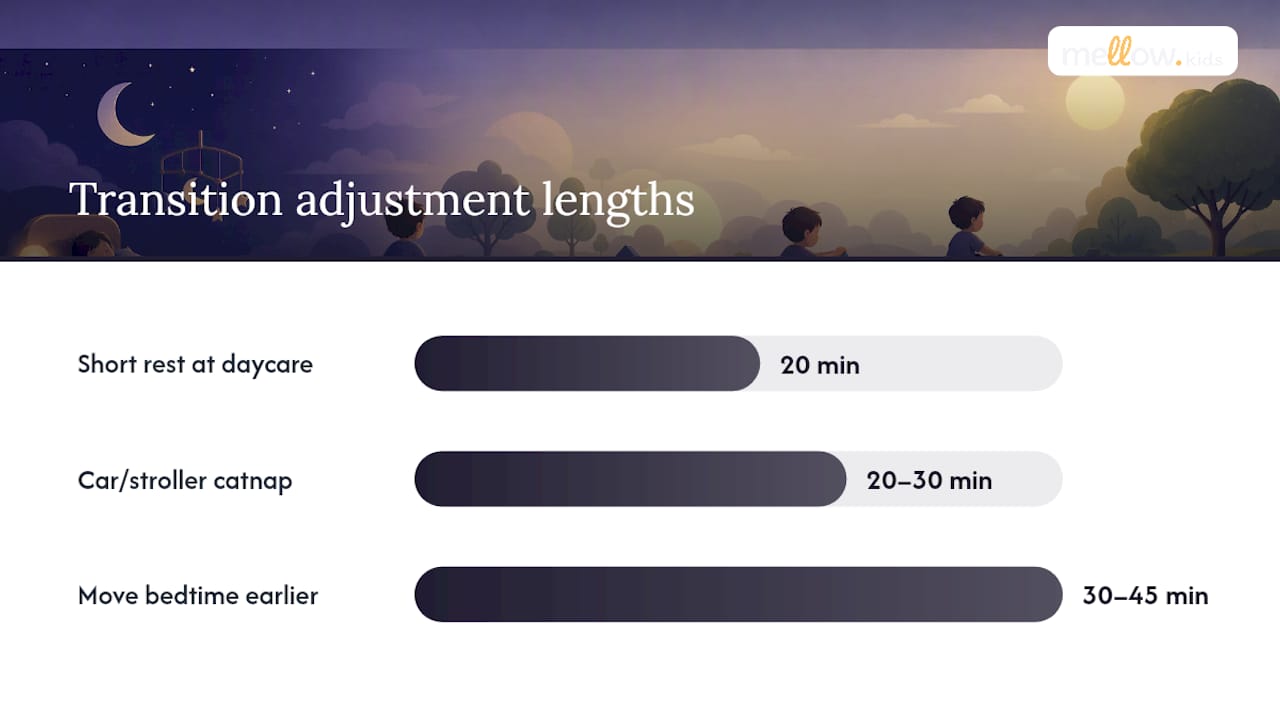
A simple message to send: "We're transitioning [child's name] to one nap and aiming for a midday nap around 12:00–12:30 PM. If they seem very tired before that, a short 20-minute rest is fine. We're moving bedtime earlier at home to help them adjust. Thanks for keeping us in the loop on how naps are going."
For more detailed guidance on working with your child's care provider, Mellow's daycare and sleep challenges resource covers sample communication templates and practical workarounds.
Handling a forced one-nap schedule at daycare:
When daycare moves your child to a one-nap room before you feel they're ready, a few workarounds help:
- Offer a short catnap (20–30 minutes) in the car or stroller on the way home from daycare on days they seem exhausted.
- On weekends, keep two naps if your child clearly needs them. Weekend flexibility doesn't undo weekday progress.
- Move bedtime earlier on daycare days by 30–45 minutes to compensate for the shorter total daytime sleep.
For families with shift work or non-standard schedules:
- Anchor the nap to a consistent clock time rather than to a specific parent's presence. This makes the schedule portable across caregivers.
- If one parent does pickups and another does drop-offs, write the target nap time and bedtime on a shared note or app so both are working from the same plan.
- Choose the best days to attempt the transition when you have more flexibility at home, typically a long weekend or a week with fewer commitments.
What pediatric experts say about nap consolidation
The research and clinical guidance on this topic are consistent: nap consolidation is a normal developmental process, and total 24-hour sleep needs, not nap count, are the right metric to track.
CHOP's sleep resource explains that daytime sleep naturally consolidates across the first two years of life as nighttime sleep lengthens and matures. This is a biological process, not something parents cause or prevent.
A peer-reviewed review published on NCBI supports this, showing that sleep consolidation across infancy and toddlerhood follows a gradual developmental trajectory with significant individual variability. The takeaway for parents: your child's timing is their own, and a wide range of ages is genuinely normal.
From HealthyChildren.org (AAP): Toddlers aged 1–2 years generally need about 11–14 hours of total sleep in a 24-hour period. After dropping to one nap, adjusting bedtime earlier is often necessary to keep total sleep within that range.
Mayo Clinic reinforces this with practical guidance: move the midday nap progressively later and shift bedtime earlier as needed. The goal is protecting total sleep, not preserving a specific schedule structure.
KidsHealth adds that wake windows of roughly 4–6 hours before the consolidated nap support nap quality and length, which is why sample schedules built around those windows tend to work better than ones based on clock time alone.
When to call your pediatrician: If your child shows persistent sleep disruption alongside poor weight gain, snoring or labored breathing during sleep, or extreme behavioral changes that don't resolve after 4–6 weeks of a well-managed transition, a conversation with your pediatrician is warranted. These can signal underlying issues unrelated to the nap schedule itself.
This article provides general information for educational purposes. For concerns specific to your child's health or development, consult your pediatrician or a qualified pediatric sleep professional.
Key Takeaways
Most children are ready to drop to one nap between 12 and 18 months, and the clearest sign is consistent nap refusal paired with contentment through longer wake windows.
| Point | Details |
|---|---|
| Readiness first | Look for consistent nap refusal and longer happy wake windows across 1–2 weeks before changing anything. |
| Typical age window | Most children are ready to drop to one nap between 12 and 18 months, with many making the shift around 15–16 months, though some are ready earlier or later. |
| Gradual methods work best | Push the morning nap later by 15–30 minutes every few days rather than dropping it abruptly. |
| Move bedtime earlier | Shift bedtime earlier during the transition to maintain toddlers' recommended total daily sleep needs. |
| Mellow supports the process | Mellow's age-specific guides for 11–14 months and 15–24 months give you personalized schedules and tracking tools to reduce trial and error. |
The transition is harder on parents than on children
Nap transitions tend to generate a lot of parental anxiety, and honestly, most of it is understandable. You've spent months building a schedule that works, and now you're being asked to dismantle it on the basis of behavioral signs that feel ambiguous. That uncertainty is real.
What I think gets underestimated in most advice is how much the parent's confidence in the process affects the child's adjustment. Children are remarkably good at picking up on hesitation. When you commit to a nap time and hold it, even on days when your child fusses or the nap is short, you're giving them a clear, consistent signal. When you second-guess the timing every other day, offering an extra nap here and a later bedtime there, the adjustment takes longer because the child's sleep system never fully commits to the new rhythm.
The other thing worth saying plainly: reverting to two naps for a few weeks is not a setback. It's a recalibration. Sleep development is not linear, and a child who wasn't quite ready at 13 months will often transition smoothly at 15 months with almost no effort. Patience here is genuinely a strategy, not just a platitude.
The families who navigate this most smoothly tend to share one trait: they observe first and act second. They watch for patterns over a week or two, they pick a method and follow it consistently, and they adjust bedtime before they adjust the nap. That sequence, readiness check, consistent method, earlier bedtime, is almost always enough.
Mellow helps you navigate the one-nap transition with confidence
Knowing the signs is one thing. Having a personalized plan that accounts for your child's exact age, temperament, and current schedule is another. Mellow's age-specific guidance for 11–14 months and 15–24 months gives you sample schedules, wake window calculators, and step-by-step transition plans built around your child's developmental stage, not a generic average.

The app also tracks naps, night sleep, and mood patterns over time, so you can see whether the transition is working or whether a course correction is needed, without relying on memory or guesswork. For parents who want a deeper dive before committing to a change, Mellow's mini-guides offer concise, evidence-based checklists you can read in under 10 minutes. Start your free trial at Mellow Kids and get a schedule that actually fits your child's stage.
Useful sources and further reading
The guidance in this article draws on the following pediatric and research sources:
- Healthy sleep habits: how many hours does your child need? | HealthyChildren.org
- Baby naps: Mayo Clinic
- PMC article on infant sleep consolidation (NCBI)
- Newborn sleep patterns | CHOP
- Signs It's Time to Drop a Nap | Taking Cara Babies
- When to transition your child to one nap | BabyCenter
- Naps | KidsHealth