

Yes, you can use a pacifier with the Ferber method, and for many families it's the right call. The short answer: if your baby is under 6 months, keeping the pacifier during sleep training is generally fine and may even support safer sleep. For babies 6 months and older, you have two clear options. Path A: keep the pacifier during training, accept that you may need to reinsert it during check-ins, and plan to wean it separately later. Path B: remove the pacifier 1–2 weeks before you start Ferber so the training targets pure self-soothing from day one. Dr. Richard Ferber, the American Academy of Pediatrics (AAP), and the American Academy of Pediatric Dentistry (AAPD) all weigh in on timing, and their guidance shapes both paths below.
Table of Contents
- What is the Ferber method, and when should you start?
- The real trade-offs of using a pacifier while Ferberizing
- How to use a pacifier during Ferber check-ins, step by step
- How to wean the pacifier before starting Ferber
- Safety, SIDS guidance, and what dentists recommend
- Troubleshooting common problems with pacifiers and Ferber
- What Dr. Ferber, the AAP, AAPD, and sleep experts actually say
- Key Takeaways
- Why one-size-fits-all sleep advice often falls short
- Mellow helps you build a sleep plan that fits your baby right now
- Useful sources and further reading
What is the Ferber method, and when should you start?
The Ferber method, formally called graduated extinction, teaches babies to fall asleep independently by gradually lengthening the time between parental check-ins. The goal is not to ignore your baby but to give them the chance to self-soothe before you return. You put your baby down drowsy but awake, leave the room, and return at set intervals to offer brief, calm reassurance without picking them up.

Most clinicians suggest starting around 4–6 months, when babies have the developmental capacity to self-soothe. Safety guidance from the AAP is strongest at 6 months and older. Many families see meaningful improvement within 3–7 nights of consistent implementation. If there is no progress after 7 days, stop and talk to your pediatrician.
Before you start, make sure these are in place:
- A consistent bedtime routine (bath, feed, song, lights out) run the same way every night
- A safe sleep environment: firm flat surface, no loose bedding, baby on their back
- No current illness, teething flare, or upcoming travel that would disrupt consistency
- Feeding and growth are on track with no medical concerns
Pro Tip: Check your baby's sleep patterns by age before picking a start date. A 4-month-old and a 9-month-old need different interval lengths and different pacifier strategies.
The real trade-offs of using a pacifier while Ferberizing
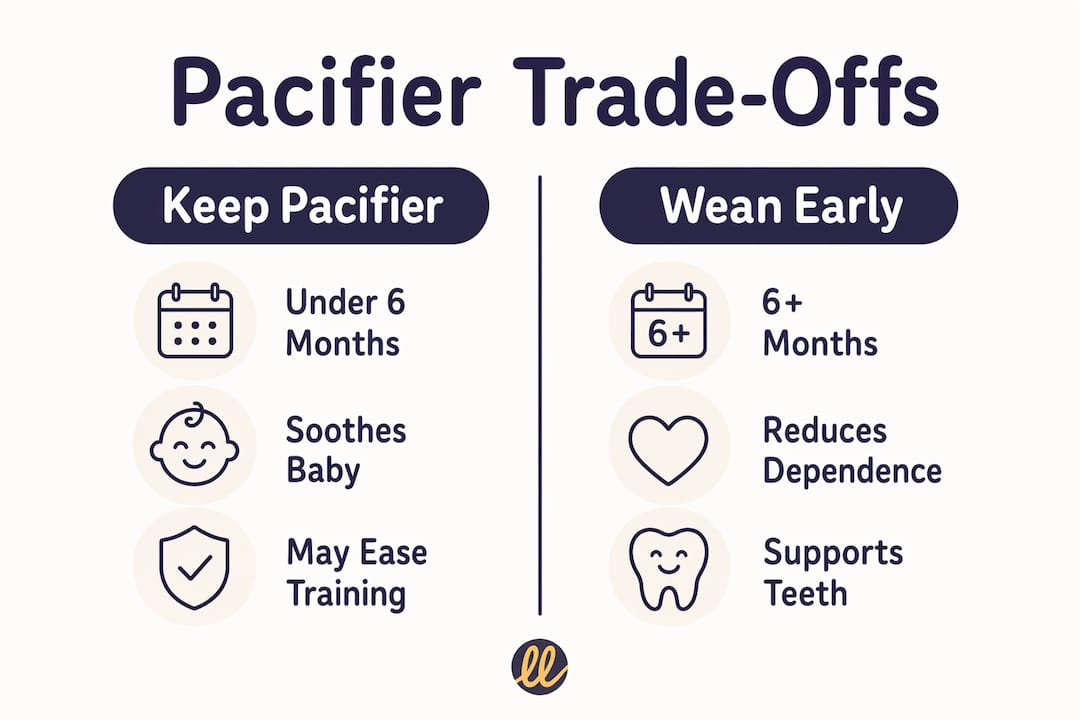
Pacifiers are not neutral tools during sleep training. They carry genuine benefits and real costs, and knowing both helps you pick the right path.
Benefits
- SIDS risk reduction: Evidence supports pacifier use at sleep time for reducing SIDS risk, particularly before 6 months. This is the strongest clinical argument for keeping the pacifier during early training.
- Faster initial settling: Some babies settle more quickly at bedtime when a pacifier is offered, which can make the first few nights of Ferber less intense for everyone.
- Pain and stress relief: Sucking has a documented calming effect, which can ease the distress that comes with learning a new sleep skill.
Costs and concerns
- Sleep prop dependency: If your baby needs the pacifier to fall asleep and cannot replace it independently, every time it falls out becomes a wake-up. That directly undermines the self-soothing goal of Ferber.
- Dental risks after 12 months: The AAPD recommends stopping nonnutritive sucking by 36 months, and notes that risks to dentition increase after 12 months.
- Otitis media risk: Extended pacifier use is associated with higher rates of middle ear infections, though rates are lowest from birth to 6 months, the same window when SIDS risk is highest.
| Factor | Keep pacifier during training | Wean before training |
|---|---|---|
| Baby age | Under 6 months | 6 months and older |
| SIDS concern | Supports keeping pacifier | Less critical after 6 months |
| Pacifier reliance | Moderate (can self-settle somewhat) | Strong reliance, frequent night waking |
| Family tolerance | Comfortable with night reinsertions | Prefer one clean process |
| Breastfeeding | Established | Established |
How to use a pacifier during Ferber check-ins, step by step
This is Path A. The key principle: decide before night one whether the pacifier stays, then stay consistent.
- Run your full bedtime routine. Keep it the same every night: feed, brief play or bath, song, dim lights. Routine signals sleep more powerfully than any single prop.
- Place baby drowsy but awake with the pacifier in. Offer it as part of the wind-down, not as a rescue tool once crying starts.
- Leave the room calmly. Say one short phrase ("Night night, I love you") and go. Do not linger.
- Wait for your first check-in. A sample framework for the first three nights:
| Night | First wait | Second wait | Third wait |
|---|---|---|---|
| 1 | 3 minutes | 5 minutes | 10 minutes |
| 2 | 5 minutes | 10 minutes | 12 minutes |
| 3 | 10 minutes | 12 minutes | 15 minutes |
- Keep check-ins under 2 minutes. Lights stay off. No picking up. Speak in a low, calm voice: "You're okay, I'm here." If you are keeping the pacifier, reinsert it quickly and step back. Do not rock, feed, or make extended eye contact.
- Leave again and repeat. Extend the interval slightly each time. The goal is for baby to fall asleep between check-ins, not during them.
What to do when the pacifier falls out:
- Under 6 months: Replace it during your next scheduled check-in, not immediately. Follow the interval.
- 7 months and older: Give baby 1–2 minutes to find and replace it independently before you go in. Many babies this age can do it with a little practice.
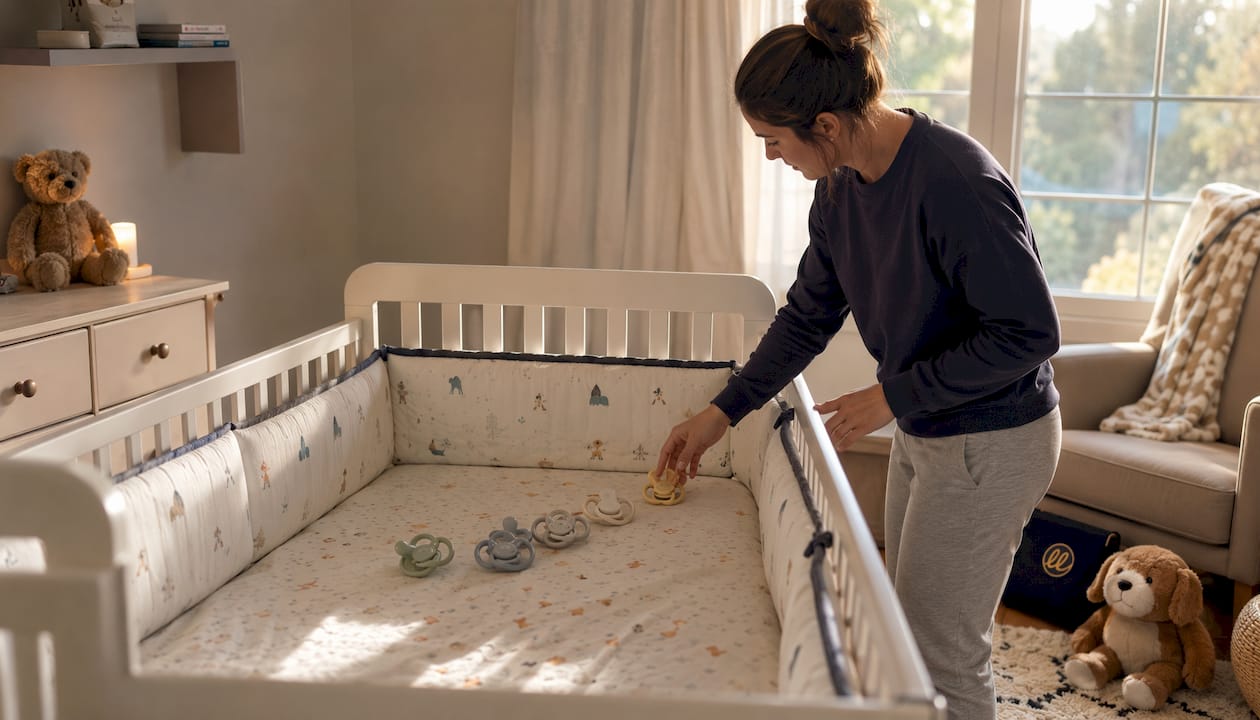
Pro Tip: Place two or three pacifiers in the crib before bed. Older babies often find one on their own in the dark, which cuts your night reinsertions dramatically without any formal weaning.
How to wean the pacifier before starting Ferber
Path B works best when your baby is 6 months or older and relies heavily on the pacifier to fall asleep. Removing it first means Ferber targets one thing: independent sleep. Introducing multiple changes at once tends to increase distress and slow progress.
A 2-week staged plan:
- Week 1, days 1–3: Stop offering the pacifier during daytime naps. Offer extra physical comfort instead (patting, brief holding before putting down). Keep it for nighttime.
- Week 1, days 4–7: Reduce nighttime use to bedtime only. If baby wakes and asks for it, wait 3–5 minutes before replacing it. Gradually stretch that wait each night.
- Week 2, days 1–4: Offer the pacifier only at the start of the bedtime routine, not in the crib. Let baby fall asleep without it in place.
- Week 2, days 5–7: Remove it entirely. Start Ferber the following night.
| Week | Goal | What changes |
|---|---|---|
| Week 1 (days 1–3) | Drop daytime pacifier | Naps without pacifier; nighttime unchanged |
| Week 1 (days 4–7) | Reduce night use | Delay reinsertions; bedtime only |
| Week 2 (days 1–4) | Bedtime routine only | Pacifier before crib, not in it |
| Week 2 (days 5–7) | Full removal | No pacifier; begin Ferber next night |
Pause weaning if your baby is:
- Currently sick or recovering
- Actively teething with visible discomfort
- Traveling or in a new sleep environment
- Going through a known sleep regression
Positive reinforcement works well for babies 12 months and older. Acknowledge when they settle without the pacifier: a calm "good job" or a brief cuddle before you leave the room costs nothing and builds the new association quickly.
Safety, SIDS guidance, and what dentists recommend
The timing of pacifier weaning is not just a sleep-training question. It sits at the intersection of SIDS prevention, dental health, and ear health.
SIDS guidance: Pacifier use at sleep time is associated with reduced SIDS risk in early infancy. This is why the AAP recommends offering a pacifier at nap time and bedtime, and why removing it before 6 months carries more risk than benefit. After 6 months, SIDS risk drops significantly, which is also when the dental and ear-health calculus starts to shift.
Dental guidance: The AAPD advises stopping nonnutritive sucking habits by 36 months to prevent dental problems, and notes that weaning between 6–12 months can reduce both dental and ear-infection risks. Research suggests harmful dental effects can begin by age 2, so starting the weaning process before that window is worth planning for.
Key safety stat: Middle ear infection rates are lowest from birth to 6 months, the same period when SIDS risk is highest and pacifier use is most beneficial. After 6 months, the risk-benefit balance shifts toward weaning.
| Age window | SIDS benefit | Dental/ear risk | Recommended action |
|---|---|---|---|
| Under 6 months | High | Low | Offer pacifier at sleep time |
| 6–12 months | Decreasing | Increasing | Consider beginning wean |
| 12–24 months | Minimal | Moderate | Plan wean; establish dental home |
| 24–36 months | None | High | Complete wean by 36 months (AAPD) |
Safe pacifier practices (AAFP-aligned):
- Use single-piece pacifiers only; two-piece models are a choking hazard
- Shield must be at least 1.5 inches across with ventilation holes
- Never attach to a string, cord, or strap around baby's neck
- Clean by boiling or dishwasher until 6 months; soap and water after that
- Never coat with sugar, honey, or any sweetener
- Replace when rubber changes color, tears, or shows wear
Breastfeeding note: The AAP and WHO advise waiting until breastfeeding is well established before introducing a pacifier, typically around 3–4 weeks. Research shows pacifier use does not harm breastfeeding duration when introduced after latch is routine.
Troubleshooting common problems with pacifiers and Ferber
Baby wakes loudly demanding the pacifier. Stay on your Ferber interval. Do not rush in the moment crying starts. When you do go in, keep the visit under 2 minutes, reinsert the pacifier if that is your plan, speak one calm phrase, and leave. Responding immediately to every cry teaches baby that crying summons you, which is the opposite of the goal.
Pacifier keeps falling out and baby can't replace it. For babies under 7 months, this is normal. Follow your intervals and replace it on your scheduled check-in. For babies 7 months and older, try placing multiple pacifiers in the crib so baby can find one independently. If this pattern persists for more than a week without improvement, it may be a signal to move to Path B and wean before continuing training.
Regression after illness, travel, or a developmental leap. Regressions are normal and do not mean training failed. When you return home or your baby recovers, restart Ferber from night one of your interval schedule. You may need to shorten intervals slightly for 2–3 nights before lengthening them again. Consistency, not perfection, is what drives results.
- Tonight's quick checklist:
- Room temperature between 68–72°F, dark, and quiet
- Pacifier placed in crib (not attached to anything)
- Intervals written down so both caregivers follow the same schedule
- One caregiver handles all check-ins per night to keep stimulation consistent
- Agree in advance: reinsert or don't, and stick to it
What Dr. Ferber, the AAP, AAPD, and sleep experts actually say
Dr. Richard Ferber's core recommendation, detailed in Your Child's Sleep Problems, is that check-in intervals should lengthen progressively across nights. He acknowledges that families may need to adapt the exact timeframes, and clinical experts agree that consistency matters more than hitting a specific minute count. A 2016 study cited by the Cleveland Clinic found that graduated extinction produced no adverse stress responses and that infants trained this way eventually fell asleep 15 minutes faster than untrained peers.
"The goal is to get your baby to learn to self-soothe, which means they can put themselves to sleep without another person intervening or assisting the entire time." — Dr. Noah Schwartz, Cleveland Clinic
The Sleep Foundation notes that consistency matters more than the exact interval lengths, and that caregivers should pick intervals they can realistically maintain every night. Ferber's own published schedule starts at 3 minutes on night one and extends from there, but a 5-minute starting interval works just as well for many families.
| Authority | Core guidance | Pacifier relevance |
|---|---|---|
| Dr. Richard Ferber | Graduated intervals; adapt to family | No specific pacifier rule; consistency is key |
| AAP | Safe sleep; offer pacifier at bedtime | Supports pacifier use for SIDS reduction |
| AAPD | Wean nonnutritive sucking by 36 months | Begin weaning 6–12 months to reduce dental/ear risk |
| AAFP | Single-piece pacifiers; no sweeteners | SIDS benefit before 6 months; risks rise with age |
When to call your pediatrician: No improvement after 7–10 nights of consistent Ferber, signs of a medical sleep disorder (snoring, labored breathing, unusual night waking patterns), or any feeding or growth concerns.
When to call a pediatric dentist: Persistent pacifier use after 12–24 months with visible bite changes, or if you notice the roof of the mouth or tooth alignment shifting. The AAPD recommends establishing a dental home by 12 months regardless.
This article is general information, not medical or dental advice. Confirm current guidance with your pediatrician or pediatric dentist for your child's specific situation.
Key Takeaways
Using a pacifier with the Ferber method works best when you pick one clear path before night one and stay consistent for at least a full week.
| Point | Details |
|---|---|
| Two clear paths | Keep the pacifier during training (Path A) or wean it 1–2 weeks before starting Ferber (Path B). |
| Age shapes the decision | Under 6 months, SIDS benefit favors keeping the pacifier; after 6 months, weaning becomes more practical. |
| Improvement timeline | Most families see meaningful progress within about a week; stop and consult a pediatrician if there is no change after about 10 days. |
| Dental and ear health | The AAPD advises stopping nonnutritive sucking by 36 months; weaning between 6–12 months reduces dental and ear-infection risk. |
| Mellow for personalized plans | Mellow's age-specific sleep tools help you track night wakings, set check-in timers, and build a routine matched to your baby's stage. |
Why one-size-fits-all sleep advice often falls short
Sleep training advice tends to flatten out the details that matter most. You will find dozens of guides that say "yes, you can use a pacifier with Ferber" and then give you the same generic interval table regardless of whether your baby is 4 months old or 11 months old, whether they are breastfed or bottle-fed, whether they have been using a pacifier since week two or picked it up at 5 months.
The pacifier question is genuinely context-dependent. A 5-month-old with moderate pacifier reliance and a family comfortable with one or two nightly reinsertions is a completely different case from a 10-month-old who wakes four times a night because the pacifier has fallen out. Treating those two situations identically is how parents end up frustrated after a week of "doing it right" and seeing no results.
The evidence from Dr. Ferber, the AAP, and the AAPD is clear on the broad strokes. What it cannot do is tell you how your specific baby responds to a 5-minute versus a 10-minute first interval, or whether your child's temperament means the staged wean will take 10 days or 3 weeks. That gap between population-level guidance and individual application is exactly where personalized, age-specific support makes a real difference.
Mellow helps you build a sleep plan that fits your baby right now
Knowing the Ferber method and pacifier principles is one thing. Putting them into practice at 2 AM, when you are exhausted and your baby has been crying for 8 minutes, is another. Mellow is built for exactly that gap.

The Mellow app gives you age-specific sleep plans that account for where your baby actually is developmentally, not just a generic schedule. For families in the thick of sleep training, the app includes check-in timers that follow your chosen Ferber intervals, night-waking trackers so you can see whether things are improving night over night, and guided weaning plans if you are on Path B. If your baby is 8–10 months old, Mellow's 8–10 month sleep guidance walks you through the exact adjustments that age group needs. For older babies approaching the 12-month dental milestone, the 11–14 month plan includes paced pacifier weaning alongside sleep training. Download Mellow and start your personalized plan tonight.
Useful sources and further reading
- American Academy of Pediatrics — Healthy Children: Pacifiers and Thumb Sucking
- American Academy of Pediatric Dentistry — Policy on Pacifiers
- American Family Physician — Pacifiers (2025)
- Mayo Clinic — Pacifiers: Are They Good for Your Baby?
- Cleveland Clinic — The Ferber Method of Sleep Training
- Sleep Foundation — The Ferber Method
- AAP Publications — Graduated Extinction and Sleep Training
- Mellow — Child Sleep and Development App
- Mellow — 8–10 Month Sleep Guidance
- Mellow — 11–14 Month Sleep Guidance
- Mellow — Safe Sleep for Newborns