

Start solids around 6 months of age, never before 4 months, and always wait until your baby shows clear developmental readiness signs. That's the consensus from the American Academy of Pediatrics (AAP) and the CDC, and it's the most reliable starting point you have.
Here's what to hold onto right now:
- When to start: Aim for around 6 months. Starting before 4 months carries real risks, including choking and digestive stress, regardless of how eager your baby seems.
- Readiness cues to confirm first: Your baby should hold their head steady, sit with minimal support, and show interest when you eat. The tongue-thrust reflex (pushing food back out automatically) should be fading.
- Your first practical step today: If your baby is close to 6 months and showing those cues, offer a small spoonful of a smooth, iron-rich food, such as pureed meat or iron-fortified single-grain cereal. One taste. No pressure. That's how it begins.
The Merck Manual confirms there's no evidence-based reason to introduce foods in a specific order, so you don't need to follow a rigid sequence. What matters is starting with iron-rich, developmentally appropriate foods and following your baby's lead.
Key Takeaways
Starting solids around 6 months, with iron-rich foods and attention to developmental readiness, gives your baby the safest and most nutritionally sound start to complementary feeding.
| Point | Details |
|---|---|
| Start around 6 months | Never before 4 months; wait for head control, sitting, and loss of tongue-thrust reflex. |
| Iron-rich foods come first | Pureed meats, iron-fortified cereals, and lentils address the nutritional gap that opens around 6 months. |
| Introduce allergens early | Offer peanuts and eggs from around 6 months unless baby has severe eczema or a known egg allergy. |
| Breastmilk or formula stays primary | Most babies don't meaningfully reduce milk feeds until after 9 months; solids build skills first. |
| Mellow Kids tracks it all | Age-specific tips, milestone tracking, and feeding reminders keep you proactive at every stage. |
Table of Contents
- What does developmental readiness actually look like at 6 months?
- The solid food introduction schedule, stage by stage
- Which first foods should you actually offer?
- How textures and feeding skills develop together
- Sample daily feeding schedules you can adapt
- How to keep mealtimes safe and prevent choking
- When should you call your pediatrician?
- What the timeline really asks of you as a parent
- Mellow Kids helps you stay one step ahead of every feeding milestone
- Sources
What does developmental readiness actually look like at 6 months?
The 6-month mark isn't arbitrary. Two things converge around this age: your baby's digestive system and motor skills are mature enough to handle solid foods, and the iron stores they were born with begin to run low.
Babies arrive with fetal iron reserves that carry them through roughly the first 6 months. After that, breastmilk and formula alone don't supply enough iron or zinc to meet growing energy needs. Introducing complementary foods at the right time fills that gap. The WHO warns that if complementary foods aren't introduced around 6 months, or are given inappropriately, growth can falter.
The developmental readiness signs to look for, according to HealthyChildren.org (AAP), are:
- Steady head control: Baby can hold their head upright without wobbling.
- Sits with minimal support: They don't need to be fully propped, but they shouldn't be slumping.
- Loss of the tongue-thrust reflex: When you touch their lips with a spoon, they don't automatically push it back out.
- Interest in food: They watch you eat, reach toward your plate, or open their mouth when food comes near.
- Ability to move food to the back of the mouth: This one is harder to observe until you try, but it develops alongside the others.
Age alone isn't enough. A baby who hits 6 months but still has a strong tongue-thrust reflex isn't ready yet. Behavioral cues are often better indicators than the calendar, which is why pediatricians watch for these milestones rather than simply marking a date.
Pro Tip: If you're unsure whether your baby's tongue-thrust reflex has faded, try touching their lower lip gently with a clean finger. If their tongue pushes forward strongly, give it another week or two before trying a spoon.
A few situations call for a conversation with your pediatrician before starting solids at all: preterm infants (whose corrected age matters more than birth age), babies with severe eczema or a known egg allergy (due to peanut allergy risk), and babies who are small or gaining weight slowly. These aren't reasons to panic, just reasons to get personalized guidance rather than following a general timeline. Learning to read your baby's hunger and satiety cues before you start solids also gives you a real advantage.
The solid food introduction schedule, stage by stage
Think of the first year as four distinct phases. Each one builds on the last, and the pace is guided by your baby's skills, not a strict calendar.
The WHO's complementary feeding guidance maps this out clearly: 2–3 complementary meals per day between 6–8 months, increasing to 3–4 meals by 9–11 months, with nutritious snacks added by 12–24 months.
A few things worth knowing about each phase:
- 4–6 months (watch): Practice tummy time and supported sitting. Expose your baby to the sights and smells of family mealtimes. No solids yet unless your pediatrician specifically advises otherwise.
- Around 6 months (start): Single-ingredient foods only. Offer one new food at a time and wait 3–5 days before introducing another, so you can spot any reactions. Iron-rich foods come first.
- 7–9 months: This is when texture matters most. Babies are developing the oral motor skills to handle lumps, and offering only smooth purees past 8 months can actually make texture acceptance harder later.
- 9–12 months: Solids start contributing meaningfully to nutrition. Solid Starts notes that most babies don't significantly reduce milk feeds until after 9 months, so don't rush to cut milk at this stage.
- 12+ months: Solids become the primary nutrition source. The Mellow Kids 15–24 months guide covers the transition from bottle or breast to family foods in more detail.
Which first foods should you actually offer?
The short answer: iron-rich foods first, allergens early, and no strict order required.
Iron is the priority because it's the nutrient most likely to fall short after 6 months. Good starting options include:
- Pureed beef, chicken, or turkey (smooth, no lumps)
- Iron-fortified single-grain cereals (oatmeal or rice cereal thinned with breastmilk or formula)
- Pureed lentils or black beans
- Pureed spinach or peas (paired with a vitamin C source to help iron absorption)
You can make these at home with a blender and a little water or breastmilk to thin the texture, or buy commercial single-ingredient purees. Either works.
Introducing common allergens
This is where many parents hesitate, but the evidence points clearly toward early introduction. The Merck Manual recommends introducing allergens like peanuts and eggs between roughly 4–11 months to reduce allergy risk, not avoid it. Delaying allergenic foods beyond 4–6 months doesn't prevent food allergy in most infants, according to AAP guidance.
Here's a practical step-by-step approach:
- Start with lower-risk allergens first (well-cooked egg yolk, smooth nut butters thinned with water or breastmilk) once your baby has tolerated a few non-allergenic foods.
- Offer peanut products around 6 months for most babies. Use smooth peanut butter thinned to a runny paste, never whole peanuts or thick globs.
- Wait 3–5 days between new allergens, just as you would with any new food.
- Consult your pediatrician before introducing peanuts if your baby has severe eczema or a confirmed egg allergy. They may recommend allergy testing or a supervised first exposure.
Foods to avoid entirely in the first year
- Honey: Carries a risk of infant botulism. Avoid completely until after 12 months, as NHS guidance confirms.
- Whole cow's milk as a main drink: Fine in cooking or mixed into foods, but not as a primary beverage before 12 months.
- Whole nuts: A choking hazard at any age under 5; use finely ground nut flours or thinned nut butters instead.
- Added salt and sugar: Baby kidneys can't handle excess salt, and there's no reason to add sugar to any food at this stage.
How textures and feeding skills develop together
Texture progression isn't just about what your baby can chew. It's about a sequence of oral motor skills that develop in a predictable order, and matching textures to those skills makes feeding safer and more successful.
The progression looks like this:
- Smooth purees (around 6 months): Baby uses a sucking and swallowing motion. The tongue moves food from front to back. No chewing needed.
- Mashed and lumpy textures (7–8 months): Baby begins a munching motion, pressing soft lumps against the roof of the mouth. This is the stage where many parents get nervous, but soft lumps are safe when the food dissolves easily.
- Soft finger foods (8–9 months): Baby picks up pieces with a raking grasp, moving toward a pincer grasp (thumb and forefinger) by around 9 months. Soft-cooked vegetables, banana pieces, and small pasta shapes work well here.
- Chopped family foods (10–12 months): Baby can handle a wider range of textures and begins to use a rotary chewing motion. Food should still be soft enough to squish between your fingers.
Watch for these skills as cues to advance textures: mouthing toys and hands (a sign the oral system is practicing), bringing objects to the mouth with control, and sipping from an open or straw cup. If your baby consistently gags on lumps past 9–10 months, mention it to your pediatrician. Some babies benefit from feeding therapy referrals, and catching it early makes a real difference. Teething can also temporarily affect willingness to chew, so factor that in if your baby suddenly resists textures they previously accepted.
Sample daily feeding schedules you can adapt
These are starting points, not rules. Every baby's appetite varies, and some days will look nothing like the schedule below.
6–7 months
- Morning milk feed (breastmilk or formula, on demand)
- Mid-morning solid meal: 1–2 teaspoons of pureed iron-rich food; offer when baby is alert and not overly hungry
- Afternoon milk feed (on demand)
- Optional second solid meal: 1–2 teaspoons of a different single-ingredient food
- Evening milk feed (on demand)
At this stage, Baby Led Bliss notes that most early feedings are exploratory. Expect mess, expect refusal, and expect most of the food to end up on the bib. That's normal.
8–9 months
- Morning milk feed, then solid breakfast 30 minutes later: mashed banana, oatmeal, or soft scrambled egg
- Mid-morning snack (optional): a few soft finger food pieces
- Lunch solid meal before a milk feed: mashed vegetables with protein, soft pasta
- Afternoon milk feed
- Dinner solid meal: soft family food, chopped or mashed; offer a cup of water
Offering solids before the milk feed at some meals encourages your baby to arrive with some appetite for food rather than filling up on milk first.
10–12 months
- Breakfast: soft scrambled egg, toast strips, fruit pieces; water in a cup
- Mid-morning snack: soft cheese cubes, banana, or puffs
- Lunch: chopped soft family food (pasta, chicken, cooked vegetables); water
- Afternoon snack: yogurt, soft fruit, or crackers
- Dinner: family meal adapted to safe textures; milk feed afterward
By 10–12 months, aim for 3 meals and 1–2 snacks daily, in line with WHO guidance. Total milk intake can begin to taper slightly to support solid food appetite, but breastmilk or formula still matters nutritionally until 12 months. The Mellow Kids 8–10 months page has age-specific milestone guidance that pairs well with this schedule.
Pro Tip: Offer solids when your baby is alert and in a good mood, roughly 30–60 minutes after waking from a nap. Overtired or overly hungry babies are rarely enthusiastic about trying new foods.
How to keep mealtimes safe and prevent choking
Choking is the fear behind most parents' hesitation to advance textures, and it's worth taking seriously without letting it paralyze you. The risk is real but manageable with consistent habits.
Foods that pose the highest choking risk and safer alternatives:
- Whole grapes → halved or quartered lengthwise
- Whole hot dogs → sliced into thin strips, not coins
- Hard raw carrots → steamed until soft enough to squish
- Whole nuts → finely ground nut flour or thinned nut butter
- Hard candies, popcorn, large chunks of raw apple → avoid entirely under 4 years
Positioning and supervision rules:
- Always seat your baby upright in a secure high chair with foot support. Slouching increases choking risk.
- Stay within arm's reach during every meal. No exceptions.
- Offer small, age-appropriate portions. One piece at a time for finger foods.
- Allow your baby time to chew and swallow before offering the next bite. Don't rush.
- Never offer food in a car seat, stroller, or lying down.
NHS guidance specifically flags honey under 12 months and whole nuts as hazards to avoid. If your baby does choke, know the difference between gagging (noisy, baby is working it out themselves) and true choking (silent, baby can't cough or cry). For true choking, call 911 immediately.
Pro Tip: Taking a hands-on infant CPR and choking course before you start solids is one of the most practical things you can do. The American Red Cross and American Heart Association both offer in-person and online options.

When should you call your pediatrician?
Most feeding challenges in the first year are normal and resolve with time and patience. Some aren't. Here's how to tell the difference.
Call your pediatrician promptly if you notice:
- Hives, swelling around the mouth, or a rash appearing within 2 hours of a new food
- Vomiting repeatedly after a specific food (more than once, not just a spit-up)
- Persistent diarrhea or blood in stool after introducing a new food
- Breathing difficulty or wheezing after eating: call 911, not the pediatrician
- Poor weight gain or dropping noticeably on the growth curve after starting solids
- Consistent gagging or choking at every meal past 9–10 months
- Complete refusal to eat for more than a week or two
Food intolerance vs. food allergy: These are different, and the distinction matters for how you respond. An allergic reaction typically appears within minutes to 2 hours of eating the food and involves the immune system: hives, swelling, vomiting, or breathing changes. Food intolerance tends to cause delayed symptoms (hours later) like gas, bloating, or loose stools, and doesn't involve the immune system. Keep a simple food diary when introducing new foods, noting what was offered, how much, and any symptoms. That record is genuinely useful when you talk to your pediatrician.
If your baby shows signs of a possible allergy, stop that food and schedule an appointment. Your pediatrician can refer you for allergy testing or to a pediatric allergist if needed. For persistent feeding difficulties, a referral to a feeding therapist or occupational therapist is a reasonable next step, not an overreaction.
What the timeline really asks of you as a parent
There's a version of the introducing solids timeline that reads like a checklist, and then there's the version that actually happens in your kitchen, with a baby who spits out every spoonful for three weeks and then suddenly eats half a bowl of lentils. Both are normal.
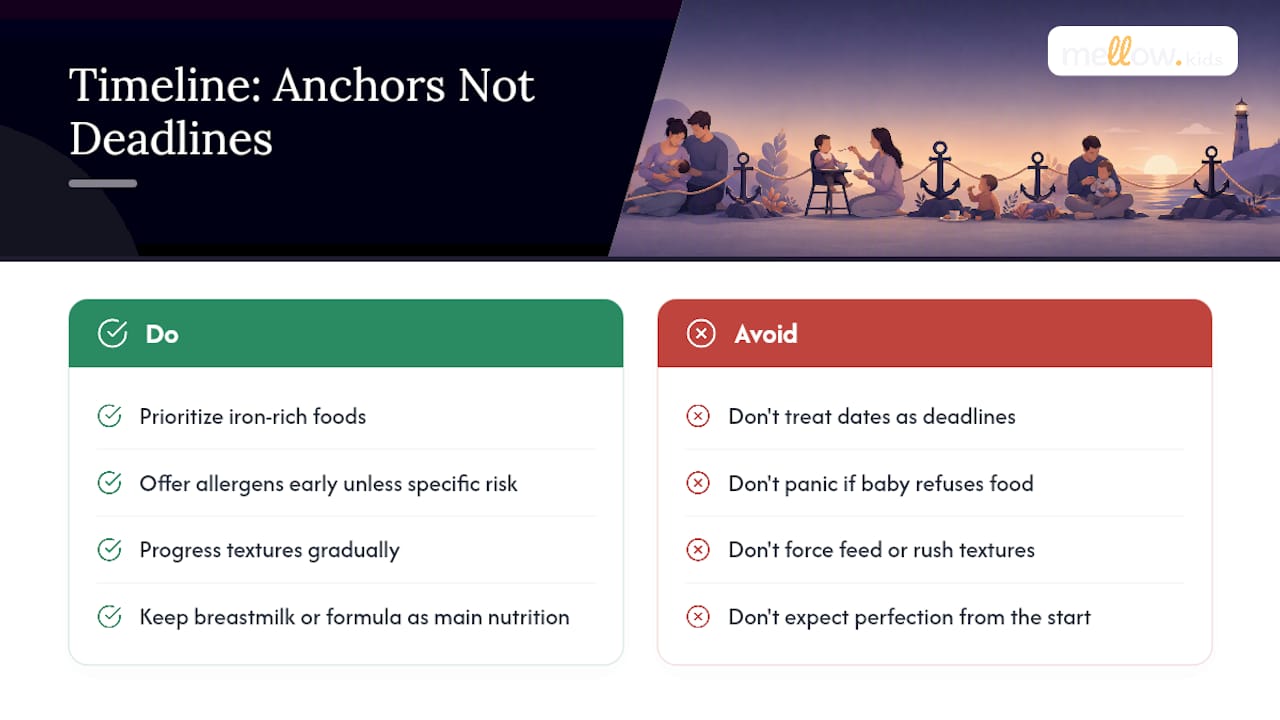
The dates in this guide are anchors, not deadlines. A baby who starts at 6.5 months instead of exactly 6 months hasn't missed anything. A baby who takes 4 weeks to accept a new texture instead of 1 week is still on track. What the research actually supports is this: prioritize iron-rich foods, offer allergens early unless there's a specific risk factor, progress textures gradually, and keep breastmilk or formula as the nutritional foundation through most of the first year.
What gets lost in the noise of competing advice is how much of this process is about skill-building, for your baby and for you. Feeding is a learned behavior. Your baby is learning to coordinate swallowing, chewing, and breathing simultaneously, which is genuinely complex. You're learning to read their cues, manage the mess, and trust the process. Neither of you will get it perfect from the start, and that's exactly how it's supposed to go.
Consult your pediatrician whenever you're uncertain. The developmental milestones resources at Mellow Kids can help you track what's typical at each stage, but your pediatrician knows your specific baby. Use both.
Mellow Kids helps you stay one step ahead of every feeding milestone
Knowing the timeline is one thing. Keeping track of what your baby has tried, which foods caused a reaction, and where they are in the texture progression while also managing sleep schedules and developmental leaps is another challenge entirely.

Mellow Kids is built for exactly this stage. The app gives you age-specific feeding tips and sample schedules that update as your baby grows, milestone tracking so you can see the full picture of development alongside feeding progress, and reminders to log new foods and note any reactions. Instead of searching for what's typical at 8 months versus 10 months, Mellow surfaces it for you before you need it. You can explore the 8–10 months guidance right now, or visit Mellow Kids to see how the app fits into your daily routine. Start with a free trial and see what proactive support actually feels like.
Sources
The guidance in this article draws on the most trusted pediatric and public health sources available. Each one is worth bookmarking for ongoing reference.
- When, What, and How to Introduce Solid Foods — CDC
- Solid Foods in Infancy — Merck Manual Professional Edition
- Complementary feeding — World Health Organization (WHO)
- Your baby's first solid foods — NHS
- Baby Feeding Schedules — Solid Starts
- Sample feeding schedule for 6 month old — Baby Led Bliss
For personalized guidance tailored to your baby's age and stage, consult your pediatrician and explore the Mellow Kids development resources for milestone tracking alongside feeding support.
This article is general information, not a substitute for advice from a qualified doctor. Consult a qualified healthcare professional about your own circumstances before acting on anything here.