

Most babies are typically ready to move from bassinet to crib in the first half year, and the single most important rule while you plan is this: the crib needs a firm, snug-fitting mattress with only a tightly fitted sheet, nothing loose. If your baby is rolling over, pushing up on hands and knees, or brushing against the sides of the bassinet, that timeline moves up regardless of age.
Start with three things tonight:
- Watch readiness signs. Rolling, sitting, or simply outgrowing the bassinet's weight and length limits means it's time, no matter what the calendar says.
- Set up the crib safely. Firm mattress, fitted sheet, and nothing else. No bumpers, pillows, blankets, or stuffed animals.
- Start with naps, not nights. A staged approach almost always beats an abrupt overnight switch.
The American Academy of Pediatrics recommendations (safe sleep summary) call for room-sharing without bed-sharing for at least the first 6 months, and for a bare crib free of loose bedding until your baby turns 12 months old. Those two rules should shape every decision you make from here.
Pro Tip: Pick a calm 10 to 14 day window with no travel, no new daycare, and no big schedule changes. A boring stretch of ordinary days is the best environment for a new sleep skill to take hold.
Key Takeaways
Moving your baby to a crib safely depends on readiness signs over age, a bare and firm sleep surface, and a staged, naps-first transition timed to a calm stretch of days.
| Point | Details |
|---|---|
| Readiness beats age | Rolling, sitting, or outgrowing the bassinet matters more than hitting a specific month. |
| Crib must stay bare | Firm mattress and fitted sheet only, no bumpers or loose bedding until 12 months. |
| Naps first, always | Practice in the crib during low-stakes daytime naps before moving bedtime there. |
| Pick a calm window | Avoid starting during travel, moves, illness, or a known sleep regression. |
| Mellow tracks the plan | Mellow's app and mini-guides help you log naps and follow the two-week transition plan. |
Table of Contents
- When Should You Move Your Baby to a Crib?
- What Does a Safe Crib Setup Actually Look Like?
- How Do You Transition a Baby From Bassinet to Crib?
- What if Baby Resists the Crib?
- When Is the Wrong Time to Start?
- A Two-Week Bassinet-to-Crib Plan You Can Print
- When Should You Call the Pediatrician?
- A Note From Mellow
- How Mellow Kids Supports Your Crib Transition
- Frequently Asked Questions
- Sources
When Should You Move Your Baby to a Crib?
Most pediatricians point to roughly 3 to 6 months as the typical window for the bassinet to crib transition, but that range is a guideline, not a deadline. Pediatricians generally agree that readiness signals matter more than age: a baby who starts rolling at 10 weeks may need a crib well before the 3-month mark, while a smaller baby who isn't yet mobile might comfortably stay in a bassinet a bit longer.
Watch for these signs rather than counting weeks:
- Your baby rolls from back to belly or pushes up onto hands and knees.
- She sits up unassisted, even briefly.
- The bassinet feels cramped. Her head or feet touch the sides, or she seems to strain against the space.
- You're approaching or have hit the manufacturer's stated weight or length limit.
That last point matters more than most parents realize. Bassinets are built with hard limits, usually somewhere between 15 and 20 pounds or a specific length, and those numbers exist because bassinet walls and bases aren't designed to contain a baby who can move with purpose. Check the tag or manual on your specific model. A limit printed on a $40 bassinet isn't a suggestion; it's an engineering boundary.
Consider two common scenarios. A petite 3-month-old who's still swaddled, not yet rolling, and well under the bassinet's weight limit can often stay put for several more weeks. A large, active 3-month-old who's already pushing up and testing the bassinet's edges needs the move now, even though "3 months" sounds early on paper. Readiness is physical, not chronological.
If you're unsure which category your baby falls into, treat mobility as the tiebreaker. Once a baby can roll or push up, the bassinet's shallow, often padded sides stop being a safety feature and start being a hazard. That single shift outweighs almost every other consideration in deciding when to move to crib.
What Does a Safe Crib Setup Actually Look Like?
Before the first night, the crib itself needs to meet a short, non-negotiable list of standards. Get this part right and the rest of the transition becomes about comfort and routine, not risk.

The mattress must be firm and fit snugly against every side of the crib frame, with no gaps you can slide more than two fingers into. Top it with a fitted sheet made for that exact mattress size. Nothing else goes in the crib: no bumpers, no pillows, no loose blankets, no stuffed animals, no positioners. The American Academy of Pediatrics recommendations (safe sleep summary) are explicit that a bare sleep surface stays bare until your baby turns 12 months old, and that guidance is echoed across pediatric safe-sleep literature, including peer-reviewed research on infant sleep safety linking back-sleeping and an uncluttered surface to lower rates of sleep-related infant death.
Room-sharing without bed-sharing is recommended for at least the first 6 months, so if you're not ready to move your baby's room yet, you don't have to. A full-size crib fits in a parents' bedroom just as well as a bassinet did.
Run through this setup checklist before the first night in crib:
- Mattress fits flush against all four sides with no gap.
- Crib slats are spaced no more than 2 3/8 inches apart (the standard federal limit).
- Mattress height is set low once your baby can sit or pull up.
- Guardrails, hardware, and drop-side mechanisms (if any) are intact and secure.
- Cords, curtains, and monitor wires sit well out of reach of the crib.
- Check the CPSC Safe Sleep resource for open recalls if you're using a secondhand or older crib.
Pro Tip: Wash a bassinet sheet your baby has slept on and put it on the crib mattress the first few nights, using unscented detergent and skipping fabric softener. It carries a familiar scent without adding anything loose or unsafe to the sleep space.
How Do You Transition a Baby From Bassinet to Crib?
Naps first, nights later. That sequence is the backbone of nearly every successful crib transition, and it works because daytime naps carry lower stakes. If a nap goes sideways, nobody loses a full night of sleep, and your baby gets low-pressure practice associating the crib with rest.
Here's a stepwise approach that spreads the change out instead of forcing it in one leap:
- Days 1 to 3: crib naps only. Put your baby down for one or two daytime naps in the crib while nights stay in the bassinet.
- Days 4 to 7: all naps in the crib. Once daytime naps feel routine, move every nap to the crib and hold nights steady.
- Days 7 to 10: bedtime moves to the crib. Keep the same bath, book, and snuggle sequence you'd use anywhere, just finish it at the crib instead of the bassinet.
- Days 10 to 14: full nights in the crib. Expect some rockiness. Stay consistent with the routine rather than introducing new tricks.
A few techniques make each stage easier. Put your baby down drowsy but awake rather than already asleep, so she learns to settle in the crib rather than just wake up there. Keep the pre-sleep routine identical to what you used with the bassinet, since consistency of sequence matters more than location. If you've stopped swaddling, a wearable sleep sack replaces loose blankets entirely and keeps her warm without violating the bare-crib rule.
You get to decide the room question separately from the crib question. Room-sharing with a full crib in your bedroom satisfies AAP guidance just as well as a bassinet did, and many families keep the crib in the parents' room through the recommended 6-month window before moving to a nursery. Treat "which sleep surface" and "which room" as two different decisions; conflating them adds pressure you don't need.
A baby monitor helps you keep tabs on a baby who's now sleeping in a bigger, less enclosed space, but calibrate your expectations: brief stirring, rustling, or a few seconds of fussing between sleep cycles is normal and doesn't always need a response. Building in a short pause before you go in gives your baby a chance to resettle on her own.
Pro Tip: If naps shrink for the first few days, don't panic and don't scrap the plan. Shorter naps during the practice phase are common and usually stretch back out within a week once the crib feels familiar.
What if Baby Resists the Crib?
Some pushback is close to universal. Expect more fussing at bedtime, shorter naps, or extra night wakings for the first several nights, with most babies settling into the new normal within a few days to two weeks.
| Do this | Skip this |
|---|---|
| Give a short pause before responding to a brief fuss | Rushing in at the first sound |
| Use the same routine every night | Adding new tools or props to fix a rough night |
| Try pat-and-talk reassurance without lifting her out | Picking her up the moment she stirs |
| Wait a consistent, planned interval before checking | Letting the wait time vary night to night |
Progressive withdrawal (staying near the crib, gradually increasing physical distance over several nights) works well for babies who settle better with a visible parent nearby. A simple pat-and-talk approach, resting a hand on her back and speaking softly without picking her up, often calms a fuss without restarting the whole sleep cycle. Give any settle-check technique a few consistent minutes before switching approaches; changing tactics mid-attempt just confuses the signal.
If disruption stretches well past two weeks, or a previously good sleeper suddenly falls apart, look for a separate cause before blaming the crib: teething, a cold, or a sleep regression tied to a developmental leap can all mimic transition trouble.
Pro Tip: Introduce one change at a time. If you're moving to the crib and switching from swaddle to sleep sack in the same week, you won't know which change caused which reaction.
When Is the Wrong Time to Start?
Timing sabotages more crib transitions than bad technique does. Avoid starting during a house move, a long trip, holiday travel, or any stretch when your household's routine is already in flux. Choosing a stable, low-stress window meaningfully improves your odds of a smooth first week.
Watch out for these overlapping factors, too:
- Teething pain or a growth spurt can mimic transition resistance and muddy your read on what's actually wrong.
- A known sleep regression window (common around 4 months and again near 8 to 10 months) adds noise you don't need while establishing a new habit.
- Illness or a recent round of vaccines can make any baby unusually unsettled regardless of where she's sleeping.
Pro Tip: Log a stable week of naps and nights before you start, using something like the Mellow app or a simple notebook. A clear baseline makes it much easier to tell whether a rough night three days in is the crib talking or something else entirely.
A Two-Week Bassinet-to-Crib Plan You Can Print
Print this plan, tape it to the nursery door, and adjust the pace if your baby needs an extra few days at any stage.
| Days | Focus | What to do | If it's a rough night |
|---|---|---|---|
| 1 to 3 | Naps only | One to two daytime naps in the crib | Return to bassinet for that nap, retry next day |
| 4 to 7 | All naps | Every daytime nap moves to the crib | Shorten the pre-nap routine, stay consistent |
| 8 to 10 | Bedtime | Same bath and book routine, finished at the crib | Extra pat-and-talk time before leaving the room |
| 11 to 14 | Full nights | All sleep, day and night, happens in the crib | Hold the routine steady rather than adding new steps |
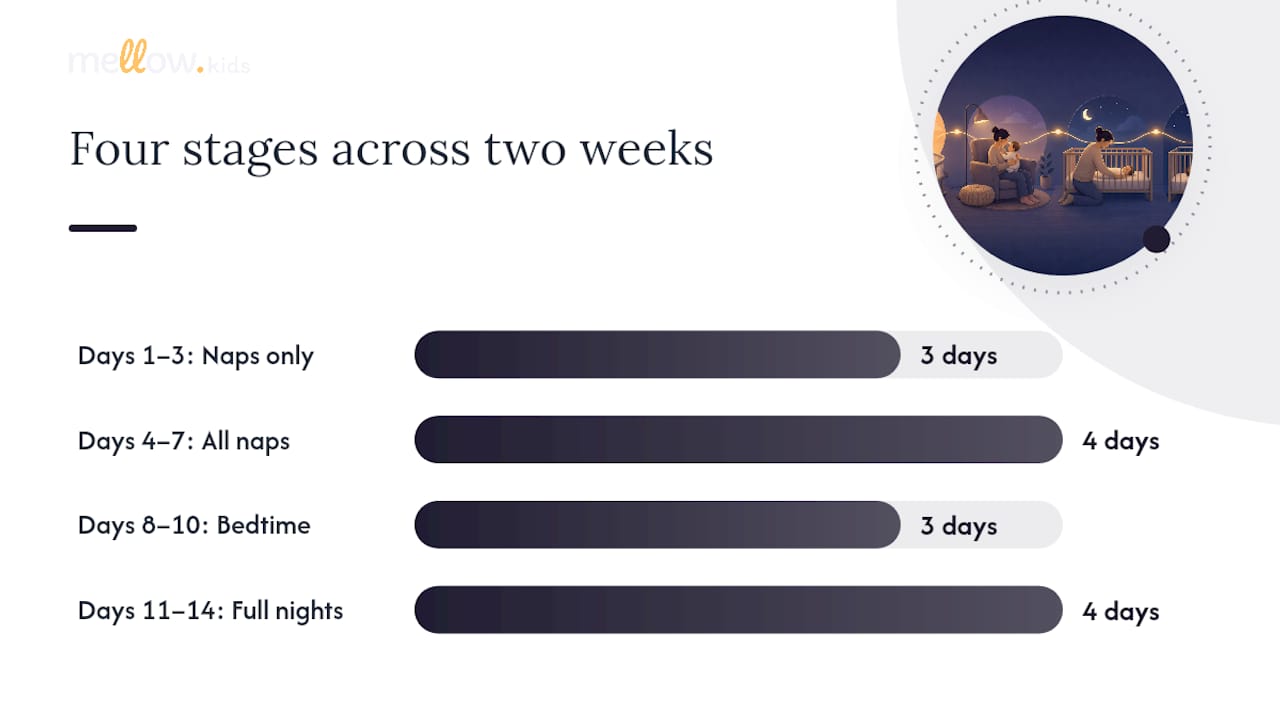
Before day one, run through this setup checklist: firm mattress with fitted sheet, sleep sack ready if swaddling has stopped, monitor positioned and tested, and every pillow, blanket, and stuffed toy removed from the crib itself.
A short, consistent phrase at bedtime gives your baby a verbal cue that pairs with the physical routine. Something as simple as "Time for sleep, I love you, goodnight" said in the same tone every night, right before you lay her down drowsy but awake, works well because it's predictable, not because of the specific words.
Pro Tip: If your baby regresses back to fussier nights midweek, don't restart the whole plan. Hold at your current stage for two or three extra days before moving forward again.
Pro Tip: Skip the urge to add a nightlight, white noise machine, and a new lovey all in the same week you introduce the crib. Layer one new element at a time so you can tell what's actually helping.
When Should You Call the Pediatrician?
Most crib-transition bumps resolve within two to three weeks with patience and consistency. A few signs mean it's time to call your pediatrician rather than wait it out:
- Difficulty breathing, unusual pauses in breathing, or persistent noisy breathing during sleep.
- Feeding problems or stalled weight gain that show up alongside the sleep change.
- Sleep disruption that persists well beyond two to three weeks with no improvement.
- Fever or illness symptoms appearing at the same time as a major sleep disturbance.
These red flags reflect broader pediatric safe-sleep guidance summarized by HealthyChildren.org and the AAP, and they're worth a call regardless of how the crib transition itself is going. When in doubt, individualized advice from your baby's own pediatrician beats guesswork every time.
A Note From Mellow
We built Mellow around one idea: parents do better with a plan than with panic at 2 a.m. The staged, naps-first approach in this guide reflects what we hear works, over and over, from families navigating this exact transition.
Every recommendation here lines up with AAP and CPSC safe-sleep guidance. If you want help tracking naps, wake windows, and progress as you move through the two-week plan, our tools are built for exactly that.
How Mellow Kids Supports Your Crib Transition
There are other ways to piece together a transition plan: a stack of parenting books, a pediatrician's handout, scattered advice from family. All of it can work, but it usually means cross-referencing several sources at 11 p.m. while your baby fusses in the next room.
Mellow gives you one place to track naps, log what's working, and get age-specific guidance without digging through five open browser tabs. Our mini-guides walk through exactly this kind of transition step by step, and the sleep challenges hub is there if resistance runs longer than expected and you want a next move instead of a guess. Start a free trial and pull up the printable checklist tonight, before your baby's next nap.
Frequently Asked Questions
What is the best age to move baby to crib? Most babies transition between 3 and 6 months, but rolling over, pushing up, sitting unassisted, or outgrowing the bassinet's weight or length limit should move that timeline up regardless of exact age.
Can I keep the crib in my room instead of moving to a nursery? Yes. The AAP recommends room-sharing without bed-sharing for at least the first 6 months, and a full-size crib fits that guidance just as well as a bassinet.
How long does the bassinet to crib transition usually take? Most families see a smoother routine within a few days to two weeks using a naps-first approach, with occasional rough nights along the way.
What should never be in the crib with my baby? No bumpers, pillows, loose blankets, or stuffed toys until your baby turns 12 months old. Use only a firm mattress with a tightly fitted sheet, and a wearable sleep sack instead of loose bedding.
When should I call the pediatrician about crib transition struggles? Reach out if you notice breathing difficulty, feeding or weight-gain issues, sleep disruption lasting beyond two to three weeks, or fever alongside a major sleep disturbance.
This article is general information, not a substitute for advice from a qualified doctor. Consult a qualified healthcare professional about your own circumstances before acting on anything here.
Sources
- American Academy of Pediatrics recommendations (safe sleep summary)
- CPSC Safe Sleep resource
- PMC article on infant sleep and safety
- Making the Move: When and How to Transition Your Baby to a Crib
Check product manuals and CPSC recall notices before using any secondhand crib or bassinet, especially older models passed between family members.