
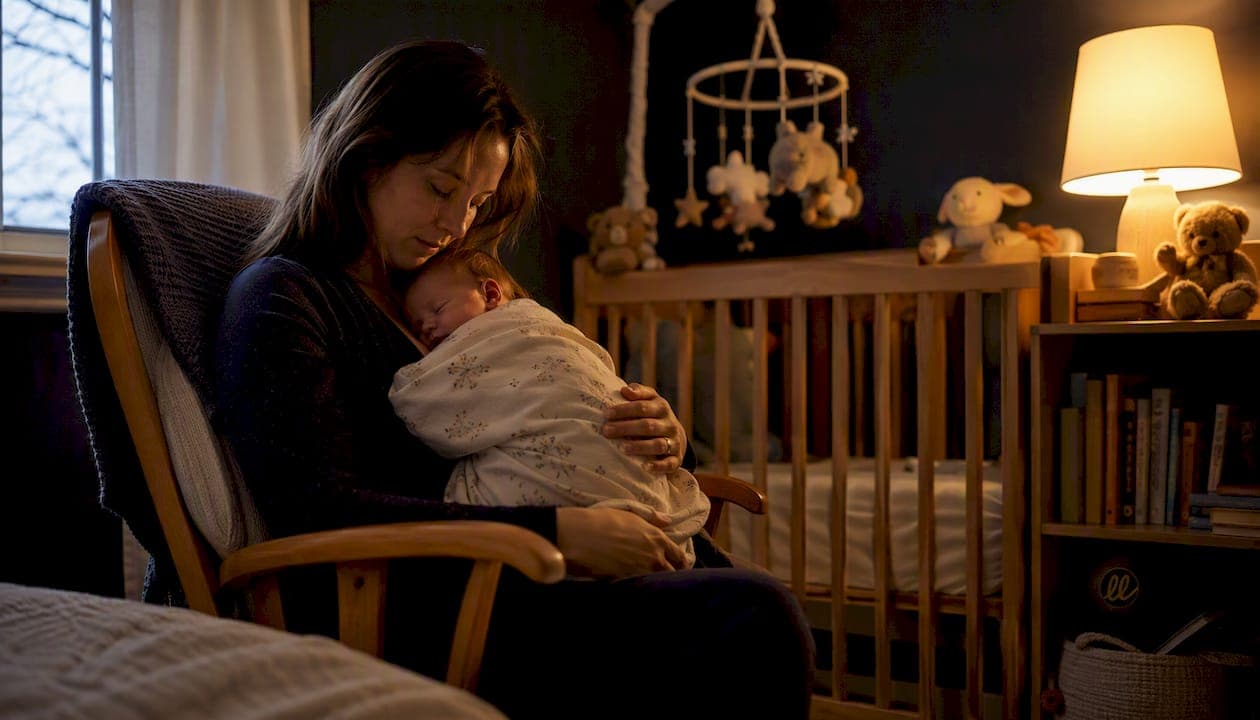
Newborns typically sleep 14–17 hours in every 24-hour period, and that sleep arrives in short, unpredictable bursts of 2–4 hours rather than long, consolidated stretches. The American Academy of Pediatrics (AAP) frames this as biologically normal, not a problem to fix. Responsive care, meaning feeding and comforting your baby when they signal need, is the single most important thing you can do in these early weeks. A rigid clock-based schedule will frustrate you both. What actually works is learning to read your baby's cues and gently nudging their environment toward day/night awareness.
Pro Tip: Tonight, keep all nighttime feeds and diaper changes as dim and quiet as possible. No talking, no bright lights, no eye contact. This one habit, started from day one, is the simplest thing you can do to help your baby begin associating darkness with sleep.
Table of Contents
- What does a newborn sleep schedule look like week by week?
- How does newborn sleep actually work biologically?
- How do feeding schedules affect night wakings and nap length?
- How do you start gentle day/night cues and a simple bedtime routine?
- Troubleshooting short naps, frequent wakings, and overtiredness
- What are the AAP safe sleep rules every parent must follow?
- When should you call the pediatrician about your baby's sleep?
- What does the research and expert consensus say about newborn sleep?
- Key Takeaways
- The part nobody tells you about newborn sleep
- Mellow can help you navigate these early weeks with confidence
- Useful sources and further reading
What does a newborn sleep schedule look like week by week?
Age-by-age sample schedules give you a realistic framework, not a rigid timetable. Think of these as starting points you adapt to your baby's cues, not rules to enforce.

Sample schedules from birth to 12 weeks
| Age | Total sleep/24 hrs | Nap count | Wake windows | Sample 24-hr rhythm |
|---|---|---|---|---|
| 0–2 weeks | Typically around 14–17 hours | — | 30–45 min | Feed, brief awake time, sleep; repeat around the clock |
| 2–4 weeks | Typically around 15–17 hours | 6–8 naps | 45 min | Feed, short play/hold, drowsy cues, sleep |
| 4–8 weeks | Typically around 14–17 hours | — | 40–50 min | 3–4 daytime naps, 2–3 nighttime wakings |
| 8–12 weeks | Typically around 14–17 hours | 4–5 naps | — | Longer morning nap emerging; night stretches lengthening |

Wake windows are the most practical tool in this table. A newborn wake window is the total time your baby can comfortably stay awake, including feeding and a diaper change, before fatigue sets in. Stretching it too long leads to overtiredness, which paradoxically makes settling harder.
Breastfed vs. formula-fed variations
Breastfed babies digest milk faster and typically wake every 2–3 hours to feed, so their nap schedule naturally fragments more. Formula-fed babies often go 3–4 hours between feeds, which can produce slightly longer individual sleep stretches. Neither pattern is better; both are normal. Premature infants generally need more total sleep and shorter wake windows than the table above suggests, so always follow your neonatologist's or pediatrician's specific guidance.
Adapting the sample schedule
- Watch for tired cues (yawning, eye rubbing, staring blankly, fussing) rather than watching the clock.
- If your baby falls asleep during a feed and stays asleep, let them sleep. Waking a sleeping newborn to follow a schedule rarely helps.
- If a nap runs long in the first 4 weeks, it is usually fine to let it continue; after 8 weeks, you can gently cap daytime naps at about 2 hours to protect nighttime sleep.
- Flexibility is the rule. A "schedule" in the newborn period is really a loose rhythm that shifts week to week.
Pro Tip: Write down wake times for two or three days before trying to impose any structure. Patterns almost always emerge on their own, and seeing them on paper helps you work with your baby's biology instead of against it.
How does newborn sleep actually work biologically?
Understanding the mechanics behind your baby's sleep makes the chaos feel far less random. Newborn sleep architecture is genuinely different from adult sleep, and those differences explain almost every frustrating pattern you are experiencing.
Sleep cycles and why babies wake so easily
Adults cycle through sleep stages roughly every 90 minutes, spending most of that time in deep, quiet sleep. Newborns cycle every 40–50 minutes, and a much larger proportion of that cycle is active sleep, the infant equivalent of REM. During active sleep, babies move, twitch, make sounds, and flutter their eyelids. Many parents mistake this light, active phase for waking and rush in to soothe, when the baby would have settled back on their own within a minute or two.
At the transition between cycles, newborns briefly surface toward wakefulness. Without the ability to link cycles independently, they signal for help. This is not a sleep problem; it is a developmental stage. The skill of linking cycles independently develops gradually over the first several months, as the nervous system matures.
The circadian rhythm timeline
Newborns are born without a functioning circadian rhythm. The hormonal signals that regulate sleep and wakefulness, primarily melatonin and cortisol, do not follow a predictable 24-hour pattern at birth. Circadian rhythm maturation begins around 8–9 weeks, which is why many parents notice a shift around the two-month mark: nights start to feel slightly more organized, and one longer stretch often appears.
You can support this process. Bright light exposure during the day and dim, quiet interactions at night help calibrate the emerging rhythm. You are not forcing sleep; you are giving the developing clock the environmental cues it needs to set itself.
Pro Tip: Take your baby outside for natural light in the morning, even for 10–15 minutes. Morning light is the strongest circadian signal available, and it costs nothing.
How do feeding schedules affect night wakings and nap length?
Hunger drives the vast majority of newborn wakings, full stop. Until your baby's stomach capacity grows and weight gain is established, there is no separating the newborn sleep and feeding schedule. They are the same thing.
Breastfed newborns typically feed every 2–3 hours; formula-fed newborns typically every 3–4 hours. Those intervals apply around the clock in the first weeks. A breastfed baby waking six to eight times in 24 hours is not a sleep problem; it is a feeding schedule working exactly as it should.
When longer stretches may begin
Most infants do not achieve a 6–8 hour stretch until at least 3 months, or until they reach approximately 12–13 pounds. Weight is the more reliable marker than age. Once your pediatrician confirms consistent weight gain, you can begin allowing slightly longer night stretches rather than waking your baby on a strict schedule. Before that milestone, most clinicians recommend waking a newborn who has not fed in 4 hours during the day, or following your provider's specific guidance if your baby was born small or early.
A practical milestone to watch for is consistent weight gain. Once established, caregivers can consider allowing slightly longer night stretches when appropriate and advised by a pediatrician. Until then, follow hunger cues without hesitation.
How do you start gentle day/night cues and a simple bedtime routine?
You can begin gentle rhythm-shaping from day one. This is not sleep training. Sleep training involves teaching a baby to fall asleep independently, usually through graduated methods, and professional sleep consultants advise waiting until 4–6 months before attempting it. Gentle rhythm-shaping simply means using environmental and behavioral cues to help your baby's developing circadian clock learn which hours are for sleep and which are for activity.
Step-by-step rhythm-shaping actions
- Open the day with light. When your baby wakes for their first morning feed, open the curtains or step outside. Bright light signals "daytime" to the developing circadian system.
- Keep daytime interactions lively. Talk, sing, make eye contact during daytime feeds and awake windows. Normal household noise is fine and actually helpful.
- Dim everything at night. Use a low-wattage nightlight or a dim lamp for nighttime feeds. Avoid overhead lights entirely.
- Keep nighttime interactions quiet and brief. Feed, change, settle. No talking, no play, no stimulation. Calm, low-stimulation nighttime interactions help newborns learn that night is for sleeping.
- Introduce a short pre-sleep sequence. Even a two-step routine, such as a brief bath followed by a feed in a dim room, can become a reliable sleep cue by 6–8 weeks.
- Practice "drowsy but awake" once a day. Starting around 4 weeks, try placing your baby down drowsy but not fully asleep once per day. It will not always work, and that is fine. The goal is gradual exposure, not immediate success.
The 3-3-3 rule explained
Some parents ask about the "3-3-3 rule," which refers to a loose framework of three hours of awake time, three naps, and a 3:00 PM last nap cutoff. In the strict newborn period (0–8 weeks), this rule does not apply; wake windows are far shorter than three hours. By 10–12 weeks, a loose version of it may begin to fit naturally as the schedule consolidates. Treat it as a rough guide for the 3-month mark, not a newborn prescription.
Pro Tip: A consistent baby bedtime routine does not need to be long. Three to five minutes of the same sequence, done in the same order, every night, is more powerful than a 30-minute elaborate ritual.
Troubleshooting short naps, frequent wakings, and overtiredness
Most newborn sleep problems trace back to one of three causes: wake windows that are too long, wake windows that are too short, or environmental factors that make settling harder. Here is how to work through the most common ones.
Common problems and what to try
- Short naps (under 20 minutes): Often a sign of overtiredness or a too-stimulating sleep environment. Try capping wake windows at the lower end of the range for your baby's age and adding white noise.
- Catnapping (30–45 minute naps that end at one sleep cycle): Normal in early weeks. Try placing your hand on your baby's chest as they stir at the 30-minute mark to help them resettle through the cycle transition. For more strategies, newborn sleep resistance is a common pattern with specific fixes worth reading about.
- Frequent night wakings beyond feeding needs: Check that the sleep environment is consistent: same temperature (68–72°F is the commonly cited comfort range), white noise running all night, and no sudden light changes.
- Overtiredness: A baby who has been awake too long becomes harder to settle, not easier. If your baby is screaming and arching, the wake window has already passed. Shorten it by 10–15 minutes the next cycle.
- Day/night confusion: Happens most in the first 2 weeks. Maximize light and activity during the day, and keep all nighttime interactions as boring as possible.
When to be patient vs. when to act
Most of these issues resolve on their own between 6 and 12 weeks as the circadian rhythm matures. If you have tried environmental adjustments for several days and nothing is shifting, that is a reasonable time to call your pediatrician, not because something is wrong, but because a second set of eyes on the pattern can be genuinely helpful.
What are the AAP safe sleep rules every parent must follow?
Safe sleep is not optional or adjustable. The AAP's guidance exists because it reduces the risk of sudden infant death syndrome (SIDS) and sleep-related infant deaths. AAP safe-sleep recommendations emphasize back positioning, a firm sleep surface, and avoiding soft bedding; room-sharing reduces SIDS risk.
The safe sleep checklist
- Back to sleep, every time. Place your baby on their back for every sleep, including naps.
- Firm, flat surface. A safety-approved crib, bassinet, or play yard with a firm mattress and fitted sheet only.
- Room-sharing, not bed-sharing. Keep your baby's sleep surface in your room for at least the first 6 months. Sharing a bed on a soft adult mattress significantly increases SIDS risk.
- No loose items in the sleep space. No pillows, blankets, bumpers, positioners, or stuffed animals.
- No sleep on soft surfaces. Sofas, armchairs, and adult beds are not safe sleep surfaces, even for a short nap.
- Avoid overheating. Dress your baby in one layer more than you would wear, and keep the room between 68–72°F.
- Pacifier at sleep time (after breastfeeding is established) is associated with reduced SIDS risk, per AAP guidance.
For a deeper look at these guidelines and how they apply to your specific setup, Mellow's dedicated safe sleep for newborns resource walks through each rule in plain language.
One-sentence reminder: always consult your pediatrician for medical exceptions, such as reflux positioning or premature birth, before adjusting any safe-sleep practice.
When should you call the pediatrician about your baby's sleep?
Most newborn sleep variation is normal. But some signs during sleep or around sleep time warrant a prompt call to your pediatrician or a trip to urgent care.
Red flags that need medical attention
- Poor weight gain or weight loss after the first two weeks. Inadequate feeding is the most common medical reason for sleep disruption.
- Difficulty breathing during sleep: noisy breathing, pauses longer than 10 seconds, or visible effort to breathe.
- High-pitched, inconsolable crying that is different from your baby's usual hunger or discomfort cry.
- Lethargy or difficulty waking for feeds after the first two weeks. A newborn who is hard to rouse is a medical concern.
- Persistent temperature above 100.4°F (38°C) in a baby under 3 months. This is an emergency room situation, not a wait-and-see one.
- Yellowing skin or eyes (jaundice) that is worsening rather than improving after day 5.
When you call, have ready: your baby's age in days or weeks, current weight if you know it, feeding frequency and amount, and a description of what you observed. The more specific you can be, the faster your provider can help.
Normal variations, like a baby who sleeps 20 hours one day and 14 the next, or one who has a rough night after a growth spurt, do not require a call. Trust your instincts. If something feels genuinely wrong, it is always appropriate to reach out.
What does the research and expert consensus say about newborn sleep?
The major pediatric and sleep-science authorities align closely on the core principles. Here is where the evidence stands.
What the evidence shows
Responsive care, responding to hunger and sleep cues, supports secure attachment and is recommended over rigid schedules in the newborn period. Responding to your baby's cues does not spoil them; it builds the neurological foundation for emotional security and, eventually, better independent sleep. The primary goal in newborn weeks is building a secure, responsive relationship. Sleep timing is secondary to consistent responsiveness.
The American Academy of Sleep Medicine (AASM) and the AAP both recognize 14–17 hours per 24 hours as the typical sleep range for newborns, with some healthy infants sleeping up to 18–19 hours. The Children's Hospital of Philadelphia (CHOP) adds that circadian rhythm maturation begins around 8–9 weeks, which is when parents can reasonably expect the first signs of a more predictable pattern. Nemours KidsHealth notes that the 6–8 hour "sleeping through the night" milestone typically arrives at or after 3 months, or around 12–13 pounds, and that many infants reach it considerably later.
Myth vs. fact
| Common belief | What the evidence actually shows |
|---|---|
| Keeping baby awake longer during the day will make them sleep longer at night | Overtiredness increases cortisol, making settling harder; shorter, age-appropriate wake windows produce better night sleep |
| Responding immediately to every cry will create bad sleep habits | Responsive caregiving supports secure attachment and does not prevent independent sleep from developing |
| Sleep training can start in the first weeks | Professional consensus places the earliest appropriate window at 4–6 months; before that, gentle rhythm-shaping is the evidence-based approach |
| A "good" baby sleeps through the night early | Frequent night waking is biologically normal and protective in the newborn period; early long stretches are not a developmental advantage |
The long-term benefits of establishing healthy sleep routines from early stages are well-documented, but the research consistently points to gentle, cue-based approaches rather than rigid scheduling as the path that serves both babies and parents best in the first three months.
Key Takeaways
Newborns sleep 14–17 hours per 24 hours in short bursts, and responsive, cue-based care in the first 12 weeks builds the foundation for healthier sleep patterns later.
| Point | Details |
|---|---|
| Total sleep range | Newborns need 14–17 hours per 24 hours, fragmented into 2–4 hour bursts; some sleep up to 18–19 hours. |
| Wake windows matter most | Follow age-appropriate wake windows (30–90 minutes depending on week) rather than clock-based schedules to prevent overtiredness. |
| Feeding drives night wakings | Breastfed babies feed every 2–3 hours; formula-fed every 3–4 hours; longer stretches typically emerge at 3 months or ~12–13 pounds. |
| Safe sleep is non-negotiable | Back to sleep, firm surface, room-sharing for at least 6 months, and no loose items in the sleep space reduce SIDS risk. |
| Mellow for personalized support | Mellow's app provides age-specific schedules, feeding and sleep tracking, and evidence-based guidance from the newborn weeks through age 2. |
The part nobody tells you about newborn sleep
There is a version of newborn sleep advice that sounds reassuring on paper but quietly sets parents up for unnecessary guilt. It goes like this: follow the schedule, watch the wake windows, do the routine, and things will improve. And they will. But the advice skips over the part where you are doing all of that at 3:00 AM on four hours of broken sleep, wondering if you are doing it wrong because your baby still woke up three times.
Here is what I want you to hold onto: the goal in these first weeks is not a perfect schedule. It is a relationship. Every time you respond to your baby's hunger, every time you pick them up when they cry, you are not creating a bad habit. You are building the neurological architecture that makes independent sleep possible later. The research on responsive caregiving is unambiguous on this point.
The parents who struggle most in the newborn period are often the ones trying hardest to follow a rigid plan. Flexibility is not failure. A baby who is fed, held, and responded to consistently will, in almost every case, find their rhythm. Your job right now is to be present and responsive, not to engineer perfect sleep. The schedule will come. The connection you build in these weeks is what makes everything else possible.
Setbacks are part of this. Growth spurts, developmental leaps, and illness will disrupt whatever rhythm you have built, sometimes repeatedly. That is not regression; it is normal development. Start again gently, stay consistent with your cues, and trust that your baby's biology is working in the right direction.
Mellow can help you navigate these early weeks with confidence
Knowing the principles is one thing. Applying them at 2:00 AM with a crying baby is another. Mellow is built specifically for this gap: the space between knowing what you should do and having the support to actually do it, night after night, week after week.

The Mellow app gives you personalized, age-specific sleep and feeding schedules updated as your baby grows, so you are never working from a generic chart that stopped fitting two weeks ago. You can log feeds, naps, and diaper changes in seconds, and the app surfaces patterns you would never spot on your own in the fog of early parenthood. When sleep challenges come up, like short naps, frequent night wakings, or a baby who suddenly resists settling, Mellow's sleep challenge guidance walks you through evidence-based strategies matched to your baby's exact age and stage.
This is not reactive advice after the fact. It is proactive support that prepares you for what is coming before it arrives. Start with the Mellow Kids app and see how much easier the next few weeks can feel when you have the right guidance at the right time.
This article provides general information for educational purposes and is not a substitute for professional medical advice. Always consult your pediatrician for guidance specific to your baby's health and development.
Useful sources and further reading
These are the primary sources behind this article. Each one is worth bookmarking for the weeks ahead.
- Sleep and Your Newborn | Nemours KidsHealth — A clear, parent-friendly summary of typical newborn sleep totals, feeding intervals, and what to expect in the first months. A reliable first stop for new parents.
- Newborn Sleep Patterns | Children's Hospital of Philadelphia — CHOP's clinical overview of sleep architecture, circadian rhythm development, and practical guidance on day/night differentiation. Particularly useful for understanding the 8–9 week shift.
- Helping Baby Sleep Through the Night | Mayo Clinic — Mayo Clinic's practical guidance on nighttime routines, feeding, and environmental strategies. Well-sourced and easy to read.
- Newborn Sleep Schedule | Sleep Foundation — A thorough breakdown of safe sleep recommendations alongside schedule guidance; includes AAP safe-sleep principles in accessible language.
- Understanding Baby Sleep 1–3 Months | Parents — Covers the "drowsy but awake" skill and what realistic progress looks like in the first trimester of life.