

Most healthy 6-month-olds who are gaining weight well and eating enough during the day are ready for gentle night weaning, but the timeline looks different for breastfed and formula-fed babies. Breastfed babies often need one or two night feeds for a few more months because breast milk digests faster than formula. Before you change anything, a quick pediatrician check on growth and daytime intake will tell you whether your baby is truly ready.
TL;DR:
- Breastfed babies typically need one or two night feeds until closer to 12 months due to faster digestion of breast milk.
- Gradual reduction of feeds, shortening each session by a few minutes or half an ounce, helps preserve milk supply and comfort.
- Proper daytime calorie intake of 24 to 32 ounces of formula or milk and consistent routines are essential for successful night weaning.
- Wait for stable growth, no recent illness or developmental leaps, and some sleep stretches before initiating night weaning.
- Expect setbacks during teething or growth spurts, and consult a pediatrician if weight gain drops or illness occurs during the process.
Table of Contents
- Is Your 6-Month-Old Ready to Reduce Night Feeds?
- Breastfed vs. Formula-Fed Babies: Why the Timeline Differs
- How to Night Wean Your 6-Month-Old, Night by Night
- Daytime Feeding Strategies That Reduce Night Hunger
- When to Pause and Call Your Pediatrician
- What to Expect: Setbacks Are Normal, Not a Failure
- A Clinician-Informed Approach to Night Weaning
- Get Guided Support for Night Weaning
- Sources
- FAQ
Is Your 6-Month-Old Ready to Reduce Night Feeds?
Readiness isn't about age alone. It's about a combination of growth, daytime habits, and overnight patterns lining up together.
Start with the basics your pediatrician already tracks. If your baby's weight has climbed steadily along their growth curve at recent checkups, that's your green light on the medical side. A baby who's dropped percentiles or plateaued needs a conversation with their doctor first, not a night-weaning plan.
Beyond the growth chart, look for these everyday signs:
- Your baby is taking in roughly 24 to 32 ounces of formula or nursing 6 to 8 times over 24 hours, with solids starting to add real calories.
- They're already stringing together 6 to 8 hour stretches of sleep at least some nights, which UCSF Benioff Children's Hospitals notes is within reach for most babies by this age.
- When they wake, they sometimes resettle briefly without needing to eat right away.
- There's no recent illness, new vaccine, big move, or major developmental leap (rolling, sitting, teething) happening this week.
That last point matters more than parents expect. Trying to change feeding habits during a growth spurt or a cold almost always backfires, so it's worth waiting a week or two for calmer ground before you start.
Breastfed vs. Formula-Fed Babies: Why the Timeline Differs
Formula-fed babies often can drop night feeds earlier because formula sits in the stomach longer, keeping them fuller through the night. Breastfed babies frequently need those night feeds to continue closer to 12 months, since breast milk moves through their system faster and the physiology of nighttime nursing play into both hunger and comfort.
That difference should shape your tactics, not just your patience level.
- Breastfed babies: Shorten the length of each night session gradually rather than cutting a feed outright. Two or three minutes off every few nights preserves supply while nudging your baby toward less reliance on the feed.
- Formula-fed babies: Trim the bottle by half an ounce to a full ounce every two or three nights instead of shortening feeding time.
- Both: A partner can offer comfort (rocking, patting, a soft word) in place of a feed once you're a few nights into the plan.
If you're breastfeeding, protecting your milk supply and your feeding relationship matters just as much as the sleep goal. La Leche League USA points out that night weaning is a family decision, not an obligation, and some parents choose to keep one night feed well past 6 months without any downside.
How to Night Wean Your 6-Month-Old, Night by Night
Gradual works better than abrupt for nearly every baby. Healthline's guidance on night weaning backs this up: small, measurable nightly changes cause far less stress for baby and parent than pulling a feed cold.
Three rules hold the whole plan together. Change one thing at a time. Keep daytime calories generous so nighttime hunger doesn't spike. And watch your baby's weight and mood along the way, not just their sleep log.
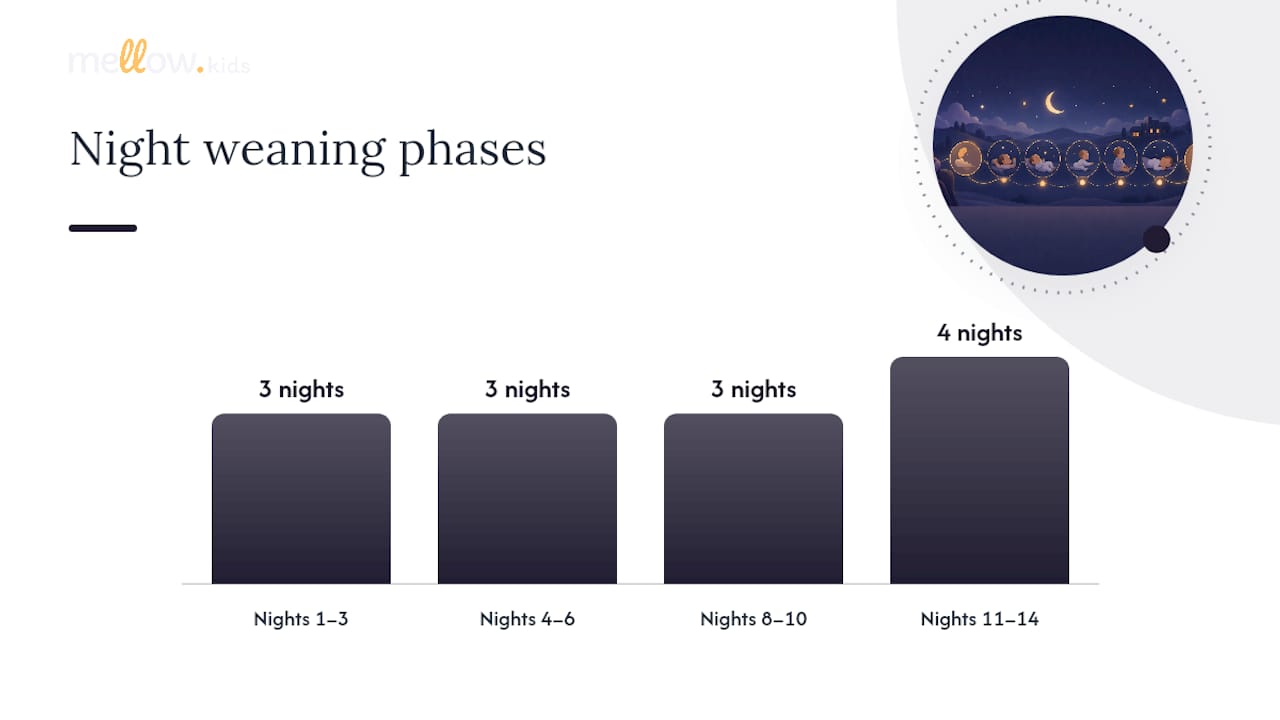
Here's a sample 10 to 14 night approach:
- Nights 1 to 3: Shorten each night nursing session by 2 to 5 minutes, or reduce each bottle by 0.5 to 1 ounce. Keep the feed timing the same.
- Nights 4 to 6: Delay the feed by 15 minutes past the usual waking time. Offer comfort first, milk second, if your baby is still upset.
- Day 7 checkpoint: Weigh how it's going. If your baby is settling faster and daytime feeding is holding steady, continue. If they seem hungrier during the day or fussier overall, hold at the current step for a few more nights before pushing further.
- Nights 8 to 10: Delay by another 15 to 30 minutes and drop another small increment of volume or nursing time.
- Nights 11 to 14: Continue trimming until the feed is brief enough to phase out entirely, or your baby is sleeping through that wake window without needing it.
- Day 14 checkpoint: Reassess growth, mood, and daytime intake. Most babies need more than two weeks to fully drop a feed, and that's completely normal.
A few gentler variations work well depending on your baby's temperament. A dream feed (a top-off feed you give while they're still mostly asleep, before your own bedtime) can sometimes replace a middle-of-the-night wake-up entirely. Offering a partial feed followed by patting or shushing lets your baby practice falling back asleep without full reliance on food. For formula-fed babies only, and only with pediatrician approval, some parents substitute a small amount of water for a middle feed as an interim step. This isn't appropriate for breastfed babies and shouldn't be attempted without medical guidance either way.
Pro Tip: Assign your partner the overnight comfort shifts for at least the first week. A baby who smells milk on the parent who usually feeds them will hold out longer for that feed, but they'll settle for comfort alone much faster with someone else.
For a longer, printable version of this timeline, Mellow's step-by-step night weaning schedule breaks the process down by age and feeding method.
Daytime Feeding Strategies That Reduce Night Hunger
Night weaning succeeds or fails mostly on what happens during the day. A baby who isn't getting enough calories before bedtime will keep waking hungry no matter how gently you approach the nights.
Aim for roughly 24 to 32 ounces of formula or its breastfeeding equivalent across the day, with solids contributing more as your baby's appetite grows. These are general ranges, not a strict target, and your pediatrician can tell you where your baby should land.
A few tactics help "tank up" your baby before the overnight stretch:
- Offer a full feed within 30 to 45 minutes of bedtime, even if your baby seems only mildly interested.
- Add a nap-time nursing or bottle session if your baby has been skipping it.
- Check wet diaper counts (six or more per day is a reasonable hydration marker) as a simple, practical check that daytime intake is adequate.
- Keep a consistent bedtime routine and nap schedule, since overtired babies often wake more at night regardless of feeding.
If your baby is already on a rhythm with clear daytime windows, tying night weaning to that same schedule tends to go more smoothly. A 6-month sleep schedule with 2 to 3 hour daytime windows can make it easier to spot where an extra feed or nap might help.
When to Pause and Call Your Pediatrician
Stop the plan and check in with your pediatrician if you notice a drop in weight gain or a shift downward on the growth chart. The same goes for signs of dehydration, persistent vomiting, or any illness that shows up mid-plan.
Watch for behavioral red flags too, especially unusual daytime irritability or lethargy that seems tied to the reduced night feeding rather than a passing mood.
Before your visit, gather a short feeding and sleep log: your baby's last two or three weigh-ins, a few days of feeding times and amounts, daily diaper counts, and a rough sleep log. That gives your pediatrician real data instead of impressions, and it usually speeds up the conversation considerably.

What to Expect: Setbacks Are Normal, Not a Failure
Most babies reduce night feeds gradually over several weeks, and a full stretch with zero night feeds can take months to become consistent. That pace is normal, not a sign you're doing something wrong.
Teething, a cold, travel, or a developmental leap will almost certainly cause a temporary return to night waking or feeding. This is common enough that it barely counts as a setback. Experts who work with families through these regressions note that the smart move is short-term flexibility, not scrapping the whole plan.
A reasonable rule of thumb: wait about a week after illness resolves or a big milestone settles before restarting your gradual steps. Pushing through while your baby is genuinely unwell or overwhelmed usually extends the struggle rather than shortening it.
Split the nighttime load with a partner when you can, and don't treat a rough week as proof the approach failed. Sleep changes rarely move in a straight line, for babies or the parents managing them.
A Clinician-Informed Approach to Night Weaning
Night weaning isn't a script every baby follows the same way. Some six-month-olds settle into it within a week; others take two or three attempts spread across a month. What separates families who feel calm through the process from families who feel stuck usually comes down to timing the plan to the baby's actual readiness signals, not a calendar date.
That's the gap Mellow works to close. Rather than reacting after sleep falls apart, Mellow's guidance anticipates the changes coming at each stage, so parents aren't guessing whether a rough night means "keep going" or "stop and check with the pediatrician."
Personalized plans and consultations are options that can help families depending on their situation, whether straightforward or more complex.
— Mauricio Vargas
Get Guided Support for Night Weaning
A generic sleep app can hand you a checklist. What most parents actually need at 3 a.m. is a plan built around their specific baby's feeding history, growth pattern, and temperament, and someone to adjust it when a setback hits. Mellow's personalized sleep support does exactly that, with options ranging from a standalone Personalized Plan to a Plan + Consultation for more complicated feeding situations.

Booking a plan gets you a specific night-weaning schedule tailored to whether you're breastfeeding, bottle feeding, or combining both, plus direct troubleshooting when teething or a growth spurt throws things off. If you'd rather talk it through first, the 45-minute consultation is a lower-commitment way to get expert input before deciding on a full plan. Parents further along, in the 8 to 10 month or 11 to 14 month range, can find age-specific guidance on those same plan pages. Start with the Personalized Plan options to get a schedule built around your baby's actual feeding pattern, not a generic timeline. And if you're also focused on your own recovery and energy through this stretch, postpartum nourishment support can make the sleepless nights easier to manage.
Sources
- PMC article (night feeding physiology / infant feeding)
- Your baby at 6 months | UCSF Benioff Children's Hospitals
- Should I night wean? | La Leche League USA
- Night Weaning: How to Gently End Middle of the Night Feeds | Healthline
FAQ
How Do I Get My 6-Month-Old to Stop Eating at Night?
Reduce feeds gradually, either by shortening nursing time or trimming bottle volume by half an ounce to a full ounce every few nights, while keeping daytime calories steady. Most babies respond better to this incremental approach than to cutting a feed all at once.
My 6-Month-Old Is Eating More at Night. Is This Normal?
Yes, especially around growth spurts, teething, or a new developmental skill like sitting or crawling. Increased night feeding at this age is usually temporary and tends to resolve once the growth spurt or milestone passes.
Can a 6-Month-Old Go All Night Without Eating?
Many can, since most babies are physically capable of 6 to 8 hour stretches by this age, but not all are there yet, especially breastfed babies who may need a feed for a few more months. Whether your baby specifically can depends on their weight gain, daytime intake, and overall health.
How Many Night Feeds Should a 6-Month-Old Have?
There's no single number that fits every baby. Formula-fed babies often manage with zero to one night feed by this age, while breastfed babies commonly still have one or two, and either pattern can be entirely healthy depending on growth and daytime intake.
Is Night Weaning at 6 Months Different for Breastfed Babies?
Yes. Breast milk digests faster than formula, so breastfed babies often need one or two night feeds to continue for a few more months, and the approach usually focuses on shortening session length rather than eliminating feeds outright.