

Most babies sit without support by 9 months, but a range of a few weeks in either direction is still typical, so one missed date rarely means something is wrong. The CDC lists "sits without support" as an expected 9 month milestone, and if your baby isn't there yet, the right move is simple: mention it at the next pediatrician visit, or call sooner if you notice other concerns.
What you can check right now:
- Watch her positioning. Can she prop herself briefly on her hands when placed in a sitting position, even if she tips over after a few seconds?
- Notice her tummy time tolerance. Babies who fuss and avoid floor time often lag on sitting simply because they've had fewer reps, not because anything is wrong.
Pro Tip: Sit your baby on the floor, place a favorite toy just out of reach to one side, and watch whether she rotates her trunk to grab it. That twisting motion is one of the building blocks of independent sitting, and pediatric physical therapists use it as an informal check of trunk control.
Key Takeaways
Most babies who aren't sitting independently at 9 months catch up within weeks through normal variation, extra floor practice, or a brief pediatric physical therapy referral.
| Point | Details |
|---|---|
| Timeline is a range, not a deadline | Independent sitting typically lands between 8 and 9 months, with some healthy babies reaching it by 12 months. |
| Prematurity shifts the clock | Use corrected age, not birth date, when judging a preterm baby's sitting progress. |
| Red flags need a same week call | Lost skills, very stiff or floppy limbs, and refusal to bear weight all warrant prompt evaluation. |
| Practice beats propping | Toys placed just out of reach and supported floor sitting build core strength better than baby seats. |
| Mellow supports tracking, not diagnosis | The 8 to 10 months hub helps log milestones and activities alongside your pediatrician's guidance. |
Table of Contents
- Not Sitting Unsupported at 9 Months: How Common Is It?
- Common Reasons a Baby Might Not Be Sitting Yet
- Signs That Mean You Should Call the Pediatrician Now
- Activities That Build Core Strength for Sitting
- What Happens at the Pediatrician Visit
- How Assessments and Early Therapy Actually Work
- Tracking Progress Between Now and Your Next Checkup
- Where Mellow Kids Fits Into Your Sitting Milestone Questions
- A Reassuring Word From Someone Who's Studied This Closely
- Get Practical Support While You Wait and Watch
- Sources
Not Sitting Unsupported at 9 Months: How Common Is It?
Sitting develops in stages, not overnight, and most babies pass through predictable checkpoints on the way there. Supported sitting (propping on hands, needing a hip or cushion for balance) typically shows up between 6 and 8 months. Independent, hands free sitting usually follows around 8 to 9 months. Some healthy babies don't sit steadily on their own until 10 to 12 months, and that's still within the range pediatricians consider normal variation.
MedlinePlus lists sitting for long periods among the expected gross motor skills clustered around 9 months, alongside crawling attempts and pulling to stand. UNICEF includes "can get into a sitting position and sit without support" in its own list of typical 9 month milestones, and recommends talking to a pediatrician if a baby needs assistance to stay upright.
Babies born early get a timeline adjustment. If your baby arrived 6 weeks premature, you'd measure her progress against 7.5 months corrected age rather than her actual birth date, not the number printed on her birth certificate. A baby born 8 weeks early who "isn't sitting at 9 months" may be squarely on track once you subtract those 2 months.
Quick reference for what's typical:
- 6 to 8 months: sits with support, hands on the floor or a caregiver's hands nearby
- 8 to 9 months: sits independently for stretches without tipping
- 10 to 12 months: still within normal range for some healthy babies, especially those born early or who spent less time on the floor
Common Reasons a Baby Might Not Be Sitting Yet
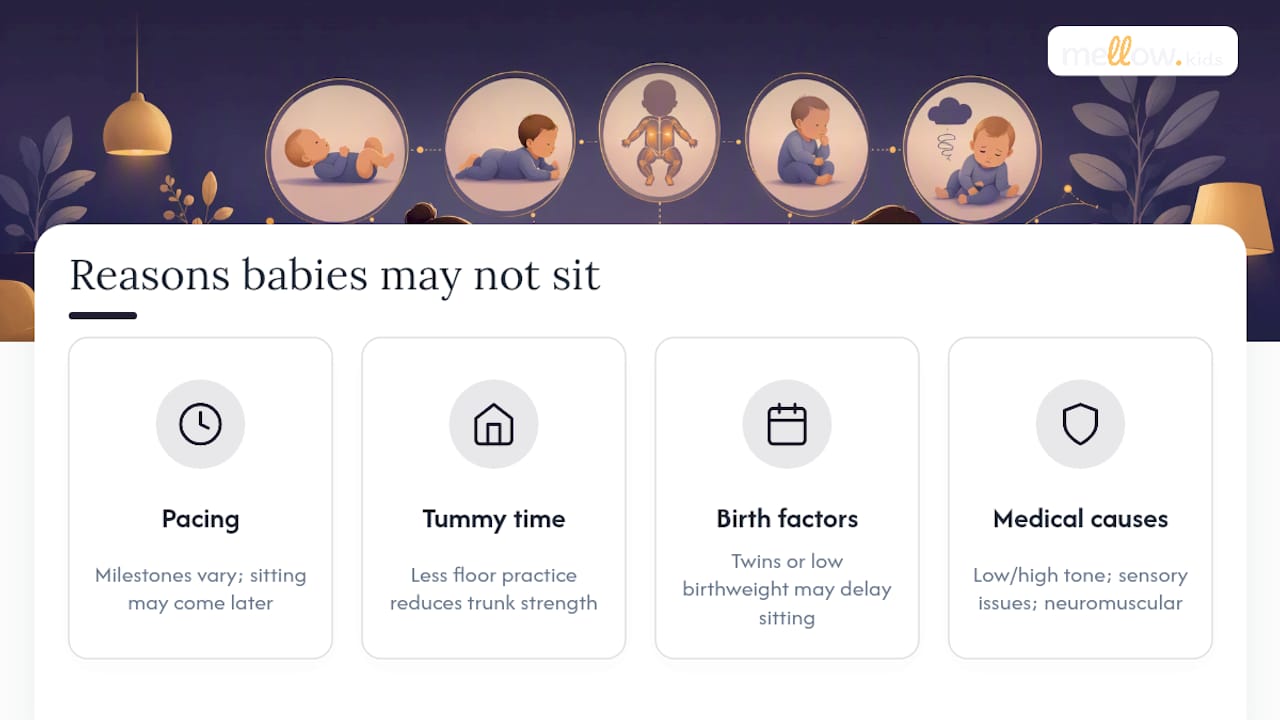
Developmental pacing varies more than most milestone charts suggest, and sitting is one of the skills where that variation shows up clearly. Some babies pour their energy into other pursuits first, like babbling or perfecting a rolling technique, and sitting simply comes later in their personal sequence. That's not a red flag on its own.
History matters too. Babies with limited tummy time, whether from reflux, a preference for being held, or simply less floor practice, often show delayed trunk strength because they've had fewer chances to build it. Prematurity plays a similar role, since corrected age shifts the whole timeline back. Twins and other multiples sometimes sit slightly later than singletons on average, often tied to lower birth weight or more time spent in shared positioning like double strollers or co-seated high chairs, though this varies widely by pair.
Medical contributors are less common but worth naming. Low muscle tone (hypotonia) makes it harder for a baby to hold herself upright against gravity. High muscle tone (hypertonia) can stiffen the trunk and limit the flexible movements sitting requires. Vision or hearing problems sometimes slow motor development indirectly, since babies use sensory feedback to orient and balance. Neuromuscular conditions, including cerebral palsy, are rarer causes that a pediatrician would screen for during an exam, not something a parent should try to diagnose from a symptom list.
Pro Tip: Pay attention to symmetry. A baby who reaches, rolls, and bears weight the same way on both sides of her body is showing a different pattern than one who favors one arm or leg, and that asymmetry is worth flagging even if the overall delay seems mild.
Signs That Mean You Should Call the Pediatrician Now
Most sitting delays resolve with time and practice, but a handful of signs deserve a same week call rather than a "we'll mention it at the next checkup" approach.
- Losing a skill she previously had, like rolling or reaching, rather than just being slow to gain a new one
- Very stiff or very floppy limbs that make positioning her feel unusually difficult
- Poor head control past 6 months, or a head that still lags noticeably when pulled to sit
- Not reaching for or bringing objects to her mouth
- Not responding to her name or to loud sounds
- Refusing to bear any weight on her legs when supported in a standing position
Each of these points to something beyond simple timing variation, since they touch coordination, sensory response, or strength in ways that ordinary developmental spread doesn't explain. CDC Act Early guidance recommends contacting a provider as soon as any of these concerns come up rather than waiting for a scheduled visit. When you call, be specific: "My 9 month old still can't sit unsupported, and she also isn't bearing weight on her legs" gives the office far more to act on than a general "I'm worried about her development."
Activities That Build Core Strength for Sitting
Building the strength and balance sitting requires doesn't take special equipment. It takes short, repeated sessions where your baby is motivated to move.
- Extend tummy time gradually. Aim for several short sessions daily, working toward 20 to 30 total minutes, using a mirror or a favorite toy to keep her engaged instead of forcing longer stretches than she can tolerate.
- Practice supported sitting on the floor. Sit behind her with your hands lightly on her hips, letting her do the work of staying upright while you provide just enough backup to prevent a hard fall.
- Place toys slightly out of reach. This encourages the trunk rotation and reaching that strengthen the muscles used in independent sitting, a technique pediatric physical therapists rely on because it's more effective than passive positioning.
- Try assisted pivoting games. With her seated, hold a toy to one side so she twists to grab it, then move it to the other side.
- Use supervised propping sparingly. A rolled towel or pillow can support early sitting practice, but only during active play sessions you're watching, never as an unattended setup.
A few safety notes matter here. Never leave your baby unattended while she's practicing sitting, even briefly. Avoid using baby seats, bouncers, or inclined loungers as a substitute for floor practice, since propped positioning doesn't build the same muscles as active balancing. Watch for signs of fatigue or frustration and stop before she's overtired, since a cranky baby won't engage with the activity anyway.
Pro Tip: Bubbles work surprisingly well for motivating trunk rotation. Blow them just out of reach to one side while your baby sits with light support, and watch her twist and reach to pop them. That combination of fun and functional movement often gets more engagement than a toy she's already bored with. For more age matched play ideas, Mellow's guide to 8 to 10 month activities covers a full range of options beyond sitting practice.

What Happens at the Pediatrician Visit
A pediatrician evaluating a sitting delay typically starts with questions, not tests. Expect a review of your baby's growth chart, a runthrough of other milestones she has or hasn't hit, and a brief hands on motor exam, checking muscle tone, reflexes, and how she moves when placed in different positions.
Depending on what the exam shows, the visit can lead to a few different paths:
- Watchful waiting with a follow up date, if your baby shows good progress in related skills and no red flags appear
- A referral to Early Intervention, a federally supported program for children birth to age 3 who show developmental delays, which can evaluate and start services often at no direct cost to families depending on the state
- A referral to pediatric physical therapy, where a therapist works directly on strength, balance, and functional sitting
- A referral to pediatric neurology, used less often and reserved for cases where the exam suggests a neuromuscular concern
Bring specifics to the appointment. A short video of your baby attempting to sit, notes on when she last gained a new skill, and any relevant history, like a NICU stay or prematurity, all help the pediatrician assess faster and more accurately than a verbal description alone. The AAP's clinical guidance on motor delays outlines this same stepwise approach: screen, observe, then refer as needed.
How Assessments and Early Therapy Actually Work
If your pediatrician refers your baby for further evaluation, several professionals might be involved depending on what the initial exam found. A developmental behavioral pediatrician can dig deeper into overall developmental patterns. A pediatric physical therapist focuses specifically on gross motor skills like sitting, crawling, and standing. Occupational or speech therapists sometimes join the team if fine motor or communication delays appear alongside the motor concern.
A typical assessment includes a hands on motor exam, an observation of how symmetrically your baby moves and reaches, a muscle tone check, and sometimes a standardized screening tool that compares her skills against expected ranges for her age.
Therapy itself is usually less clinical than parents expect. Sessions often look like structured play: building core strength through supported sitting practice, working on balance reactions (what happens when she's gently tipped off center), and encouraging midline control, meaning the ability to bring both hands to the center of her body. Early sessions typically aim for small, visible wins: a few extra seconds of unsupported sitting, or a cleaner pivot toward a toy, rather than dramatic overnight change.
Tracking Progress Between Now and Your Next Checkup
A loose weekly checklist keeps you from either panicking over normal ups and downs or missing a genuine plateau.
- Check head control. Is it steadier week to week when she's pulled gently to sit?
- Time her supported sitting. Note roughly how many seconds she holds herself upright with minimal help.
- Watch for pivoting and reaching. Is she twisting toward toys more often than last week?
- Confirm rolling both directions. Front to back and back to front, since asymmetry here is worth mentioning at your next visit.
A short weekly video clip, even just 15 seconds, captures subtle changes better than memory alone, and it gives your pediatrician something concrete to compare over time. If you see steady week over week gains, a routine follow up at the next well visit is usually fine. If two or three weeks pass with no change at all, or you notice a red flag from earlier in this guide, call sooner rather than waiting.
Pro Tip: Pair the video habit with something you already do daily, like right after her evening bath. A tracking routine that piggybacks on an existing habit is far more likely to actually happen than one that requires remembering a separate task.
Where Mellow Kids Fits Into Your Sitting Milestone Questions
Mellow's 8 to 10 months hub breaks the sitting stage down into age tailored activity guides and milestone context, so you're not guessing what "on track" looks like for your baby's exact age.
The app helps in a few concrete ways:
- Capture and store short video clips of sitting attempts to review privately or share at appointments
- Track milestones alongside sleep and feeding patterns, since fatigue and hunger both affect how much a baby engages with floor time
- Get age specific activity suggestions that update as your baby moves from the 8 to 10 month range into the next stage
A Reassuring Word From Someone Who's Studied This Closely
Parents come to this question already anxious, and the honest answer is that most of the babies behind this search end up sitting just fine within a few weeks. Variation in timing is normal, but that doesn't mean you should sit on your hands, either. Notice what you're seeing, write it down, film it if you can, and bring it to your pediatrician without waiting for a "perfect" moment to raise it.
Get Practical Support While You Wait and Watch
Waiting to see whether your baby hits a milestone can feel like the hardest part, especially when a search result list makes every scenario sound urgent. Mellow gives you something more useful than another symptom checklist: age specific activity plans, milestone tracking, and a place to log the small daily observations that actually matter at your next pediatrician visit. The 8 to 10 months guide walks through sitting, crawling, and related motor skills together, so you can see how they connect instead of fixating on one milestone in isolation.

To be clear, Mellow supports tracking and practical activities. It does not replace a pediatrician's evaluation, and any red flag covered earlier in this guide still warrants a call to your child's doctor first. Once that conversation is underway, open the 8 to 10 months hub and start logging what you notice this week. It takes less time than you'd think, and it gives you a clearer picture the next time your pediatrician asks how things have been going.
Sources
- Milestones by 9 Months | Learn the Signs. Act Early. | CDC
- Your baby's developmental milestones at 9 months | UNICEF Parenting
- Motor Delays: Early Identification and Evaluation | Pediatrics (AAP)
- Child development: Milestones by age — MedlinePlus
This article is general information, not a substitute for advice from a qualified doctor. Consult a qualified healthcare professional about your own circumstances before acting on anything here.