

If your 18-month-old isn't walking independently yet, take a breath. Many children who aren't walking at 18 months are still within the normal developmental range, particularly if they're pulling to stand, cruising along furniture, or moving around in other ways. That said, 18 months is the clinical threshold the CDC uses to flag delayed walking for professional evaluation, so this is the right moment to loop in your pediatrician, even if everything else looks fine.
Your single most important next step: call your pediatrician this week. If you're in a U.S. state that allows self-referral, you can also contact your local Early Intervention program directly without waiting for a referral.
Before that appointment, run through these three quick checks:
- Can they pull to stand? A child who can grab furniture and haul themselves upright has the leg strength and motivation to eventually walk.
- Are they bearing weight? When you hold them upright, do their feet press into the floor? No weight-bearing at all is a more urgent sign.
- Any loss of skills or asymmetry? If they used to stand and no longer will, or if they favor one leg strongly, those are red flags that need faster attention.
Pro Tip: Film a 20–30 second video of your child attempting to stand, cruise along furniture, and take any steps. Clinicians can learn more from 30 seconds of real movement than from a verbal description alone.
Table of Contents
- When do most children start walking?
- What actually counts as walking?
- Common reasons toddlers are late to walk
- Red flags that need urgent evaluation, not watchful waiting
- What your pediatrician or specialist will do
- How pediatric physical therapy and Early Intervention help late walkers
- Practical home activities to encourage walking right now
- How to track milestones and prepare for the pediatric appointment
- Timeline and prognosis: what to realistically expect
- Key Takeaways
- The worry is real, and so is the path forward
- Mellow can help you stay organized through this
- Trusted sources and where to learn more
When do most children start walking?
Most children take their first independent steps within the first year, with some variation in timing. Walking by 18 months is considered within the normal range, and the CDC milestone guidance specifically identifies 18 months as the point at which not walking independently warrants a professional evaluation.
For parents of premature infants, the timeline shifts. Clinicians use a child's corrected age (subtracting weeks of prematurity from their chronological age) when assessing motor milestones. A baby born 8 weeks early who is 18 months old chronologically is developmentally closer to 16 months, which changes the picture. If your child was premature or had significant neonatal complications, earlier evaluation may be appropriate even before the 18-month mark.
| Age Range | What It Means |
|---|---|
| — | Early walkers; well within normal |
| — | Average range for first independent steps |
| 15–18 months | Late but often normal, especially with cruising present |
| 18 months | Clinical threshold; professional evaluation recommended |
| Beyond 18 months | Evaluation needed; may require specialist referral |
The table above reflects typical ranges, not a strict pass/fail. A child who cruises confidently at 17 months and takes first steps at 18.5 months is on a very different trajectory than one who shows no interest in standing at all.
What actually counts as walking?
Parents often describe their child's movement in ways that don't quite match what a clinician needs to know. Getting the language right helps you give a more useful picture at the appointment.
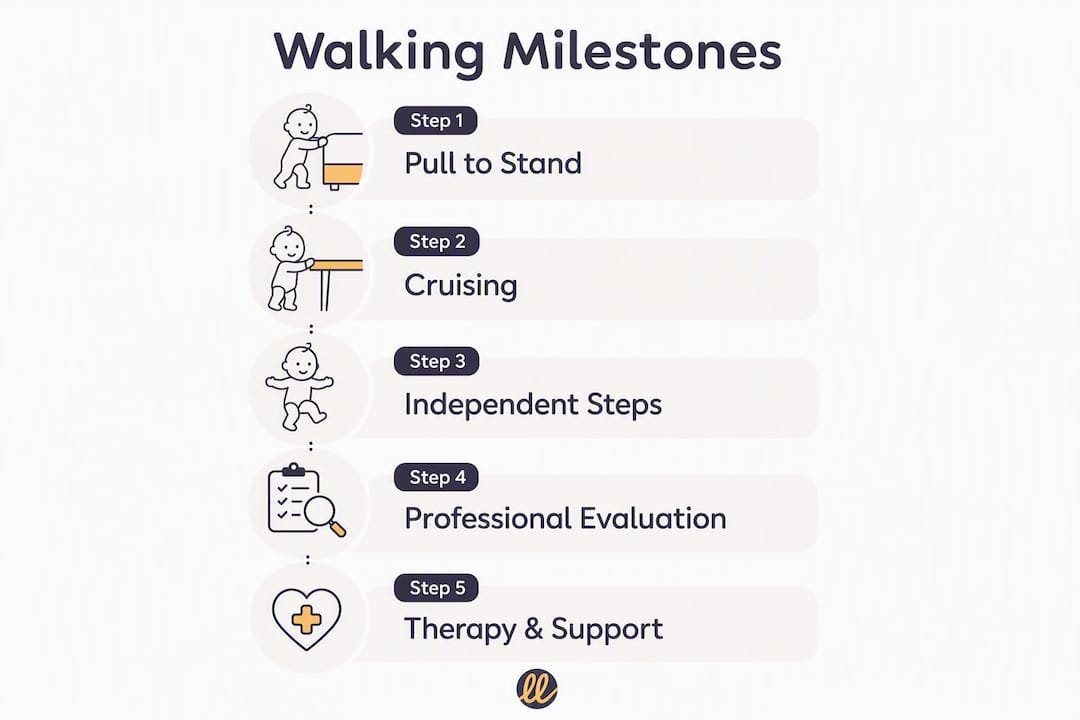
Independent walking means several consecutive steps taken without holding onto anything or anyone. The child initiates movement, balances mid-stride, and completes the steps on their own. Two steps and a grab for the couch doesn't quite qualify yet, though it's a promising sign.

Cruising is walking sideways or forward while holding onto furniture, a wall, or a caregiver's hands. It shows weight-bearing, leg strength, and coordination, all of which are building blocks for independent steps. A child who cruises confidently is developmentally much closer to walking than one who doesn't cruise at all.
Assisted stepping describes a child who takes steps only when both hands are held. This is a step below cruising in terms of independence, though it still demonstrates some weight-bearing capacity.
When you observe your child, notice these specifics:
- Do both legs move with roughly equal strength and coordination?
- Does the child press their feet flat into the floor, or do they toe-walk or avoid weight-bearing?
- Do they shift their weight from side to side when standing, or do they lock their knees and stiffen?
- How long can they stand holding one hand versus two?
These details, captured on video, give a clinician far more to work with than a general "they're not walking yet." Quality of movement matters as much as timing, and steady progression through the motor sequence, even if slow, is usually a reassuring sign.
Common reasons toddlers are late to walk
Late walking has a wide range of causes, from completely benign to medically significant. The list below moves from most to least common. Use it to frame what you report to your pediatrician, not to diagnose.
Benign and behavioral causes (most common):
- Temperament. Some children are simply more content to sit, observe, and play. A laid-back child may have the physical ability to walk but little motivation to try. This is a real and recognized pattern, not a parenting failure.
- Family history of late walking. Late walking often runs in families. If a parent or sibling walked late and had no lasting issues, that context matters and is worth mentioning to your pediatrician.
- Limited floor time. Children who spend significant time in bouncers, swings, or other devices that hold them in a fixed position get fewer opportunities to build the core and leg strength that walking requires. More time on the floor, on their belly and back, builds the foundation.
- Bottom-shuffling. Some children skip crawling entirely and scoot on their bottom instead. Bottom-shufflers tend to walk later on average, but most catch up without intervention.
Medical and physical causes (less common but important to rule out):
- Low muscle tone (hypotonia). A child with hypotonia feels floppy when held and may have difficulty sustaining the muscle engagement needed to stand. It can be a standalone finding or a sign of an underlying condition. Suspect it if the child's body feels unusually soft or if they tire quickly during supported standing.
- High muscle tone (spasticity). The opposite of hypotonia: legs feel stiff or scissor together when the child is held upright. This pattern can be associated with cerebral palsy and warrants prompt evaluation.
- Hip dysplasia. A shallow or malformed hip socket can make weight-bearing painful or mechanically difficult. Asymmetric leg movement or an unusual gait pattern are the signs to watch for.
- Metabolic and endocrine causes. Rickets (vitamin D deficiency causing soft bones) and hypothyroidism (low thyroid function) can both delay motor development. A clinical review of delayed walking identifies these as part of the differential that blood work can help rule out.
- Neuromuscular disorders. Cerebral palsy, muscular dystrophy, and spinal muscular atrophy are rare but serious causes of delayed walking. These typically present with other signs: abnormal tone, weakness, regression, or delays across multiple developmental domains.
The presence of delays in language, social engagement, or fine motor skills alongside late walking raises the level of concern significantly. An isolated walking delay in an otherwise thriving, communicative toddler carries a very different weight than delays across multiple areas.
Red flags that need urgent evaluation, not watchful waiting
Most late walkers don't need an emergency room. But some signs call for faster action than a routine appointment allows. Know the difference.
Contact your pediatrician promptly (within days, not weeks) if you notice:
- Loss of a skill the child previously had (was pulling to stand, now won't or can't)
- A clear preference for one side of the body, using one leg significantly more than the other
- Legs that feel very stiff, scissor together, or that the child holds in an unusual position
- Legs that feel very floppy, with little resistance when you move them
- No weight-bearing at all when held upright, even briefly
- No interest in moving, exploring, or changing position
- Signs of pain during movement or when legs are touched
Go to the ER or call 911 if:
- There is a sudden, acute loss of motor skills over hours or days
- The child shows signs of severe pain, inability to move a limb, or a possible injury
- Neurological symptoms appear suddenly (unresponsiveness, seizure, extreme limpness)
The CDC's act-early guidance specifically lists loss of previously mastered skills, strong preference for one side, and markedly abnormal muscle tone as signs that need prompt professional attention.
Pro Tip: When you call the pediatrician's office, lead with the most specific observation you have: "My 18-month-old was pulling to stand two weeks ago and has stopped entirely" gets faster triage than "I'm worried about her walking." Attach your video clip if the office has a patient portal.
What your pediatrician or specialist will do
Walking into the appointment knowing what to expect makes the whole visit less stressful. Here's the typical sequence.
At the pediatric visit, expect:
- A developmental screening tool (such as the M-CHAT or ASQ) to assess multiple domains, not just motor skills
- A focused physical exam: muscle tone, deep tendon reflexes, symmetry of movement, range of motion in hips and ankles, and foot position
- A review of birth and perinatal history, growth curve, and family history
- Direct observation of the child's movement, either in the office or via your video
If the exam raises concerns, the clinician may order:
- Basic blood work: TSH (thyroid function), calcium, vitamin D, and creatine kinase (a marker for muscle disease) are common starting points when metabolic or neuromuscular causes are suspected
- Imaging: hip X-rays if dysplasia is suspected; brain MRI only when neurological findings are present
- Referral to pediatric physical therapy for assessment and treatment
- Referral to a developmental pediatrician, pediatric neurologist, or pediatric orthopedist depending on findings
Bring to the appointment:
- Your 20–30 second video of movement attempts
- A written timeline of motor milestones (when they sat, crawled or bottom-shuffled, pulled to stand, cruised)
- Birth history: gestational age, any NICU stay, birth complications
- Family history of late walking or neuromuscular conditions
- Any concerns about hearing or vision (both affect motivation to move toward objects)
One option many parents don't know about: in most U.S. states, you can self-refer to Early Intervention under IDEA Part C without waiting for a physician referral. This can shorten the wait for a therapy evaluation significantly. Your state's Early Intervention program will conduct a free developmental evaluation and determine eligibility for services.
How pediatric physical therapy and Early Intervention help late walkers
Pediatric physical therapy (pediatric PT) is not just for children with diagnosed conditions. It's a practical, play-based service that helps children build the specific skills they're missing, whether that's core stability, hip strength, balance, or the confidence to take that first unsupported step.
A pediatric PT will assess your child's muscle tone, strength, range of motion, and movement patterns, then design a program targeting the gaps. Sessions typically involve guided play on the floor, supported standing practice, stepping over small obstacles, and gait training with just enough support to let the child feel success. Crucially, the therapist also coaches you on what to do at home between sessions, which is often where the most progress happens.
For children with isolated gross motor delays and no underlying neurological diagnosis, therapy often accelerates skill emergence noticeably. The timeline varies: some children take their first independent steps within weeks of starting therapy; others need several months of consistent work. Children with cerebral palsy, muscular dystrophy, or other neuromuscular diagnoses benefit from therapy too, but the goals and timelines look different and are set in collaboration with specialists.
Early Intervention under IDEA Part C covers children from birth through age 2 and is available in every U.S. state. Services are provided at low or no cost based on family income and the child's needs, and they're delivered in the child's natural environment, often at home or in daycare. Coverage for private pediatric PT varies by insurance plan; ask your insurer whether a physician referral is required and whether there are session limits.

Practical home activities to encourage walking right now
You don't need equipment or a therapy degree to support your child's motor development at home. The most effective strategies are also the simplest.
Do these:
- Maximize barefoot floor time. Bare feet give children sensory feedback from the floor that shoes and socks block. More floor time, more often, builds the strength and balance that walking requires.
- Place motivating toys just out of reach. A favorite toy or snack positioned slightly beyond arm's length encourages a child to shift weight, reach, and eventually step toward it.
- Use low, stable furniture for cruising practice. A coffee table, couch, or low bookshelf gives a child something to hold while they practice weight-shifting and stepping sideways.
- Offer a push toy once they're pulling to stand. A sturdy push toy (not a baby walker) lets a child practice stepping while holding something for balance. Introduce it only when they're already pulling to stand confidently.
- Celebrate every attempt. Clapping, smiling, and verbal encouragement after any movement attempt, even a failed one, builds the motivation to try again.
Avoid these:
- Baby walkers. Research and clinical guidance consistently link baby walkers to injury risk and reduced floor-based strengthening. They hold children in a position that bypasses the balance and core work that independent walking actually requires.
- Excessive time in bouncers, swings, or jumpers. These devices are fine in moderation, but heavy reliance on them reduces the floor time where real motor development happens.
- Forcing or pressuring attempts. A child who associates walking with stress or frustration will be less motivated to try. Keep the tone playful.
- Shoes indoors. Indoors, bare feet or non-slip socks are better than shoes for building proprioceptive awareness and foot strength.
Pro Tip: Structure two or three 5–10 minute "movement windows" across the day rather than one long session. Short, frequent practice is more effective than a single extended effort, and it's easier to keep playful. Film one of these sessions each week so you can show the clinician how your child's movement is progressing.
How to track milestones and prepare for the pediatric appointment
Walking into the pediatrician's office with a clear, organized picture of your child's development gets you better answers faster. Here's a simple framework.
Step 1: Build a one-page motor milestone timeline. Write down the approximate dates (even rough months) for each skill: rolling, sitting independently, belly crawling or bottom-shuffling, pulling to stand, cruising, and any assisted or independent steps. If you're not sure of exact dates, check photos or videos on your phone. Most parents have more documentation than they realize.
Step 2: Note what you're observing now. For each of these, write one sentence: Does the child bear weight when held upright? Do they cruise? Do they attempt independent steps? Is movement symmetric? Does anything seem to cause discomfort?
Step 3: Capture video. Aim for three short clips: one showing pulling to stand, one showing cruising, and one showing any attempt at independent steps. Keep each clip under 30 seconds. Natural lighting and a clear background help the clinician see movement details.
Step 4: Note the broader developmental picture. Is language on track? Are they pointing, waving, making eye contact, and engaging socially? Fine motor skills (picking up small objects, using both hands)? Clinicians look at the whole child, and combined delays across domains raise the priority for investigation more than an isolated walking delay alone.
Mellow's milestone tracking tools for 15–24 months give you a structured way to log these observations over time, so nothing gets lost between appointments. When you arrive at the pediatrician's office with a timeline, a video, and a clear description of what you're seeing, the visit becomes a much more productive conversation.
For telehealth visits, the video is even more important since the clinician can't observe movement in person. Frame the camera at floor level, give the child a motivating toy, and let them move naturally for 30–60 seconds.
Phrase your concern clearly: "My 18-month-old is not taking independent steps. They cruise along furniture and bear weight when held, but haven't let go yet. I've attached a 30-second video." That sentence gives the clinician everything they need to triage appropriately.
Timeline and prognosis: what to realistically expect
The honest answer is that outcome depends heavily on what's driving the delay. Here are the three most common scenarios.
- Isolated gross motor delay with no underlying diagnosis. This is the most common and most reassuring scenario. A child who is cruising, bearing weight, and otherwise meeting milestones often begins walking within weeks to a few months of starting targeted home strategies or pediatric PT. The progression from confident cruising to first independent steps can happen quickly once strength and balance reach a tipping point.
- Delay associated with low or high muscle tone. Children with hypotonia or mild spasticity typically benefit significantly from pediatric PT. Progress is real but slower, often measured in months rather than weeks. Many children with mild tone differences walk independently, though they may need ongoing therapy for gait quality and endurance.
- Delay associated with a neuromuscular or neurological diagnosis. Conditions like cerebral palsy, muscular dystrophy, or spinal muscular atrophy require specialist-led care. Walking may be achievable with support, or adaptive mobility equipment may become part of the plan. Early diagnosis and early therapy consistently improve functional outcomes even when full independent walking isn't the endpoint.
Pediatric orthopedic guidance notes that many gait and walking concerns sit on a spectrum and resolve with time, but the 18-month check exists precisely to catch the children who need support before the window for early intervention narrows. When language, social skills, and fine motor development are all on track alongside a walking delay, the prognosis for catch-up is generally good. When multiple domains are affected, comprehensive evaluation sooner rather than later changes outcomes.
Key Takeaways
Not walking at 18 months is the clinical threshold for professional evaluation, but many children in this situation catch up quickly once the cause is identified and addressed.
| Point | Details |
|---|---|
| 18 months is the evaluation threshold | The CDC flags not walking independently by 18 months as a reason to seek professional evaluation, even if other milestones look fine. |
| Red flags need faster action | Loss of skills, asymmetric leg use, or absent weight-bearing warrant a prompt pediatrician call, not watchful waiting. |
| Home strategies make a real difference | Barefoot floor time, motivating toys just out of reach, and push toys (not baby walkers) support strength and balance between appointments. |
| Bring video and a timeline | A 30-second movement clip and a written milestone timeline help clinicians triage faster and more accurately than a verbal description alone. |
| Mellow supports the whole picture | Mellow's 15–24 month tracking tools help parents log milestones, organize observations, and prepare for pediatric appointments with confidence. |
The worry is real, and so is the path forward
Watching other children walk while yours is still holding the couch is genuinely hard. The anxiety that comes with that is not an overreaction. What I find reassuring, looking at the clinical evidence, is that the 18-month threshold exists not to alarm parents but to create a clear, practical moment of action. Most children who aren't walking at 18 months are not facing a serious diagnosis. Many are simply temperamentally cautious, have had less floor time than ideal, or are a few weeks away from putting it all together.
What matters most is not waiting passively. Call your pediatrician. Film your child's movement. Consider self-referring to Early Intervention if your state allows it, because earlier support consistently produces better outcomes. And track the whole developmental picture, not just walking, because a child who is talking, pointing, making eye contact, and engaging socially is telling you something important even while they're still holding the furniture.
The CDC and AAP guidance is clear: 18 months is the moment to act, not to wait another few months and see. Acting now, even when the outcome turns out to be "everything is fine," is always the right call.
Mellow can help you stay organized through this
Keeping track of your child's milestones, videos, and appointment notes across a busy week is harder than it sounds. Mellow's 15–24 month guidance hub gives parents of toddlers a structured place to track motor milestones, log observations, and prepare for pediatric visits without scrambling the night before.

The app isn't a substitute for your pediatrician or a physical therapist. It's an organizational layer that helps you show up to those appointments with the right information already in hand: a milestone timeline, movement notes, and a clear picture of what's changed week to week. For parents managing the stress of a developmental concern on top of everything else, having that structure in one place genuinely reduces the mental load. Start with the 15–24 month hub and see how Mellow fits into your family's routine.
This article is for general informational purposes only and is not a substitute for professional medical advice. Always consult your child's pediatrician or a qualified healthcare provider for guidance specific to your child's situation.
Trusted sources and where to learn more
| Source | Best for |
|---|---|
| CDC — Milestones: 18 months | Official milestone definitions and red-flag guidance at the 18-month mark |
| CDC — Early Intervention (IDEA Part C) | How to access Early Intervention services and self-refer in your state |
| PMC — Delayed Walking Clinical Review | Medical differential diagnoses and the clinical workup for late walkers |
| PMC — Developmental Assessment Guidance | Why combined developmental delays raise the priority for evaluation |
| PMC — Pediatric Gait and Timing | Spectrum of walking pattern concerns and when evaluation is warranted |
| Tufts Medicine — Baby Walkers | Why baby walkers are not recommended and what to use instead |
| ParentsCanada — Late Walker Guidance | Practical guidance on quality of movement versus exact timing |