

Postpartum sleep deprivation is nearly universal, but it exists on a spectrum that runs from expected caregiving-driven fragmentation all the way to clinical insomnia that needs treatment. Many parents see their total sleep hours approach pre-pregnancy levels by around 13 weeks, according to Postpartum Support International (PSI), while consolidated, uninterrupted sleep often lags well behind. If you're in the thick of it right now, here's what matters most tonight:
- Keep baby safe first. Place your infant on their back in a crib or bassinet with no soft bedding, bumpers, or toys, especially when you're exhausted. Never move to the sofa to feed.
- Protect at least one long sleep block. Share night duties with a partner or support person so one of you gets a 3–4 hour stretch.
- Watch for mood red flags. Persistent sadness, inability to sleep even when the baby is settled, or thoughts of harming yourself or your baby are signs to call your provider promptly.
Safety first: Healthychildren advises that exhausted caregivers should never place a baby to sleep on a sofa, armchair, or adult bed. When you're too tired to stay awake during a feeding, put the baby down in their crib or bassinet and rest nearby.
Key Takeaways
Postpartum sleep deprivation is nearly universal, but distinguishing caregiving-driven fragmentation from clinical insomnia is the most important step toward getting the right support.
| Point | Details |
|---|---|
| Total vs. uninterrupted sleep | Total sleep hours may approach pre-pregnancy levels by ~13 weeks, but longest uninterrupted stretches often lag behind and drive ongoing exhaustion. |
| Mood red flags require action | Difficulty sleeping when the baby is settled, persistent low mood, or intrusive thoughts lasting beyond two weeks warrant prompt clinical evaluation. |
| CBT-I is first-line treatment | A randomized trial found prenatal CBT-I reduced nighttime wakefulness and insomnia severity at 8, 18, and 30 weeks postpartum. |
| Safe sleep is non-negotiable | When exhausted, always place the baby in a crib or bassinet on their back; never feed on a sofa or armchair where you might fall asleep. |
| Mellow supports the whole journey | Mellow's sleep-challenge tools and age-specific guidance help parents build schedules and anticipate developmental sleep changes before they hit. |
Table of Contents
- What does postpartum sleep deprivation actually look like?
- How sleep loss affects your mood, focus, and mental health
- What the recovery timeline really looks like
- When sleep problems go beyond normal: CBT-I and clinical care
- Practical strategies you can start using tonight
- Staying safe when you're dangerously tired
- When should you call your doctor?
- What the research shows and what we still don't know
- What actually matters most: a perspective on priorities
- Mellow can help you track sleep and protect your wellbeing
- Sources
What does postpartum sleep deprivation actually look like?
Sleep deprivation after childbirth is not simply "getting less sleep." Clinicians distinguish between two overlapping problems: sleep fragmentation (sleep that is repeatedly interrupted by infant care) and insomnia (inability to sleep even when the opportunity exists). Most new parents experience fragmentation. Some develop true insomnia on top of it, and that distinction matters enormously for how you treat it.
A review published in Archives of Women's Mental Health argues that normalizing postpartum sleep loss can obscure clinical insomnia, and that failing to assess whether a parent can sleep when infant care is not required leads to misclassification and undertreated psychiatric risk. In other words, the cultural message of "this is just what new parenthood is" sometimes delays care that would genuinely help.
The primary causes of new parent sleep deprivation include:
- Newborn feeding and wake cycles. Infants feed every 2–3 hours around the clock in early weeks, making any sustained sleep nearly impossible regardless of parental effort.
- Immature circadian rhythms. Newborns have not yet developed a day/night sleep pattern, so their wakings are distributed across all hours.
- Hormonal shifts. The sharp postpartum drop in estrogen and progesterone, combined with elevated prolactin in breastfeeding parents, alters sleep architecture and can reduce slow-wave and REM sleep quality.
- Feeding method. Breastfeeding parents typically experience more nighttime wakings than those using formula or shared bottle-feeding, though breastfeeding also carries other health benefits that factor into the overall picture.
- Structural and social factors. Single caregiving, lack of partner support, return-to-work pressure, and limited family help all compress the window available for rest.
- Underlying medical or mental health conditions. Postpartum thyroid changes, anemia, and perinatal mood disorders can independently worsen sleep quality.
PSI notes that disruption is most pronounced in the first postpartum week, with daytime napping increasing as parents try to compensate. Understanding which of these factors is driving your own sleep loss helps you target the right solution.
How sleep loss affects your mood, focus, and mental health
Sleep loss degrades concentration, emotional regulation, and mood within a single night. Research published in a PMC peer-reviewed study found that even one fragmented night of postpartum-style sleep impairs daytime functioning in measurable ways, including slower reaction times and lower positive affect. For new parents facing weeks of this pattern, the cumulative toll is significant.
Beyond daytime impairment, sleep disruption is a recognized risk factor for postpartum depression and anxiety. The National Institute of Mental Health (NIMH) describes perinatal depression as often beginning within 4–8 weeks after birth, with symptoms that include extreme sadness, anxiety, fatigue, and difficulty sleeping even when the baby is asleep. That last detail is the clinical signal: if you cannot sleep during a quiet window, the problem may be insomnia layered on top of caregiving disruption, not caregiving disruption alone.
Prevalence note: CDC PRAMS surveillance data show that a notable minority of women report postpartum depressive symptoms, and provider inquiry about depression is not universal. Many cases go undetected without routine screening.
The distinction between caregiving-driven sleep loss and insomnia matters clinically:
- Caregiving-driven sleep loss: You fall asleep quickly when the baby settles, you feel better after a nap, and your mood improves with more rest opportunity.
- Clinical insomnia: You lie awake even when the baby is sleeping, feel hyperaroused or anxious at bedtime, and rest does not feel restorative even when you get it.
- Perinatal depression/anxiety overlap: Persistent low mood, inability to feel pleasure, excessive worry, or intrusive thoughts that persist beyond the first two weeks warrant evaluation regardless of sleep pattern.
Parental wellbeing and sleep are deeply connected, and protecting one tends to support the other.
What the recovery timeline really looks like
The honest answer is that recovery is uneven, and total hours and uninterrupted sleep recover on different schedules. Many parents' total sleep approaches pre-pregnancy levels by around 13 weeks postpartum, but their longest continuous stretch often remains substantially shorter for much longer, according to PSI's postpartum sleep guidance. That gap explains why parents who are "technically" getting enough hours still feel exhausted: the architecture of sleep matters as much as the quantity.

A 2025 observational study reported by ScienceDaily quantified this gap directly, finding that new mothers averaged approximately 4.4 hours of sleep in the first postpartum week compared to 7.8 hours pre-pregnancy, with longest uninterrupted stretches falling sharply and recovering only partially over subsequent weeks.
A rough week-by-week picture:
- Week 1: Most disrupted period. Total sleep is lowest, night wakings are most frequent, and exhaustion peaks. Survival mode is appropriate here.
- Weeks 2–7: Gradual increase in total sleep as feeding intervals lengthen slightly. Fragmentation remains high. Daytime napping helps but rarely fully compensates.
- Weeks 8–13: Many parents see total sleep hours creeping toward pre-pregnancy norms. Longest uninterrupted stretches may still be 2–4 hours. Mood often stabilizes alongside this, though not always.
- Beyond 13 weeks: Baby sleep patterns consolidate gradually, but sleep regressions at 4 months, 8–10 months, and around 12 months can temporarily reverse progress. Parents who feel they have "turned a corner" and then hit a regression often need reassurance that this is developmentally normal.
Red flags for persistence: if sleep does not improve at all by 8–10 weeks, or if you cannot sleep even during quiet windows, that pattern warrants clinical evaluation rather than continued waiting.
When sleep problems go beyond normal: CBT-I and clinical care
The first-line, evidence-based treatment for insomnia is cognitive behavioral therapy for insomnia (CBT-I), not sleep medication. CBT-I addresses the thought patterns and behaviors that perpetuate sleeplessness, and it has been adapted specifically for the perinatal period.
A randomized controlled trial found that CBT-I delivered during pregnancy reduced time awake at night unrelated to infant care at 8, 18, and 30 weeks postpartum, and lowered insomnia severity scores at 30 weeks. The preventive implication is notable: treating insomnia during pregnancy carries forward benefits into the postpartum period.
Treatment options and when each fits:
- CBT-I (perinatal adaptation): Recommended when insomnia symptoms are present alongside caregiving disruption. Perinatal adaptations modify standard sleep restriction and stimulus control techniques to account for infant feeding schedules. Delivered by a trained therapist, via telehealth, or through structured digital programs. This is the appropriate first step before considering medication.
- Pharmacological aids: Short-term sleep medications may be considered when CBT-I is unavailable or insufficient, but safety in breastfeeding requires careful review. Some medications pass into breast milk at varying levels; decisions should be made with an OB-GYN, psychiatrist, or prescribing provider who can weigh individual risk and benefit. The NIMH perinatal depression guidance supports individualized treatment planning.
- Perinatal mental health treatment: When insomnia co-occurs with postpartum depression or anxiety, treating the mood disorder often improves sleep. Antidepressants with established safety profiles in lactation (such as sertraline) are frequently used; again, this is a conversation with your provider.
When to escalate care:
- Primary care or OB-GYN: first contact for screening, medication review, and referral.
- Perinatal mental health specialist: when mood symptoms are moderate to severe or when CBT-I alone is insufficient.
- Sleep medicine: when insomnia persists beyond 3 months postpartum or when a sleep disorder such as sleep apnea is suspected.
The ACOG and USPSTF both recommend routine depression screening during pregnancy and the postpartum period. You do not need to wait for a crisis to ask for help.
Practical strategies you can start using tonight
The single most effective overnight strategy is structured shared care that protects at least one long, uninterrupted sleep block per 24 hours for each caregiver. Everything else builds around that anchor.
Core tactics:
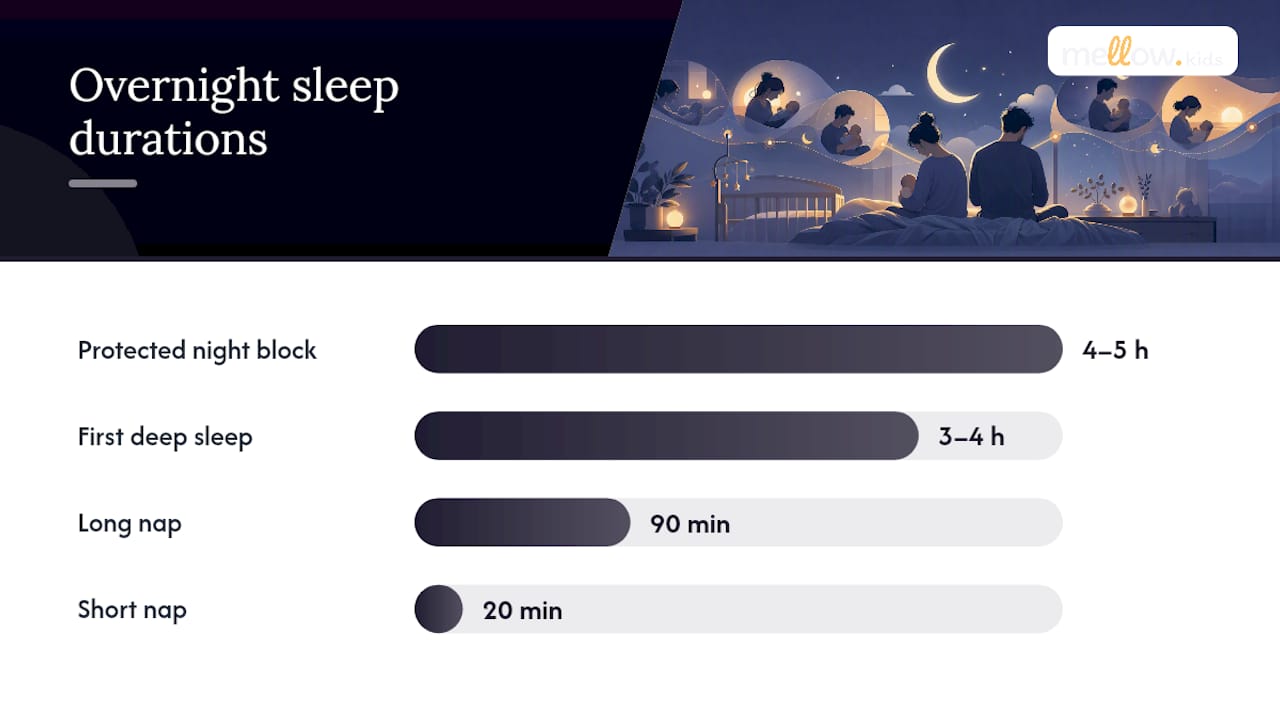
- Shift scheduling. Divide the night into defined blocks rather than both parents waking for every feeding. A common structure: one parent handles 9 PM–2 AM, the other takes 2 AM–7 AM. Each gets a 4–5 hour protected stretch.
- Pumped milk or formula for one feeding. If breastfeeding, pumping a bottle for the early-morning feed allows the breastfeeding parent to sleep through one cycle. This does not compromise milk supply when done occasionally and thoughtfully.
- Strategic napping. A 20-minute nap taken within 6 hours of your next planned sleep period is restorative without disrupting nighttime sleep drive. Longer naps (90 minutes) can complete a full sleep cycle but require more planning.
- Optimize the sleep environment. Blackout curtains, white noise, and a cool room temperature (around 65–68°F) reduce arousal threshold. These are small changes that compound over weeks.
- Limit phone use during night feeds. Bright screens during 2 AM feeds delay return to sleep. A dim, warm-toned light is enough to feed safely without signaling "morning" to your brain.
Pro tips from clinical practice:
Pro Tip: Protect your first sleep block of the night. The first 3–4 hours after you fall asleep contain the most slow-wave (deep) sleep, which is the most physically restorative. If you can arrange care so that block is uninterrupted, you will feel meaningfully better the next day even if total hours are short.
Pro Tip: Keep a simple sleep log for one week: note when you slept, how long, and whether you woke due to the baby or on your own. This single habit helps you and your provider distinguish caregiving-driven disruption from insomnia, and it makes clinical conversations much more productive.
For parents struggling with a newborn resisting sleep, recognizing sleepy cues early and building a consistent pre-sleep routine can reduce the time spent trying to settle the baby, which directly extends your own rest window.
Staying safe when you're dangerously tired
When exhaustion reaches the point where you are falling asleep mid-feed or struggling to stay awake while holding your baby, safety becomes the immediate priority. The risk is not hypothetical: a caregiver who falls asleep on a sofa or armchair while holding an infant creates a suffocation hazard that a crib or bassinet eliminates entirely.
Safe sleep rule: HealthyChildren.org is clear: if you feel yourself falling asleep during a feeding, place the baby on their back in their crib or bassinet immediately. A firm, flat sleep surface with no soft bedding is always safer than any adult sleeping surface, no matter how carefully you position yourself.
Behaviors to avoid when exhausted:
- Feeding the baby on a sofa, recliner, or armchair where you might fall asleep.
- Bringing the baby into an adult bed with pillows, blankets, or other adults or pets.
- Driving with the baby when you have had fewer than 4 hours of sleep.
- Leaving the baby unattended on an elevated surface (changing table, sofa) when your reaction time is impaired.
A practical fallback plan:
Set up the baby's sleep space before you are exhausted, not during a crisis; consider professional maternity and newborn photography to capture these early days meaningfully. Keep the crib or bassinet within arm's reach of where you feed at night. If you feel yourself losing the ability to stay awake, put the baby down, set a 20-minute alarm, and rest in a chair or on the floor nearby. It feels counterintuitive, but 20 minutes of safe rest beats the alternative.
If you have a partner, family member, or trusted friend available, designate them as a backup caregiver for at least one overnight session per week. Even one night of protected sleep per week has measurable effects on mood and cognitive function. For detailed guidance on setting up a safe sleep environment for newborns, Mellow's practical guide covers crib setup, room-sharing logistics, and what to do during sleep regressions.
When should you call your doctor?
Seek medical or mental health care promptly if any of the following are present. These are not signs of weakness; they are clinical signals that deserve professional attention.
Red flags that warrant same-day or urgent contact:
- Thoughts of harming yourself or your baby, or thoughts that your baby or family would be better off without you.
- Inability to care for yourself or your infant due to mood, exhaustion, or confusion.
- Persistent inability to sleep even when the baby is settled and you have the opportunity.
- Depressive symptoms (persistent low mood, inability to feel pleasure, hopelessness) lasting more than two weeks.
- Severe anxiety, panic attacks, or intrusive thoughts that feel uncontrollable.
- Hallucinations or confusion (these require emergency evaluation).
Screening recommendations:
The American College of Obstetricians and Gynecologists (ACOG) and the U.S. Preventive Services Task Force (USPSTF) both recommend depression screening during pregnancy and at postpartum visits. The American Academy of Pediatrics (AAP) recommends that pediatricians screen mothers for postpartum depression at the 1-month, 2-month, and 4-month well-child visits. CDC PRAMS data show that about one in eight women report postpartum depressive symptoms, yet provider inquiry is not universal. If your provider has not asked, bring it up yourself.
Practical steps before your appointment:
- Keep a brief sleep diary for 5–7 days: bedtime, wake times, infant-care wakings vs. spontaneous wakings, and daytime mood rating (1–10).
- Note any medications, supplements, or herbal products you are taking.
- Write down your three most disruptive symptoms so you do not forget them in the appointment.
Resources:
- Postpartum Support International (PSI) Helpline: 1-800-944-4773 (call or text)
- National Maternal Mental Health Hotline: 1-833-943-5746 (24/7, free, confidential)
- Crisis Text Line: Text HOME to 741741
Mellow's parenting and wellbeing resources also include guidance on recognizing mood changes and connecting with support.
What the research shows and what we still don't know
The evidence base for postpartum sleep deprivation is growing but uneven. Here is an honest summary of what is well-established, what is emerging, and where gaps remain.
What is well-established:
The randomized controlled trial by Felder et al. provides the strongest evidence that CBT-I delivered during pregnancy reduces postpartum insomnia severity and nighttime wakefulness unrelated to infant care at multiple time points (8, 18, and 30 weeks postpartum). This is a meaningful finding because it suggests a preventive window during pregnancy, not just a reactive treatment after symptoms appear.
CDC PRAMS surveillance establishes prevalence: approximately one in eight women report postpartum depressive symptoms, and screening gaps mean many go undetected. NIMH's clinical guidance confirms the 4–8 week onset window for perinatal depression and the importance of distinguishing sleep-opportunity problems from sleep-ability problems.
The Archives of Women's Mental Health review makes a clinically important argument: postpartum sleep loss is so culturally normalized that true insomnia disorder is frequently missed. Screening tools that do not ask about sleep opportunity (not just sleep duration) will misclassify caregiving-driven fragmentation as insomnia, and vice versa.
Evidence gaps and limitations:
- Most CBT-I trial data come from prenatal delivery; evidence for postpartum-initiated CBT-I is thinner and needs larger trials.
- Pharmacotherapy safety data in lactation remain limited for many sleep agents; most guidance is extrapolated from general psychiatric prescribing rather than dedicated lactation studies.
- Observational data on sleep fragmentation (including the 2025 quantitative study showing first-week averages of approximately 4.4 hours vs. 7.8 hours pre-pregnancy) are largely drawn from maternal samples; paternal and non-birthing-parent data are underrepresented.
- Long-term outcomes of untreated postpartum insomnia on maternal cognitive function and child development are not yet well characterized.
- Research on culturally and socioeconomically diverse populations remains limited, which affects how broadly current guidelines can be applied.
What actually matters most: a perspective on priorities
The conversation around postpartum sleep deprivation tends to split into two unhelpful camps. One camp minimizes it entirely ("everyone goes through this, you'll survive"). The other medicalizes every yawn and turns normal caregiving exhaustion into a diagnostic checklist. Neither serves new parents well.
What the evidence actually supports is a middle path: treat caregiving-driven sleep fragmentation as a practical problem to be managed with scheduling, shared care, and realistic expectations, while staying alert to the clinical signals that indicate something more is happening. The distinction between "I'm exhausted because my baby wakes every two hours" and "I cannot sleep even when my baby is settled" is not a subtle one, but it gets lost when we treat all postpartum sleep loss as identical.
The finding from the Archives of Women's Mental Health review deserves more attention than it typically gets: normalizing postpartum sleep loss is not neutral. It actively delays care for parents who have developed insomnia disorder or a perinatal mood disorder on top of their caregiving demands. A parent who has been told "this is just how it is" for eight weeks while lying awake during every quiet window has been failed by that framing.
At the same time, the CBT-I trial data offer something genuinely encouraging: treating insomnia during pregnancy carries forward measurable benefits into the postpartum period. That means the window for intervention is not just after the baby arrives. If you are pregnant and already struggling with sleep, that is worth raising with your provider now, not later.
The practical priority order, in my view: safety first (safe sleep, no driving on no sleep), then mood protection (screen early, act on red flags), then sleep architecture (protect one long block), and finally sleep hygiene refinements. Most parents try to do it in reverse, obsessing over white noise and blackout curtains while skipping the partner shift schedule conversation. The sequence matters.
Mellow can help you track sleep and protect your wellbeing
Sleep-deprived parents often know what they should do but struggle to implement it consistently when they're running on empty. Mellow offers personalized, age-specific guidance that prepares you for what's coming before it arrives, so you're not searching for answers at 3 AM.
With Mellow, you get tools built specifically for the newborn-to-2-year stage: sleep-schedule planning that adapts as your baby grows, developmental milestone tracking so you can anticipate the next sleep change rather than be blindsided by it, and evidence-based strategies for the most common sleep challenges including night wakings, short naps, and early rising. The app also includes guidance on parental wellbeing, recognizing mood changes, and knowing when to seek support. If you're in the thick of postpartum sleep deprivation right now, start with Mellow's sleep challenges hub and explore the tools designed to help you build a schedule that actually works for your family.
Sources
- Perinatal Depression - National Institute of Mental Health (NIMH)
- Randomized controlled trial of cognitive behavioral therapy for perinatal insomnia: postpartum outcomes
- Healthychildren
- Prevalence of Self-Reported Postpartum Depressive Symptoms — PRAMS analysis | CDC MMWR
This article provides general information and is not a substitute for professional medical advice. If you are experiencing symptoms of postpartum depression, insomnia, or any mental health concern, please consult your healthcare provider or call the National Maternal Mental Health Hotline at 1-833-943-5746.