

Most babies begin rolling between 3 and 6 months, often starting with an accidental tummy-to-back flip before mastering the reverse. By around 6 months, many babies can roll both ways with intention. The moment your baby starts attempting to roll, stop swaddling and start watching sleep surfaces more closely. That single safety change matters more than the exact date on the calendar.
TL;DR:
- Babies typically begin intentional rolling between 4 and 6 months, with some showing signs as early as 3 months or as late as 7 months.
- Key indicators of readiness include steady head control, side-lying pivots, and reaching across midline during play.
- Once a baby can roll both ways, parents should stop swaddling, place them on their back for sleep, and lower the crib mattress to ensure safety.
- Delays outside the normal range often relate to discomfort during tummy time or muscle tightness, which can benefit from early physical therapy.
- Developmental progress, rather than strict age targets, effectively predicts safety and future motor skill success.
Table of Contents
- Rolling Over Age: The Typical Timeline and Normal Variation
- Signs Your Baby Is Getting Ready to Roll
- How to Encourage Rolling Safely
- What Changes the Moment Your Baby Starts Rolling
- When to Contact Your Pediatrician
- How Mellow Kids Supports This Stage
- Premature Babies and Developmental Differences
- Common Struggles Babies Face While Learning to Roll
- Rolling and the Motor Skills That Follow
- Common Parent Worries, and What Actually Reassures
- Discomfort or Pain That Can Slow Rolling Progress
- Why the Rush to a "Normal" Age Misses the Point
- Sources
Rolling Over Age: The Typical Timeline and Normal Variation
There's a predictable order to this milestone, even though the exact timing varies from baby to baby. The rolling over age range most pediatric sources point to runs from about 3 to 6 months, with plenty of room on either side for babies who take a different path.
Here's how it usually unfolds:
- 3 to 4 months: Some babies experience their first accidental roll, tummy-to-back, driven more by momentum than muscle control.
- 4 months: Intentional tummy-to-back rolling tends to show up around here, once neck and shoulder strength catch up with curiosity.
- 5 to 7 months: Back-to-tummy rolling usually follows, since it demands more coordinated hip and trunk movement.
- Around 6 months: Many babies can roll confidently in both directions.
That "many babies" phrasing is deliberate. Rolling milestone age isn't a single fixed point, and a baby who rolls at 3.5 months isn't necessarily ahead of one who rolls at 5.5 months. What matters more is the direction of progress.
One detail that surprises a lot of parents: babies sometimes seem to lose a skill right after gaining a new one. A baby who was reliably rolling tummy-to-back might suddenly stop doing it for a week while focusing all their energy on the harder back-to-tummy roll. This isn't regression. Rolling pulls together neck, shoulder, trunk, and hip control all at once, and young brains often focus on one new skill at a time, temporarily sidelining an older one while the new movement gets wired in.
Anecdotal reports from parenting communities echo the clinical timelines almost exactly: tummy-to-back rolls clustering around 4 months, back-to-tummy landing closer to 6, with a wide spread on both ends that nobody seems to worry about after the fact.
Signs Your Baby Is Getting Ready to Roll
You don't need to guess when rolling is coming. Babies telegraph it through a handful of physical cues that show up during ordinary play, usually weeks before the first real roll.
Watch for these during tummy time and floor play:
- Steady head control. Your baby holds their head at midline without wobbling and lifts their chest during tummy time.
- Forearm push-ups. Instead of just resting their head on the mat, they push up on their forearms, then eventually straighten their arms to lift their whole chest.
- Side-lying pivots. They rock side to side, shift their weight onto one hip, or reach across their own body toward a toy.
That last one, reaching across midline, is one of the most reliable predictors of an imminent roll. It means your baby's brain has started coordinating both sides of the body together instead of moving them independently, which is exactly the coordination rolling requires.
It's worth telling the difference between this kind of purposeful movement and a reflex. The Moro reflex, also called the startle reflex, is an involuntary full-body extension triggered by a sudden noise, light, or the sensation of falling. Startle reflex newborn behavior looks dramatic, arms flinging outward, back arching, but it has nothing to do with rolling. The Moro reflex is present from birth and typically fades by around 6 months as the nervous system matures. Rolling, by contrast, is slow, deliberate, and gets more controlled with practice, not less.

Pro Tip: If the startle reflex seems to wake your baby repeatedly during naps, try swaddling for sleep only until they show rolling attempts, then transition to a sleep sack that keeps the startle contained without restricting hip movement.
How to Encourage Rolling Safely
Building the strength behind rolling doesn't require special equipment or a strict curriculum. It requires consistent floor time and a little patience.
- Start tummy time from day one. Even a minute or two of supervised tummy time in the newborn stage counts. Build gradually toward 15 to 30 minutes total per day by 2 months, split into short sessions rather than one long stretch.
- Place toys just out of reach. Set a favorite toy slightly to one side during tummy time so your baby has a reason to shift their weight and reach across their body.
- Practice side-lying play. Prop your baby on their side with a rolled towel for a few minutes at a time. This builds the same hip and trunk control used in a real roll.
- Use chest time. Lay your baby tummy-down on your chest while you're reclined. The visual motivation of your face encourages them to push up and look around.
- Offer assisted half-rolls. Gently guide one hip over while your baby is on their back, letting them finish the motion themselves rather than completing the roll for them.
Resist the urge to buy rolling "trainers" or push your baby through repeated forced exercises. Muscle development for this milestone comes from repetition and motivation, not drills. A tummy-time schedule built around your baby's age gives you a realistic framework without turning play into a chore.
What Changes the Moment Your Baby Starts Rolling
Rolling changes the safety math overnight, sometimes literally. The moment you see a rolling attempt, even a clumsy, incomplete one, it's time to adjust sleep and supervision habits.
The first and most urgent change: stop swaddling. A swaddled baby who rolls onto their stomach loses the ability to push up or turn their head freely, which raises suffocation risk. Transitioning to a sleep sack with arms free keeps your baby warm without restricting the movement they now need for safety.
Once a baby can roll independently in both directions, you generally don't need to reposition them every time they roll during sleep. The key safety step is placing them on their back at the start of every sleep period. Safe-sleep guidance from the American Academy of Pediatrics confirms this shift once rolling becomes a reliable, two-way skill.
A few other adjustments matter just as much:
- Lower the crib mattress as soon as your baby shows pushing-up strength, since rolling often arrives around the same time as the ability to rock onto hands and knees.
- Clear the crib of loose blankets, pillows, and stuffed animals, all of which become more dangerous once a baby can roll into them.
- Never leave a rolling or roll-attempting baby unattended on a changing table, bed, or couch, even for a few seconds.
A safe-sleep setup built around your baby's current mobility is worth revisiting every few weeks during this stretch, since capability changes fast.
When to Contact Your Pediatrician
Most rolling delays sort themselves out with time and tummy time. Certain signs, though, deserve a call to your pediatrician rather than a wait-and-see approach.
- No head control or inability to lift their chest during tummy time by around 4 months.
- Loss of a previously mastered skill, such as head control or reaching, that doesn't return within a week or two.
- Persistent one-sided weakness or asymmetry, where your baby consistently favors one arm, leg, or side of their body.
- A Moro reflex that's still present past 6 months, or one that looks noticeably asymmetric, arms extending unevenly on each side.
Not rolling at 6 months isn't automatically a red flag on its own. Plenty of healthy babies are late rolling babies who catch up within weeks without any intervention. What matters more is the overall pattern: are other skills progressing, is head control solid, does your baby seem engaged and physically active during play? A single missed milestone rarely means much in isolation. A cluster of missed milestones, or a skill that's actually regressing, is what warrants a pediatric evaluation.
How Mellow Kids Supports This Stage
Guidance based on evidence-based, age-specific development patterns is particularly helpful during variable developmental stages like rolling. Editorial guidance helps translate research into practical parenting decisions.
A few resources worth bookmarking for this stage:
- Step-by-step direction for transitioning away from swaddling once rolling attempts start.
- A month-by-month milestone reference to see how rolling fits alongside other skills.
If your baby's development pattern feels genuinely off, not just different from a chart, that's the moment to bring your pediatrician into the conversation rather than searching for reassurance online.
Premature Babies and Developmental Differences
Prematurity shifts the entire timeline, and it's one of the most common sources of unnecessary parental worry. A baby born eight weeks early doesn't roll on the same calendar-age schedule as a full-term baby. Instead, pediatricians typically track development against adjusted age, meaning the age counted from the original due date rather than the birth date.
A baby born at 32 weeks who's now 5 months old by birth date is closer to 3 months adjusted age, and their rolling progress should be compared against that adjusted timeline, not the calendar one. This single shift resolves most of the anxiety around "late" rolling in babies born early.
Developmental differences outside of prematurity, including certain neuromuscular conditions or general low muscle tone, can also shift the timeline. These babies often benefit from targeted physical therapy support alongside standard tummy time, and their pediatrician typically flags this early during routine well visits rather than leaving parents to notice a delay on their own.
The takeaway: age rollover options and milestone expectations aren't identical for every baby, and adjusting your expectations based on birth history is appropriate, not a sign you're making excuses for a delay.
Common Struggles Babies Face While Learning to Roll
Rolling looks simple once it's mastered, but getting there involves real trial and error. Most babies hit a few predictable snags along the way.
Getting stuck halfway. A baby might roll onto their side and get stuck there, arm trapped underneath, unable to complete the roll or return to their back. This is one of the most common frustrations in this stage and usually resolves as shoulder strength improves.
One-sided preference. Many babies roll more easily in one direction than the other, often because of a slight head-turning preference that developed in the womb or during early sleep positioning. Alternating which end of the crib faces the window, or which side you offer toys from, can help balance this out over a few weeks.
Frustration and crying. Learning a new physical skill is genuinely hard work for a small body, and it's common for babies to fuss or cry mid-attempt. Short, low-pressure practice sessions work better than long ones when frustration builds quickly.
Plateaus. Progress on rolling milestone age often isn't linear. A baby might roll confidently for a few days, then seem to lose interest entirely for a week while working on something else, like babbling or grasping.
None of these struggles signal a problem on their own. They're the normal texture of learning a whole-body movement.
Rolling and the Motor Skills That Follow
Rolling isn't an isolated milestone. It's the first big test of core strength, and it sets up nearly every motor skill that follows.
The same muscle groups that power a roll, neck, shoulders, trunk, and hips, are the ones a baby needs to sit independently a few months later. Babies who roll comfortably in both directions often transition into sitting with less wobble, because they've already practiced shifting their weight and stabilizing their trunk against gravity.
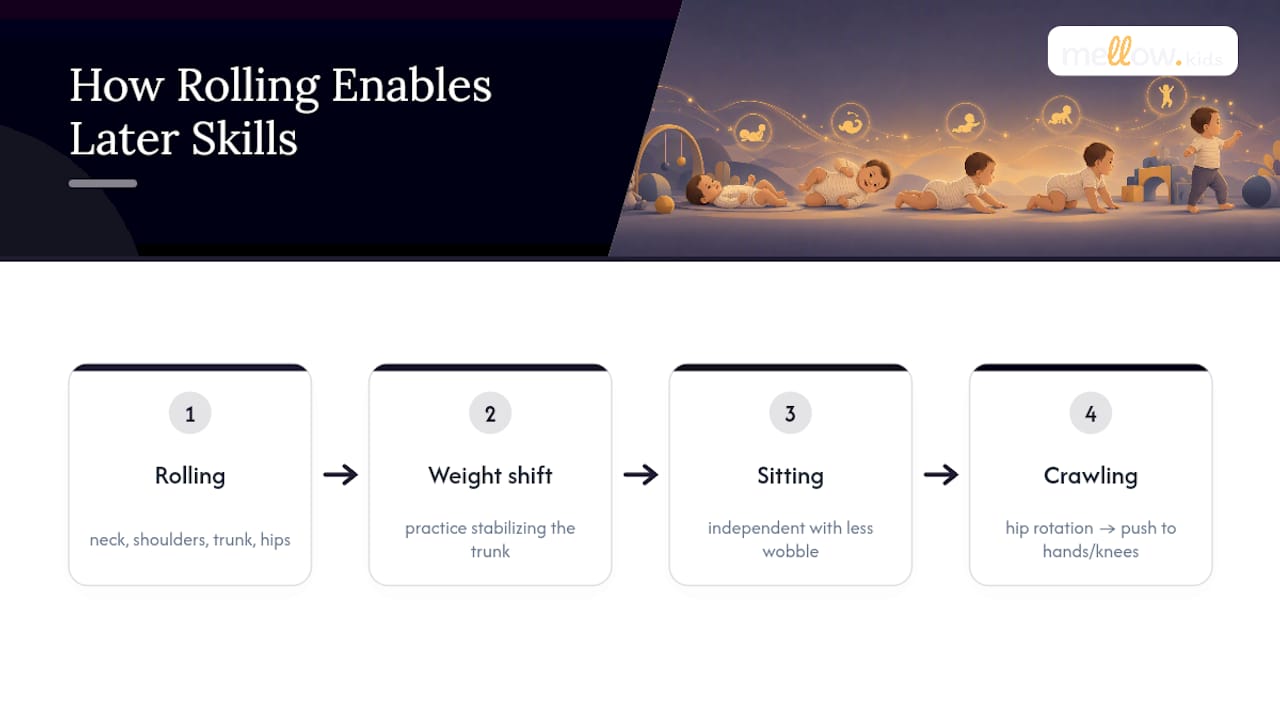
Crawling builds on this even further. The hip rotation used in a back-to-tummy roll is nearly identical to the movement a baby uses to push up onto hands and knees. Some babies even use rolling as their primary form of mobility for weeks before crawling clicks, rolling across a room to reach a toy instead of crawling toward it.
This is part of why pediatricians treat rolling as a meaningful checkpoint rather than a milestone to check off and forget. A milestone checklist that tracks the first year holistically can help you see how rolling connects to what comes next, rather than viewing each skill in isolation.
Common Parent Worries, and What Actually Reassures
Nearly every parent hits a moment of quiet panic around this milestone, usually triggered by a friend's baby rolling "early" or a pediatrician's app showing a milestone as "upcoming" without much context.
A few worries come up again and again. "My baby only rolls one way, is that a problem?" Almost never, at least not on its own. One-directional rolling for several weeks is common and typically resolves as the harder direction catches up. "My baby rolled once and never again, did I imagine it?" No. Early rolls are often inconsistent because the movement hasn't been fully wired in yet; it'll return with more practice. "Everyone else's baby rolled at 4 months and mine is almost 6." A two-month spread is well within normal range, and it says very little about long-term development.
The most reassuring shift you can make is trading a strict age target for a pattern check. Is your baby getting stronger during tummy time compared to a month ago? Are they showing more interest in reaching, rocking, or pushing up? Progress, not a specific date, is the real signal worth watching.
Discomfort or Pain That Can Slow Rolling Progress
Sometimes a rolling delay has nothing to do with strength or timing and everything to do with discomfort. A baby who's uncomfortable on their tummy has little motivation to practice the movements that lead to rolling.
Watch for these signs during tummy time specifically:
- Immediate, intense crying the moment they're placed on their stomach, rather than the mild fussiness that's common at first.
- Arching away from the floor or stiffening rather than settling into the position after a minute or two.
- A visible preference for turning the head only one direction, which can point to torticollis, a tightness in the neck muscle that makes tummy time genuinely uncomfortable.
- Reflux symptoms that worsen when lying flat, making tummy time feel physically unpleasant rather than just unfamiliar.
If tummy time consistently triggers distress well beyond the typical newborn adjustment period, it's worth mentioning to your pediatrician rather than pushing through it. Torticollis in particular responds well to early physical therapy, and catching it early often shortens the whole process considerably.
Why the Rush to a "Normal" Age Misses the Point
Most rolling-over-age content leads with a chart and stops there, as if a date on a calendar tells you anything meaningful about your baby's development. It doesn't. What actually predicts a smooth path through this milestone is the pattern of small physical gains, head control, push-up strength, weight-shifting, not the week number attached to the first roll.
The conventional advice also underplays urgency on safety. Parents get told the age range but rarely told clearly enough that the safety changes need to happen the moment rolling is attempted, not once it's mastered. That gap causes real risk during an ordinary, low-drama transition.
If you take one thing from all of this: watch behavior, not birthdays. Adjust your sleep setup the day you see the first wobbly attempt, and treat everything else, the exact week, the direction, the pace, as background noise. That's where the real safety margin lives.
— Mauricio Vargas
This article is general information, not a substitute for advice from a qualified doctor. Consult a qualified healthcare professional about your own circumstances before acting on anything here.
Sources
- When Does a Baby Start to Roll Over? — WebMD
- When Babies Start To Roll Over (and How To Encourage It) — Cleveland Clinic
- What Is the Moro Reflex in Babies? — Cleveland Clinic
- Healthychildren