
Sleep training for a 4-month-old is the process of teaching your baby to fall asleep independently, using methods matched to your infant's developmental readiness and your family's comfort level. At four months, babies experience a major neurological shift that permanently changes how they cycle through sleep stages. This shift, commonly called the 4-month sleep regression, is not a phase that passes on its own. It is the new normal, and it is exactly why so many parents start researching sleep training at this stage. This guide covers the main methods, how to prepare, a step-by-step process, and what to do when things go sideways.
Which sleep training methods work best for a 4-month-old?
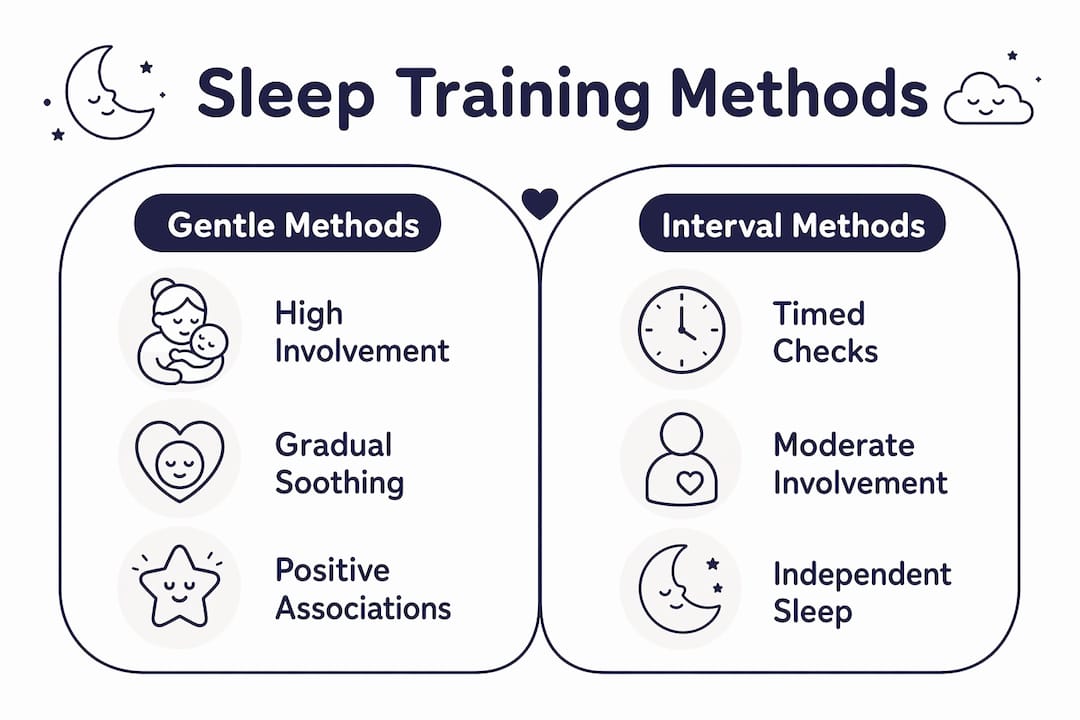
Three main approaches define sleep training for 4-month-old babies: gentle methods, moderate interval methods, and extinction. Each works differently, and the right fit depends on your baby's temperament and how much crying you can tolerate as a parent.
Gentle methods focus on gradual soothing and building positive sleep associations. You place your baby in the crib drowsy but awake, then respond with brief check-ins every 5–10 minutes if they fuss. The goal is to offer reassurance without immediately picking them up, so your baby learns the crib is a safe, comfortable place. This approach takes longer but produces less distress for both baby and parent.
The Ferber method is a moderate interval approach. You put your baby down awake, leave the room, and return at timed intervals to offer brief verbal or physical comfort. The intervals increase gradually over several nights. The Child Mind Institute notes that parents should watch for trends across multiple nights rather than reacting to a single hard night. One rough night does not mean the method is failing.
Extinction, often called cry-it-out, involves placing your baby down awake and not returning until morning or a set feeding time. There are no check-ins. This method tends to produce faster results, but it requires strong parental resolve and is not suited to every family.
| Method | Parental involvement | Typical emotional response |
|---|---|---|
| Gentle (gradual soothing) | High, frequent check-ins | Low to moderate distress |
| Ferber (timed intervals) | Moderate, scheduled check-ins | Moderate distress, decreasing nightly |
| Extinction (cry-it-out) | Low, no check-ins | Higher initial distress, faster resolution |
Pro Tip: No single method is universally superior. The most effective approach is the one you can apply consistently every night, because switching methods mid-process is one of the most common reasons sleep training stalls.
How do you prepare your 4-month-old for sleep training?
Preparation matters as much as the method itself. Skipping this step is why many parents feel like sleep training "isn't working" when the real issue is that the conditions were never right to begin with.
Check developmental readiness first. Signs your baby may be ready to include showing early self-soothing behaviors like sucking on their hands, settling briefly between sleep cycles, and following a loosely predictable sleep pattern. That said, experts often recommend waiting until 6 months for most families, since developmental readiness varies widely. Some babies are ready at 3–4 months; others are not.
Talk to your pediatrician before you start. A healthcare provider can confirm that your baby's growth and feeding are adequate to support longer stretches without nighttime feeds. Starting sleep training when a baby still genuinely needs a nighttime feeding will make the process harder and less effective.
Build a consistent bedtime routine. Research shows that pre-sleep rituals involving baths, lullabies, gentle massage, and dim lighting signal sleep time and help babies transition from alert to drowsy. The routine does not need to be long. Fifteen to twenty minutes is enough. What matters is that it happens in the same order every night.
Here are the core environment factors to get right before night one:
- Crib setup: Baby sleeps on a firm, flat surface with no loose bedding, following safe sleep guidelines.
- Lighting: Use blackout curtains or shades to block light, especially during early evening bedtimes.
- Sound: A white noise machine at a consistent, low volume can mask household noise and help your baby stay asleep between cycles.
- Temperature: Keep the room between 68°F and 72°F for comfortable sleep.
- Timing: Put your baby down before they are overtired. Watch for sleepy cues like eye rubbing and slowing movements, not full-on crying.
Pro Tip: Align your nap and night schedule before starting sleep training. A baby who is chronically overtired from poor naps will fight bedtime harder, making every method feel like it is not working.
How to sleep train a 4-month-old: a step-by-step process
Once your environment is set and your pediatrician has given the green light, follow a clear process. Consistency in the first two weeks is what separates families who see results from those who give up too early.
- Choose your method and commit to it. Decide before night one whether you are using gentle, Ferber, or extinction. Write down your check-in intervals if using Ferber. Discuss the plan with your co-parent so you both respond the same way.
- Run your bedtime routine. Bath, feed, lullaby, dim lights. Keep it calm and predictable. End the routine in the room where your baby sleeps.
- Put your baby down drowsy but awake. This is the single most important step. A baby placed fully asleep will wake between sleep cycles and not know how to get back to sleep without your help. Drowsy but awake teaches independent sleep skills from the very first night.
- Follow your method's rules exactly. If you are using Ferber, your first check-in might be at 3 minutes, then 5, then 10, increasing each night. If you are using gentle soothing, check in every 5–10 minutes with brief verbal reassurance. If you are using extinction, do not re-enter the room.
- Keep check-ins brief and calm. When you do check in, spend no more than 60 seconds. Offer a quiet "I love you, it's time to sleep" and leave. Picking up your baby during a Ferber check-in resets the process.
- Respond consistently to every waking. Apply the same approach at 9:00 PM and at 3:00 AM. Inconsistency at night wakings is the most common reason sleep training takes longer than expected.
- Track your progress across nights, not hours. Most babies show meaningful improvement by nights 3–5. Some take up to two weeks.
| Step | Gentle method | Ferber method | Extinction |
|---|---|---|---|
| Baby placement | Drowsy but awake | Drowsy but awake | Drowsy but awake |
| Check-in frequency | Every 5–10 minutes | Timed, escalating intervals | None |
| Response to crying | Brief verbal or touch comfort | Brief verbal comfort only | No response |
| Typical improvement | 1–2 weeks | 3–7 nights | 2–5 nights |
What are the most common sleep training challenges at 4 months?
Even with the right method and preparation, obstacles come up. Knowing what to expect keeps you from abandoning a working plan too soon.
- The 4-month sleep regression itself. This regression is not a temporary blip. It reflects a permanent change in how your baby's brain processes sleep cycles. Consistent routines and self-soothing are the primary tools for managing it, not waiting it out.
- Inconsistent parental responses. If one parent does check-ins and the other picks the baby up, your baby receives mixed signals. Agree on your approach before you start and hold each other accountable.
- Confusing distress with hunger. At four months, some babies still need one or two nighttime feeds. If your baby feeds and immediately settles, that was hunger. If they feed and then fuss again, the issue is likely a sleep association, not hunger. Your pediatrician can help you determine which nighttime wakings are feeding-related.
- Teething and illness disruptions. Pause sleep training during illness. Teething discomfort at four months is rare but possible. If your baby is running a fever or clearly unwell, this is not the time to hold firm on check-in intervals.
- Giving up too early. Night one and night two are almost always the hardest. Many parents interpret a rough second night as proof the method is not working. It is not. Watching for trends across a full week gives you a much more accurate picture.
Pro Tip: If your baby is extremely distressed every night for more than two weeks with no improvement, consult your pediatrician or a certified sleep consultant. Persistent difficulty may signal an underlying issue that a method change alone will not fix.
Key Takeaways
Successful sleep training at four months requires matching your method to your baby's temperament, preparing your environment, and applying your chosen approach with unwavering consistency across at least one full week.
| Point | Details |
|---|---|
| Method choice matters | Pick gentle, Ferber, or extinction based on your comfort level and your baby's temperament. |
| Preparation is non-negotiable | Confirm readiness with your pediatrician and build a consistent bedtime routine before night one. |
| Drowsy but awake is the foundation | Placing your baby down awake is the core skill that makes every method work. |
| Consistency drives results | Inconsistent responses at night wakings are the leading reason sleep training stalls. |
| Trends beat single nights | Evaluate progress over 5–7 nights, not one hard evening, before deciding to change your approach. |
What I've learned after watching hundreds of families sleep train at 4 months
The most common mistake I see is parents choosing a method based on what sounds right in theory rather than what they can actually sustain at 2:00 AM on night three. Extinction sounds efficient until you are standing in the hallway listening to your baby cry. Gentle soothing sounds kind until you realize you have been doing check-ins for 90 minutes. Neither method fails because it is wrong. It fails because the parent was not prepared for what it actually feels like.
The other thing I want to say plainly: four months is early. The Child Mind Institute and most pediatric sleep experts set 6 months as the standard starting point for a reason. If you start at four months and it is not going well, that is not a failure. It may simply mean your baby needs a few more weeks. Waiting is a legitimate choice, and it does not mean you missed a window.
What does matter is that when you do start, you go in with a clear plan, a consistent partner, and realistic expectations. Sleep training is not a cure for all nighttime waking. It is a skill-building process. Your baby is learning something genuinely hard, and so are you. Give it time, track your nights, and ask for help when you need it.
— Mauricio
How Mellow supports your baby's sleep from 4 months onward
Knowing which method to use is one thing. Having support through the process is another.

Mellow is built specifically for parents navigating the 0–2 year window, including the 4-month sleep regression and everything that follows. The Mellow Kids app gives you age-specific guidance that arrives before each developmental shift, not after you are already exhausted and searching for answers at midnight. You get structured routines, progress tracking, and evidence-based strategies matched to your baby's exact stage. As your child grows, Mellow continues to prepare you for what comes next, from the 8–10 month sleep changes through toddlerhood. You do not have to figure this out alone.
FAQ
Is 4 months too early to start sleep training?
Four months is on the earlier end. Most experts recommend starting at 6 months, but some babies show readiness signs as early as 3–4 months. Consult your pediatrician before beginning.
How long does sleep training take at 4 months?
Most babies show clear improvement within 3–7 nights using Ferber or extinction methods. Gentle approaches typically take 1–2 weeks. Progress varies by temperament and consistency.
Will sleep training harm my baby emotionally?
Current research does not support lasting emotional harm from evidence-based sleep training methods. The evidence on sleep training consistently shows that well-rested babies and parents support healthier development overall.
What if my baby cries for hours during sleep training?
Extremely prolonged crying every night for more than two weeks without improvement is a signal to pause and consult your pediatrician. One or two hard nights early in the process is normal and expected.
Do I need to stop nighttime feedings to sleep train?
Not necessarily. At four months, many babies still need one or two nighttime feeds. Your pediatrician can help you identify which wakings are hunger-driven and which are habit-driven before you begin.