
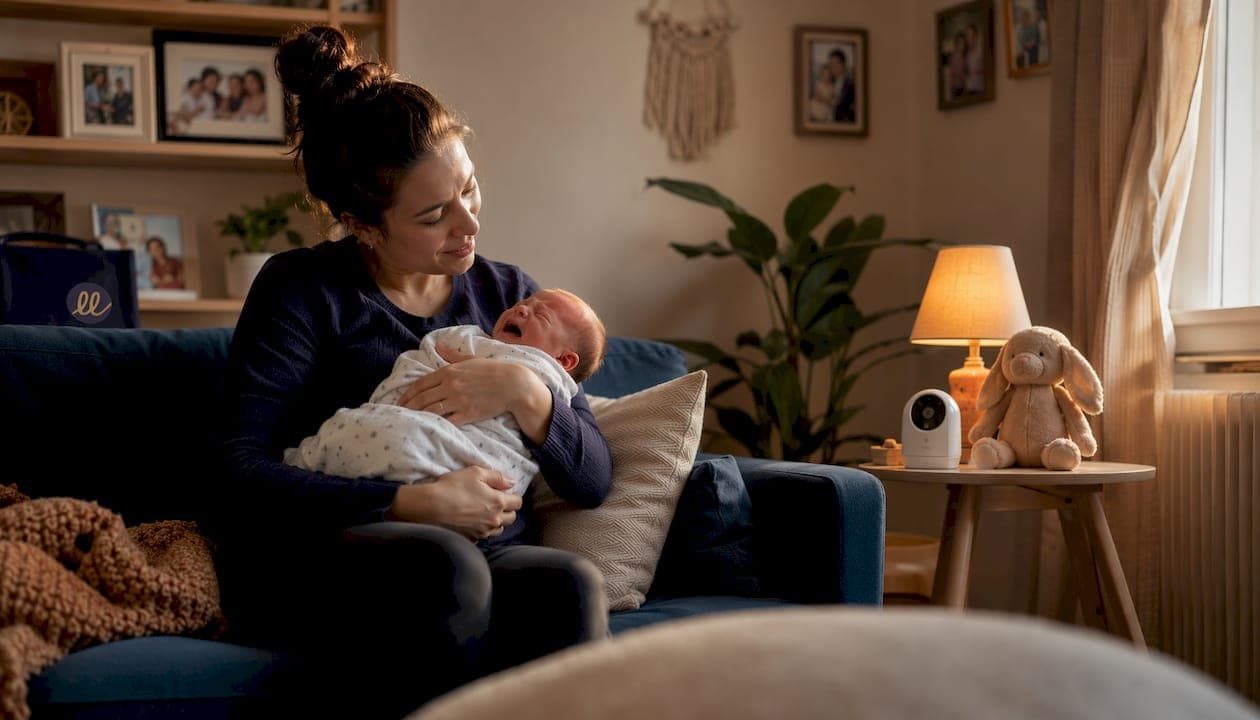
Most babies cry for anywhere from a few minutes to over an hour on the first night of sleep training, then noticeably less by night three or four. There is no single "magic minute" that works for every child. What matters most is confirming your baby is safe and fed before you begin, picking a method you can apply consistently, and knowing that the hardest night is almost always the first one.
Before you leave your baby to settle, run through three quick checks:
- Confirm safety, hunger, and health first. A baby who is hungry, running a fever, or in pain should not be left to cry. Rule those out before starting any session.
- Choose one method and commit to it. Switching between approaches midnight, or across nights, prolongs training and can trigger an extinction burst where crying actually intensifies.
- Expect the most crying on night one. Crying often peaks on the first night and commonly drops noticeably within a week. Many parents see real improvement by night three.
Red flags that require you to check immediately or call your pediatrician: crying that sounds like pain rather than protest, a fever, poor urine output, refusing feeds, or no measurable improvement after roughly two weeks of consistent training. If any of those appear, pause and consult your pediatrician before continuing.
Table of Contents
- How long to let your baby cry depends on which method you choose
- When is your baby actually ready to start sleep training?
- What to check before you leave your baby to settle
- How to do graduated checks (Ferber-style): a night-by-night plan
- How to use strict extinction (CIO) safely
- How long does sleep training usually take, and when should you change course?
- What does the research actually say about crying during sleep training?
- Practical tips and troubleshooting from Mellow
- Key Takeaways
- Listening to yourself matters as much as the method
- Mellow can guide you through every night of sleep training
- Useful sources and further reading
How long to let your baby cry depends on which method you choose
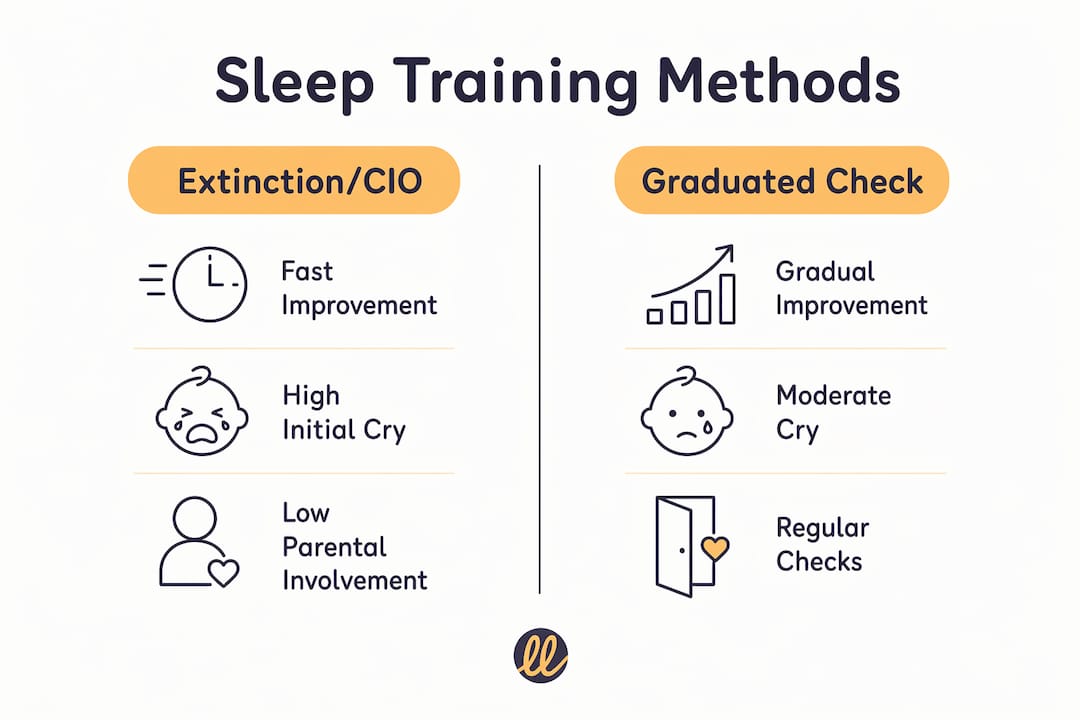
The answer to "how long" is inseparable from the method you pick. Each approach carries a different crying expectation, a different level of parental involvement, and a different timeline to results. Here is how the most common ones compare.

| Method | Typical initial crying | Usual nights to improvement | Parental involvement | Best fit |
|---|---|---|---|---|
| Graduated checks (Ferber-style) | 20–45 min, night one | 7–10 nights | Moderate (timed check-ins) | Parents who need to respond but can hold off |
| Extinction/CIO | Minutes to 60+ min, night one | 3–4 nights | Low (no room entry until morning) | Parents who can tolerate a harder start for faster results |
| Pick-up/put-down | Variable crying duration, often longer | May take several weeks | High (frequent in-room response) | Families with younger infants or low tolerance for crying |
| Chair/camping out | Moderate crying decreasing over time | Typically requires several weeks | High (gradual physical withdrawal) | Parents who want presence without full feeding/rocking |
| Gentle/controlled comforting | Low to moderate crying | Can require multiple weeks for improvement | Very high | Families prioritizing minimal crying over speed |
A few things worth knowing about these timelines. Strict extinction (CIO) tends to produce the fastest results of any method, but the first night can be genuinely hard. Graduated checks soften that first night at the cost of a slightly longer overall process. Gentler approaches like camping out or pick-up/put-down can work well for many families but generally require weeks of consistent practice before sleep consolidates.
One thing no study has established: that a specific check interval, say 3 minutes versus 10 minutes, reliably outperforms another. No high-quality evidence identifies one interval schedule as superior. Your ability to apply the schedule consistently matters far more than the exact numbers on the clock.
When is your baby actually ready to start sleep training?
Most pediatric guidance points to 4–6 months (roughly 16 weeks corrected age) as the earliest window for standard sleep training. Before that, babies typically need nighttime feeds and have not yet developed the neurological capacity for reliable self-soothing. That does not mean you cannot work on healthy sleep habits earlier, but formal training before 16 weeks is generally not recommended.
For toddlers in the 15–24 month range, sleep training still works, though the protest can be louder and more persistent because older children understand cause and effect. The principles are the same; the emotional intensity is often higher.
Behavioral signs your baby is ready:
- Settles briefly on their own at least occasionally (a hint of self-soothing capacity)
- Has a reasonably predictable feeding schedule and is gaining weight normally
- Shows consistent wake windows during the day (not overtired or under-tired at bedtime)
- Has been healthy for at least a week with no illness, vaccinations, or major disruptions in the last few days
Pro Tip: Delay starting if your baby is sick, teething intensely, recovering from travel, or in the middle of a developmental leap. Sleep training during a disruption usually means more crying and slower results. Wait until you have at least 10–14 days of relative stability ahead of you.
Understanding how sleep patterns shift with development can help you time your start more precisely, since the weeks just after a developmental leap are often the worst time to begin.
What to check before you leave your baby to settle
Running a short pre-sleep checklist each night is not optional. It is what separates productive crying (protest to a habit change) from crying that signals a real need.
Each night before sleep training, confirm:
- Safe sleep environment: firm, flat mattress; no loose blankets, pillows, or bumpers; baby on their back
- Last feed: baby fed within the last 30–60 minutes and not showing hunger cues
- Diaper: clean and dry
- Room temperature: 68–72°F is the commonly cited comfortable range for infants
- Health screen: no fever, no unusual fussiness earlier in the day, no signs of ear pain or respiratory distress
A consistent pre-sleep routine also does real work here. A 20–30 minute sequence of bath, lotion, feeding, a short story or song, and a calm put-down in the crib while baby is drowsy but awake gives your baby a reliable signal that sleep is coming. That routine is not decoration; it is part of the training.
Clinical guidance is clear that if crying sounds like pain rather than protest, or if it is paired with other concerning signs like refusing feeds or unusual lethargy, you should intervene and assess rather than continue the session. The AAP's safe sleep recommendations, including back-to-sleep positioning and a clutter-free crib, apply every night regardless of which training method you use.
How to do graduated checks (Ferber-style): a night-by-night plan
Graduated checks, often called the Ferber method, work by having you check on your baby at progressively longer intervals. You are present enough to reassure yourself that baby is safe, but you are not picking up, feeding, or rocking to sleep.
Step-by-step for the first two weeks:
- Complete your bedtime routine and place baby in the crib drowsy but awake.
- Say a brief, calm goodnight phrase ("It's sleepy time, I love you") and leave the room.
- If baby cries, wait the interval for that night before entering.
- During a check: enter calmly, speak softly for 1–2 minutes, offer a brief pat if needed, then leave again before baby is asleep. Do not pick up, feed, or stay until they settle.
- After each check, extend the wait time before the next one.
- Repeat until baby falls asleep.
Sample interval schedule:
| Night | First wait | Second wait | Third wait and beyond |
|---|---|---|---|
| 1 | 3 min | 5 min | 10 min |
| 2 | 5 min | 10 min | 10 min |
| 3 | 10 min | 10 min | 15 min |
| 4 to several | minutes | 15 min | minutes |
| 8+ | 15 min | 20 min | 20 min |
These are example intervals, not mandates. As Cleveland Clinic pediatricians note, the key is to gradually extend how long you wait, not to hit a specific number.
What resets the method: picking baby up and rocking or feeding to sleep, staying in the room until they are fully asleep, or abandoning the schedule mid-night. Any of those signals to your baby that crying long enough brings the old response back.
Troubleshooting the extinction burst: Many parents hit a harder night two or three. This temporary spike in crying is normal and usually resolves if you hold the plan. The instinct to rescue is strongest right here. Tracking the actual minutes of crying each night often helps, because the numbers usually show progress even when it does not feel that way.
Pro Tip: Write down your check intervals before bedtime so you are not making decisions under pressure at 2 AM. Having the schedule on paper means you follow the plan, not your exhausted instincts.
How to use strict extinction (CIO) safely
Strict extinction, commonly called the cry-it-out method, means placing your baby in the crib awake and not re-entering the room until morning (or a pre-agreed safe check time). There are no timed intervals. The baby learns to fall asleep without a parental response.
In strict CIO, crying duration varies widely; some babies settle quickly while others may cry for an extended period on the first night. That variability is real and documented. What the evidence does show is that crying typically decreases across 3–4 nights when the approach is applied consistently.
The difference from graduated checks is significant. With CIO, you are not going in at all during the settling window. That makes it harder emotionally for many parents, but it also removes the variable of whether your check is accidentally reinforcing the crying.
Before you start CIO, confirm:
- Baby is at least 4–6 months old and medically healthy
- The pre-sleep checklist above is complete (fed, safe environment, no illness signs)
- Both caregivers are aligned on the plan for the night
What to expect, night by night:
- Night one: Potentially long crying, sometimes 45–60 minutes or more. This is the hardest night for most families.
- Nights two through four: Crying duration commonly drops, often significantly.
- By night four or five: Many babies are settling within minutes.
Red flags that require you to enter the room regardless of the method: crying that escalates to a shriek or sounds like pain, vomiting, or any sign of physical distress. As Cleveland Clinic pediatricians put it, if your baby is shrieking after a set period, it is time to go in and reset. CIO is not a reason to ignore genuine distress signals.
For parents who find strict CIO too difficult to sustain, that is not a failure. Consistency matters more than the specific method, and a graduated approach you can actually follow will outperform a strict approach you abandon on night two.
How long does sleep training usually take, and when should you change course?
The timeline varies by method, but the general pattern is consistent across clinical summaries.
| Method | Typical improvement timeline |
|---|---|
| Extinction/CIO | 3–4 nights |
| Graduated/Ferber | 7–10 nights |
| Gentler methods (camping out, pick-up/put-down) | Up to 3–4 weeks |
"Improvement" here means noticeably shorter settling times and fewer or shorter night wakings, not necessarily sleeping through the night without any sound. Full consolidation often takes a few more weeks after the initial training period.
Signs it is time to change strategies:
- No measurable reduction in crying duration after two full weeks of consistent training
- Sleep is getting worse, not better (more night wakings, shorter total sleep)
- Feeding has dropped off or weight gain has slowed
- Baby seems unusually distressed during the day, not just at bedtime
When to call your pediatrician: weight loss or poor weight gain, fever, respiratory symptoms, ear tugging paired with crying, extreme lethargy, or any sign of physical illness. If a sleep-training program shows no improvement in about two weeks, a pediatrician can rule out underlying issues and help you co-develop a different approach. Sleep regressions tied to developmental milestones can also stall progress; understanding how to manage those regressions is a separate but related skill.
What does the research actually say about crying during sleep training?
The short answer: the evidence does not support the fear that appropriate sleep training causes lasting emotional harm.
A widely cited 2012 study published in Pediatrics (PMC3422632) found no significant differences in stress hormones, behavior, or parent-child attachment between sleep-trained infants and controls. A 2016 randomized controlled trial published in Pediatrics (publications.aap.org) similarly found no evidence of increased emotional or behavioral problems in children who underwent behavioral sleep interventions. Research reviews also note that parent education combined with sleep-training strategies reduced reported sleep problems at follow-up, with benefits for both children and parents.
Pediatric sleep experts frame the crying that occurs during training as protest to a habit change, not evidence of harm, provided basic needs and safety are met.
The practical takeaway from the evidence is straightforward: confirm safety, choose a consistent plan, and track progress night by night. Mellow's evidence-based review of sleep training covers the key studies in more depth if you want to read further.
Practical tips and troubleshooting from Mellow
Even with a solid plan, real-world sleep training rarely goes in a straight line. Here are three templates and a troubleshooting checklist to keep you on track.
Sample bedtime routine (30 minutes)
- T-30 min: Begin wind-down. Dim lights, lower noise, stop active play.
- T-20 min: Warm bath or sponge wipe.
- T-15 min: Lotion, pajamas, sleep sack.
- T-10 min: Final feed (breast or bottle) in a calm, lit room.
- T-5 min: One short book or song.
- T-0: Place baby in crib drowsy but awake. Say your goodnight phrase and leave.
Nap training anchor plan
Start nap training only after nights are improving, or run both simultaneously if you have the capacity. Pick one consistent nap location (the crib, not the stroller or car seat) and use the same abbreviated version of your bedtime routine. If baby does not fall asleep within 30–45 minutes, end the nap attempt and try again at the next wake window. For a fuller breakdown of when to apply training to naps versus nights, Mellow's guide on nap and night sleep training timing is worth reading before you start.
Night-check script (for graduated methods)
Walk in calmly. Say: "I'm here. You're okay. It's sleepy time." Offer one brief pat on the back or chest. Do not make eye contact for more than a second or two. Leave within 90 seconds. That is it. Longer stays or emotional responses tend to escalate rather than calm.
Troubleshooting checklist:
- Crying gets worse on night two or three: This is likely an extinction burst. Hold the plan for two more nights before reassessing.
- Baby was doing well, then regressed after a trip or illness: Restart from night one of your chosen method. Regressions after disruptions are normal.
- One caregiver is inconsistent: Align before bedtime, every night. A single rescue can reset days of progress.
- Naps are not improving: Check that wake windows are appropriate for age. An overtired or under-tired baby at naptime will resist settling regardless of method.
Pro Tip: Track the actual minutes your baby cries each night in a simple notes app. Parents almost always underestimate progress because the crying feels longer than it is. Objective data helps you decide whether to continue or consult a professional.
Choosing a method that matches your emotional capacity is not a compromise. It is the strategy. Consistency beats the "perfect" interval every time.
Key Takeaways
Most babies show meaningful improvement within 3–10 nights of consistent sleep training, with crying peaking on night one and declining steadily when parents apply one method without switching.
| Point | Details |
|---|---|
| No magic minute exists | No study has shown one specific check interval outperforms another; consistency matters more than the exact timing. |
| Night one is the hardest | Crying commonly peaks on the first night and drops noticeably by night three or four across most methods. |
| Method shapes the timeline | CIO typically shows results in 3–4 nights; graduated checks in 7–10 nights; gentler methods up to 3–4 weeks. |
| Red flags require action | Pause training if you see pain-like crying, fever, poor feeding, or no improvement after two weeks, and call your pediatrician. |
| Mellow offers age-specific plans | The Mellow app provides personalized sleep schedules and night-by-night tracking tailored to your baby's exact age and stage. |
Listening to yourself matters as much as the method
Sleep training is one of those parenting decisions that sits right at the intersection of exhaustion and self-doubt. You are trying to do right by your baby while running on broken sleep yourself, and every cry feels louder at 1 AM than it would at noon. That is not weakness. That is just the reality of this season.
What the research keeps coming back to is not that one method is morally superior, but that the method you can actually sustain is the one that works. A graduated plan applied imperfectly for three weeks will not serve your family as well as a gentler approach you follow through on every single night. Track your progress objectively, lean on the data rather than the feeling, and reach out for help when progress stalls. You do not have to figure this out alone, and stalling at two weeks is a signal to get support, not to push harder in isolation.
Mellow can guide you through every night of sleep training
Sleep training is easier when you have a plan built around your baby's specific age, not a generic schedule copied from a forum. Mellow gives parents of newborns through 2-year-olds personalized sleep routines, age-specific guidance, and night-by-night progress tracking so you always know whether things are moving in the right direction.

Whether your baby is in the thick of the 8–10 month sleep window or you are navigating the 11–14 month stretch with its own set of challenges, Mellow's app walks you through a step-by-step plan matched to your child's developmental stage. You get reminders, tracking tools, and evidence-based resources, all in one place, so you spend less time searching and more time sleeping. Download the Mellow app and get your baby's personalized sleep plan today.
Useful sources and further reading
These are the primary sources used in this article, along with a few additional resources for parents who want to go deeper.
- Mayo Clinic: Healthy Baby Sleep Guidance — Practical clinical guidance on when to consult a pediatrician and how to assess crying in context.
- UChicago Medicine: Sleep Training in Infants and Toddlers — Clear method-by-method timeline summaries from a major academic medical center.
- NPR Health Shots: Sleep Training Truths — Balanced review of what the science can and cannot tell us about crying during training.
- Cleveland Clinic: Cry-It-Out Method — Pediatrician-reviewed explainer on CIO, graduated extinction, and when to intervene.
- Dr. Craig Canapari: How Long Will My Child Cry? — Pediatric sleep specialist's practical breakdown of crying duration, extinction bursts, and tracking.
- Pampers: Cry-It-Out Method Explained — Parent-facing summary of strict CIO expectations and consistency guidance.
- PMC3422632 (Pediatrics, 2012) — Peer-reviewed study finding no significant differences in stress or attachment outcomes between sleep-trained and control infants.
- AAP Behavioral Interventions for Infant Sleep (Pediatrics, 2016) — Randomized controlled trial showing no increased emotional or behavioral problems following behavioral sleep interventions.
- Mellow: Sleep Training Evidence Review — Mellow's own evidence-based summary for parents who want a deeper look at the research.
- Audiobooks and Early Childhood Literacy: A Parent's Guide — Useful companion resource for parents exploring calming audio and bedtime story routines alongside sleep training.
When in doubt about your baby's health or whether sleep training is appropriate for your child's specific situation, your pediatrician is always the right first call.
This article is for general informational purposes only and does not constitute medical advice. Consult your pediatrician or a qualified healthcare professional for guidance specific to your child's health and development.