
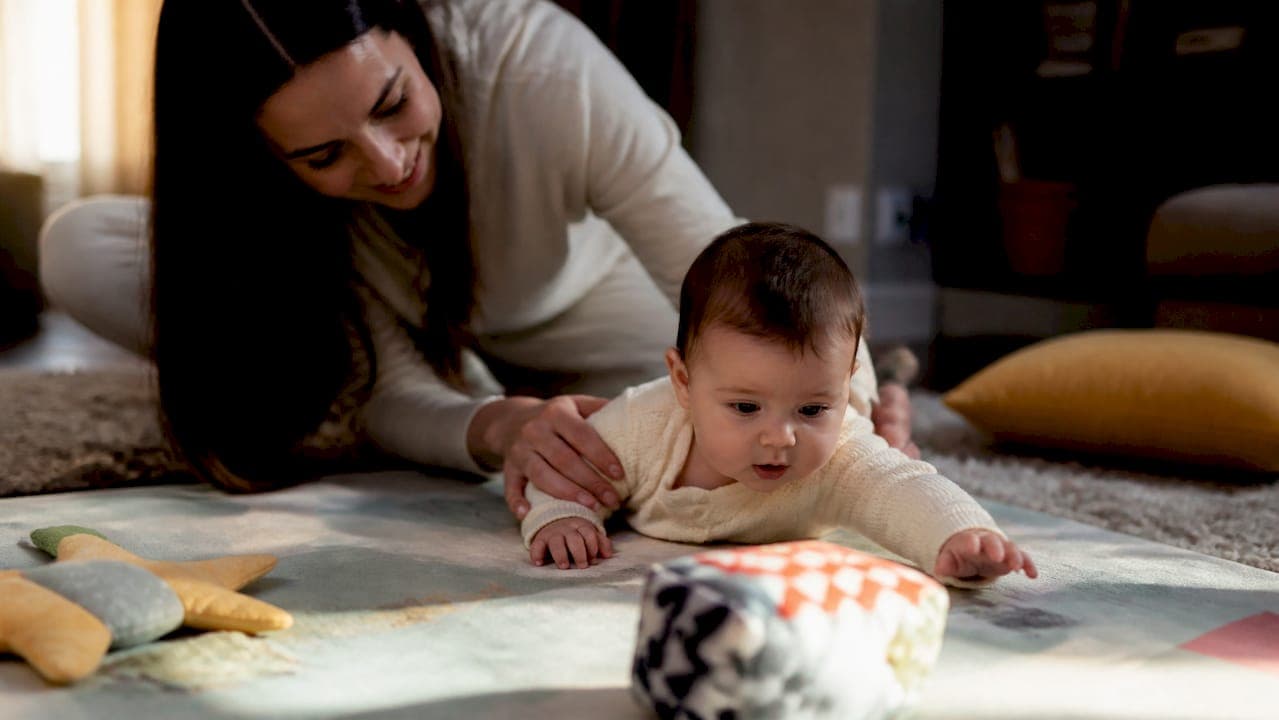
For a newborn, aim for two to three short sessions daily. By 2 to 4 months, increase to multiple short sessions lasting several minutes each. By 6 months, most babies can tolerate prolonged tummy time spread throughout the day in longer, more independent stretches. The rule underneath all of it is: start small, repeat often, and let tolerance build the schedule rather than the clock.
Every plan follows the same shape. Short, frequent sessions early on. Longer, more consolidated sessions as neck and shoulder strength improve. A few practical anchors make the whole thing easier to stick to:
- Schedule sessions after a diaper change or a nap, never right after a feed.
- Stay within arm's reach the entire time. Tummy time is always supervised, always on a firm surface, and never a substitute for back sleeping.
- If your baby fusses in the first minute, that's normal. End on a calm note rather than pushing for one more minute.
Pediatric guidance from the American Academy of Pediatrics recommends two to three short three to five minute sessions daily for very young infants, increasing in length and frequency as head control develops. That single guideline is the backbone of everything below.
Key Takeaways
Tummy time should progress from two to three minute sessions several times a day as a newborn to 60 to 90 total daily minutes by 6 months, with consistency mattering more than hitting any single number.
| Point | Details |
|---|---|
| Start immediately | Begin short sessions as soon as your baby is home, even if that's just one to two minutes at a time. |
| Frequency beats duration | Four to five short sessions a day build tolerance faster than one long, forced session. |
| Watch for red flags | A persistent head-turn preference or no progress by 6 to 8 weeks warrants a pediatrician conversation. |
| Safety is non-negotiable | Always supervised, always awake, always on a firm surface, and never during sleep. |
| Build it into routines | Attach tummy time to a fixed daily event, and let Mellow help turn the age-based chart into a plan matched to your baby's own schedule. |
Where to read more
- HealthyChildren.org (AAP) covers safe sleep positioning alongside tummy time frequency guidance.
- Cleveland Clinic breaks down exactly when to start and how to build tolerance safely.
- Nationwide Children's Hospital offers detailed session targets and transitional techniques like assisted airplane holds.
- KidsHealth (Nemours) explains the clinical signs that warrant a pediatrician visit.
- Lovevery maps position changes and milestones month by month.
Table of Contents
- Why Tummy Time Matters for Development and Head Shape
- Tummy Time by Age: The Full Chart
- How to Do Tummy Time the Right Way
- What to Do When Your Baby Resists
- How Mellow Tailors a Tummy Time Plan to Your Baby
- Build a Tummy Time Plan That Fits Your Baby's Actual Day
- Frequently Asked Questions
- Sources
Why Tummy Time Matters for Development and Head Shape
Tummy time builds the neck, shoulder, arm, and trunk strength your baby needs to roll, sit, and eventually crawl. It's the single biggest lever parents have over early gross motor development, and it does double duty: strengthening muscles while also taking pressure off the back of the skull.
Babies spend most of their day on their backs, whether sleeping, riding in a car seat, or lying in a bassinet. That's necessary for safe sleep, but it also means consistent pressure on one part of the head. Time spent prone gives that area a break and encourages the kind of active neck rotation and lifting that shapes healthy motor patterns. Nationwide Children's Hospital notes that tummy time builds strength in the neck, shoulders, arms, and trunk, which supports rolling, sitting, and crawling while also helping maintain a rounded head shape.
Consistent, brief prone practice each day does more for early motor development than occasional long sessions. Strength builds through repetition, not duration.
The takeaway for scheduling purposes: frequency beats intensity. Five short sessions spread across the day accomplish more than one marathon attempt that ends in tears.
Tummy Time by Age: The Full Chart
Use this as your baseline. Every baby has an off day, and preterm infants or those with larger head circumference often need a gentler ramp than the chart suggests.

Nationwide Children's Hospital frames the early goal as building each session toward 10 minutes, four to five times daily, with some babies reaching about 90 minutes of total daily tummy time by around 4 months. That's an upper benchmark, not a pass/fail line.
A few notes worth flagging by stage. Newborns tire fast because the neck muscles are working against gravity for the first time. At 2 to 4 weeks, watch for signs the session should end early, like a red face or crying that doesn't settle with a change in position. By 3 to 5 months, position progression shifts toward elbow support and prone push-ups, which lay the groundwork for rolling and crawling. Babies born preterm or with a larger head circumference often need more frequent, shorter bursts rather than longer stretches, according to guidance from the Royal Children's Hospital.
Pro Tip: If your baby struggles to hit the daily total, prioritize consistency over the number. Five sessions of one minute each, spaced through the day, build tolerance faster than one long session that ends in tears.
How to Do Tummy Time the Right Way
Before you lay your baby down, run through this short checklist:
- Baby is awake and alert, not drowsy or just fed.
- You're within arm's reach the entire session.
- The surface is firm: a play mat or blanket on the floor, not a couch or pillow.
- The room is comfortably warm, and there's nothing nearby that could obstruct breathing.
Once the setup is right, the position you choose depends on age and tolerance. Chest-to-chest tummy time works well for newborns because your body's warmth and heartbeat are calming, and it doubles as bonding time. Lying your baby across your lap, with a slight recline, is a gentler entry point for babies who fuss on a flat mat. As strength develops, move to a firm mat, sometimes with a small rolled towel tucked under the chest to lift the shoulders slightly and encourage pushing. Cleveland Clinic recommends starting tummy time as soon as your baby is home from the hospital, beginning with very short sessions and building up frequency and duration as tolerance increases.
Timing matters as much as position. The best windows are right after a diaper change, before a nap rather than after a full feed, and any point where your baby is already alert and content. Avoiding tummy time on a full stomach isn't superstition. The American Academy of Pediatrics and pediatric specialists emphasize supervision, awake-only practice, and firm surfaces, while steering clear of sessions right after feeding to reduce spit-up and discomfort.

If your baby seems to hate every position, try adding a mirror at eye level or a high-contrast toy just out of reach. Engagement often does more to extend a session than any physical adjustment. And remember the one absolute: tummy time never happens during sleep. Babies always go down on their backs for naps and nighttime, no exceptions.
What to Do When Your Baby Resists
Resistance is common, and it doesn't mean you're doing anything wrong. A few adjustments usually help:
- Cut the session to 30 to 60 seconds and repeat it more often through the day instead of pushing for a longer stretch.
- Switch to chest-to-chest or lap positioning if the mat isn't working yet.
- Add a toy, board book, or mirror at eye level to give your baby a reason to lift their head.
- Try the "airplane" hold, carrying your baby prone along your forearm, as a transitional way to build pushing strength without full mat time.
- Get on the floor with them, face to face. Babies tolerate tummy time longer when a parent's face is the reward for lifting their head.
Pro Tip: For babies with reflux, upright variations like chest-to-chest or lying across your legs at a slight incline still build strength while easing discomfort. You don't need flat-mat time to make progress.
Most resistance resolves with patience and repetition. But a few signs are worth flagging to your pediatrician rather than waiting out. If your baby consistently turns their head to one side and resists turning the other way, or you notice one side of the head flattening, that's a sign worth mentioning at the next visit. Poor head control that isn't improving, or no progress toward pushing up or rolling by the expected window, are other markers pediatricians want to know about.
If a baby shows no improvement in tolerance or a persistent head-turn preference or asymmetry by 6 to 8 weeks, pediatricians advise evaluation for possible torticollis or other muscular issues.
That evaluation typically starts with a physical exam checking neck muscle tightness and range of motion, sometimes followed by a referral to physical therapy. Early referral tends to shorten the path to full range of motion, according to guidance from KidsHealth, so raising the concern sooner rather than later is worth the five-minute conversation at your next appointment.
How Mellow Tailors a Tummy Time Plan to Your Baby
Mellow builds tummy time into a baby's broader daily rhythm rather than treating it as an isolated task on a checklist, syncing it with feeding and sleep windows so the whole day fits together.
Picture a 2-month-old on a fairly typical schedule: wake at 7 a.m., feed, then a five-minute tummy time session on the mat while a parent narrates and holds up a high-contrast card. Second session happens after the early afternoon nap, another five minutes with a small mirror propped nearby. A third short burst, maybe three minutes on the lap, fits in before the evening wind-down. That's three sessions and roughly 13 minutes total, comfortably within the 2-month target range, and it never competes with sleep or feeding windows.
A repeatable structure looks something like this:
- Anchor the first session to a fixed daily event, like the first diaper change of the day.
- Add a second session after a nap, when your baby is alert but not yet hungry.
- Use a third session in the evening only if your baby is tolerating the first two well.
- Track total minutes loosely by week, not by day, so one off day doesn't feel like a setback.
Embedding sessions in existing routines, rather than scheduling them as a separate task, tends to produce better consistency over time, a pattern noted in guidance from Nationwide Children's Hospital on daily tummy time habits. Mellow's approach leans on that same insight: habits that piggyback on something you already do every day survive far longer than habits that need their own slot on the calendar.
Pro Tip: Pair tummy time with a task you already never skip, like the first diaper change after waking. You'll remember it without needing a reminder.
A short parenting perspective on patience and consistency
Most parents overestimate how much tummy time their baby "should" be doing by a given week, and that mismatch is where a lot of unnecessary guilt creeps in. The honest answer is that a baby who tolerates three one-minute bursts a day is making real progress, even if it looks nothing like the chart's upper range. Consistency, not volume, is what actually moves the needle week over week.
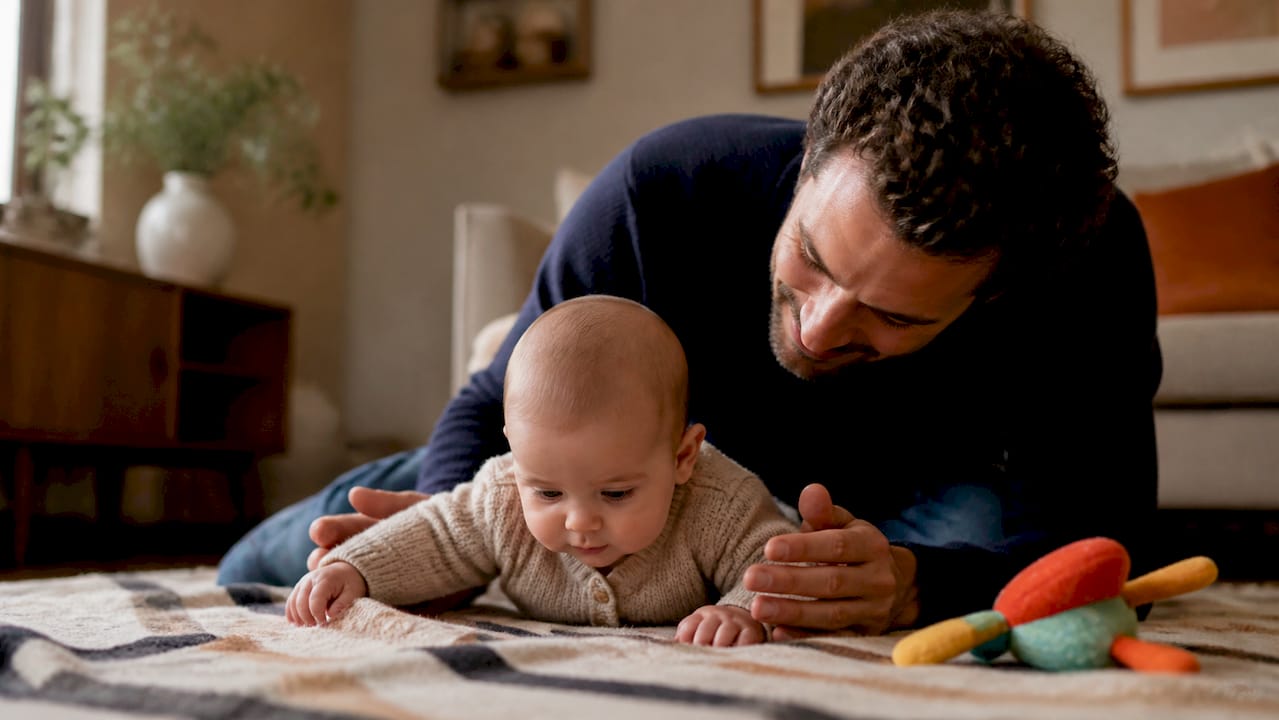
Don't turn tummy time into a battle of wills. If your baby is done, they're done. Pick it back up in an hour, pair it with your voice and your face, and let the strength come on its own timeline rather than yours.
Build a Tummy Time Plan That Fits Your Baby's Actual Day
Every baby tolerates tummy time differently, and guessing at the right pace is where most parents lose momentum. Mellow turns the age-based schedule above into a plan built around your baby's actual wake windows, feeds, and naps, so tummy time stops competing with the rest of the day and starts fitting into it.

Inside the app, you'll find personalized daily targets that adjust as your baby grows, gentle reminders timed to your baby's own routine, a short library of age-appropriate activities to keep sessions engaging, and simple tracking so you can see progress over weeks instead of guessing day to day. If your baby is moving into the 8 to 10 month stage, the 8 to 10 months plan shifts the focus from prone strength to crawling and sitting practice. For babies still working through disrupted naps or short sleep stretches that make scheduling harder, Mellow's sleep challenges resources help you find windows where tummy time actually fits. Start building your baby's personalized routine at Mellow.
Frequently Asked Questions
How much tummy time does a newborn need each day? Aim for three to four short sessions of one to two minutes each, totaling around 5 to 10 minutes a day. That number climbs steadily over the following weeks as neck strength improves.
What if my baby cries every time I try tummy time? Shorten the session to 30 seconds, switch to a chest-to-chest or lap position, and try again later in the day. Most babies build tolerance gradually rather than all at once.
Can tummy time alternatives replace mat time for a baby who really struggles? Chest-to-chest holds, lap reclines, and supervised airplane carries all build the same muscles without full prone tolerance, and they're reasonable substitutes while your baby adjusts.
When should I be concerned about my baby's progress with tummy time? If there's no improvement in tolerance, a consistent head-turn preference, or visible head asymmetry by 6 to 8 weeks, mention it to your pediatrician. Early evaluation for torticollis tends to lead to faster resolution.
Does tummy time really help with flat head shape? Yes. Time spent off the back of the skull reduces sustained pressure on one area, which is a meaningful part of preventing positional flattening alongside regular position changes during awake time.
This article is general information, not a substitute for advice from a qualified doctor. Consult a qualified healthcare professional about your own circumstances before acting on anything here.
Sources
- Healthychildren
- When To Start Tummy Time and How To Do It Safely — Cleveland Clinic
- Tummy time — Nationwide Children’s Hospital
- Tummy time for your baby — KidsHealth (Nemours)
- Tummy time milestones by month — Lovevery blog