

A well-hydrated newborn should reach at least six wet diapers per 24 hours by day five. That single number is the benchmark most pediatric clinicians use, and knowing it can save you a lot of anxious middle-of-the-night second-guessing.
Here is what to expect, day by day:
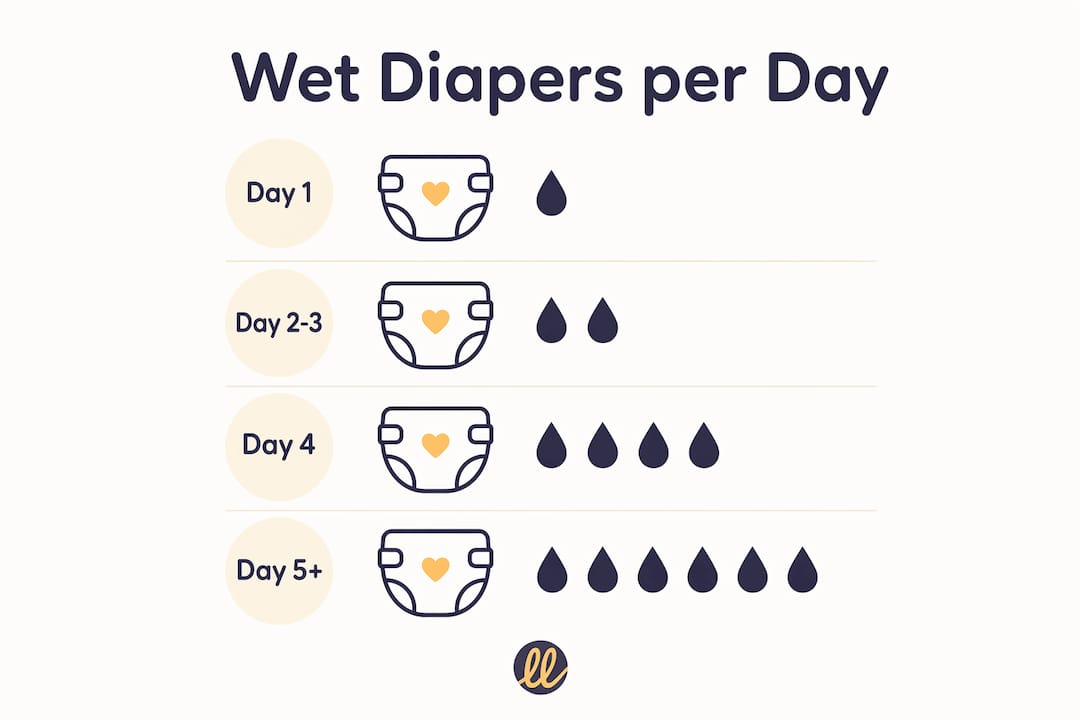
- Day 1: 1–2 wet diapers (normal while colostrum is the only feed)
- Days 2–3: 2–4 wet diapers
- Day 4: 4–6 wet diapers
- Day 5 and beyond: 6 or more wet diapers per 24 hours
- Through the first month: typically 6–8 per day, sometimes up to 10
These counts come from clinical guidance used by pediatricians and lactation consultants to confirm that a newborn is feeding adequately. Low counts in the first two days are common and expected. The concern starts later.
Two thresholds to hold onto:
- Fewer than 6 wet diapers in 24 hours after day 4–5 warrants a call to your pediatrician.
- No wet diaper for 8 hours at any age after day 5 is a red flag that needs same-day attention.
If counts are low right now, offer a feeding, note the time of the last wet diaper, and call your pediatrician's office. You do not need to wait until the next scheduled appointment.
Table of Contents
- What does a "wet diaper" actually mean?
- Day-by-day diaper chart for the first week
- Does feeding method change how many wet diapers you should expect?
- When should you call the pediatrician about diaper output?
- Key Takeaways
- The habit that actually helps in those early days
- Mellow helps you track what matters from day one
- Trusted sources and further reading
What does a "wet diaper" actually mean?
Not every damp diaper counts the same way. A clinically meaningful wet diaper is one that feels noticeably heavier than a dry one, not just a small damp spot at the center. That distinction matters more than most parents realize.
Modern disposable diapers are designed to pull moisture away from the skin, which is great for comfort but can make it genuinely hard to tell how much urine your baby has passed. A diaper that looks barely used might actually contain a meaningful void, and one that feels slightly heavy might only hold a tablespoon.
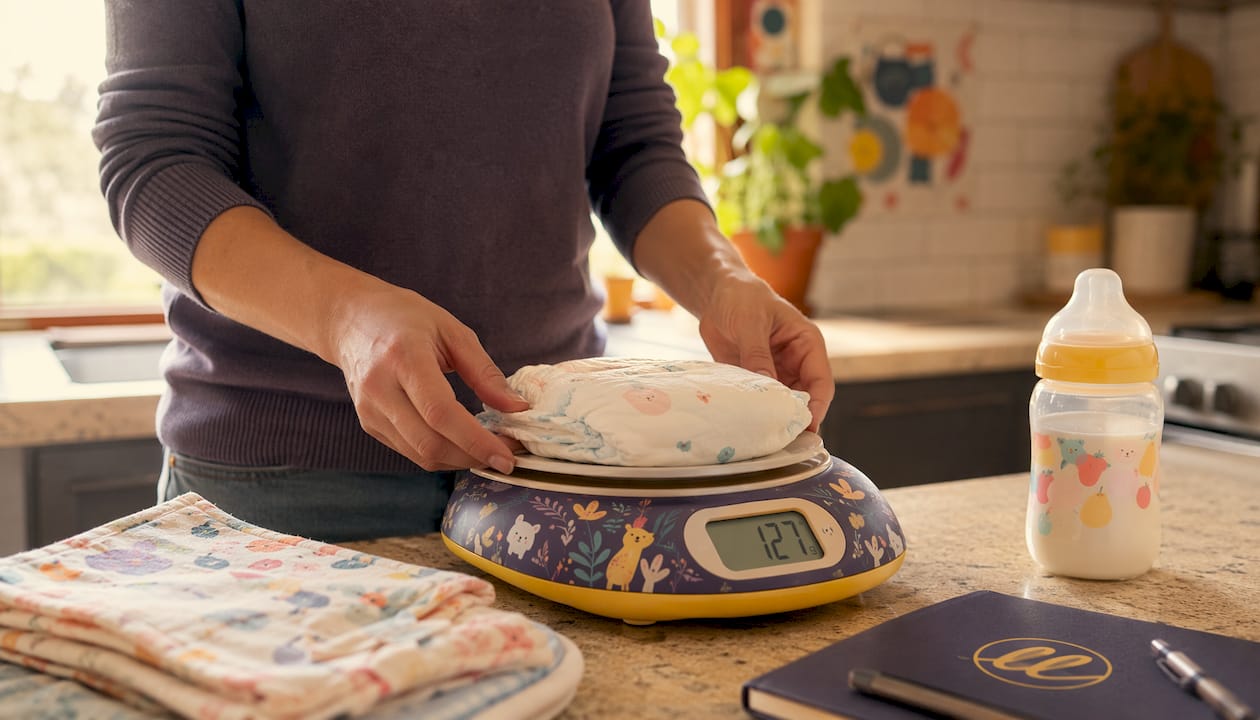
A simple home check: pick up the wet diaper and compare its weight to a fresh one straight from the pack. If it feels noticeably heavier, it counts. You can also place a thin tissue or piece of toilet paper inside the diaper before putting it on — any moisture will show up clearly on the tissue, even when the diaper's outer layer feels dry.
Pro Tip: If you are concerned about volume, weigh the wet diaper on a kitchen scale. One milliliter of urine weighs roughly one gram, so a diaper that is 30–40 grams heavier than a fresh one represents a meaningful void.
One more thing worth knowing: a newborn's bladder capacity grows over the first month. By weeks three and four, your baby may go slightly longer between wet diapers while still producing the same total daily urine volume. Saturation per diaper tends to increase with age, so raw frequency alone becomes a less complete picture over time.
Urate crystals, sometimes called "brick dust," can appear as a pinkish-orange stain in the diaper during the first two to three days of life. This is usually harmless and resolves as your milk comes in and hydration improves. Persistent brick-dust urine after day four, especially alongside low diaper counts, is worth mentioning to your pediatrician.
Day-by-day diaper chart for the first week
Use this table as a quick reference. The counts reflect what pediatric guidance considers the normal range for a healthy, adequately fed newborn.
| Day | Expected wet diapers | Typical stool notes |
|---|---|---|
| Day 1 | 1–2 | Meconium (dark, tarry) |
| Day 2 | 2–3 | Meconium transitioning |
| Day 3 | 3–4 | Transitional stool (greenish) |
| Day 4 | 4–6 | Transitional to yellow |
| Day 5 | 6+ | Yellow, seedy (breastfed) or tan/yellow (formula) |
| Day 6 | 6–8 | Established pattern forming |
| Day 7 | 6–8 | Consistent yellow stools expected |
After day five, most newborns go through 8–12 total diaper changes per day when you count both wet and dirty diapers together. That pace tends to feel relentless in the early weeks, and that is completely normal.
A few things can cause counts to vary within the normal range:
- Growth spurts (typically around days 7–10 and again at three weeks) often bring cluster feeding, which temporarily increases wet diaper output.
- Cluster feeding in the evenings can compress several feeds into a short window, sometimes producing more wet diapers in a few hours than earlier in the day.
- Diaper absorbency varies by brand and size, which can affect how saturated a diaper appears even when output is consistent.
The clinical threshold that pediatricians rely on is ≥6 wet diapers per 24 hours after day four to five. That number does not mean exactly six every single day without exception. It means a consistent pattern at or above that level, with no long dry gaps.
Does feeding method change how many wet diapers you should expect?
Yes, in the first few days it does. Breastfed newborns typically have fewer wet diapers in days one through three because colostrum, the early milk, is produced in small volumes. That is by design. Colostrum is dense with antibodies and nutrients, and a newborn's stomach is genuinely tiny at birth. Lower early counts in a breastfed baby are not a sign of a problem.
By day four to five, wet-diaper counts for breastfed and formula-fed babies should be roughly equivalent. If a breastfed baby has not reached four or more wet diapers by day four, that is the moment to call your pediatrician and discuss a weight check.
Formula-fed babies tend to have slightly more predictable early output because intake volume is measurable from the start. That said, the same thresholds apply: six or more wet diapers per day by day five is the target for all newborns regardless of feeding method.
Beyond feeding method, a few other factors can shift daily counts:
- Ambient temperature: Babies lose more fluid through sweat in warm environments, which can reduce urine output slightly.
- Diaper-change timing: Changing every 2–3 hours during waking hours is standard practice. If you are changing less often, one diaper might hold two voids, making the count look lower than it is.
- Illness or fever: Either can increase fluid loss and reduce urine output.
- Supplemental water: Babies under six months should not receive plain water. It can dilute electrolytes and actually worsen hydration status.
Diaper counts work best as one piece of a larger picture. Clinicians combine them with weight checks and feeding patterns to assess whether a newborn is thriving. At home, you can do the same by tracking wet diapers alongside feeding frequency, stool output, and your baby's alertness and feeding cues. For more context on how developmental milestones connect to feeding and diaper patterns, Mellow's blog covers those shifts week by week.
A breastfeeding-specific diaper chart, like the one published by California WIC, can also be a helpful visual reference to keep on the fridge during the first week. For additional feeding support, postpartum breastfeeding resources can offer practical guidance alongside what your pediatrician provides.
When should you call the pediatrician about diaper output?
Some signs are worth a same-day call. Others mean go now. Here is how to tell the difference.
Call your pediatrician's office the same day if:
- Your baby has four or fewer wet diapers in 24 hours after day four of life.
- Urine appears dark yellow or very concentrated after day four.
- Brick-dust (pink or orange) urine persists beyond day three.
- Your baby seems less interested in feeding than usual.
- You notice fewer wet diapers than the previous day with no clear reason.
Go to urgent care or the ER if your baby shows any of these signs:
- No wet diaper for 8 hours after day five.
- Lethargy or unusual difficulty waking for feeds.
- Sunken soft spot (fontanelle) on top of the head.
- Sunken eyes or no tears when crying.
- Dry mouth or lips.
- Rapid breathing or a fast heart rate.
These are signs of dehydration that require prompt evaluation, not a wait-and-see approach.
Practical steps to take while you arrange care:
- Note the exact time of the last wet diaper and write it down.
- Offer a feeding right away, even if it is not the usual scheduled time.
- Check skin turgor: gently pinch the skin on your baby's abdomen. If it does not spring back quickly, that is a sign of dehydration.
- Do not give water or diluted formula to a baby under six months.
- When you call the clinic, say: "My baby is [X] days old, has had [X] wet diapers in the last 24 hours, and the last wet diaper was at [time]." That information helps the nurse triage quickly.
A sudden jump in wet-diaper frequency is also worth mentioning. Unexpected increases paired with fever, irritability, or behavioral changes can sometimes indicate illness and deserve a conversation with your pediatrician.
Key Takeaways
By day five, a well-hydrated newborn should consistently produce at least six wet diapers per 24 hours, and saturation matter as much as count.
| Point | Details |
|---|---|
| Day-by-day targets | Day 1: 1–2; Days 2–3: 2–4; Day 4: 4–6; Day 5+: 6 or more wet diapers. |
| Saturation over frequency | A heavy, noticeably weighted diaper counts; a small damp spot may not reflect adequate output. |
| Key red flags | Fewer than 6 wet diapers after day 4–5, or no wet diaper for 8 hours, warrants a call or visit. |
| Feeding method variation | Breastfed babies may have lower counts in days 1–3; both groups should reach 6+ by day 5. |
| Mellow for tracking | Mellow's app lets you log wet diapers, visualize daily trends, and receive stage-based guidance from newborn through age two. |
The habit that actually helps in those early days
Early diaper counts can feel like a test you did not study for. One day the numbers look great, the next day you are counting again at 11 PM wondering if you missed one. That anxiety is completely normal, and you are not alone in it.
What I have seen help most is shifting from anxious counting to calm tracking. There is a real difference. Anxious counting means checking after every diaper change and spiraling if the number seems low. Calm tracking means noting each wet diaper at the time of the change, building a simple log, and looking at the trend over 24 hours rather than the last two.

Trends are what matter. A baby who had five wet diapers yesterday and six today is moving in the right direction. A baby who had seven and now has three deserves a call. The number in isolation tells you less than the direction it is heading.
The other habit worth forming in week one: weigh the diaper informally before you toss it. You do not need a special scale. A kitchen scale works fine. It takes five seconds and gives you far more information than a visual check alone. Pair that with noting your baby's sleepy cues and feeding windows, and you have a genuinely useful picture of how your newborn is doing. Mellow's tracking tools are built exactly for this kind of low-friction daily log, so you are not relying on memory at 3 AM.
Mellow helps you track what matters from day one
Counting wet diapers is one of the clearest windows into your newborn's health, but keeping track of it all while running on little sleep is genuinely hard. Mellow gives you a simple, structured way to log wet diapers, feeding sessions, and daily patterns in one place, so you can see trends at a glance instead of trying to reconstruct the last 24 hours from memory.

The app is built for parents of newborns through age two, with stage-specific guidance that updates as your baby grows. When diaper counts shift during a growth spurt or a feeding change, Mellow helps you understand what is normal for that stage and what warrants a call to your pediatrician. It is not a substitute for clinical care, and any urgent concern should go straight to your doctor or urgent care. But for the day-to-day tracking that keeps you informed and confident, Mellow's sleep and development tools are a practical place to start. You can also explore stage-based support resources to see how the guidance evolves as your baby develops.
This article is for general informational purposes only and is not a substitute for professional medical advice. Always contact your pediatrician or a qualified clinician for concerns about your baby's health.
Trusted sources and further reading
| Source | Type | What it covers |
|---|---|---|
| Sutter Health — How many diapers a day | Clinician-facing | Day-by-day diaper counts and when to call a provider |
| Healthline — Wet diapers and milk intake | Parent-facing | How wet diapers confirm adequate feeding; saturation guidance |
| Pampers — How many wet diapers | Parent-facing | Total diaper changes per day; red-flag thresholds |
| California WIC Diaper Chart | Clinician/parent | Breastfeeding-specific diaper output chart for the first week |
| Lane Regional Medical Center | Parent-facing | Day-by-day breakdown and dehydration signs |
| NHS — Dehydration | Clinician-facing | Signs of dehydration in babies; when to seek care |
| MyHealth Alberta — Newborn urine | Clinician-facing | Urate crystals, urine color, and normal newborn output |
| BabyCenter — Dehydration in babies | Parent-facing | Signs of dehydration and when sudden changes in output need evaluation |