
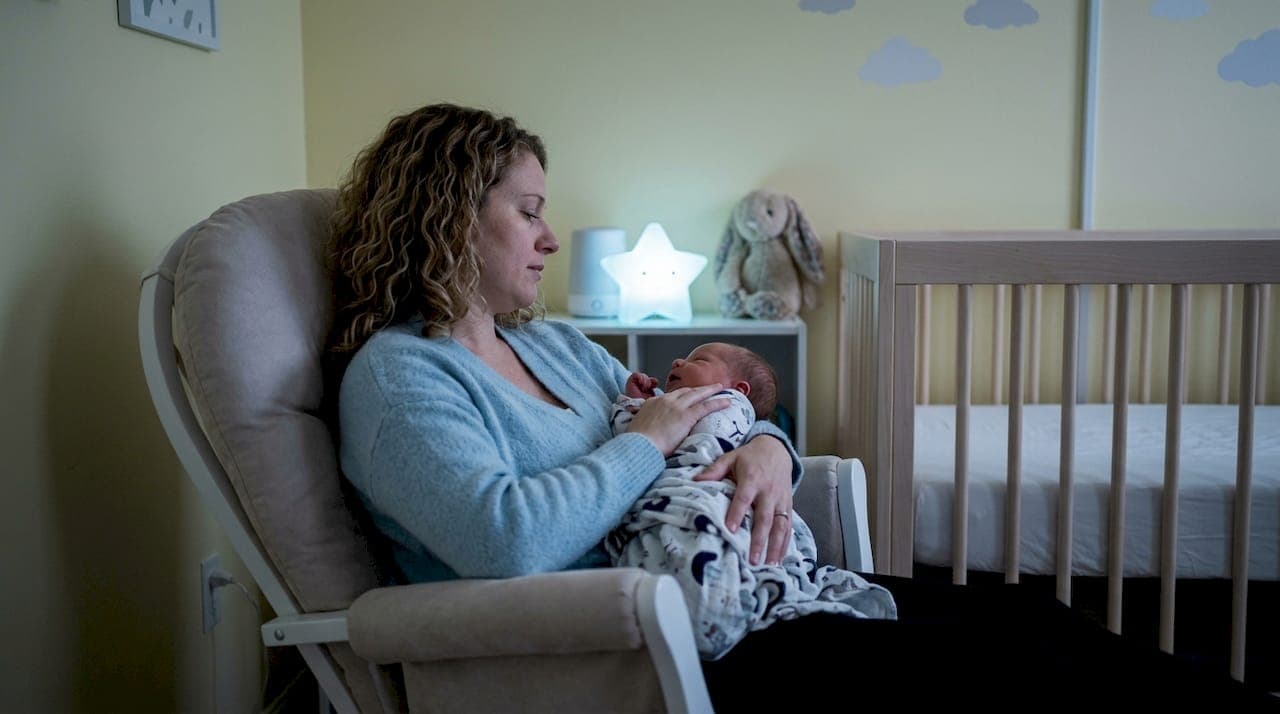
Frequent night waking in 3-month-old babies is driven primarily by immature sleep cycles and normal developmental needs, not by anything you are doing wrong. When a 3 month old wakes up every hour at night, the cause is almost always biological. Infant sleep cycles last roughly 50–60 minutes, compared to the 90-minute cycles adults experience. At the end of each cycle, your baby briefly surfaces into light sleep and may fully rouse. Understanding this biology is the first step toward responding with confidence rather than panic. Mellow exists to help you get there, with evidence-based guidance built around your baby's exact age and stage.
Why does a 3 month old wake up every hour at night?
Short sleep cycles are the core reason babies wake so frequently. Infant sleep cycles run approximately 50–60 minutes, meaning your baby cycles through light and deep sleep far more often than you do. At the end of each cycle, a partial arousal occurs. If your baby has not yet learned to resettle independently, that arousal becomes a full waking.
Two types of waking are worth distinguishing: micro-arousals and true awakenings. A micro-arousal is a brief stir between cycles. A true awakening involves crying or distress that signals a need. Most babies stir between cycles but can learn to self-soothe as they grow. Responding immediately to every sound can actually interrupt that learning process.

Around 3 months, a meaningful physiological shift occurs. Melatonin production increases around this age, which begins to promote longer nighttime stretches. This is good news. It means your baby's biology is already moving in the right direction, even if the nights still feel relentless.
Growth spurts also play a real role. Growth spurts around 3 months increase hunger, which drives more frequent night feeds and wakings. This is temporary and supports healthy development. Minor physical discomforts like gas or reflux can also cause waking, though these are usually brief and self-resolving.
One common myth worth addressing: the "4-month sleep regression" is often blamed for waking that actually begins at 3 months. The reality is that night terrors are extremely rare in 3-month-olds. Most nighttime screaming reflects partial arousals during cycle transitions, not a regression or a terror. Knowing this can genuinely reduce your anxiety.
| Feature | Adult sleep cycles | Infant sleep cycles |
|---|---|---|
| Cycle length | ~90 minutes | ~50–60 minutes |
| Light sleep proportion | Lower | Higher |
| Self-soothing ability | Developed | Still developing |
| Night wakings | Rare | Common and expected |
| Melatonin rhythm | Established | Emerging at 2–3 months |
Pro Tip: Wait 3–5 minutes before responding to nighttime sounds. Many stirrings resolve on their own within that window, giving your baby the chance to resettle without your help.
How can you help a 3 month old sleep longer at night?
A consistent bedtime routine is the single most effective tool available to you right now. A regular calming routine correlates with faster sleep onset and longer sleep stretches. The routine does not need to be elaborate. A warm bath, a feed, a short song, and dim lights repeated in the same order each night signals to your baby's brain that sleep is coming.
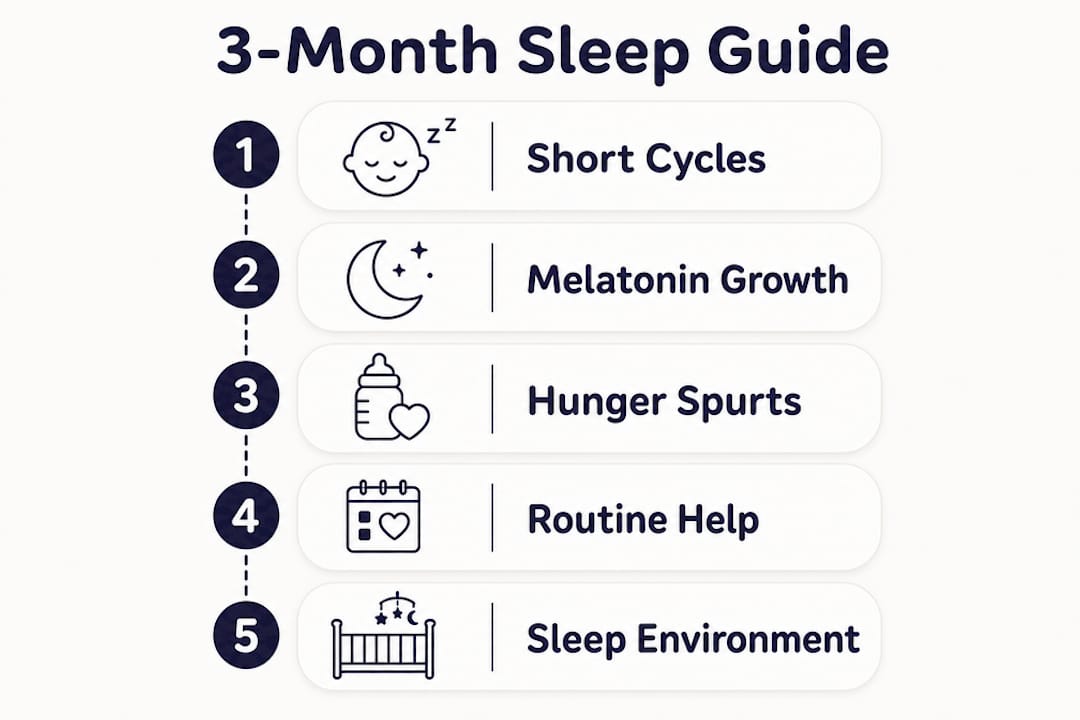
Managing awake windows is equally important. 3-month-olds need 14–16 hours of total sleep daily with awake windows of just 60–90 minutes. Keeping your baby up longer in hopes of a longer night stretch backfires. Overtired babies release cortisol and adrenaline, making it harder to fall and stay asleep. This is the "second wind" you may have noticed: a baby who seemed tired suddenly becomes wired.
The sleep environment matters more than most parents realize. A dark room and consistent white noise both reduce the chance that environmental changes, like a car passing or a light shifting, will trigger a waking. A safe sleep setup is also non-negotiable. Mellow's guidance on safe sleep practices covers the essentials clearly.
Putting your baby down drowsy but still awake is the foundation of independent settling. When a baby always falls asleep while feeding or being rocked, they associate those conditions with sleep onset. When they surface between cycles and those conditions are gone, they cry to recreate them. Drowsy-but-awake placement teaches them that the crib itself is where sleep begins.
Formal sleep training is not recommended before 4–6 months. At 3 months, the goal is a predictable, calm environment, not a rigid schedule. Gentle consistency now builds the foundation for better sleep later.
Do's and don'ts for better night sleep at 3 months:
- Do keep the room dark and use white noise consistently
- Do follow a short, predictable bedtime routine every night
- Do put your baby down drowsy but awake when possible
- Do wait a few minutes before responding to stirring sounds
- Don't keep your baby awake longer hoping for a longer stretch
- Don't introduce stimulating activity close to bedtime
- Don't rush to feed at every waking before checking if it is a true hunger cue
- Don't expect full night sleep at this age. It is not developmentally realistic
Pro Tip: Dim the lights in your home 30–45 minutes before your baby's bedtime. This environmental cue supports melatonin release and makes the transition to sleep smoother.
When should you seek medical advice for frequent night waking?
Most hourly waking at 3 months is developmental, not medical. That said, certain signs point to a physical cause that deserves a pediatrician's attention. Knowing the difference protects your baby and saves you from unnecessary worry.
Persistent arching, feeding difficulties, or poor weight gain alongside frequent waking are red flags for silent reflux. Silent reflux causes discomfort without visible spitting up, making it easy to miss. If your baby seems to be in pain during or after feeds and wakes screaming, mention this specifically to your pediatrician.
Watch for these warning signs:
- Poor weight gain or weight loss
- Intense arching of the back during or after feeds
- Persistent crying that cannot be soothed by any method
- Difficulty feeding, including pulling away repeatedly during nursing or bottle feeding
- Fever or other signs of illness alongside increased waking
- Ear pulling combined with increased fussiness and waking
Common medical causes of frequent waking at this age include reflux, ear infections, and colic. Each has distinct patterns. Reflux waking tends to worsen after feeds. Ear infection waking often intensifies when the baby lies flat. Colic waking typically clusters in the evening hours.
Your pediatrician will assess weight gain, feeding mechanics, and physical comfort during an evaluation. Bring a brief log of your baby's waking patterns, feed times, and any behaviors you have noticed. This information helps the doctor identify patterns quickly and gives you a clearer picture of what is actually happening across the day and night.
How do daytime naps affect night waking at 3 months?
Daytime sleep and nighttime sleep are not separate systems. They are deeply connected. A baby who naps poorly during the day arrives at bedtime overtired, and overtiredness causes cortisol spikes that fragment nighttime sleep. Getting naps right is one of the most direct ways to reduce night waking.
At 3 months, most babies take 4–5 naps per day, with each nap lasting 30–90 minutes. Total daytime sleep typically falls between 4–6 hours. The exact timing matters less than keeping awake windows within the 60–90 minute range. Understanding wake windows by age gives you a clear framework for timing each nap.
Here is a practical approach to managing daytime sleep:
- Watch for tired cues. Yawning, eye rubbing, staring blankly, and fussiness all signal that the awake window is closing. Act on these cues rather than watching the clock alone.
- Cap awake time at 90 minutes. Even if your baby seems content, the 90-minute mark is the outer limit before overtiredness sets in. Start the nap wind-down at 75 minutes.
- Keep nap environments consistent. Use the same room, the same white noise, and the same pre-nap cues each time. A short pre-nap routine of 5–10 minutes helps your baby shift gears.
- Avoid late-afternoon long naps. A nap that ends after 5:00 PM can push bedtime too late, creating an overtired cycle that worsens night waking.
- Adjust based on the previous night. After a rough night, your baby may need an earlier first nap. Flexibility within a consistent framework serves you better than rigid scheduling.
Tracking nap times and durations for a few days often reveals patterns that are invisible in the moment. You may notice that nights following well-timed naps are measurably calmer.
Key Takeaways
Hourly night waking at 3 months is caused by short infant sleep cycles, emerging melatonin rhythms, and overtiredness, all of which respond to consistent routines and appropriate awake windows.
| Point | Details |
|---|---|
| Short sleep cycles drive waking | Infant cycles last 50–60 minutes, causing frequent light-sleep arousals throughout the night. |
| Awake windows prevent overtiredness | Keep awake time to 60–90 minutes to avoid cortisol spikes that fragment sleep. |
| Routines reduce night waking | A consistent bedtime routine speeds sleep onset and reduces mid-night disturbances over time. |
| Wait before responding | Pausing 3–5 minutes lets babies practice self-settling during micro-arousals. |
| Medical red flags need attention | Arching, poor weight gain, and feeding difficulties alongside waking warrant a pediatrician visit. |
What I have learned from watching families through the 3-month stretch
The 3-month mark is one of the hardest points I see families navigate. The newborn haze has lifted enough that parents expect things to be improving. When the nights are still broken every hour, the exhaustion hits differently. There is a quiet shame that creeps in: "Why can't I get my baby to sleep?"
Here is what I have come to believe after working with many families at this stage. The parents who struggle most are often the ones trying hardest to fix something that is not broken. Hourly waking at 3 months is not a problem to solve. It is a developmental phase to move through. The families who fare best are the ones who stop fighting the biology and start working with it.
Consistency matters more than perfection. A bedtime routine done imperfectly every night beats a perfect routine done three times a week. Your baby learns from repetition, not from flawless execution. The cumulative effect of a steady routine builds over weeks, not nights.
I also want to say this plainly: every baby is different. Some 3-month-olds begin sleeping 4–5 hour stretches. Others wake every 60 minutes for months. Neither is a reflection of your parenting. Comparing your baby's sleep to another family's is one of the fastest ways to undermine your own confidence. Trust what you observe in your own baby, seek guidance when you need it, and give yourself credit for showing up every night.
— Mauricio
How Mellow helps parents through the hardest nights
Parenting a 3-month-old through broken nights is exhausting, and generic advice rarely fits your specific baby. Mellow provides evidence-based sleep and development guidance built around your child's exact age and stage, so you are always working with the right information at the right time.

Mellow's baby sleep and development guides cover the specific challenges of the newborn to 2-year window, including the 3-month period in detail. As your baby grows, Mellow's guidance grows with them. Parents navigating the next stage can find targeted support for the 8–10 month period, when new sleep challenges often emerge. The goal is always the same: fewer surprises, more confidence, and more rest for your whole family.
FAQ
Is it normal for a 3 month old to wake every hour?
Yes. Infant sleep cycles last approximately 50–60 minutes, so waking at the end of each cycle is biologically normal at this age. Most babies grow out of this pattern gradually as their sleep architecture matures.
How many hours should a 3 month old sleep at night?
Most 3-month-olds sleep a total of 14–16 hours daily, split between nighttime sleep and 4–5 daytime naps. Continuous nighttime stretches of 4–6 hours are common but not universal.
When will my baby start sleeping longer at night?
Many babies begin consolidating nighttime sleep between 4–6 months as melatonin rhythms strengthen and sleep cycles lengthen. Consistent routines and appropriate awake windows support this transition.
Should I try sleep training at 3 months?
Pediatric sleep experts recommend waiting until 4–6 months for formal sleep training. At 3 months, focus on a predictable routine and a calm sleep environment rather than any structured method.
What signs mean I should call the pediatrician about night waking?
Contact your pediatrician if waking is accompanied by poor weight gain, intense back arching, feeding difficulties, or persistent inconsolable crying. These signs may indicate reflux or another medical cause that needs evaluation.