

A 5 month old waking up every hour is one of the most common and exhausting experiences new parents face. This pattern is not a sign that something is wrong with your baby. It reflects a normal stage of infant sleep development, where short sleep cycles, feeding needs, and emerging self-soothing skills all collide at once. Between 28% and 57% of babies still wake frequently at night even at one year old. Understanding why this happens is the first step toward doing something about it.
Why does my 5 month old wake up every hour?
Frequent night waking at 5 months is driven by biology, not behavior problems. Infant sleep cycles last only 50–60 minutes, compared to adult cycles of 90–120 minutes. At the end of each cycle, your baby passes through a brief light sleep phase where a full awakening is easy to trigger. Adults do this too, but we roll over and fall back asleep without noticing. Babies who have not yet learned to self-soothe call out for help instead.
Sleep onset associations also play a major role. If your baby falls asleep while nursing, being rocked, or held, the brain links those conditions to sleep. When the next light sleep phase arrives, your baby wakes and searches for those same conditions to fall back asleep. This is the core mechanism behind the hourly waking cycle most parents describe.

Breastfed babies tend to wake more often because breast milk digests faster than formula. Developmental milestones, including rolling, increased social awareness, and early language processing, also activate the brain in ways that fragment sleep. None of this is a flaw. It is your baby's nervous system doing exactly what it is supposed to do at this age.
What are infant sleep cycles and how do they affect night waking?
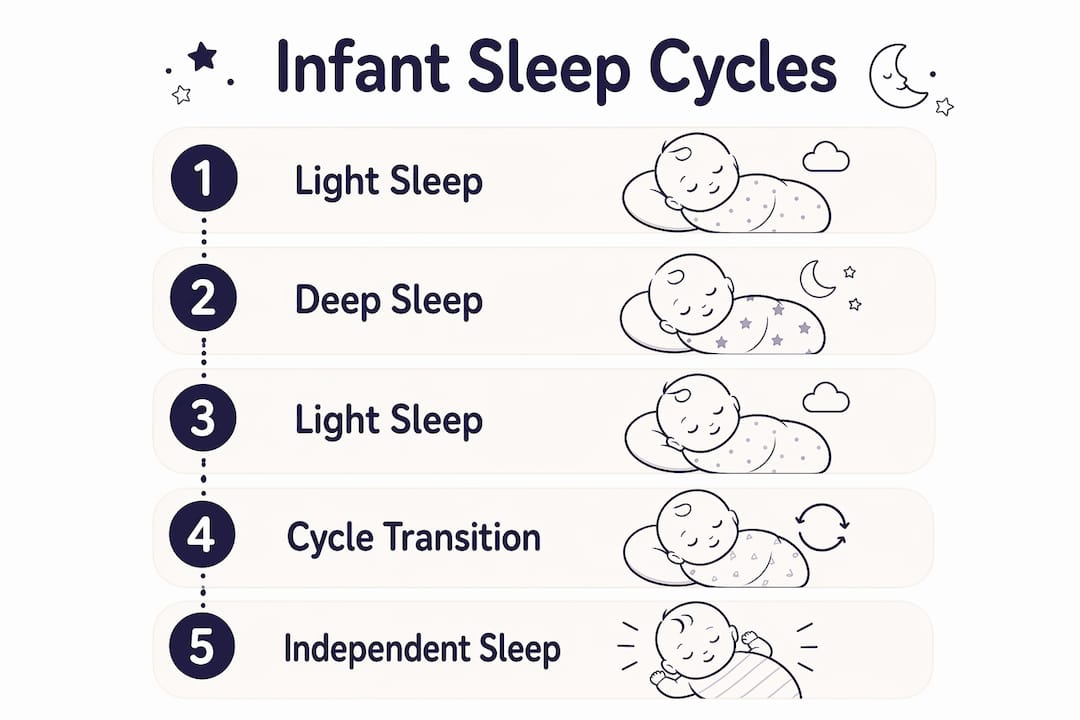
Every sleep cycle moves through stages: light sleep, deep sleep, and back to light sleep again. Adults consolidate these transitions without waking. Babies are still learning to do the same.
Infant sleep cycles run about 50–60 minutes from start to finish. That means your baby naturally surfaces into light sleep roughly once an hour all night long. During that surface moment, any small discomfort, sound, or missing sleep cue can trigger a full waking. The goal is not to prevent these transitions. The goal is to help your baby move through them without needing you every time.
Here is what happens inside each cycle:
- Active sleep (light sleep): Your baby moves, makes sounds, and is easy to rouse. This is the stage where most night wakings happen.
- Quiet sleep (deep sleep): Your baby is still, breathing slowly, and hard to wake. This is the restorative stage.
- Transition: The brief moment between cycles where a baby either self-settles or fully wakes.
The transition is the critical window. Babies who can fall asleep independently pass through it quietly. Babies who rely on external help signal for it again.
Pro Tip: If your baby wakes exactly 45–60 minutes after going down, that is almost certainly a sleep cycle transition, not hunger. Wait 2–3 minutes before responding to see if your baby can resettle.
Understanding this biology removes a lot of guilt. You did not cause the waking. You can, however, help your baby learn to handle it.
How do sleep associations contribute to a baby waking every hour?
Sleep associations are the conditions your baby links to falling asleep. They are learned, not innate. And they are the single biggest driver of repeated night waking at 5 months.
Research by Burnham et al. (2002) found a direct link between parent presence at sleep onset and frequent night waking. When a baby falls asleep in your arms and wakes in a crib, the brain registers a mismatch. That mismatch triggers distress. The baby cries. You return. The association is reinforced.
The good news is that sleep associations can shift gradually. Here is a practical sequence to work through:
- Start at bedtime, not overnight. Changing the bedtime routine is easier than managing night wakings in real time when you are exhausted.
- Put your baby down drowsy but awake. Placing babies drowsy but awake gives them the chance to complete the final step of falling asleep on their own.
- Reduce the intensity of the association gradually. If you nurse to sleep, try unlatching just before your baby is fully asleep. If you rock, try stopping the motion while still holding.
- Stay consistent for at least a week. Inconsistency teaches babies that crying long enough brings back the old association.
- Respond to genuine distress. There is a difference between fussing during a transition and true upset. You do not need to let your baby cry without any response. Gentle check-ins work.
Pro Tip: Keep a simple log for three nights before changing anything. Note the time of each waking and what you did to resettle. Patterns become obvious fast, and you will know exactly which association to target first.
Shifting sleep associations takes time. Most families see meaningful improvement within two to three weeks of consistent practice. The key word is consistent.
Establishing routines and schedules to improve 5-month-old sleep
A predictable bedtime routine is one of the most well-supported tools in infant sleep science. Research by Mindell et al. (2015) found a dose effect: the more consistent the routine, the better the sleep outcomes, including faster sleep onset, fewer night wakings, and longer total sleep duration. Consistency is the active ingredient.
At 5 months, wake windows matter as much as the routine itself. A wake window is the amount of time your baby can comfortably stay awake between sleep periods. Overtired babies produce more cortisol, which makes falling and staying asleep harder.
| Sleep metric | Typical range for 5-month-olds |
|---|---|
| Wake windows | 2–2.5 hours between sleep periods |
| Daytime naps | 2–3 naps totaling 3–4 hours |
| Total sleep per 24 hours | 12–15 hours |
| Nighttime sleep stretch | 4–6 hours (varies widely) |
These typical awake times give you a framework, not a rigid rule. Watch your baby's tired cues alongside the clock.
A solid bedtime routine for a 5-month-old includes:
- Dim the lights 30 minutes before bed to signal the shift from day to night.
- Warm bath to relax the body and mark the transition.
- Feeding in a calm, low-stimulation environment.
- Short story or song to create a predictable wind-down sequence.
- Place in crib while drowsy but still awake.
Differentiating day and night also strengthens your baby's circadian rhythm. Keep daytime naps in a lighter, noisier environment and reserve the dark, quiet room for nighttime sleep. Room darkening at night and white noise can reduce environmental disruptions that trigger light-sleep wakings.
Common challenges at 5 months: sleep regression, teething, and separation anxiety
The phrase "4-month sleep regression" is widely used, but it is slightly misleading. What actually happens between 3 and 6 months is a gradual shift in sleep architecture, where babies begin producing more adult-like sleep cycles. This change is permanent, not a temporary regression that passes on its own.
Several factors compound this shift at 5 months:
- New motor skills. Rolling, reaching, and increased body awareness activate the brain and can cause mid-night startling or positional discomfort.
- Cognitive leaps. Your baby is processing more information during the day. That processing continues at night, making sleep lighter and more fragmented.
- Early teething. Some babies begin teething as early as 4–6 months. Gum discomfort tends to peak during light sleep phases, which is exactly when your baby is already most vulnerable to waking.
- Separation anxiety. Separation distress is linked to more night waking and bedtime resistance. While it peaks around 8–9 months, early signs can appear at 5 months, especially in babies with strong parental attachment.
The most effective response to all of these is not a quick fix. It is patience combined with consistent routines. Understanding the developmental milestones driving these changes helps you respond with empathy rather than frustration. If teething seems to be the issue, talk to your pediatrician about appropriate comfort measures. If separation anxiety is emerging, extra daytime connection and brief, reassuring check-ins at night can help without reinforcing the waking cycle.
Key Takeaways
A 5-month-old waking every hour is primarily caused by short sleep cycles and learned sleep associations, both of which improve with consistent routines and gradual independent sleep practice.
| Point | Details |
|---|---|
| Short sleep cycles drive waking | Infant cycles last 50–60 minutes, creating natural light-sleep transitions every hour. |
| Sleep associations are the key variable | Babies who fall asleep with help will seek that same help at every cycle transition. |
| Drowsy but awake is the goal | Placing your baby down before fully asleep builds the self-soothing skills that reduce night waking. |
| Consistent routines improve outcomes | Research shows the more consistent the bedtime routine, the fewer night wakings over time. |
| Development compounds the pattern | Teething, motor skills, and early separation anxiety all worsen sleep temporarily at this age. |
What I have learned from watching families navigate this stage
The hardest part of this stage is not the waking itself. It is the uncertainty. Parents lie awake between wakings wondering if they are doing something wrong, if their baby is in pain, or if this will ever end. I want to be direct with you: hourly waking at 5 months is normal, and it does not mean you have failed.
What I have seen work, consistently, is not any single technique. It is the combination of realistic expectations and steady, calm consistency. Parents who pick one change, practice it for two weeks without abandoning it at 2:00 AM, and stay attuned to their baby's cues see real progress. Parents who try three different approaches in the same week usually do not.
The insight that most families miss is this: learning to transition between sleep cycles is gradual. There is no shortcut. But there is a clear direction. Start at bedtime. Build the routine. Shift the association slowly. Give it time.
One more thing. Your own sleep deprivation is real and it affects your judgment, your mood, and your relationship. Taking care of yourself is not separate from taking care of your baby. It is part of it. If you are struggling, ask for help. Talk to your pediatrician. Lean on your support system. You do not have to white-knuckle this alone.
Most babies develop better sleep with supportive, consistent guidance. Yours will too.
— Mauricio
How Mellow can support your baby's sleep right now
Navigating 5-month-old sleep issues is much easier when you have guidance that stays one step ahead of your baby's development.

Mellow is built specifically for parents of infants and toddlers from newborn to 2 years old. The Mellow Kids app gives you age-specific sleep guidance, daily tracking tools, and proactive advice timed to your baby's actual developmental stage. Rather than reacting to problems after they start, Mellow prepares you before the next change arrives. The mini guides cover sleep routines, wake windows, and self-soothing strategies in short, practical formats you can actually read at midnight. When your baby reaches the next big sleep transition, the 8–10 month support is already waiting for you.
FAQ
Why does my 5-month-old wake up so often at night?
Infant sleep cycles last only 50–60 minutes, so your baby naturally surfaces into light sleep roughly every hour. If your baby relies on feeding or rocking to fall asleep, they will seek that same help at each transition.
Is it normal for a baby to wake every hour at 5 months?
Yes. Research shows that between 28% and 57% of babies still wake frequently at night even at one year old. Hourly waking at 5 months is within the normal range of infant sleep behavior.
How do I get my 5-month-old to sleep longer stretches?
Place your baby in the crib drowsy but awake at bedtime to build independent sleep skills. A consistent bedtime routine, appropriate wake windows of 2–2.5 hours, and a dark, quiet sleep environment all support longer stretches over time.
What is the 5-month sleep regression?
The term "sleep regression" is a misnomer. What happens around 4–5 months is a permanent shift in sleep architecture as babies develop more adult-like sleep cycles. This change does not reverse on its own, but consistent routines and independent sleep skills help babies adapt.
When should I be concerned about frequent night waking?
Talk to your pediatrician if your baby shows signs of pain, breathing irregularities, or significant weight concerns alongside frequent waking. Hourly waking alone, without other symptoms, is a developmental pattern rather than a medical issue.