

Most 24-month-olds do best with 11 to 14 hours of sleep across the day, typically 10 to 12 hours overnight plus one 1 to 2 hour nap. A practical day looks like this: wake around 7:00 AM, lunch and nap 12:30 to 2:00 PM, bedtime routine starting 6:30 PM, lights out by 7:15 PM. Treat the clock times as a starting point, not a rule, and adjust based on how your child actually sleeps.
TL;DR:
- Toddlers who wake around 6:00 to 6:30 AM typically need an earlier nap and bedtime, while those waking at 8:00 AM can shift everything later without losing total sleep.
- Keeping the nap between 1.5 to 3 hours and ending it 3 to 4.5 hours before bedtime minimizes bedtime resistance and sleep disruptions.
- Consistent routines, including a short, predictable bedtime sequence and limited choices, help reduce bedtime resistance and promote better sleep.
- Wake windows of about 5 to 6 hours before nap and bedtime are crucial; exceeding these tends to cause overtiredness and difficulty falling asleep.
- Milk intake should decrease to 16 to 20 ounces daily at age 2, with no milk or juice at least an hour before sleep to prevent night disturbances.
Table of Contents
- How Much Sleep Does a 24-Month-Old Need?
- Three Sample Schedules for Early, Mid, and Late Risers
- When Should You Schedule the Nap?
- Building a Bedtime Routine That Actually Works
- Signs Your Toddler Is Outgrowing the Nap
- What About Milk and Meal Timing?
- How Mellow Maps Milestones to Sleep Needs
- Consistency Matters, but So Does Reading Your Own Kid
- Build a Schedule That Adjusts as Your Toddler Does
- Where This Guidance Comes From
- Sources
- FAQ
How Much Sleep Does a 24-Month-Old Need?
Sleep needs at this age sit in a fairly tight range. The Sleep Foundation puts total daily sleep for 2 year olds at 11 to 14 hours, with most of that happening overnight (10 to 12 hours) and the remainder covered by a single daytime nap running 1 to 2 hours. Some toddlers nap closer to 90 minutes on a good day; others need the full 2 hours to feel rested.
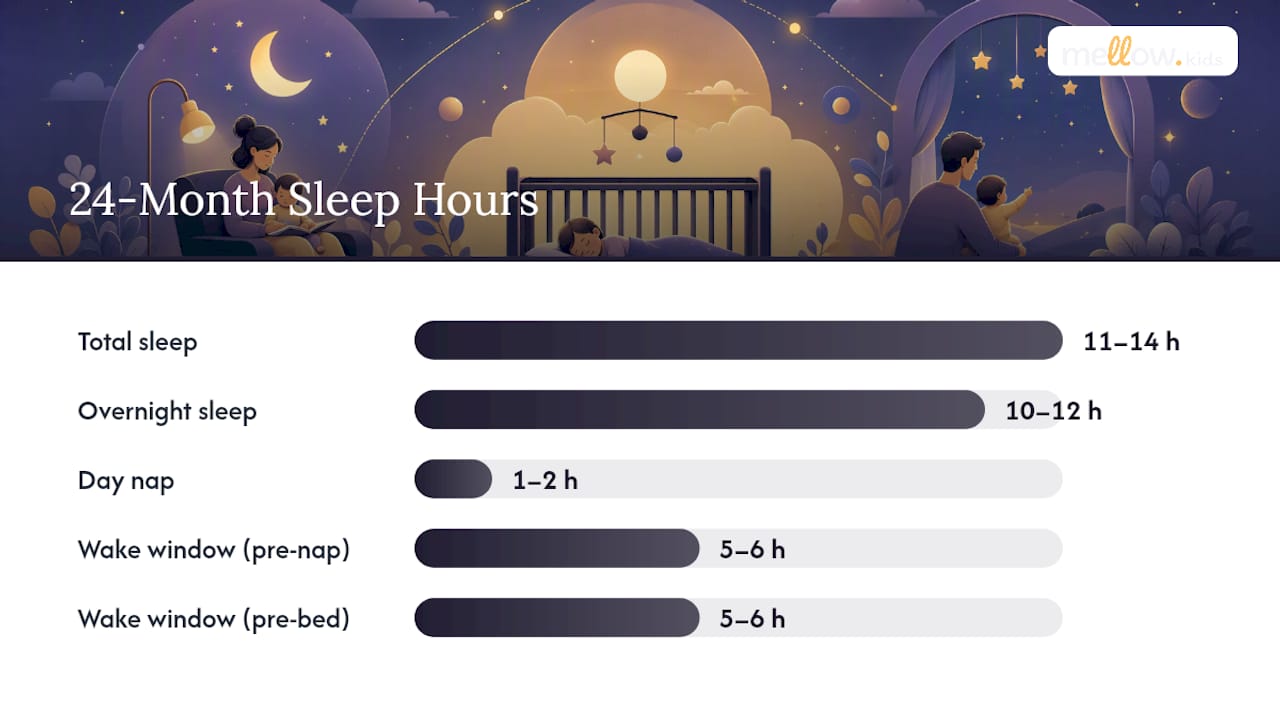
Wake windows matter just as much as total hours. At 24 months, most toddlers handle roughly 5 to 6 hours awake between the morning start and the nap, then another 5 to 6 hours between waking from the nap and bedtime. Push much past that and you tend to see overtiredness, which paradoxically makes it harder for a toddler to fall asleep, not easier. That overtired second wind is why a 24-month-old who "isn't tired" at 9:00 PM often crashed the wake window an hour earlier and is now running on stress hormones instead of sleepiness.
Predictability itself does developmental work. The CDC's guidance on toddler routines notes that consistent daily structure supports emotional regulation, and CDC milestone tracking for 2 year olds links routine to smoother language and behavior development. A toddler who knows what comes next spends less energy managing uncertainty and more energy on the actual business of growing.
Sleep needs at 24 months, at a glance:
- Total sleep: 11 to 14 hours per 24 hours
- Overnight sleep: 10 to 12 hours
- Daytime nap: 1 to 2 hours, typically one nap per day
- Wake window before nap: about 5 to 6 hours
- Wake window before bedtime: about 5 to 6 hours
Quick stat: A 24-month-old averaging 11 hours overnight plus a 90-minute nap lands right at 12.5 total hours, comfortably inside the recommended 11 to 14 hour range.
Three Sample Schedules for Early, Mid, and Late Risers
Not every family runs on the same clock, and forcing a 6:45 AM wake time onto a toddler who naturally surfaces at 8:00 doesn't create better sleep. It creates a fight. Here are three workable versions built around real wake times.
- Early riser (wakes around 6:00 to 6:30 AM). Breakfast by 7:00, morning play, lunch at 11:30, nap window 12:00 to 1:30 PM, afternoon activity, dinner at 5:00, bedtime routine 6:15 PM, lights out 6:45 PM. Early wakers need an earlier nap and an earlier bedtime; stretching this child to a 7:30 bedtime usually backfires into a cranky, overtired evening.
- Mid riser (wakes around 7:00 to 7:15 AM). This is the schedule most 24-month-olds land on. Breakfast 7:30, lunch 12:00, nap 12:30 to 2:00 PM, dinner 5:30, bedtime routine 6:30 PM, lights out 7:15 PM. It builds in the standard 5 to 6 hour wake windows on both sides of the nap.
- Late riser (wakes around 8:00 AM). Breakfast 8:30, lunch 12:30, nap 1:15 to 2:45 PM, dinner 6:00, bedtime routine 7:15 PM, lights out 8:00 PM. Late risers can still hit 11 to 12 hours overnight because everything shifts later together, not just bedtime.
Nap length changes the rest of the day more than most parents expect. A short nap, 60 to 75 minutes, usually means bedtime should move 15 to 30 minutes earlier to cover the sleep debt. A full nap of 90 to 120 minutes lets you keep the standard bedtime, and sometimes push it 15 minutes later without a fight. If your toddler's nap runs long on a particular day, watch the clock rather than the crib. The Sleep Foundation recommends ending naps at least 3 to 4.5 hours before bedtime regardless of which sample schedule you're using.
Test any new schedule for a full one to two weeks before deciding it isn't working. A single rough night or an off nap doesn't mean the timing is wrong. It usually means teething, a growth spurt, or an off day. Track wake times, nap length, and bedtime resistance for that stretch, and adjust one variable at a time rather than overhauling the whole day.
When Should You Schedule the Nap?
Early afternoon is the sweet spot, and there's a real mechanism behind that timing, not just convention. Sleep pressure, the physiological drive to sleep that builds the longer a toddler is awake, tends to peak in early afternoon for most 2 year olds, and it lines up with a natural dip in circadian alertness. Push the nap to mid or late afternoon and you're fighting both a shrinking sleep-pressure window and a shrinking runway to bedtime.
- Start the nap between 12:00 and 1:30 PM for most 24-month-olds.
- Keep naps in the 1.5 to 3 hour range as normal, per Sleep Foundation guidance.
- End the nap at least 3 to 4.5 hours before bedtime.
- Cap even a great nap around 3 hours; beyond that, night sleep often suffers.
An occasional 2.5 to 3 hour nap is not automatically a problem. Research on toddler sleep patterns notes that nap length varies widely as children transition to one nap, and daycare schedules that cap naps at 60 to 90 minutes can leave a toddler running a sleep deficit that a longer weekend nap partially repays. The issue only shows up when a long nap pushes bedtime past the 3 to 4.5 hour minimum wake window. If your toddler naps until 3:30 PM and bedtime is 7:00 PM, that's fine. If bedtime is 6:30, you have a problem brewing.
Quick stat: Ending the nap 3 to 4.5 hours before bedtime is the single most reliable lever for avoiding bedtime battles, according to Sleep Foundation nap research.
Building a Bedtime Routine That Actually Works
A short, repeatable sequence beats a long, elaborate one. Twenty to 40 minutes is plenty, and the order matters more than the exact activities.
- Bath or wash up (5 to 10 minutes)
- Pajamas and teeth brushing (5 minutes)
- One or two books, read in the same spot every night (10 minutes)
- Dim lights, brief cuddle or song, then into the crib or bed (5 to 10 minutes)
The order itself does real work. Research on toddler routines shows that a predictable, repeated sequence reduces bedtime resistance because the toddler's brain starts anticipating sleep before you even say goodnight.
Limited choices cut down on stalling without turning bedtime into a negotiation. Offer two books, not the whole shelf. Offer two pairs of pajamas, not "what do you want to wear?" A toddler who picks between two acceptable options feels a sense of control, which tends to shortcut the power struggle that an open-ended question invites.

Keep the bedroom cool, dark, and quiet, and cut screens at least 30 to 60 minutes before the routine starts. Screen light and fast-paced content both work against the wind-down you're trying to build. Skip sugary snacks in the hour before bed too; a sugar spike right before lights out is fighting the exact drowsiness you spent the whole routine building.
Pro Tip: Keep the same two book choices in rotation for a week at a time instead of swapping nightly. Toddlers find comfort in repetition even when you assume they'd prefer novelty.
For more detail on sequencing and limited-choice tactics, Mellow's guide to a toddler bedtime routine walks through variations by temperament.
Signs Your Toddler Is Outgrowing the Nap
Most toddlers hold onto their single nap well past 24 months, but some show early signs of transitioning. Watch for consistent, not occasional, patterns: taking 45 minutes or longer to fall asleep at nap time, skipping the nap altogether two or more days a week with no crankiness afterward, or fighting bedtime specifically on days with a nap but sleeping fine on days without one.
When you see those signs, work through adjustments in this order rather than jumping straight to dropping the nap:
- Shift the nap 30 minutes earlier first. Sometimes the "resistance" is really a wake window that's grown slightly longer than the current schedule accounts for.
- Shorten the nap and move bedtime earlier. If a full nap is now causing 90 minutes of bedtime stalling, try capping the nap at 60 to 75 minutes and moving bedtime up by 30 minutes to compensate.
- Keep the nap on weekdays, allow a longer weekend catch-up. A toddler in daycare with short, capped naps often needs a longer nap on weekends. That's a normal adjustment, not a sign your schedule is broken.
For night wakings, work through the basics before assuming something's wrong: check whether your toddler is actually hungry or thirsty (a too-early dinner can backfire here), respond the same way every time so you're not accidentally teaching a new expectation, and resist turning a 2:00 AM wake into an elaborate interaction. A brief, boring response usually resolves things faster than a full conversation or a snack.
A guide on personalizing a 2-year-old sleep schedule by watching cues covers this transition period in more depth if your toddler is showing several signs at once.
What About Milk and Meal Timing?
Milk guidance changes right around this age. Pediatric guidance recommends switching from whole milk to reduced-fat 1% or 2% once your toddler turns 2, with a daily total capped around 16 to 20 ounces (480 to 600 ml).
- Switch to 1% or 2% milk at 24 months.
- Cap daily milk intake at 16 to 20 oz (480 to 600 ml).
- Stop milk or juice at least 60 to 90 minutes before bedtime.
- Time dinner 2 to 3 hours before lights out so digestion doesn't interfere with sleep onset.
Too much milk too close to bedtime does two things against you: it can suppress appetite for dinner, and it sets up a fuller bladder overnight, both of which show up later as night wakings. A light snack an hour before the bedtime routine, something like crackers or fruit, tends to support sleep pressure better than a big glass of milk right at lights out.
Quick stat: The 16 to 20 oz daily milk cap reflects pediatric guidance from Valley Children's aimed at preventing milk from crowding out solid food and disrupting appetite regulation.
How Mellow Maps Milestones to Sleep Needs
Every toddler drifts from the textbook schedule eventually, and that's exactly where a static chart stops being useful. Developmental stage is considered alongside chronological age to adjust wake windows and nap timing accordingly.
If your 24-month-old is pushing back on the crib, hitting a language leap, or suddenly resisting the nap, Mellow flags what's likely driving it and suggests a specific fix rather than a generic tip. That might mean shifting a wake window by 20 minutes, or trying the two-book, two-pajama limited-choice tactic covered above with the exact phrasing that tends to work at this age. The 15 to 24 month guidance in Mellow is built around this exact stretch, where naps, milestones, and bedtime behavior all shift at once.
Parents track daily patterns, log what changed, and get milestone-aware suggestions instead of guessing which of three possible causes is behind a rough week.
Consistency Matters, but So Does Reading Your Own Kid
Every schedule in this guide is a starting point, not a mandate. Predictability genuinely helps toddlers regulate their emotions and sleep better, but the parents who struggle most are usually the ones treating a sample schedule as a contract instead of a template. Wake windows shift by 20 minutes during growth spurts. Naps get shorter during teething. A toddler who's been rock solid at 7:15 PM lights out for a month can suddenly push back for no obvious reason.
Hold the structure loosely and remember the importance of consistency in toddler routines. Keep the sequence and rough timing consistent, and let the exact minutes flex with what your child's behavior is telling you that week. If sleep problems persist beyond a couple of weeks, or you notice snoring, unusual daytime sleepiness, or a pattern that worries you, that's worth a conversation with your pediatrician rather than another schedule tweak.
— Mauricio Vargas
Build a Schedule That Adjusts as Your Toddler Does
A printed schedule tells you where most 24-month-olds land. It can't tell you what your specific toddler needs next week when the nap starts slipping or a new word explosion throws off the whole afternoon. That's the gap Mellow is built to close.

Mellow's 15 to 24 month guidance tracks your child's actual patterns against developmental stage, then flags exactly when a wake window, nap length, or bedtime tactic needs to shift. Instead of re-reading a generic article every time something changes, you get milestone-aware suggestions timed to what's actually happening in your house. Parents managing nap transitions, bedtime stalling, or early rising get specific next steps rather than another list of general tips.
If your toddler's schedule feels like it's drifting from what you set up, start with Mellow's child sleep and development app and build a version of this schedule that adjusts as your child does.
Where This Guidance Comes From
The sleep totals, nap windows, and bedtime timing in this guide come from established pediatric and public health sources, cross-checked against real-world toddler sleep behavior.
- Sleep Foundation: nap length and timing for 2-year-olds
- CDC: routines and structure for toddlers
- CDC: developmental milestones at 2 years
- Valley Children's: milk guidance after age 2
- NCBI: toddler sleep pattern research
Sources
- How Long Should a 2-Year-Old Nap? | Sleep Foundation
- Tips for Relying on Routines and Rules | CDC
- How Much Milk Should My Child Actually Drink? | Valley Children's
- Sleep patterns and development (example NCBI review)
FAQ
What time should a 24-month-old go to bed?
Most 24-month-olds do best with bedtime between 6:30 and 8:00 PM, timed so the wake window since nap-end is at least 3 to 4.5 hours.
Is a 2.5-hour nap too long for a 2-year-old?
Not necessarily. A 2.5-hour nap falls within the normal 1.5 to 3 hour range from Sleep Foundation, as long as it still ends 3 to 4.5 hours before bedtime.
Is 9 PM too late for a 2-year-old to go to bed?
For most 24-month-olds, yes. A 9:00 PM bedtime usually pushes past the ideal wake window and total sleep range, leading to overtiredness rather than an easier bedtime.
Is 2:30 PM too late for a toddler to nap?
For most 24-month-olds, a 2:30 PM nap start is workable if bedtime is later in the evening, around 7:30 to 8:00 PM, to preserve the recommended 3 to 4.5 hour gap between waking and lights out.