
Use age-appropriate wake windows and these sample nap schedules to structure daytime sleep instead of chasing exact clock times. A baby between 9 and 12 months typically does well on two naps: morning from 9:00 to 9:45 a.m., afternoon from 1:00 to 2:45 p.m., with bedtime around 7:00 p.m. That structure flexes with your baby's own rhythm, but it gives you a real starting point tonight.
- Watch your baby's cues, not the clock, when a nap window opens.
- Adjust the sample times below by 15 to 30 minutes based on morning wake time.
- Expect naps to shorten or shift during growth spurts and developmental leaps.
Quick stat: A 2022 systematic review found that stopping naps entirely before age 2 is rare. Most kids keep at least one nap well into the preschool years, so if your toddler still needs daytime sleep at 20 months, that is completely normal. The Mayo Clinic and Nemours KidsHealth both back the wake-window approach used throughout this guide, and Mellow Kids builds its age-specific plans around the same principle.
Key Takeaways
Age-appropriate wake windows, not fixed clock times, produce the most reliable nap schedule for babies from birth through age 2.
| Point | Details |
|---|---|
| Follow wake windows | Use age-based wake window ranges instead of exact nap times; adjust by 15 to 30 minutes as needed. |
| Expect gradual transitions | Naps typically drop from 4 to 3, 3 to 2, and 2 to 1 across the first 18 months, not on a strict timeline. |
| Cap late naps | Wake your baby from naps running past 4:00 to 4:30 p.m. to protect bedtime and nighttime sleep. |
| Watch nights, not just days | Improved nighttime sleep is the best signal that a nap transition or schedule change is working. |
| Use Mellow for ongoing guidance | Mellow Kids' age-specific plans and tracking tools apply this same wake-window method as your baby grows. |
Table of Contents
- Sample Nap Schedules By Age
- How Do You Use Wake Windows and Tired Cues?
- When Should You Drop a Nap?
- Why Is My Baby Only Napping 30 Minutes?
- How Does Mellow Kids Apply This Research?
- Nap Schedule Baby: What The Research Actually Supports
- Get Age-Specific Nap Guidance That Grows With Your Baby
- Frequently Asked Questions
- Sources
Sample Nap Schedules By Age
Every baby is different, but wake windows and total sleep needs follow a predictable arc from birth to age 2. Here is what a realistic day looks like at each stage, drawn from Nemours' age-based sleep guidelines.
1. Newborn (0 to 3 months) Newborns nap constantly and unpredictably. Expect 4 to 6 naps a day with wake windows of just 45 to 90 minutes. Total sleep runs 14 to 17 hours across 24 hours. A sample stretch might look like: wake at 7:00 a.m., nap 8:00 to 9:30 a.m., wake and feed, nap again around 10:30 a.m., and so on through the day with bedtime drifting anywhere from 7:00 to 9:00 p.m. Do not force a rigid grid here. Follow tired cues almost entirely at this stage.

2. 4 to 6 months Wake windows stretch to 1.5 to 2.5 hours, and most babies settle into 3 naps a day. A typical day: wake 7:00 a.m., nap one 8:30 to 9:30 a.m., nap two 12:00 to 1:30 p.m., nap three 3:30 to 4:15 p.m., bedtime 7:00 p.m. Total sleep needs sit at 12 to 16 hours. This is also when many families start their first real schedule, since sleep rhythms become more consistent around the 4 month mark.
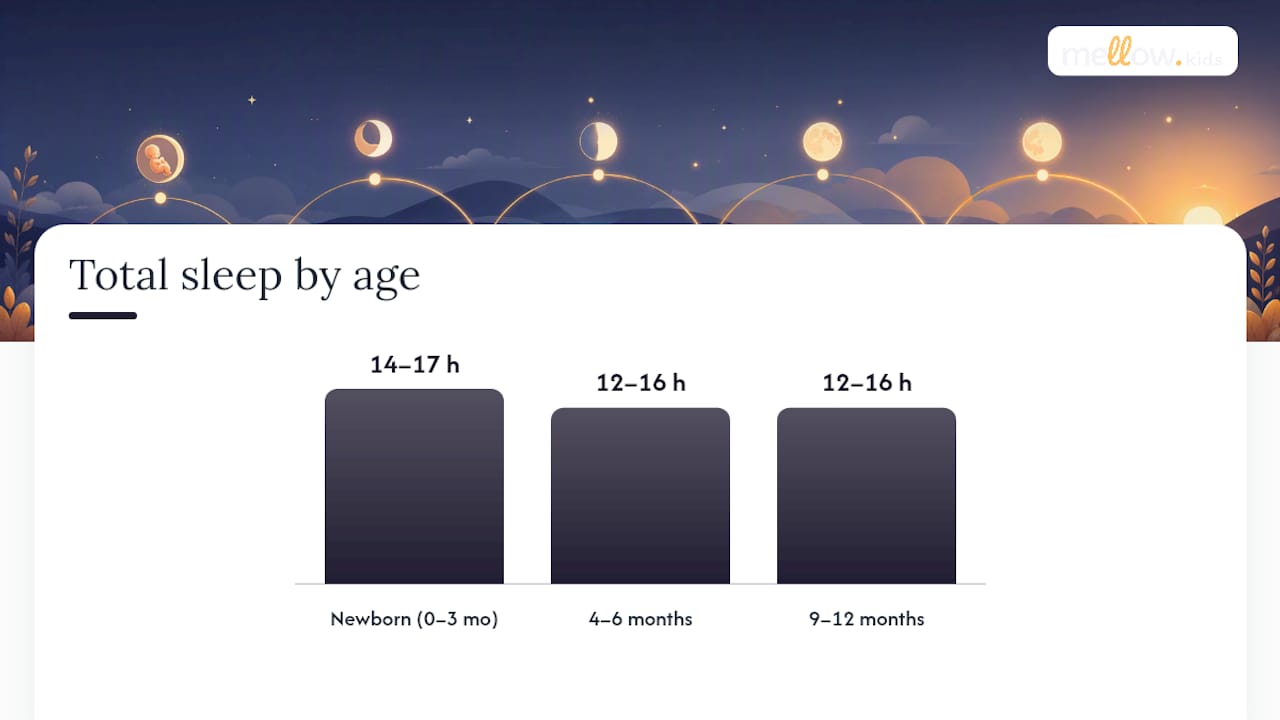
3. 6 to 9 months Most babies drop to 2 to 3 naps with wake windows of 2 to 3 hours. Sample schedule: wake 6:30 a.m., nap one 9:00 to 10:15 a.m., nap two 1:00 to 2:30 p.m., optional short catnap 4:30 to 5:00 p.m. if needed, bedtime 7:00 p.m. Total sleep stays in the 12 to 16 hour range. Check Mellow's 8-10 months guidance for a more detailed breakdown as your baby nears the back half of this window.

4. 9 to 12 months This is the classic two-nap stage. Wake windows run 2.5 to 3.5 hours, longer before the afternoon nap than before the morning one. Sample day: wake 6:30 a.m., nap one 9:00 to 9:45 a.m., nap two 1:00 to 2:45 p.m., bedtime 7:00 p.m. Total sleep: 12 to 16 hours. Many 10 to 12 month olds start dropping the morning nap during this stretch, per Mayo Clinic, so don't panic if the morning nap suddenly gets short or disappears.
5. 12 to 18 months Most toddlers transition from two naps to one somewhere in this window, though the exact timing varies widely. A two-nap sample: wake 6:30 a.m., nap one 9:30 to 10:15 a.m., nap two 1:30 to 3:00 p.m., bedtime 7:30 p.m. A one-nap sample: wake 6:30 a.m., nap 12:30 to 2:30 p.m., bedtime 7:30 p.m. Total sleep needs shift to 11 to 14 hours. Mellow's 11-14 months resources map this transition in detail.
6. 18 to 24 months Nearly every toddler is on one nap by this stage, usually 1 to 3 hours long, with a wake window of 5 to 6 hours beforehand. Sample day: wake 7:00 a.m., nap 12:30 to 2:30 p.m., bedtime 7:30 or 8:00 p.m. Total sleep sits at 11 to 14 hours across the day.
- If your baby fights every sample time listed above, shift the whole day 15 to 30 minutes and reassess after a few days.
- Individual variation is large. A happy, well-rested baby who deviates from these numbers does not need "fixing."
How Do You Use Wake Windows and Tired Cues?
A wake window is simply the stretch of time your baby can comfortably stay awake between sleep periods. The first wake window of the day is always the shortest; the last one before bedtime is the longest, since it needs to build enough sleep pressure for a good night. Newborns might only handle 45 minutes awake, while an 18 month old can go 5 to 6 hours before bedtime.
Watching your baby inside that window matters more than watching the clock. Common tired cues include:
- Rubbing eyes or ears
- Staring off or losing interest in toys
- Increased fussiness or clinginess
- Yawning (often a later, not earlier, sign)
- Jerky or slower movements
Once you spot cues, start the wind-down. A simple pre-nap routine works better than an elaborate one: dim the lights, close the curtains, maybe a short song or a few minutes of rocking, then put your baby down drowsy but awake. Healthychildren notes that forcing a nap when a baby isn't actually tired can create negative associations with the crib, so timing the routine to the cues, not a fixed minute, tends to work better.
Environment matters too. A dark room, white noise, and a temperature around 68 to 72 degrees Fahrenheit all support longer, deeper naps.
Pro Tip: If a nap runs long and threatens bedtime, cap it. Waking a baby after 9 to 10 months from a nap that's dragging past the 3:30 p.m. mark protects the night's sleep far more than an extra 20 minutes of daytime rest does.
When Should You Drop a Nap?
Most nap transitions follow a loose but predictable order: 4 naps to 3 around 4 to 6 months, 3 to 2 around 6 to 9 months, and 2 to 1 somewhere between 12 and 18 months. Watch for these signals before making a change:
- Fighting a nap consistently for one to two weeks, not just an occasional off day.
- Bedtime getting harder because a nap is now too close to it.
- Early morning waking that doesn't resolve with earlier bedtime adjustments.
Once you see two or more of these signals, try a gradual approach rather than an abrupt switch:
- Stretch the wake window before the nap you're dropping by 15 minutes every few days.
- Trial the new schedule for 3 to 5 days before deciding it's a real transition and not a rough patch or a growth spurt.
- Watch nighttime sleep as your main signal of success. Better, more consolidated night sleep means the transition is working.
- If nights get worse, move bedtime 30 minutes earlier temporarily to offset the lost daytime sleep.
The most common pitfall is letting the remaining nap creep too late in the day, which pushes bedtime later and starts a cycle of overtiredness. Mellow's guide on transitioning from two naps to one walks through pacing this specific shift in more detail.
Why Is My Baby Only Napping 30 Minutes?
Short naps, often called catnaps, usually come down to one of three causes: an overtired baby who couldn't settle deeply, an undertired baby put down too early, or a sleep environment that's too bright or noisy to support a full sleep cycle. Try resettling with a few minutes of quiet reassurance before assuming the nap is over, and darken the room further if light is leaking in. Mellow's piece on lengthening short naps before 5 months covers specific resettling techniques for younger babies.
Late naps that run past 4:00 or 4:30 p.m. tend to eat into bedtime sleep pressure. Waking a baby from a nap that's running long, per guidance from Cleveland Clinic, is often the better move than letting it stretch and pushing the whole evening back.
Refusing naps altogether for several days in a row, especially paired with good nighttime sleep, often signals a real transition rather than a problem. Offer quiet time in the crib or a dim room even if sleep doesn't happen.
Talk to your pediatrician if nap refusal comes with fever, feeding changes, or a sudden shift in mood that doesn't resolve within a week or two. That combination points to something beyond a normal sleep transition.
How Does Mellow Kids Apply This Research?
Mellow Kids builds its guidance around the same three pillars covered in this article: age-specific wake windows, flexible nap counts by developmental stage, and daily tracking to catch patterns before they become problems. Instead of handing parents a static chart, the app adjusts recommendations as your baby moves through each stage, which matters because the PMC systematic review confirms nap needs shift gradually and unevenly, not on a fixed calendar.
The gap between generic advice and useful advice is timing. A schedule that was right for your baby at 7 months can actively work against her at 11 months, and most parents don't get a signal until bedtime has already fallen apart for a week.
That's the problem age-banded tracking solves: catching the shift before it becomes a battle, using the same wake-window logic outlined by Mayo Clinic and reflected in Mellow's own sleep schedule guide.
Nap Schedule Baby: What The Research Actually Supports
The evidence points to a simple but underused truth: wake windows beat clock times, yet most parents still hunt for a rigid hourly grid because it feels more controllable. That instinct is understandable and mostly wrong. A baby's sleep pressure builds on biology, not a printed schedule, and the systematic review on nap cessation makes clear that even the broad milestone ages (dropping the last nap, for instance) vary by years, not weeks.
Where conventional advice falls short is in treating nap transitions as single events. They are not. A baby doesn't go from two naps to one on a Tuesday. She trials it, regresses, tries again, and the parents who panic at the first rough day often push a transition before their baby is ready, which just creates weeks of overtiredness.
Prioritize watching nighttime sleep over defending a daytime number. If nights are solid, the nap schedule, however far from any sample chart, is working.
Get Age-Specific Nap Guidance That Grows With Your Baby
Sample schedules get you started, but they can't tell you what changes the week your baby hits a new developmental stage. That's the gap Mellow closes: instead of a static chart you outgrow in a month, Mellow's app tracks your baby's actual age and stage, then adjusts wake windows and nap recommendations automatically as things shift.

If your baby is between 8 and 10 months, the 8-10 months guide walks through exactly what schedule fits that window. Approaching the two-naps-to-one transition around 11 to 14 months? That age-specific page covers pacing and pitfalls in more depth than any general guide can. And if you're navigating the toddler stretch from 15 to 24 months, Mellow's toddler guidance picks up right where nap consolidation ends. Start by checking which age band fits your baby right now at Mellow, and get a plan built for this exact stage instead of the one you'll need to replace next month.
Frequently Asked Questions
How many naps should my baby take by age? Newborns take 4 to 6 naps a day, dropping to 3 naps around 4 to 6 months, 2 naps around 6 to 9 months, and 1 nap somewhere between 12 and 18 months for most babies, according to Nemours.
How long should a baby's nap last? Nap length varies by age, but most healthy naps run 45 minutes to 2 hours. Consistent naps under 30 minutes are considered catnaps and often benefit from resettling or environment changes.
What are the signs my baby is tired and ready for a nap? Eye rubbing, staring off, increased fussiness, and jerky movements are earlier cues than yawning. Catching these signs early, inside the wake window, makes settling easier.
How do naps affect nighttime sleep? Naps that run too late in the day reduce the sleep pressure needed for an easy bedtime. Capping naps after about 9 to 10 months, per Cleveland Clinic, helps protect the night.
When do babies transition from 2 naps to 1? Most toddlers make this shift between 12 and 18 months, though timing varies widely. Watch for consistent nap refusal and bedtime struggles as the signal, not a specific birthday.
Is it normal for my toddler to still nap after age 2? Yes. Research shows full nap cessation before age 2 is rare, and most children keep napping well into the preschool years.
Sources
- PMC systematic review on napping cessation
- Mayo Clinic — Baby naps: Daytime sleep tips
- Nemours KidsHealth — Naps