
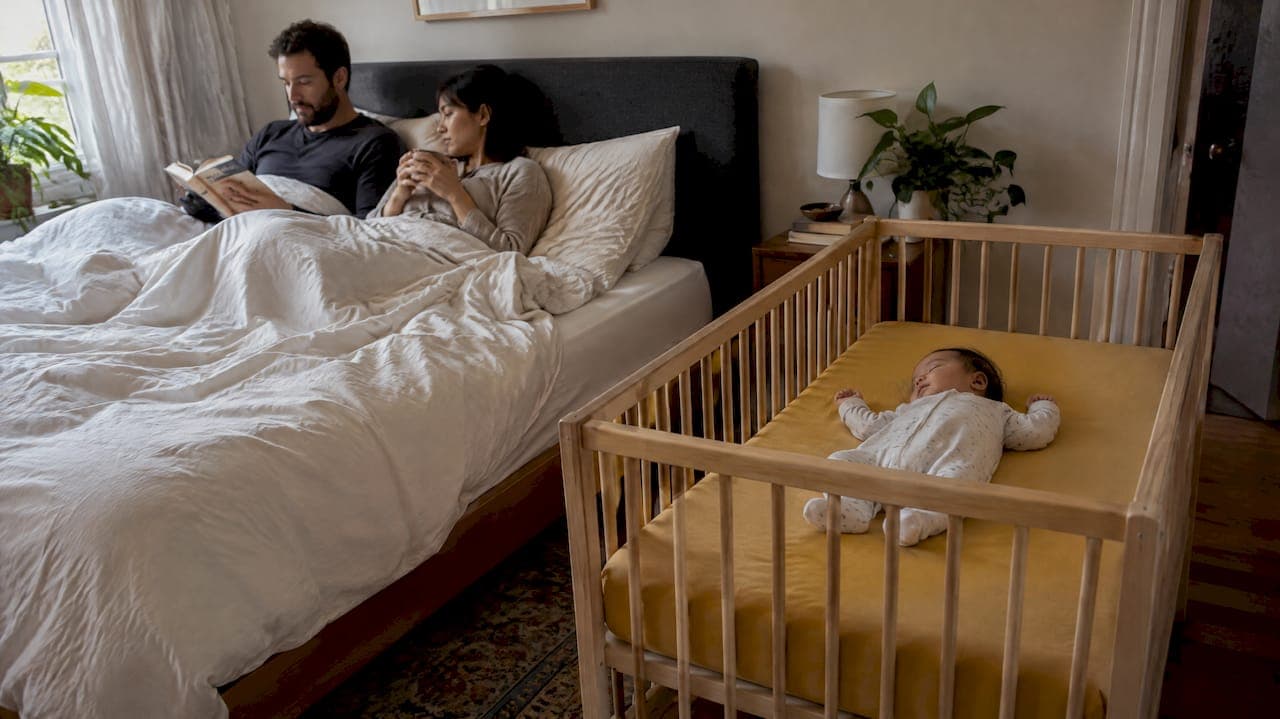
Every baby should sleep on their back, alone on a firm, flat, noninclined surface, with nothing else in that space, for every sleep until age 1. This is the core recommendation from the American Academy of Pediatrics, echoed by the CDC and reinforced by federal product standards from the CPSC. Room-share without bed-sharing, skip the soft bedding, and keep the room comfortably cool. These rules apply to every caregiver, every nap, every night.
TL;DR:
- Keep your baby in your room, but on a separate surface, for at least 6 months; the recommendation ideally extends through the first year.
- Accidental suffocation and strangulation accounted for 28% of U.S. SUID cases in 2022, underscoring why bumpers, blankets, pillows, and toys belong outside the crib.
- Stop swaddling at the first sign of rolling, which can occur before 3 months, and never use weighted swaddles or sleep clothing.
- Car seats, swings, loungers, and inclined sleepers are not routine sleep spaces; move a sleeping baby to a flat crib as soon as practical.
- Breathing and heart rate monitors have not been shown to prevent SIDS, so they cannot replace a compliant sleep space or basic precautions.
Table of Contents
- The AAP safe sleep checklist parents can follow today
- What makes a crib or bassinet actually safe to sleep in
- Why back sleeping is safe, and how to swaddle correctly
- Room-sharing helps, bed-sharing raises real risk
- Keeping the crib clear and the room at a safe temperature
- Getting every caregiver on the same page about safe sleep
- Why monitors and "SIDS-proof" products don't replace the basics
- Mellow's age-by-age checklist for putting the guidance into practice
- Tummy time still matters, even with back-only sleep
- Moving from swaddled to unswaddled sleep
- Safe sleep rules don't pause for travel or daycare
- What changed in the latest AAP guidance and why
- Why a consistent routine supports safer, better sleep
- Why the simple rules are the ones that work
- Turning the guidance into your family's routine
- FAQ
- Sources
The AAP safe sleep checklist parents can follow today
The guidance can feel like a lot at first, but it breaks down into a handful of concrete habits explained in this parent's guide to newborn sleep. Once you set them up, they become automatic, and that consistency is what protects your baby.
Back sleeping comes first. Every sleep, every time, until your baby turns 1, your little one should be placed on their back. Side sleeping is not considered safe, even as a transition position, because babies can roll from their side onto their stomach without the strength to reposition themselves.
The sleep surface matters just as much as the position. A firm, flat, noninclined surface, meaning a crib, bassinet, or play yard that meets current safety standards, with nothing but a fitted sheet, gives your baby the stable base they need to breathe freely. Soft mattresses, pillow-top toppers, and anything that lets a baby's face sink in raise suffocation risk.
Room-sharing, keeping your baby's sleep space in your bedroom but on a separate surface, is recommended for at least the first 6 months. This single change is associated with a meaningfully lower risk of sleep-related death, according to the CDC, which also notes that breastfeeding and offering a pacifier at nap time and bedtime are additional protective steps once breastfeeding is established.
Here is the checklist in its simplest form:
- Place your baby on their back for every sleep, including naps.
- Use a crib, bassinet, or play yard with a firm, flat surface and a fitted sheet only.
- Keep your baby's sleep space in your room, separate from your bed, for at least 6 months.
- Remove pillows, blankets, bumpers, and stuffed animals from the sleep area.
- Dress your baby for the room temperature instead of relying on blankets.
- Avoid smoke, nicotine, alcohol, marijuana, opioids, and illicit drugs during pregnancy and after birth.
- Offer a pacifier at sleep times once breastfeeding is going well, if you choose to use one.
One of the leading causes of sudden unexpected infant death in the United States is accidental suffocation and strangulation in bed, which made up 28% of SUID cases in 2022, alongside SIDS and unknown causes. That proportion is a direct argument for an empty, firm sleep space: most of these deaths are preventable with the setup described above.
Nicotine exposure, whether prenatal or secondhand, is one of the stronger modifiable risk factors identified by the CDC, and it compounds with other risks like soft bedding or bed-sharing. If you smoked during pregnancy or smoke now, keeping your baby's sleep environment smoke-free and seeking support to quit are both protective steps worth taking seriously.
What makes a crib or bassinet actually safe to sleep in
A sleep surface qualifies as safe when it is firm, flat, and noninclined, three words that sound simple but are worth testing in your own home. Firm means the mattress does not visibly indent when your baby lies on it. Flat means no incline greater than about 10 degrees, ruling out any product designed to prop a baby at an angle. Noninclined also rules out car seats, swings, and loungers for routine sleep, even though babies often doze off in them during travel.
In June 2021, the CPSC established a federal rule requiring that products marketed for infant sleep meet strict safety standards, which effectively removed many inclined sleepers from the market and forced manufacturers to redesign or discontinue noncompliant products. That rule is the reason you will see fewer inclined loungers sold as sleep products today, though older models may still be in circulation through resale or hand-me-downs.
Avoid these for any sleep, intentional or accidental:
- Inclined sleepers and loungers, even ones marketed as "safe" alternatives to a crib.
- Baby swings and bouncers, which position a baby in a seated or reclined posture.
- Car seats and strollers for anything beyond transit; transfer a sleeping baby to a flat crib as soon as you reasonably can.
- Adult beds, couches, and armchairs, none of which meet firm, flat, noninclined standards.
Recalls happen more often than most parents expect. The CPSC has pulled millions of units of infant swings and recalled crib bumpers for suffocation risk, and checking a product's recall status takes less time than assembling it.
Pro Tip: Before you use any secondhand crib, bassinet, or sleep product, search its model number on CPSC.gov to confirm it has not been recalled.
If you ever learn that a product you own has been recalled, stop using it immediately, register it with the manufacturer for remedy instructions, and do not pass it along to another family until the issue is resolved.
Why back sleeping is safe, and how to swaddle correctly
Many parents worry that a baby sleeping on their back might choke, especially babies with reflux, but the anatomy works in their favor. A baby's airway and the way the esophagus connects make it easier to clear fluid while lying on the back than the stomach, which is why the AAP's guidance through HealthyChildren.org applies even to infants with reflux.
Swaddling can help some babies settle, but it is a comfort tool, not a SIDS-prevention method, and it has to be done correctly to stay safe.
- Wrap the arms snugly, but leave enough room at the hips for your baby to bend their knees and move their legs, which protects healthy hip development.
- Check that the swaddle is not so tight it restricts breathing, and never cover your baby's face or head.
- Stop swaddling the moment your baby shows signs of rolling, which is commonly between 3 and 4 months but can happen earlier.
- Never use a weighted swaddle or weighted sleep clothing; added weight on a baby's chest has no established safety backing and raises risk.
Once your baby starts attempting to roll, a swaddle becomes a hazard rather than a help, because a swaddled baby who rolls onto their stomach cannot free their arms to reposition. Our guide to swaddling technique walks through the transition step by step, and comparing a sleep sack to a swaddle can help you decide what fits your baby's stage.
Room-sharing helps, bed-sharing raises real risk
Room-sharing means your baby sleeps in your bedroom, on their own separate surface, within arm's reach. The AAP and CDC recommend this arrangement for at least the first 6 months, and ideally through the first year, because it makes nighttime feeding and soothing easier while keeping your baby on a surface built for infant sleep.
Bed-sharing, where a baby sleeps in the same adult bed, is a different situation. Soft adult mattresses, pillows, and heavy blankets create suffocation risks that a crib mattress is specifically designed to avoid, and an adult can unknowingly roll or shift in ways that press against a baby.
Certain situations make bed-sharing especially dangerous:
- Either parent has used alcohol, marijuana, opioids, or any sedating substance before sleep.
- Either parent smokes, even if not in the bedroom itself.
- A parent is extremely fatigued, since exhaustion reduces awareness of a baby's position.
- The baby was born preterm or at low birthweight, both of which independently raise SIDS risk.
- The sleep surface includes soft bedding, a couch, or an armchair rather than a firm mattress.
If you are breastfeeding at night, feed your baby in your bed if that is more comfortable, but return them to their bassinet or crib before you fall asleep. Keeping the bassinet within arm's reach of your bed makes that transfer easier at 3 AM, and our newborn safe sleep setup guide covers how to arrange the room so the transfer becomes second nature.
Keeping the crib clear and the room at a safe temperature
An empty crib looks stark compared to the cushioned, decorated nurseries in catalogs, but that bare look is exactly what keeps your baby safe. Soft bedding is one of the most consistently cited risk factors in sleep-related infant deaths, and removing it is one of the simplest changes a parent can make.
Keep these out of the sleep space entirely:
- Crib bumpers, padded or mesh, which have been the subject of a federal ban due to suffocation risk.
- Pillows, cushions, and positioning wedges of any kind.
- Loose blankets, quilts, and comforters.
- Stuffed animals and soft toys, no matter how small.
Padded crib bumpers are now banned under federal law, and the CPSC has issued direct warnings telling parents to stop using specific bumper products immediately. If you have a bumper in your home, even one gifted or inherited, remove it from the crib rather than assuming an older product is grandfathered in as safe.
Overheating is a separate but related concern. Dress your baby in one layer more than you would wear yourself, rather than piling on blankets, and choose a wearable blanket or sleep sack sized for your baby's weight instead of loose bedding. Watch for sweating, damp hair, flushed cheeks, or heat rash as signs your baby is too warm, and adjust the room temperature or clothing layer accordingly. Our guide to room temperature and sleepwear breaks down what to use season by season.
Getting every caregiver on the same page about safe sleep
Safe sleep only works if it is consistent, which means grandparents, babysitters, and daycare providers need to follow the same rules you do at home, even if that means pushing back gently on outdated advice.
A short, direct script helps: "We're following back-sleeping and an empty crib for every nap, even quick ones, because that's what keeps the SIDS risk lowest." Most caregivers appreciate clarity rather than vague requests.
Before handing your baby off to a new caregiver or daycare, share a simple checklist:
- Back to sleep, every time, no exceptions for naps.
- Firm, flat crib or play yard with a fitted sheet only.
- No blankets, pillows, bumpers, or toys in the sleep space.
- Room temperature comfortable for a lightly dressed adult.
- No swaddle once baby shows any rolling attempt.
Pro Tip: Tape a laminated copy of your baby's sleep rules inside the diaper bag or on the inside of the crib rail at daycare, so there is never a moment of guessing.
Many hospitals model safe sleep before discharge, and pediatricians are a reliable source for reinforcing the guidance at well-child visits, so it is worth asking directly if you have questions about your baby's specific situation.
Why monitors and "SIDS-proof" products don't replace the basics
Baby monitors that track breathing or heart rate are marketed heavily to anxious new parents, but no home cardiorespiratory monitor has been shown to prevent SIDS, and the AAP cautions against relying on them as a substitute for the fundamentals.
The same skepticism applies to "breathable" mattresses and other products marketed with vague safety claims. A marketing label is not a safety certification.
- Verify any sleep product against CPSC federal standards rather than manufacturer claims alone.
- Search the model number on CPSC.gov before buying secondhand or accepting hand-me-downs.
- Treat "SIDS-reducing" or "breathable" claims as marketing language unless backed by a named safety standard.
- Check that a used crib or bassinet still has its original manual and has not been altered or missing parts.
The simplest setup, an empty crib, back positioning, and a cool room, remains the combination with the strongest backing, and it costs nothing extra to implement.
Mellow's age-by-age checklist for putting the guidance into practice
Knowing the rules is one thing, applying them at 2 AM with a crying newborn is another. Breaking the guidance down by age makes it easier to build habits before you need them.
- Newborn (0 to 1 month): Set up the crib or bassinet before birth with a firm mattress and fitted sheet only, place your baby on their back for every sleep, and transfer them from a car seat or stroller to a flat crib as soon as you arrive home, since car seats are for transit, not sleep.
- 1 to 4 months: If you swaddle, keep the hips loose and the wrap snug but not restrictive, watch closely for early rolling attempts, and have a properly sized sleep sack ready to replace the swaddle the moment rolling starts.
- Night feeds: Feed your baby in a chair or your bed if needed, but return them to their own crib or bassinet before you drift off, keeping the sleep space within arm's reach so the transfer stays quick and low-disruption.
Pro Tip: Keep a night light dim enough to avoid overstimulation but bright enough that you can safely see the crib during a 3 AM transfer.
If building and adjusting these routines on your own feels like a lot on top of everything else a newborn demands, personalized guidance that accounts for your baby's age, temperament, and your specific setup can take some of the guesswork out of it.
Tummy time still matters, even with back-only sleep
Back sleeping protects your baby overnight, but it is not a reason to skip tummy time during the day. Supervised tummy time while your baby is awake builds the neck, shoulder, and core strength babies need for rolling, sitting, and eventually crawling.
Start with short sessions, just a few minutes at a time, a handful of times a day, and build up as your baby gets stronger and more tolerant of the position. You can start from day one, placing your baby on their stomach on a firm surface, like a play mat on the floor, always while you are awake and watching.

If your baby fusses during tummy time at first, that is normal. Try shortening the sessions, getting down on the floor at eye level, or using a small rolled towel under their chest for support, then gradually extending the time as they build strength and tolerance.
The distinction to keep clear for yourself and any caregiver is simple: tummy time is a supervised, awake activity, never a sleep position. The back-to-sleep rule applies to every nap and every nighttime sleep, with no exceptions, while tummy time happens only when an adult is present and watching.
Moving from swaddled to unswaddled sleep
The transition away from swaddling is driven by one signal: your baby attempting to roll. Most babies show early rolling signs between 3 and 4 months, though some start earlier, which is why watching for the behavior matters more than watching the calendar.

Once you notice your baby pushing up, twisting their hips, or rolling partway onto their side during awake time, it is time to stop swaddling for sleep, even if it has been working well up to that point. A swaddled baby who rolls onto their stomach loses the ability to free their arms and reposition their face, which raises suffocation risk substantially.
The usual next step is a wearable sleep sack, sized appropriately for your baby's weight and height, which allows free arm and leg movement while still providing the enclosed, secure feeling many babies find soothing. Some parents transition gradually, swaddling with one arm free for a few nights before switching fully to a sleep sack, which can ease the adjustment for a baby used to the snug wrap.
Expect a few rough nights during the switch. A baby accustomed to a tight swaddle often startles more easily without it, and that adjustment period typically settles within a week or two as your baby adapts to the new sensation.
Safe sleep rules don't pause for travel or daycare
The guidance that applies at home applies everywhere your baby sleeps, which means travel, grandparents' houses, and daycare all need the same setup: back positioning, a firm flat surface, and an empty sleep space.
When traveling, pack a travel crib or play yard that meets the same CPSC standards as your home crib rather than assuming a hotel crib or a makeshift setup will do. Many hotels provide cribs on request, but their condition and compliance with current standards can vary, so bringing your own portable play yard removes that uncertainty.
At daycare, confirm directly that the facility follows back-sleeping and empty-crib practices, since licensing requirements vary and it is worth asking rather than assuming. Share your baby's specific routine, including their current sleep sack size and any special notes, so the transition between home and daycare stays consistent.
For overnight stays with relatives, bring your own crib or bassinet sheet and your baby's own sleep sack if possible, since familiar items can also help your baby settle in an unfamiliar room. The consistency of the sleep setup matters just as much as the consistency of the rules themselves.
What changed in the latest AAP guidance and why
The AAP updated its safe sleep policy in 2022, and the core changes reflected both new evidence and a push for clearer, more actionable language for parents. The update reinforced the room-sharing recommendation, sharpened guidance on swaddling and rolling, and added more explicit warnings against inclined sleep products following a wave of related recalls.
The policy also addressed disparities directly, noting that some racial and ethnic groups in the United States experience higher rates of sudden unexpected infant death, which points to gap in access to safe sleep education and affordable, compliant sleep equipment rather than any difference in how the guidance itself should be applied.
These updates did not reverse earlier recommendations, back sleeping and room-sharing have been consistent since the "Back to Sleep" campaign of the 1990s, but they tightened language around product safety and gave pediatricians clearer tools for counseling families, particularly as inclined sleepers and loungers became more common in stores before CPSC rules addressed them directly.
Why a consistent routine supports safer, better sleep
A predictable bedtime routine does more than help your baby fall asleep faster. It reinforces the same safe environment night after night, which reduces the chance of a tired caregiver reaching for a shortcut, like leaving a blanket in the crib or letting a baby doze in a swing, instead of placing them back in their crib.
Consistency also helps your baby's body anticipate sleep, which can mean fewer struggles at bedtime over time. A simple sequence, bath, feed, sleep sack, crib, repeated in the same order and roughly the same timeframe each night, builds that association.
The environment matters as much as the sequence. A room that is consistently cool, dark, and quiet, with the same firm crib and the same sleep sack, gives your baby fewer variables to adjust to, which supports both safety and sleep quality at once. Changing the setup frequently, switching between a crib and a swing, or varying the room temperature night to night, makes it harder for a baby to settle and easier for a caregiver to slip from the routine under pressure.
Why the simple rules are the ones that work
The safe sleep guidance can sound almost too basic for how much it matters: back, firm surface, empty crib, cool room. We have found that the simplicity is the point. Complicated advice gets skipped at 2 AM by an exhausted parent, but a rule you can recite half-asleep gets followed.
What strikes us most is how often the hardest part is not understanding the guidance, it is holding the line when a grandparent insists a blanket never hurt anyone, or when a baby seems to sleep better on their stomach for one rough night. Those moments are where small, consistent choices protect against real risk, even when the payoff is invisible.
We built our approach around anticipating these moments before they catch a tired parent off guard, because a family prepared for the 4-month rolling transition or the daycare handoff conversation makes safer choices than one scrambling to catch up. Prioritizing safety over a few extra minutes of convenience is rarely the easy choice in the moment, but it is consistently the right one.
— Mauricio Vargas
Turning the guidance into your family's routine
Reading the guidelines is the easy part. Applying them consistently through sleep regressions, rolling milestones, and the swaddle-to-sleep-sack transition is where most families want a second opinion, and that is exactly where we can help.

A Personalized Plan takes your baby's age, temperament, and current setup and turns the AAP's general rules into a routine built for your household. If you have a specific question, a 45-minute consultation gives you direct time with a certified consultant to work through it. For families who want both a plan and ongoing guidance, Plan + Consultation combines the two, and an Upgrade your support option is available if your needs grow after you start.
- Personalized Plan: a tailored sleep setup and routine for your baby's age and stage.
- Plan + Consultation: a personalized plan paired with direct guidance from a consultant.
- 45-minute consultation: focused, one-on-one time to address a specific sleep question.
- The Peaceful Sleeper series: additional resources for building sleep confidence at home.
If your baby is already struggling with night wakings or short naps, our sleep challenges resources are a good place to start, or you can go straight to exploring personalized sleep support today.
This article is general information, not a substitute for advice from a qualified doctor. Consult a qualified healthcare professional about your own circumstances before acting on anything here.
FAQ
What are AAP sleep guidelines?
The AAP recommends placing infants on their back for every sleep until age 1, using a firm, flat, noninclined sleep surface, and room-sharing without bed-sharing for at least 6 months. The guidance also calls for keeping soft bedding out of the crib and avoiding overheating, smoke, and substance exposure, as summarized by HealthyChildren.org.
What are the 7 safe sleep rules?
The commonly cited core rules are back sleeping for every sleep, a firm and flat sleep surface, room-sharing without bed-sharing, an empty crib free of soft bedding, avoiding overheating, avoiding smoke and substance exposure, and offering a pacifier at sleep times. These align with the CDC's safe sleep guidance, which also notes breastfeeding as an additional protective step.
What are the AAP guidelines for safe sleep for infants in 2026?
The guidance reflects the AAP's 2022 policy update, which reinforced back sleeping, room-sharing for at least 6 months, and a firm, flat, noninclined sleep surface free of soft bedding. There has been no reversal of these core recommendations, though CPSC product rules and recalls continue to shape which sleep products are available and compliant.
What are the new safe sleep guidelines for babies in 2026?
There is no new AAP policy update, the current guidance remains the 2022 update covering back sleeping, room-sharing, and safe sleep surfaces. Parents should continue checking CPSC.gov regularly for product recalls, since those can change which specific cribs, bassinets, or sleep products meet federal standards even when the underlying AAP recommendations stay the same.
Sources
- Healthychildren
- Sleep safely | SUID and Infant Sleep | CDC
- Recalls | U.S. Consumer Product Safety Commission