

Baby developmental milestones by month are observable behaviors that most babies (about 75%) achieve by a given checkpoint age. They fall into four domains: social/emotional, language/communication, cognitive, and physical (gross and fine motor). Formal screening happens at 9, 18, and 30 months, with autism-specific checks at 18 and 24 months.
Your job right now is simple: watch, jot down what you notice, and bring it to the pediatrician.
- Note specific behaviors and examples, not just "yes" or "no"
- Flag any skill that seems to have disappeared, not just one that hasn't arrived yet
- Bring those notes to well-child visits, especially around the screening checkpoints
Table of Contents
- What Do Milestone Checklists Actually Measure?
- Month-by-Month Milestone Checklist
- How Should Parents Track Milestones at Home?
- Simple Activities That Support Each Stage
- When Should You Be Concerned About Milestones?
- How Mellow Supports Milestone Tracking
- Do Cultural or Individual Differences Affect Milestones?
- What's the Best Way to Document Milestones?
- How Do You Talk to Your Pediatrician About Concerns?
- How Does Vaccination Timing Relate to Milestone Checks?
- What Actually Matters More Than the Checklist Itself
- Get Age-Specific Guidance Before the Next Leap Hits
- Sources
What Do Milestone Checklists Actually Measure?
A milestone is a skill most babies reach within a typical range, not a deadline every baby must hit on schedule. Some babies walk at 10 months; others take their first steps past 14 months, and both are within the range clinicians call normal. That range is exactly why the CDC frames its checklists around a 75% threshold: if about three out of four babies can do something by a certain age, it becomes a checkpoint worth watching, not a strict cutoff. Missing one item on one visit rarely means much on its own.
Development gets grouped into four areas that clinicians and MedlinePlus both use consistently:
- Social/emotional — smiling at caregivers, showing affection, reading facial expressions
- Language/communication — cooing, babbling, first words, following simple directions
- Cognitive — problem solving, cause and effect (shaking a rattle), object permanence
- Physical — gross motor (rolling, sitting, walking) and fine motor (grasping, pincer grip)
Pro Tip: Look for patterns across a few weeks, not a single day. A baby who suddenly stops babbling after weeks of steady progress is a more meaningful signal than one who simply hasn't started yet.
Month-by-Month Milestone Checklist
Development follows a head-to-toe sequence, called cephalocaudal progression, which is why head and neck control shows up before sitting, and sitting shows up before walking. Here's what most babies do by each common checkpoint age.
By 2 months:
- Social: calms when picked up or spoken to, starts to smile at people
- Language: makes sounds other than crying, turns toward voices
- Cognitive: watches faces, follows objects with eyes past midline
- Physical: holds head up briefly during tummy time, moves both arms and legs
By 4 months:
- Social: smiles on their own to get your attention, laughs
- Language: makes sounds back when you talk to them
- Cognitive: reaches for a toy with one hand, acts bored if activity doesn't change
- Physical: holds head steady without support, pushes up onto elbows during tummy time
By 6 months:
- Social: knows familiar people, likes to look at self in a mirror
- Language: makes several different sounds, blows raspberries
- Cognitive: puts things in mouth to explore, closes lips to show they don't want more food
- Physical: rolls from tummy to back, pushes up with straight arms
By 9 months (screening checkpoint):
- Social: shy or fussy around strangers, has favorite toys
- Language: makes different sounds like "mamamama," lifts arms to be picked up
- Cognitive: looks for things dropped out of sight, plays peek-a-boo
- Physical: sits without support, moves things from one hand to the other
At 9 months, the AAP recommends a routine developmental screening at the well-child visit. This is standard practice, not a sign anything is wrong.
By 12 months:
- Social: plays games with you like pat a cake, waves bye bye
- Language: says "mama" or "dada" and other names, understands "no"
- Cognitive: puts something in a container, looks for things hidden under a cover
- Physical: pulls up to stand, walks holding onto furniture (cruising)
By 15 months:
- Social: copies other children while playing, shows you an object they like
- Language: tries to say one or two words besides "mama" or "dada"
- Cognitive: tries to use objects the right way (drinks from a cup)
- Physical: takes a few steps on their own, uses fingers to feed self
By 18 months (screening plus autism check):
- Social: points to show you something interesting, helps dress or undress
- Language: tries to say three or more words besides "mama" or "dada"
- Cognitive: knows what ordinary things are for (phone, brush, spoon)
- Physical: walks without holding on, scribbles
Both a general screening and an autism-specific screening are recommended at this visit.
By 24 months (second autism check):
- Social: notices when others are hurt or upset, looks at your face to check your reaction
- Language: points to things in a book, says at least two words together
- Cognitive: plays with more than one toy at a time, follows two-step instructions
- Physical: kicks a ball, runs
By 30 months (final routine screening):
- Social: plays next to other children, follows simple routines when told "time to eat"
- Language: says about 50 words, says two or more words together
- Cognitive: uses things to pretend, shows simple problem-solving skills
- Physical: uses hands to twist things (knobs, lids), jumps off the ground
How Should Parents Track Milestones at Home?
You don't need a spreadsheet, just a consistent habit. A simple log works: date, baby's age, what you observed, a specific example, and how often it happens. "14 months, tried to stack two blocks, did it three times this week" tells a pediatrician far more than "seems fine."
- Write down the date, age, behavior, and a concrete example
- Note whether it's a one-time event or a repeated pattern
- Bring specific observations, not general impressions, to well-child visits
- Mention any skill your baby used to do but has stopped doing
Johns Hopkins Medicine notes that documenting specific behaviors, rather than relying on memory during a rushed appointment, helps clinicians act sooner when something needs a closer look. Screenings land at 9, 18, and 30 months, with autism-specific checks folded into the 18 and 24 month visits.
Pro Tip: A 15-second video clip on your phone often communicates more than a description ever could. Clinicians can watch how a baby moves, babbles, or reaches in real time.

Simple Activities That Support Each Stage
You don't need special toys to support development, just consistent, low-effort interaction at the right stage.
- Newborn to 3 months: tummy time and face-to-face talking build the neck and shoulder strength behind later head control (more ideas here)
- 4 months: reaching games with a rattle or soft toy build the hand-eye coordination behind grasping (activities for a 4-month-old)
- 5 to 7 months: peek-a-boo and simple back-and-forth games support both object permanence and social engagement (5-7 month activities)
- 8 to 10 months: supported standing and stacking cups encourage the balance behind pulling up (8-10 month guide)
- 11 to 14 months: naming objects during play builds the vocabulary behind first words
- 15 to 24 months: reading aloud and pretend play stretch language and imagination together (15-24 month activities)
When Should You Be Concerned About Milestones?
Certain signs warrant a call sooner rather than waiting for the next scheduled visit. A 4 percent to 1 in 5 range of developmental concerns benefit from early evaluation, and acting early is about access to support, not blame.
- No social smile by 6 months
- No babbling or reaching for objects by 9 months
- No single words by 12 to 16 months
- Loss of a skill your baby previously had, at any age
If you notice any of these: write down what you're seeing, take a short video if you can, call the pediatrician, and ask directly for a developmental screening or referral. Early intervention services exist specifically to help, and earlier evaluation tends to open more doors, not fewer.
How Mellow Supports Milestone Tracking
Mellow builds age-specific guides that pair directly with the checklist ages above, including a dedicated 8 to 10 months guide covering sitting, crawling, and early gestures. The guides link development to sleep, since developmental leaps often disrupt naps and nights in predictable ways.
- Age-by-age guides that anticipate the next developmental stage before it arrives
- Structured activity pages tied to specific checklist skills
- An app for tracking daily patterns alongside developmental progress
This article draws on CDC and AAP screening guidance and reflects editorial review by Mauricio Vargas. Specific credentialing and case study details will be added as they become available.
| Point | Details |
|---|---|
| Milestones are ranges, not deadlines | Missing one item on one visit matters less than a pattern or a lost skill. |
| Four domains to track | Watch social/emotional, language, cognitive, and physical skills together. |
| Bring specifics to visits | Log dates, examples, and frequency instead of relying on memory. |
| Mellow supports the gap | Guides like the 8-10 months plan map activities to each checklist stage. |
Do Cultural or Individual Differences Affect Milestones?
Yes, and this matters more than most checklists let on. The CDC's checkpoint ages reflect broad population data, but individual babies vary for reasons that have nothing to do with delay. A baby who spends more time being carried, for instance, may reach independent walking a bit later than one who spends more floor time, simply because of different practice opportunities, not different ability.
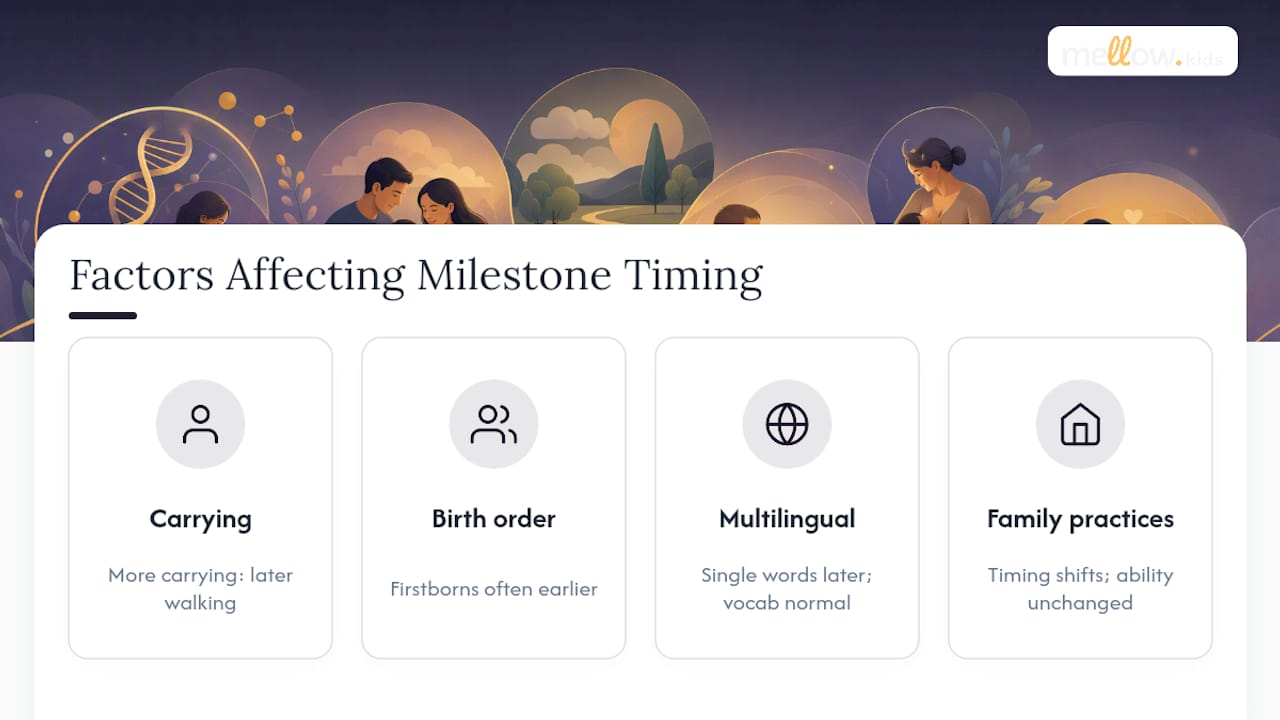
Birth order plays a role too. Firstborns sometimes hit certain physical milestones slightly earlier because they get more one-on-one floor time; younger siblings sometimes talk earlier because they're constantly exposed to older kids' speech. Multilingual households often see single words appear a bit later, since a baby is processing two or more language systems at once, but total vocabulary across both languages tends to track normally.
Family practices around holding, feeding, and sleep positioning also shift the timing of certain physical milestones without affecting a baby's underlying ability. None of this means checklists are wrong. It means the checklist tells you where to look, not what your specific baby must do on a specific date.
The healthiest way to use a milestone list is as a conversation starter with your pediatrician, someone who knows your baby's full context, rather than as a scorecard you're grading alone at home. If your baby's pattern looks different from a sibling's or a friend's baby, that difference is usually just that: a difference, not a red flag.
What's the Best Way to Document Milestones?
A written or digital log beats memory every time, especially during the newborn haze when days blur together. The most useful entries include four things: the date, your baby's age in weeks or months, exactly what you observed, and how often it happened.
Paper baby books work fine for parents who like handwriting things down, but they're easy to lose track of during a busy month. A notes app on your phone is faster and searchable later. Purpose-built tracking apps go a step further by organizing entries by domain and age, which makes it far easier to spot a pattern (or a gap) across several weeks instead of scattered notes.
Photos and short videos add a layer text can't capture. A 10-second clip of your baby babbling, reaching, or pulling up gives a clinician something concrete to assess, rather than a secondhand description filtered through a tired parent's memory at a rushed appointment. Save clips by month so you can compare side by side later.

Whatever method you choose, consistency matters more than sophistication. A simple weekly check-in, even five bullet points, beats an elaborate system you abandon after two weeks. The goal isn't a perfect record. It's having real examples ready when your pediatrician asks, "What has she been doing lately?"
How Do You Talk to Your Pediatrician About Concerns?
Specific language gets better answers than general worry. Instead of saying "I'm not sure he's on track," try "He's not saying any single words yet at 14 months, and he stopped waving about a month ago." That second version gives your pediatrician something concrete to evaluate immediately, rather than a feeling to interpret.
Bring your notes or your phone with saved video clips to the visit. Mention timeframes clearly: when a skill appeared, when it disappeared (if it did), and how consistent it's been. If your child attends daycare, ask the caregivers what they've noticed too. A second set of eyes across a different setting is often surprisingly useful.
Don't hesitate to ask directly for a developmental screening or referral if you're not sure your concern is being taken seriously. You can say plainly, "Can we do a formal screening for this?" Pediatricians expect and welcome that question, especially around the AAP's recommended checkpoints at 9, 18, and 30 months.
If the appointment feels rushed and you don't get through everything, ask for a follow-up call or a longer visit dedicated to development. You know your baby's day-to-day patterns better than anyone sees in a 15-minute checkup, and that knowledge deserves full airtime, not a squeezed-in afterthought.
How Does Vaccination Timing Relate to Milestone Checks?
The CDC's well-child visit schedule already bundles vaccinations and developmental screening into the same appointments, which is a convenience worth using. The 2, 4, 6, 9, 12, 15, and 18 month visits, built primarily around immunizations, are also exactly when milestone checklists and formal screenings happen.
That overlap means you can prepare once for each visit instead of juggling separate appointments. Bring your milestone notes to the same visit where your baby gets their scheduled shots. You're already there, already have the pediatrician's attention, and the visit is structured to cover both.
Some parents worry that a fussy or feverish day after vaccination might muddy a developmental observation, and that's a fair instinct. If your baby seems off for a day or two after a shot, it's reasonable to note that context when discussing behavior, though typical post-vaccine fussiness is short-lived and distinct from a real developmental change. If a skill genuinely regresses and stays gone for more than a few days, that's worth mentioning regardless of timing.
Using the same visit for both purposes also means your pediatrician sees the full picture at once: physical growth, vaccination status, and developmental progress, all discussed in a single conversation instead of fragmented across separate appointments months apart.
What Actually Matters More Than the Checklist Itself
The conventional advice on milestones treats every checkpoint age like a finish line, and that framing does parents a disservice. Most parenting content skips past that detail because "here's your exact checklist" is a cleaner headline than "here's a range with real variation."
What deserves more attention is the pattern over time, not the single data point. A baby who's behind on one item but steadily progressing across every domain is in a completely different situation than one who's plateaued or lost a skill. Zero to Three's framing gets this right: warm, responsive interaction predicts healthy development more reliably than any single checklist box.
If you take one thing from this list, make it this: document specifics, watch for regressions, and treat the pediatrician conversation as a partnership rather than a report card. The checklist is a starting point for that conversation, not the verdict itself.
— Mauricio Vargas
Get Age-Specific Guidance Before the Next Leap Hits
Mellow gives you the piece a checklist can't: what to actually do this month, before the next developmental leap disrupts sleep and routine without warning. Instead of scrambling to interpret a missed milestone after the fact, Mellow's age-specific guides prepare you for what's coming next, from the 8 to 10 months guide through the 15 to 24 months guide.

Each guide pairs developmental stages with sleep strategies, so you're not treating milestones and sleep disruptions as two separate mysteries. If you're not sure where your baby's stage fits, start here to find the right guide for your baby's current age, or explore the full app for ongoing tracking across both development and sleep.
This article is general information, not a substitute for advice from a qualified doctor. Consult a qualified healthcare professional about your own circumstances before acting on anything here.
Sources
- Milestones for 3 years | Learn the Signs. Act Early. | CDC
- Infant development: MedlinePlus Medical Encyclopedia
- Babies and toddlers developmental milestones | Johns Hopkins Medicine
- Developmental milestones | Zero to Three