
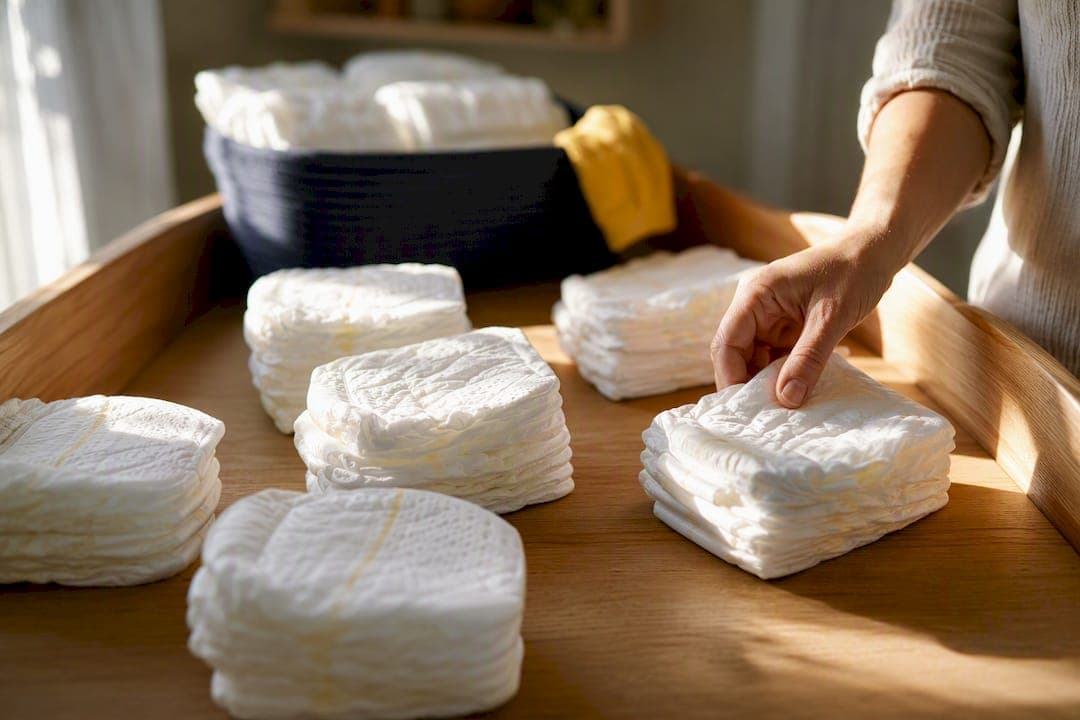
Most newborns typically use about 8 to 12 diapers a day, decreasing gradually with age to about 8 to 10 by 2 to 4 months, 7 to 9 by 5 to 8 months, 6 to 8 by 9 to 12 months, and 5 to 6 by the toddler stage. For newborns specifically, watch for at least 6 wet diapers each day by day five, as this indicates adequate hydration.
TL;DR:
- Most newborns typically use 8 to 12 diapers daily, with counts decreasing to about 5 to 6 diapers per day by toddlerhood.
- Producing at least six wet diapers in 24 hours by day five indicates proper hydration and feeding in newborns.
- Stocking extra diapers for the first month should be based on a monthly estimate of 240 to 360 diapers, plus a 15% buffer for growth spurts and leaks.
- Fewer than six wet diapers after day four, or signs of dehydration, require immediate pediatrician consultation.
- Using simple tracking methods or apps during the first two weeks helps parents catch early feeding or hydration issues without excessive effort.
Table of Contents
- Diaper Count by Age: The Numbers Behind the Ranges
- What Wet Diapers Tell You About Feeding and Hydration
- Turning Daily Counts Into a Shopping and Registry Plan
- Simple Ways to Track Diaper Counts Without the Guesswork
- When Diaper Counts Signal Something Off
- What Diaper Tracking Taught Me About Trusting the Range
- Track Diaper Counts Without the Mental Math
- Sources
Diaper Count by Age: The Numbers Behind the Ranges
Diaper counts move in one direction as your baby gets older: down. A newborn's stomach is tiny and empties fast, so feedings happen often and diapers pile up quickly. By the toddler years, bigger meals and longer stretches between bathroom needs cut that number nearly in half. Here's how the typical daily and monthly counts break down by stage.
| Age Range | Diapers per Day | Estimated Diapers per Month |
|---|---|---|
| Newborn (0 to 1 month) | 8 to 12 | 240 to 360 |
| 2 to 4 months | 8 to 10 | 240 to 300 |
| 5 to 8 months | 7 to 9 | 240 to 360 |
| 9 to 12 months | 6 to 8 | 240 to 300 |
| 1 to 2 years | 5 to 6 | 180 to 270 |
These ranges come from widely cited pediatric diapering guidance, and they hold up across most healthy, full-term babies. But "typical" doesn't mean "identical." A few things push your baby's numbers up or down within that range:
- Feeding method: Breastfed babies often produce more frequent, looser stools in the early weeks, which can nudge the daily count toward the higher end.
- Growth spurts: Around 2 to 3 weeks, 6 weeks, and 3 months, babies often feed more often, which temporarily increases both wet and dirty diapers.
- Prematurity: Preterm babies may need more frequent changes early on due to smaller bladder capacity and closer feeding intervals.
- Multiples: Twins and triplets don't change the per-baby math, but they do multiply your household total, so plan supply runs accordingly.
If you're stocking a registry before birth, the first month is where most new parents overbuy or underbuy. A realistic newborn month runs 240 to 360 diapers depending on your baby's size and feeding pattern. Rather than buying six massive boxes of newborn-size diapers, plan for a smaller newborn stash (one to two packs) since many babies outgrow that size within two to four weeks. Add progressively larger sizes so you're not stuck with unused newborn diapers once your baby hits the next size up. Registries built this way tend to age better with your baby instead of against your baby.
What Wet Diapers Tell You About Feeding and Hydration
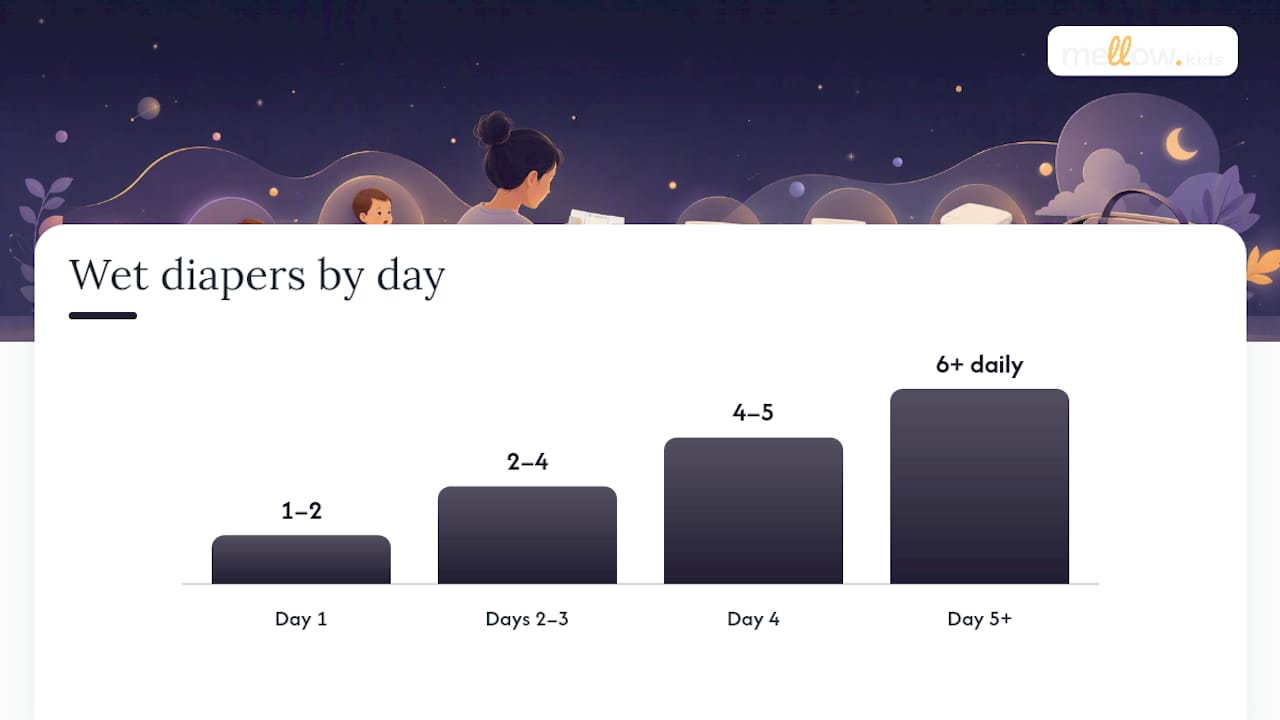
Wet-diaper counts climb fast in the first week, and pediatric guidance treats that climb as a rough hydration timeline — see this first week survival guide for practical newborn care basics. Pampers' newborn wet-diaper guidance lays it out day by day:
- Day 1: 1 to 2 wet diapers
- Days 2 to 3: 2 to 4 wet diapers
- Day 4: 4 to 5 wet diapers
- Day 5 and beyond: 6 or more wet diapers daily
By day five, most healthy newborns should be producing 6 or more wet diapers in 24 hours. Pediatricians lean on this number because it tracks closely with how much milk a baby is actually taking in. Fewer wet diapers than expected can point to a feeding issue before weight loss or other symptoms show up, which is exactly why this simple count carries so much clinical weight.
Urine color matters almost as much as volume. In the first few days, you might notice pinkish or orange residue in the diaper. That's usually just urate crystals, a normal and temporary finding that has nothing to do with blood. After day two or three, urine should look pale and mostly clear. Dark, concentrated urine past that point, or a return of black, tarry stool after the initial meconium has passed, are both signs worth a call to your pediatrician.
Contact your provider if your baby has fewer than 6 wet diapers in 24 hours after day four, seems unusually sleepy or hard to wake for feeds, or shows a dry mouth and sunken soft spot. Kaiser Permanente's guidance on newborn diapers treats this threshold as one of the clearest early signals that feeding needs a closer look.
Turning Daily Counts Into a Shopping and Registry Plan
Once you know your baby's rough diaper count by age, the math for stocking up is simple.
- Estimate the baseline. Multiply the daily count for your baby's age by 30 days. A newborn averaging 10 diapers a day needs about 300 diapers for the month.
- Add the buffer. Add 15% on top for spurts, leaks, or diaper-rash changes. That newborn month becomes roughly 345 diapers, not a bare 300.
- Size your packs accordingly. Buy in smaller newborn quantities, then scale up as your baby grows into the next size.
For registries and early stockpiling, a few practical habits keep you from wasting money:
- Register for a mix of sizes rather than one giant newborn case, since sizing changes fast in the first two to three months.
- Lean on gift cards or a diaper subscription service by baby age instead of bulk-buying months of one size upfront.
- Keep one unopened newborn pack as backup rather than a full case. Most babies outgrow that size within a month.
This approach saves you from the common trap of a closet full of unused newborn diapers by month two.
Simple Ways to Track Diaper Counts Without the Guesswork
Tracking matters most in three windows: the first two weeks home, right after a feeding change (starting solids, weaning, a formula switch), or whenever your pediatrician asks for numbers before a visit. Outside those windows, most parents relax into a rough mental count rather than logging every change.
A few low-effort tracking options work well depending on how detailed you want to get:
- A paper 24-hour log taped near the changing table, with simple tally marks for wet and dirty diapers.
- A one-tap smartphone tracker that timestamps each change automatically, which saves the mental math during sleep-deprived weeks.
- A diaper-logging app that generates a pediatrician-ready summary, showing 24-hour totals and 7-day averages instead of raw memory.
That last option solves a real problem: recalling exact diaper counts from memory during a rushed pediatrician appointment is hard even for organized parents. A printed or exported summary hands your provider the numbers instantly, which speeds up the conversation about feeding and hydration.
Pro Tip: Log intensively for the first 14 days, then switch to a quick daily glance once feeding settles into a rhythm. You don't need forever-tracking, just enough data to catch patterns early.
Once your baby settles into a steady feeding routine, you can usually pull back to a casual daily glance rather than logging every single change.
When Diaper Counts Signal Something Off
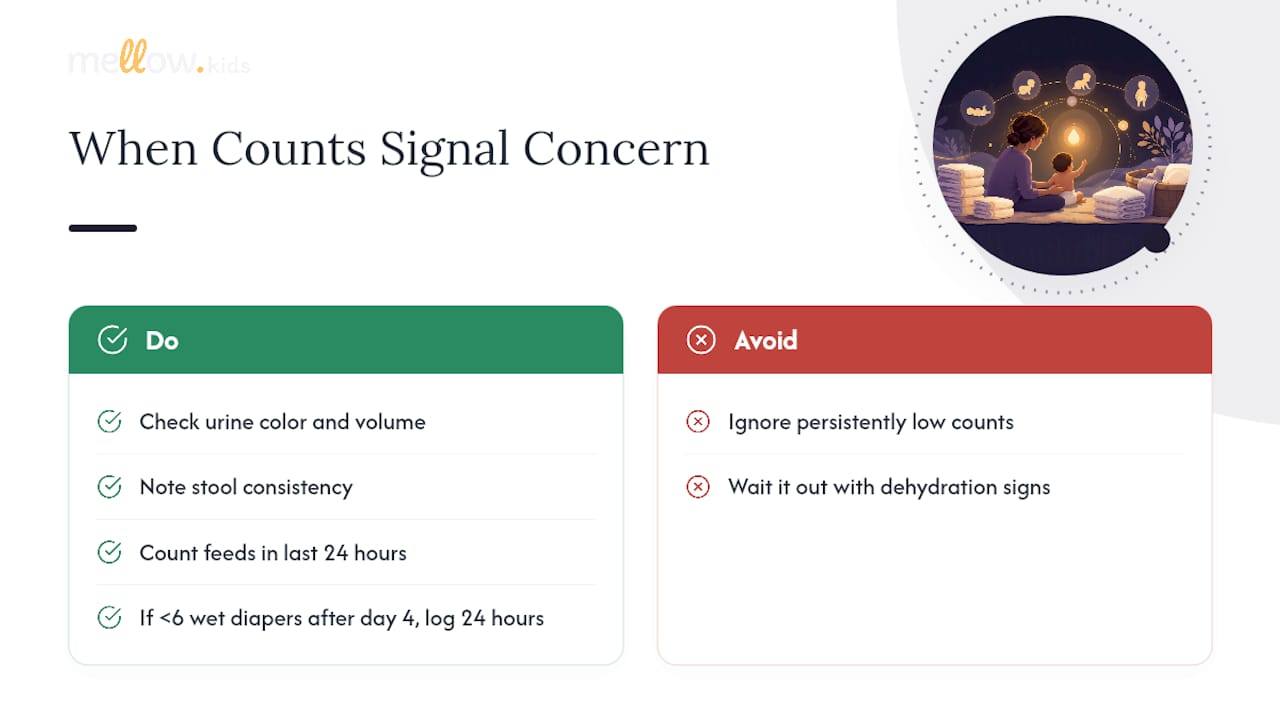
Higher-than-usual counts often trace back to a growth spurt or a stretch of cluster feeding, both completely normal. Lower counts deserve more attention. They can point to dehydration, a nursing latch issue, or simply less milk intake than your baby needs.
Start with quick checks: look at urine color and volume, note stool consistency, and count how often your baby has fed in the last 24 hours. If those checks raise concern, or if your baby has fewer than 6 wet diapers after day four, run a full 24-hour log and call your pediatrician. Watch too for a dry mouth, sunken soft spot, or unusual sleepiness. These are signs worth acting on quickly rather than waiting out.
What Diaper Tracking Taught Me About Trusting the Range
The most useful thing I've seen a diaper log do for a nervous parent is quiet the noise in their head. A written number carries more weight than a worried guess at 2 a.m. Pediatricians don't want a perfect count. They want a real one, even if it's messy or written on the back of a receipt.
The range exists because babies aren't identical, and a few diapers off the average rarely means something is wrong. Numbers just make the uncertainty easier to sit with.
— Mauricio Vargas
Track Diaper Counts Without the Mental Math
Some parenting apps offer one-tap diaper logging that builds pediatrician-ready reports automatically, tracking daily totals and 7-day averages so you're never reconstructing diaper counts from memory before a checkup.

Beyond diaper tracking, Mellow provides age-specific guidance that adjusts as your baby grows. If your baby is heading into the 8 to 10 month stretch where diaper counts and feeding schedules both start shifting, the 8 to 10 months guide walks you through what to expect next. Parents further along can check the 11 to 14 months resources or the 15 to 24 months guidance for toddler-stage changes. Start with the Mellow Kids app and try the free tracking tools before your next pediatrician visit.
Sources
- How Many Diapers a Day Does a Baby Need? — Pampers
- Baby’s diapers: What’s normal, what’s not — Kaiser Permanente
- Newborn Diaper Log: Tracker App — App Store