

If your 2-year-old has fewer than 50 words, isn't combining two words like "more milk," or has lost skills they once had, that's a language delay worth acting on now. Call your pediatrician this week, ask for a hearing test, and request an early intervention evaluation. You don't need to wait and see. Early evaluation consistently leads to better outcomes, and it costs you nothing to check.
TL;DR:
- Most toddlers should use over 50 words and combine two-word phrases by age 24 months, or they may need evaluation.
- Red flags include also losing skills, speaking unclearly, or showing little interest in social interactions, requiring prompt assessments.
- Causes vary from normal developmental delays to hearing loss, autism, or motor speech issues like apraxia, guiding specific interventions.
- Early evaluation involves pediatric screening, hearing tests, and speech-language assessments, with parent input being essential.
- Parents can support progress by narrating routines, expanding child's words, reading repetitively, and minimizing background noise at home.
Table of Contents
- Language Delay in a 2-Year-Old: Milestones at 24 Months
- Signs and Red Flags at Age Two: When to Act
- Common Causes of Language Delay in 2-Year-Olds
- How Professionals Evaluate a 2-Year-Old
- Treatment and Therapy Options for Toddlers
- What Parents Can Do at Home Today
- What to Expect After an Evaluation
- A Practical Checklist to Start This Week
- Where to Go for More Guidance
- Sources
Language Delay in a 2-Year-Old: Milestones at 24 Months
Before you can tell whether your child is delayed, you need a real benchmark, not a vague sense of "other kids talk more." By 24 months, most toddlers hit a fairly specific set of markers, and both the CDC and ASHA track them closely.
Here's what typically shows up by the second birthday:
- Uses a moderate to substantial number of words and puts two together, like "want cookie" or "daddy go"
- Follows simple two-step directions ("get your shoes and bring them here")
- Points to pictures in a book or to body parts when named
- Is understood by strangers to a moderate extent, according to Mayo Clinic
- Names familiar people, objects, and body parts
It helps to separate what your child understands (receptive language) from what they say (expressive language). A toddler who follows directions well but says little may have a purely expressive delay, which tends to respond faster to intervention than a delay affecting both sides.
Signs and Red Flags at Age Two: When to Act
Some signs matter more than others. If you notice any of these, don't wait for the next well visit. Call sooner.
- Your child says a notably limited number of words total
- They aren't combining two words into short phrases
- Speech is so unclear that even you struggle to understand most of it
- They've lost words or skills they used to have
- They show little interest in interacting, pointing, or making eye contact during play
- Frustration and tantrums spike, especially when they can't get an idea across
That last item catches a lot of parents off guard. Research from Northwestern found that behavioral outbursts are often the first visible sign of communication frustration, and expanding a child's vocabulary tends to calm those outbursts. If two or more of these apply, request a hearing screening and an early intervention referral in the same phone call.
Common Causes of Language Delay in 2-Year-Olds
Not every quiet toddler has the same issue, and the cause shapes the treatment. A few patterns show up again and again.
- Late talker (simple developmental delay): Follows the normal sequence of language growth, just slower. Many catch up with support.
- Developmental language disorder: Language develops out of the typical order or plateaus rather than progressing. Northwestern's speech-language program draws this distinction and notes that waiting for spontaneous catch-up isn't the right move for either group.
- Hearing loss or fluid in the middle ear: Even mild, intermittent hearing loss from ear infections can blunt speech growth, which is why hearing tests come before speech evaluation.
- Autism spectrum disorder: Often paired with reduced eye contact, limited pointing, or narrow interests.
- Childhood apraxia of speech: A motor planning issue that makes sounds inconsistent even when the child knows what they want to say.
How Professionals Evaluate a 2-Year-Old
Evaluation isn't one appointment. It's usually a short sequence, and knowing the order helps you feel less lost walking in.
- Pediatrician screening: Your doctor asks about milestones, uses a standardized checklist, and rules out obvious medical issues.
- Hearing test: An audiologist runs a screening, and if needed, tympanometry (checking middle-ear function) or an ABR test for infants and toddlers who can't respond to behavioral testing.
- Speech-language evaluation: An SLP observes your child in play, samples spontaneous speech, and tests both what they understand and what they can say.
- Early intervention intake: You can request an evaluation directly through your state's program or through a pediatrician referral, per Usa.
Pro Tip: Bring a simple list of your child's actual words to the SLP appointment. Clinicians rely heavily on parent report, and a real word list is far more useful than "not many."
If your family speaks more than one language, keep every language on the table. ASHA notes that bilingualism doesn't cause delay, but evaluators need to test both languages to see the full picture.
Treatment and Therapy Options for Toddlers
Once an evaluation confirms a delay, treatment usually starts fast, and it looks different than most parents expect. It's playful, not clinical.
- Early intervention services are state-run for children under 3 and typically happen in your home or another familiar setting, coaching you alongside your child rather than replacing you.
- Speech therapy sessions for toddlers lean on play: blowing bubbles to build breath control, naming toys during pretend play, and songs with repetitive, predictable phrases.
- Family coaching teaches you to fold therapy techniques into ordinary moments, snack time, bath time, car rides, so practice happens all day, not just during a session.
- Multidisciplinary referral comes into play when hearing loss, suspected autism, or apraxia is on the table. That might mean audiology, developmental pediatrics, or a behavioral specialist joining the SLP.
Delays caught and treated early carry a real advantage. Research summarized in pediatric literature links early speech-language intervention to better long-term literacy and academic outcomes compared to delayed treatment.
What Parents Can Do at Home Today
Therapy works faster when it doesn't stop at the clinic door. You're with your child far more than any specialist will be, and small daily habits add up.
- Narrate everything. Talk through diaper changes, meals, and errands like a sportscaster. "We're putting on your shoes. Left shoe first."
- Follow their lead. If they're fascinated by a truck, talk about the truck. Interest drives attention, and attention drives learning.
- Expand, don't correct. If they say "ball," respond with "big red ball" instead of asking them to repeat it.
- Read the same book repeatedly. Repetition builds vocabulary faster than novelty at this age, and pausing before a familiar word lets your child fill it in.
- Cut background noise. A TV playing in the background competes with your voice for a toddler's attention.
Pro Tip: Turn everyday routines into two-word practice. If your child points at juice, say "want juice?" instead of just handing it over. That tiny pause is where language grows.
For structured ideas by age, Mellow's playtime activities for 15 to 24 months walks through specific games built for this exact stage.
What to Expect After an Evaluation
Timelines vary by state and by how full local caseloads are, but most families hear back on eligibility within a few weeks of the intake evaluation. If your child qualifies, services often begin within a month.
Early goals tend to be small and measurable: five new spontaneous words in six weeks, combining two words consistently, or responding to their name every time. Your SLP or early intervention coordinator will track progress at regular check-ins and adjust the plan.
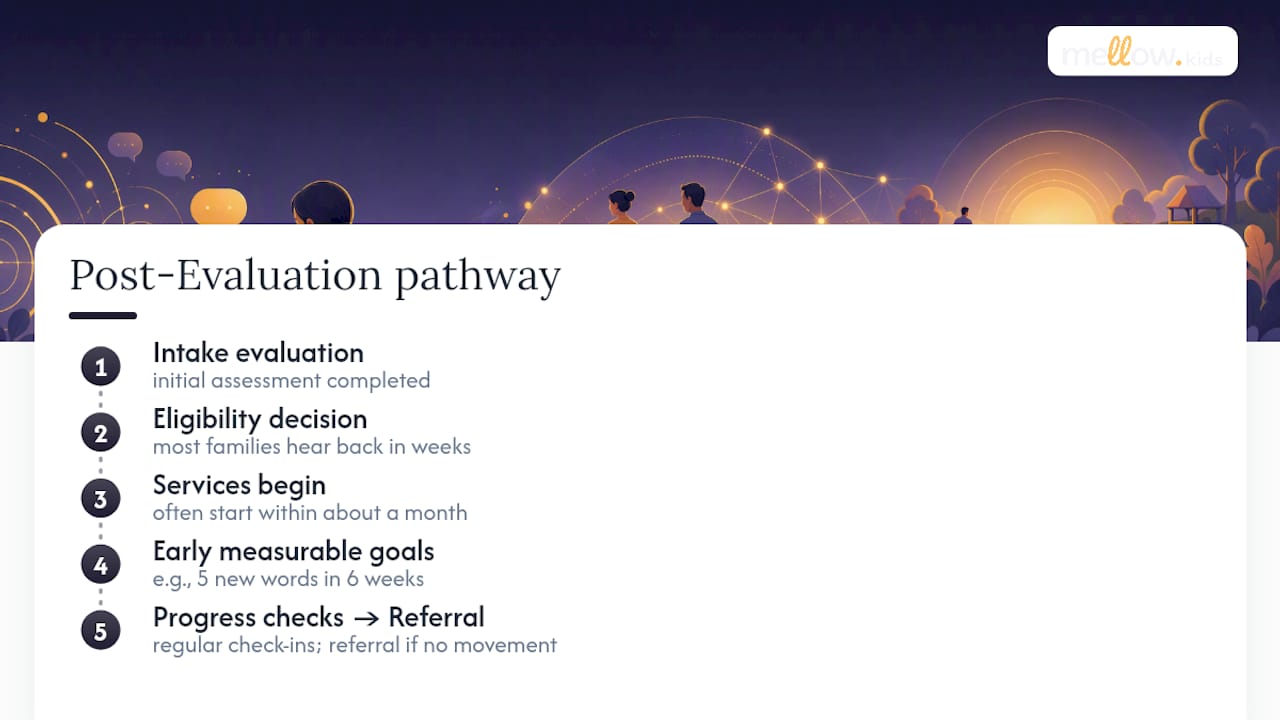
If your child doesn't show measurable movement after a few months, or if new concerns surface (unusual behaviors, regression, hearing that seems inconsistent), expect a referral to a broader evaluation, possibly involving developmental pediatrics or audiology again.
A Practical Checklist to Start This Week
Language delays are the most common developmental concern parents raise, according to HealthyChildren.org, so you're not overreacting by asking questions now. Mellow's 15 to 24 months guidance tracks these exact milestones alongside sleep and behavior, so you're never guessing what's next.
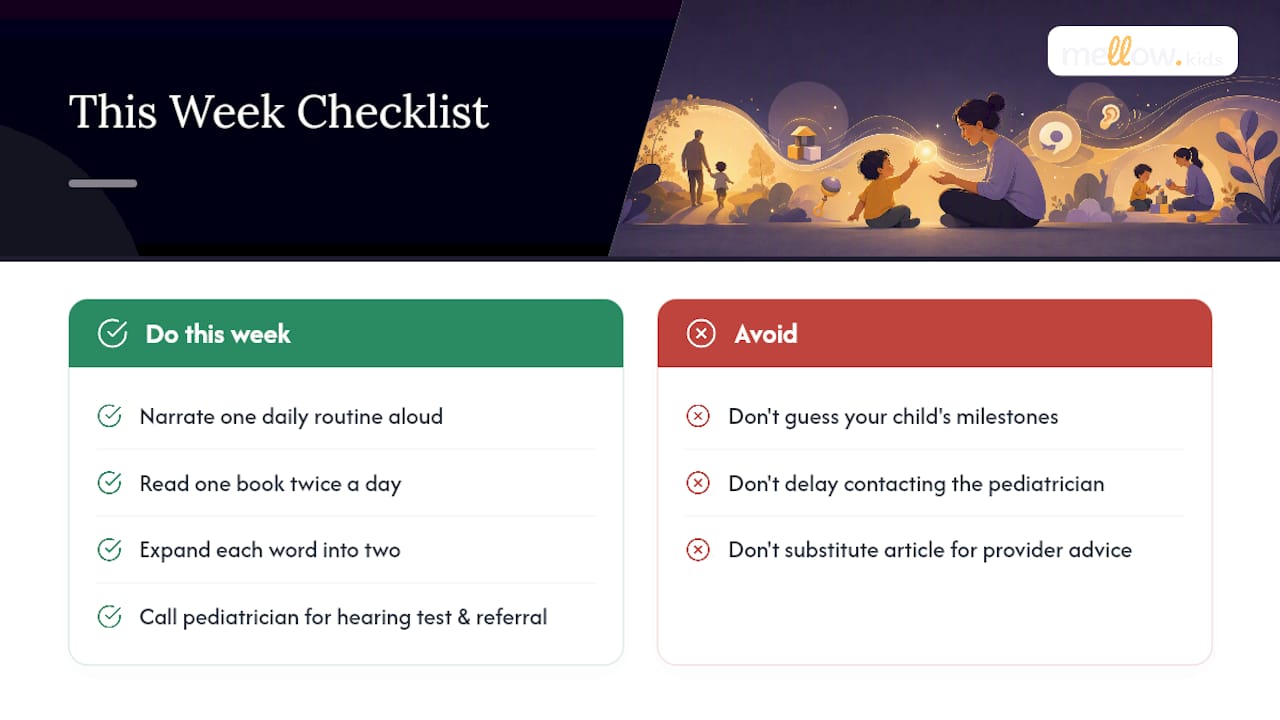
This week, try three things: narrate one daily routine out loud, read one book twice a day, and expand every single word your child says into two. Then make one phone call, to your pediatrician, requesting a hearing test and an early intervention referral.
This article offers general guidance and isn't a substitute for individualized advice from your child's pediatric provider.
— Mauricio Vargas
Where to Go for More Guidance
- CDC milestone checklists for age-by-age developmental tracking
- ASHA's ProFind directory to locate certified speech-language pathologists and audiologists
- Usa for state program access
- Mayo Clinic's toddler speech FAQ for clinical benchmarks
- AAFP's referral guidance on when watchful waiting isn't appropriate
- Baby Bare Essentials' age-by-age guide for additional sign spotting at home
This article is general information, not a substitute for advice from a qualified doctor. Consult a qualified healthcare professional about your own circumstances before acting on anything here.