
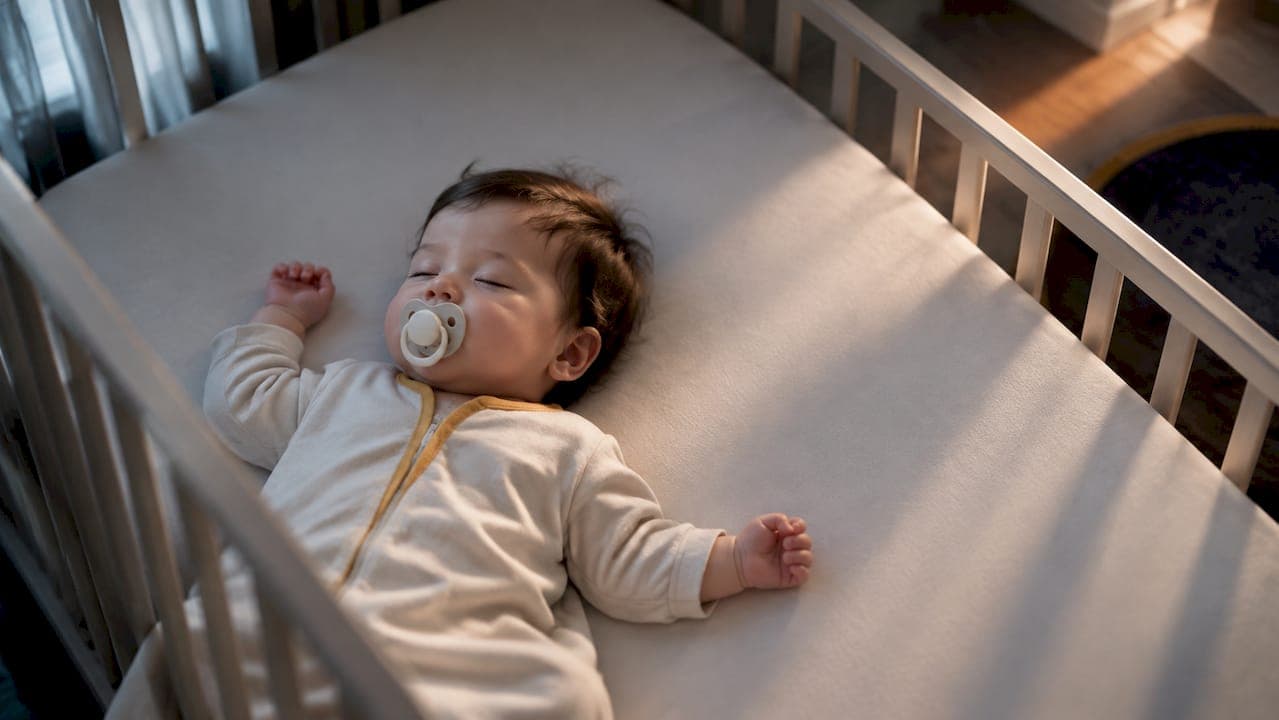
Yes, a pacifier can become a sleep association, and yes, it also lowers the risk of SIDS. Both things are true at once, and neither cancels the other out. Keep safe-use habits in place while your baby is young, then move into a staged, age-appropriate weaning plan once dependence starts working against sleep instead of for it.
TL;DR:
- Pacifier sleep associations form through repeated pairing of non-nutritive sucking with sleep onset, strengthening during light sleep stages and around teething periods.
- Using a pacifier at sleep reduces SIDS risk by up to 90 percent, and safety tips include offering it at sleep start and avoiding attachment with clips or strings.
- Dependence can lead to disruptions after six months due to increased ear infections and dental concerns, requiring careful monitoring of behaviors like frequent waking and reliance on reinsertions.
- Introduce pacifiers around three to four weeks after establishing breastfeeding, and fully wean by age three to protect dental health, with gradual methods preferred for sensitive babies.
- A staged, consistent weaning plan centered on the baby's age and temperament, combined with a soothing bedtime routine, minimizes distress and supports successful independence.
Table of Contents
- What Is a Pacifier Sleep Association, and How Does It Form?
- The Safety Case for Pacifiers at Sleep
- When the Pacifier Becomes the Problem
- When to Introduce a Pacifier and When to Start Weaning
- A Step-by-Step Plan for Weaning Your Baby off the Pacifier
- Alternatives and Routines That Reduce Dependence
- When to Call Your Pediatrician or Dentist
- How an age- and temperament-based approach to pacifier-related sleep changes works
- A Realistic Take on Pacifier Weaning
- Try an Age-Based Sleep Plan Built Around Your Baby
- Sources
What Is a Pacifier Sleep Association, and How Does It Form?
Every baby learns to associate certain conditions with falling asleep. That's non-nutritive sucking at work: the rhythmic sucking motion that soothes without delivering milk. When a pacifier gets paired with drifting off, night after night, your baby's brain starts to treat "pacifier in mouth" as a required step before sleep can happen at all.
That pairing is a textbook-conditioned response. It's the same mechanism behind rocking-to-sleep or nursing-to-sleep associations. The pacifier isn't causing anything unusual. It's just one more variable a baby's nervous system links to the transition into sleep, alongside darkness, white noise, or a specific crib.
Sleep associations tend to intensify around two developmental windows. Between four and six months, sleep architecture matures and babies start cycling through lighter and deeper stages more distinctly, so a missing pacifier is more likely to trigger a full wake up rather than a quick, unnoticed stir. Teething, which often ramps up around six months, adds another layer: sore gums make sucking feel comforting in a way that has nothing to do with actual hunger or sleep readiness.
Temperament matters too. Some infants are naturally more sensitive to changes in their environment and will fuss the instant a pacifier slips out. Others barely register it. Neither pattern is a problem on its own, it just means the weaning approach that works for one baby might need adjusting for another.
A few things worth understanding as you watch this pattern develop in your own baby:
- The association forms through repetition, not through a single night of use.
- It's strongest at sleep onset and during the natural brief wakings that happen throughout the night.
- It isn't a sign of anything wrong with your baby's development.
- It can be managed with a plan, but rushing the process before your baby is developmentally ready tends to backfire.
The Safety Case for Pacifiers at Sleep
The evidence here is strong enough that it should sit at the center of any decision about pacifier use, not on the sidelines. Offering a pacifier at naptime and bedtime is associated with a 50% to 90% reduction in SIDS risk, and the protective effect appears to hold even if the pacifier falls out once your baby is asleep.
By the Numbers: SIDS affects thousands of infants in the United States each year. One meta-analysis calculated that 2,733 babies would need to consistently use a pacifier at sleep to prevent a single SIDS death, a number that looks small only until you consider that a pacifier is one of the few interventions with this level of consistent research support.
That statistic explains why the American Academy of Family Physicians and the American Academy of Pediatrics both recommend pacifier use at sleep for the first year of life, even for parents who worry about later dependence. Reducing SIDS risk now outweighs the inconvenience of a weaning process later.
Following a few safe-use rules keeps the benefit intact without adding unnecessary risk:
- Offer the pacifier at the start of sleep rather than forcing it if your baby refuses.
- If it falls out during sleep, there's no need to reinsert it, the protection doesn't depend on it staying in all night.
- Choose a single-piece pacifier with a shield at least 1.5 inches across and ventilation holes, never one with detachable parts.
- Never attach a pacifier to a clip, string, or clothing, this is a strangulation risk regardless of how convenient it seems at 2 a.m.
- If you're breastfeeding, wait until feeding is well established, usually around three to four weeks, before introducing a pacifier at all.
None of this changes once you start thinking about weaning. The safety guidance stays constant through the first year regardless of how tired you are of hunting for a pacifier at 3 a.m. The dependence question is separate from the safety question, and it's worth keeping them that way in your own head as you plan next steps.
When the Pacifier Becomes the Problem
A pacifier sleep association isn't automatically a problem. It becomes one when it starts working against your baby's sleep quality, or against their physical health, more than it supports it.
Age changes the risk calculation in specific ways. Somewhere between six and twelve months, otitis media, or middle ear infection, risk starts climbing with pacifier use, particularly once your baby is in daycare and exposed to more germs. Between twelve and twenty-four months, dental concerns start entering the picture as more teeth come in and prolonged sucking habits can begin shifting how they align.
Watch for these behavioral signs that dependence has crossed into disruptive territory:
- Your baby wakes fully and cries, rather than briefly stirring, every time the pacifier falls out.
- They can't resettle without you physically walking over to reinsert it, sometimes multiple times a night.
- Naps have gotten shorter or more fragmented compared to a few months ago.
- You're doing more nighttime pacifier "reinsertion runs" than you were a month ago, not fewer.
If that list sounds familiar, you're not dealing with a failure of parenting, you're dealing with a sleep association that has gotten stronger than it needs to be. The good news is that limiting pacifier use to naps and bedtime, rather than letting your baby have it constantly throughout the day, reduces the total exposure that drives both the ear infection risk and the intensity of the dependence itself.
When to Introduce a Pacifier and When to Start Weaning
Timing matters on both ends of this process. Introduce too early for a breastfeeding baby and you risk latch problems. Wean too late and you're negotiating with a toddler who has opinions.
If you're breastfeeding, hold off on the pacifier for the first three to four weeks while feeding gets established. This isn't about the pacifier itself causing harm; it's about giving your baby's sucking pattern time to lock in around the breast before introducing a different shape and rhythm.
On the other end of the timeline, here's how the recommended windows generally break down:
| Age | Recommended action |
|---|---|
| 3 to 4 weeks (breastfed infants) | Safe to introduce once feeding is established |
| Birth to 4 months | Offer at every sleep for SIDS protection |
| 6 to 12 months | Start limiting daytime use; keep it for naps and bedtime |
| Around 12 months | Aim to have daytime use fully weaned |
| 12 to 24 months | Bedtime use can continue, but plan for full weaning |
| Around 3 years | Most clinicians recommend pacifiers be gone entirely to protect dental alignment |
Beyond the calendar, think about what else is happening in your baby's world before you pick a start date. Weaning during a round of vaccinations, a teething flare, or a big life change like starting daycare or moving rooms tends to go worse than weaning during a stretch of relative calm. You're not just fighting the pacifier habit at that point, you're fighting it while your baby is already stressed by something else. Pick a quieter week if you can.
A Step-by-Step Plan for Weaning Your Baby off the Pacifier
Before you start, get two things sorted: pick a start date that doesn't collide with teething, illness, or a big transition, and make sure every caregiver, grandparents, sitters, daycare staff, is on the same page about the plan. Nothing undoes progress faster than one well-meaning adult handing the pacifier back the moment your baby cries.
Here's a four-stage approach that works for most families:
- Limit to naps and bedtime only. If your baby currently has the pacifier throughout the day, cut that first. This alone often resolves a chunk of the dependency because it reduces total exposure without touching the sleep routine itself.
- Shorten the access window at sleep. Instead of leaving the pacifier in the crib all night, offer it at the start of the routine and remove it once your baby is drowsy but not fully asleep, if they'll tolerate that. If not, let it stay for now and revisit this stage in a week.
- Move to night-only, drop the naps. Once daytime naps are pacifier-free, your baby has already proven they can fall asleep without it under some conditions. Bedtime becomes the last hurdle.
- Remove it entirely. Pick a night and stick with it. Some families do this gradually by shortening the time it's offered each night over a week. Others do it all at once, sometimes called the "cold turkey" approach, which tends to involve a rougher two or three nights but often resolves faster overall.
A gentler variation some families prefer is "wean by location," keeping the pacifier for the crib only and removing it from the diaper bag, car seat, and stroller first. That way your baby experiences pacifier-free settling in lower-stakes moments before tackling bedtime.
If teething or illness hits mid-plan, pause. Don't abandon the plan, just hold at your current stage until your baby feels better, then pick back up. Trying to push through a fever or a swollen gum is a fight you're unlikely to win, and it can make your baby associate weaning itself with feeling unwell.
A simple script helps here too: "Pacifier stays in the crib now. You can do this." Said calmly and repeated the same way every night, it gives your baby a predictable cue even before they fully understand the words.
Pro Tip: Keep a one-week sleep log during weaning, just bedtime, wake times, and how many times you intervened. Most parents underestimate how much progress is happening night to night until they see it written down.
Alternatives and Routines That Reduce Dependence
A consistent bedtime routine does a lot of the heavy lifting during pacifier weaning. The same bath, book, and lights-out sequence every night gives your baby's brain other reliable cues for "sleep is coming," so the pacifier isn't carrying that signal alone.
Sleep-training methods pair naturally with this process. Graduated withdrawal, gradually reducing your presence in the room over several nights, tends to work well alongside pacifier weaning because it teaches independent settling skills at the same time you're removing the sucking cue. The Ferber method, with timed check-ins, is another option some families use once their baby is developmentally ready, generally past four to six months.
For babies over 12 months, a safe comfort object, a small lovey or light blanket, can step into the role the pacifier used to play. Consistency matters more than the specific object you choose, a point echoed in broader research on toddler routine consistency.
A few things to weigh when picking your approach:
- Gradual methods tend to suit more sensitive babies and more anxious parents.
- Faster methods often resolve in fewer total nights of disruption, but the first two nights are harder.
- No single method is right for every family, temperament and your own tolerance for short-term crying both factor in.
When to Call Your Pediatrician or Dentist
Most pacifier weaning happens without any need for professional input, but a few signals are worth flagging. Reach out if you notice poor weight gain, sleep loss severe enough to affect your baby's daytime mood or feeding, or feeding difficulties that started around the same time as pacifier introduction.
It's also worth a call if:
- You suspect recurrent ear infections tied to pacifier use.
- Your child is past 24 to 30 months and still pacifier-dependent, a dentist can advise on timing before it affects tooth alignment.
- Weaning attempts have repeatedly stalled and you want a second opinion on your approach.
Bring a short sleep log and a rough timeline of when pacifier use started intensifying. That handful of details usually helps a pediatrician or dentist give you a faster, more specific answer than a general conversation would.
How an age- and temperament-based approach to pacifier-related sleep changes works
Guidance based on a baby's actual age and temperament, rather than a one-size-fits-all script, can be more effective. Because pacifier weaning intersects with feeding, teething, and developmental leaps, the timing question is rarely as simple as "wait until 12 months." A baby who's cutting four teeth at once needs a different week than one who isn't.
An approach that anticipates sleep regressions, flags weeks where teething or a developmental leap might impact the weaning plan, and adjusts the timeline before things unravel can help parents manage this process. Tracking a sleep log, noting what's working, and revisiting the plan as the baby's needs shift can be more efficient than using scattered notes or multiple online resources.
This article draws on current pediatric guidance from the American Academy of Family Physicians, Cleveland Clinic, and Mayo Clinic, along with an approach to translating that guidance into a practical plan.
A Realistic Take on Pacifier Weaning
Parents come to this decision carrying two fears at once: the fear of doing anything that raises SIDS risk, and the fear of raising a child who can't sleep without a plastic object in their mouth. Both fears are understandable. Only one of them is backed by hard mortality data, and it points toward keeping the pacifier, not ditching it early.
What I'd push back on is the instinct to treat weaning as an emergency. A staged plan, done with consistency over two or three weeks, beats a dramatic one-night removal nine times out of ten in terms of how much crying everyone has to sit through. If you've tried a reasonable plan twice and it's still not working, that's a sign to loop in your pediatrician, not a sign you've failed.
— Mauricio Vargas
Try an Age-Based Sleep Plan Built Around Your Baby
Generic weaning advice treats every ten-month-old the same. Mellow is built on the opposite premise: your baby's temperament, teething timeline, and sleep history all change what a good pacifier weaning plan looks like this month versus next month.

If your baby is between eight and ten months, the 8-10 months program walks you through exactly where pacifier dependence typically peaks and how to start limiting daytime use without a sleep regression. For babies closer to the twelve-month mark, the 11-14 months guide covers the daytime weaning window most clinicians point to, with a plan you can adjust as your baby's teething and nap schedule shift. And if you're deep in a stretch of frequent night wakings that feel bigger than the pacifier alone, the sleep challenges hub breaks down what else might be driving them.
Open the app, tell it your baby's age, and get a weaning timeline built around your actual situation instead of a one-size-fits-all checklist.
Sources
For deeper clinical detail beyond what's covered here, the American Academy of Family Physicians' pacifier guidance and Healthychildren both offer thorough, clinician-reviewed detail worth reading in full.
This article is general information, not a substitute for advice from a qualified doctor. Consult a qualified healthcare professional about your own circumstances before acting on anything here.
- Pacifiers: Common Questions and Answers | AFP
- Pacifiers: Are they good for your baby? - Mayo Clinic
- Should Newborns Sleep With Pacifiers? | Sleep Foundation