
Limit the pacifier to sleep only, right now, and pick either a gradual taper or a planned removal day based on your child's age and temperament. Expect a rough few nights, maybe up to two weeks, but that disruption is temporary. Clinical guidance points toward weaning typically by the second half-year, around one year when possible. You can build a routine that carries your child through it.
TL;DR:
- The optimal time to start weaning a pacifier varies from 6 to 18 months, depending on the child's age, health factors, and development, with earlier for risk reduction and later for dental concerns.
- Gradual reduction over one to three weeks is generally better for anxious or sensitive toddlers, while cold turkey may work faster but with more intense initial distress.
- Consistency in wording and routine across caregivers significantly improves success rates, especially when implementing a structured plan with clear cues and a set removal day.
- Most families experience the hardest few nights within two weeks, but protest and nighttime wakings tend to diminish gradually if routines are maintained.
- Using a comfort object and positive reinforcement can smooth the transition, minimizing distress and encouraging self-soothing without punishing protests.
Table of Contents
- When Is the Right Age to Start Pacifier Weaning for Sleep?
- How Do I Choose a Pacifier Weaning Method?
- What's the Step-by-Step Plan for Weaning a Pacifier at Night?
- How Long Does Sleep Disruption Last After Pacifier Weaning?
- How Do I Handle Nighttime Wakings Without the Pacifier?
- What Can Replace the Pacifier for Sleep Comfort?
- What if Weaning Doesn't Go as Planned?
- What Do Clinical Experts Say About Pacifier Weaning?
- Why "Perfect" Isn't the Goal With Pacifier Weaning
- Get a Personalized Pacifier Weaning Plan With Mellow
- Sources
- FAQ
When Is the Right Age to Start Pacifier Weaning for Sleep?
The clinical case for the pacifier changes dramatically depending on your child's age, and that shift is what should drive your timeline. In the first six months, pacifier use during sleep is linked to a meaningful drop in SIDS risk, according to the American Academy of Family Physicians. That benefit is real and worth protecting for young infants.
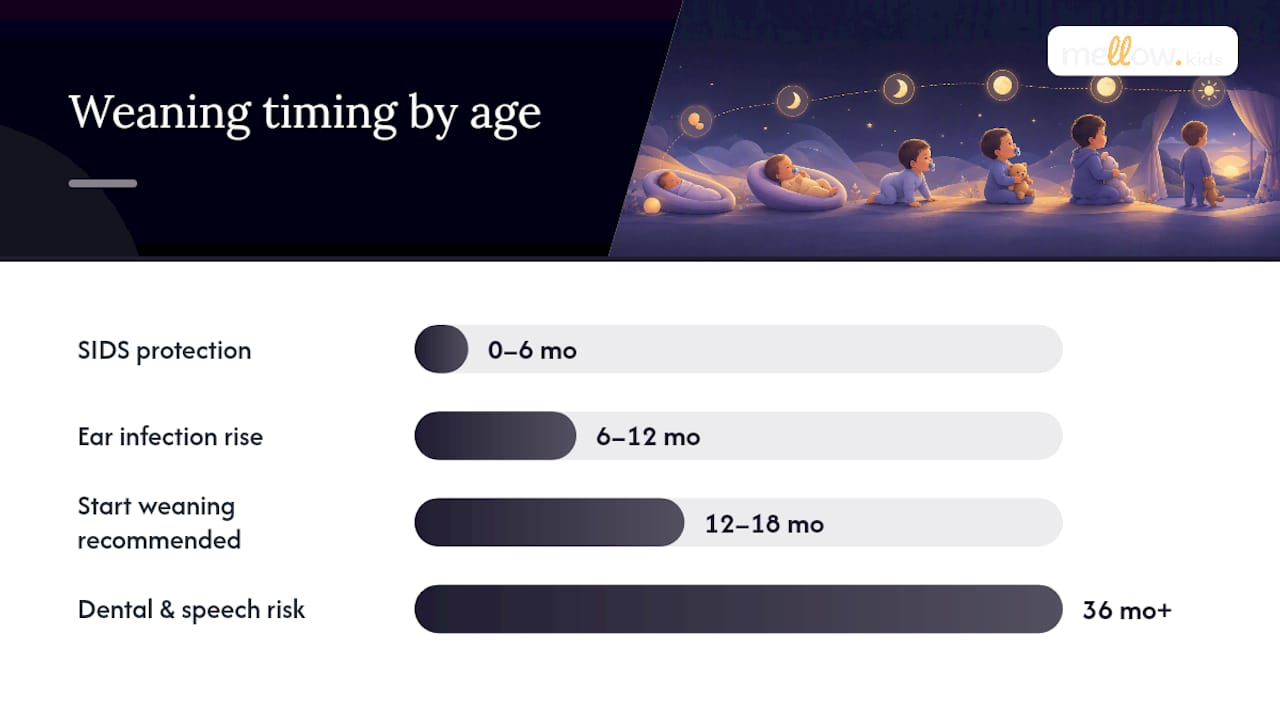
The calculation flips as your child gets older. After 6 to 12 months, the risk of ear infections climbs, and by 12 to 18 months, pediatric sources including the University of Utah Health system recommend most families have started weaning. The American Academy of Pediatric Dentistry draws a firmer line at 36 months, after which prolonged sucking habits raise the odds of dental and speech issues.
A few individual factors can reasonably shift your timing window:
- Breastfeeding status. Some pediatricians suggest waiting until nursing is well established before introducing limits, since sucking needs can overlap.
- Temperament. A highly sensitive or anxious toddler may do better with a slower taper started slightly later, rather than an abrupt stop during a stressful stretch.
- Recent transitions. Starting daycare, moving homes, or welcoming a sibling are poor moments to launch a new sleep rule.
- Dental or speech flags. If a dentist or speech therapist has already raised concerns, that overrides the general timeline. Start sooner.
None of this needs to be perfect. The window between 6 and 18 months is wide enough to fit almost any family's real life.
How Do I Choose a Pacifier Weaning Method?
There's no single best method. There's only the method that matches your child's personality and your household's capacity for consistency, which turns out to be the single biggest predictor of success no matter which route you pick.
Gradual reduction trims pacifier access bit by bit over one to three weeks. You might drop daytime use first, then nap time, then finally bedtime.
- Pros: Lower intensity per day, gentler on anxious kids, easier for grandparents and daycare to follow along with.
- Cons: Takes longer, and a slow pace can invite more negotiating from an older toddler who senses the change coming.
Cold turkey removes the pacifier in one decisive move, often on a day you choose in advance.
- Pros: Shorter total disruption window, and it avoids the drawn-out bargaining that gradual approaches sometimes trigger.
- Cons: The first few nights tend to be harder emotionally, both for the child and for you.
Trade-in or ritual-based weaning frames the pacifier's departure as an event, often tied to a small reward or a symbolic act like giving the pacifiers to a younger baby or leaving them for a "pacifier fairy."
- Pros: Works especially well for toddlers over two who understand cause and effect and respond to praise.
- Cons: Requires more setup and buy-in from the child, so it can flop with a younger or less verbal toddler.
Babies and young toddlers under 18 months generally respond best to gradual reduction, since they have no framework yet for understanding a trade. Toddlers over two, who can grasp a story and enjoy a sense of ceremony, often do beautifully with a ritual approach. Whichever you choose, write it down and stick to it. Wavering is what actually prolongs the process.
What's the Step-by-Step Plan for Weaning a Pacifier at Night?
Here's a practical sequence for transitioning from pacifier at night, moving from full-time use down to sleep-only, then out entirely.
- Restrict daytime use first. Keep the pacifier in the crib only, so it stops being a general-purpose comfort object for tantrums, car rides, or boredom.
- Shift to bedtime and naps only. Once daytime use is gone for a week or two, you're already halfway there.
- Pick a removal approach. Choose either a single planned day (mark it on a calendar, tell your toddler in advance if they're old enough to process it) or a progressive shortening, where you hand the pacifier over later and later in the wind-down routine each night.
- Replace the old routine with a new one. A consistent order matters more than any single element: wind-down activity, cuddle time, a short calming phrase you repeat every night, a comfort object if you're using one, dim lights, then into the crib or bed awake.
- Loop in every caregiver. Grandparents, a partner, and daycare staff all need the same script and the same limits. One exception at grandma's house can undo four nights of progress.
Pro Tip: Pick a short phrase, something like "pacifiers stay in the crib now," and repeat it verbatim every single time your toddler asks. Consistency in wording calms kids faster than a new explanation each time.
Coordinate with daycare before you start, not after a rough night forces the conversation. Ask providers to hold the line on naps the same way you're holding it at home.
How Long Does Sleep Disruption Last After Pacifier Weaning?
Most families see the hardest stretch in the first three to fourteen nights, with a cold-turkey approach usually front-loading the distress into a shorter, sharper window. Gradual methods spread the adjustment out over one to three weeks, with lower intensity each night but a longer overall tail.
Watch for these markers that things are moving in the right direction:
- Protest at bedtime shortens night over night, even if it doesn't disappear completely.
- Your child starts settling with the new routine alone, without a pacifier substitute in hand.
- Night wakings become less frequent, even if they haven't stopped yet.
If protest is intensifying rather than easing after 10 to 14 nights, that's a signal to reassess, not necessarily to quit. A survey-based analysis from Hiccapop found that families who paused briefly during acute stressors like illness or travel, then resumed with tight limits, had meaningfully better outcomes than those who plowed through or abandoned the plan entirely.
How Do I Handle Nighttime Wakings Without the Pacifier?
The middle-of-the-night waking is where most weaning attempts quietly fail, usually because a tired parent reaches for the pacifier out of sheer exhaustion. Having a script ready before 2 a.m. matters more than any daytime prep.
Use short, repeatable phrases rather than long explanations. Something like "I love you, time for sleep" said in a calm, flat tone works better than reasoning with a half-asleep toddler. Keep your response low-stimulation: a hand on the back, a few pats, then step away rather than picking your child up or turning on lights.
If your toddler still needs help settling, step your presence back gradually across the week rather than all at once:
- Night one or two: sit next to the crib or bed until they're drowsy.
- A few nights later: sit near the door.
- By the end of the week: check in briefly from the doorway, then leave.
Pro Tip: If you're parenting with a partner, split the overnight shifts. One parent handles the first waking, the other handles the second. Nobody can hold a firm, calm line at 3 a.m. on zero sleep for a full week straight.
Managing sleep problems after pacifier weaning is as much about protecting your own rest as your child's. A short nap during the day, even fifteen minutes, makes a measurable difference in how patient you feel that night.
What Can Replace the Pacifier for Sleep Comfort?
A washable comfort object, sometimes called a lovey, can absorb a lot of the sucking need that a pacifier used to fill, especially for toddlers over 12 months. Introduce it a week or two before you start restricting the pacifier, so it already carries a comforting scent and association by the time it needs to do the heavy lifting.
Build a short sequence of sensory cues that signals sleep is coming, regardless of what comfort object you use:
- Dim the lights 20 to 30 minutes before bed, every night, same time.
- Use the same short playlist or white noise track so the sound itself becomes a cue.
- End with the identical cuddle and phrase sequence, night after night, without variation.
Positive reinforcement, calibrated to age, speeds this along. A simple sticker chart works well for toddlers past two, where a physical star for each pacifier-free night builds visible momentum. For younger toddlers who can't yet grasp a chart, verbal praise delivered warmly in the moment does the same job. Avoid bitter coatings on the pacifier or any punitive response to protest. Federal guidance from Head Start is explicit that punishment and aversive tactics tend to backfire, prolonging the very attachment they're meant to break.
What if Weaning Doesn't Go as Planned?
Thumb-sucking sometimes fills the gap the pacifier leaves. It's usually not worth intervening on unless it's constant, intense, or still happening well past age four, since a thumb is harder to "wean" than an object you control.
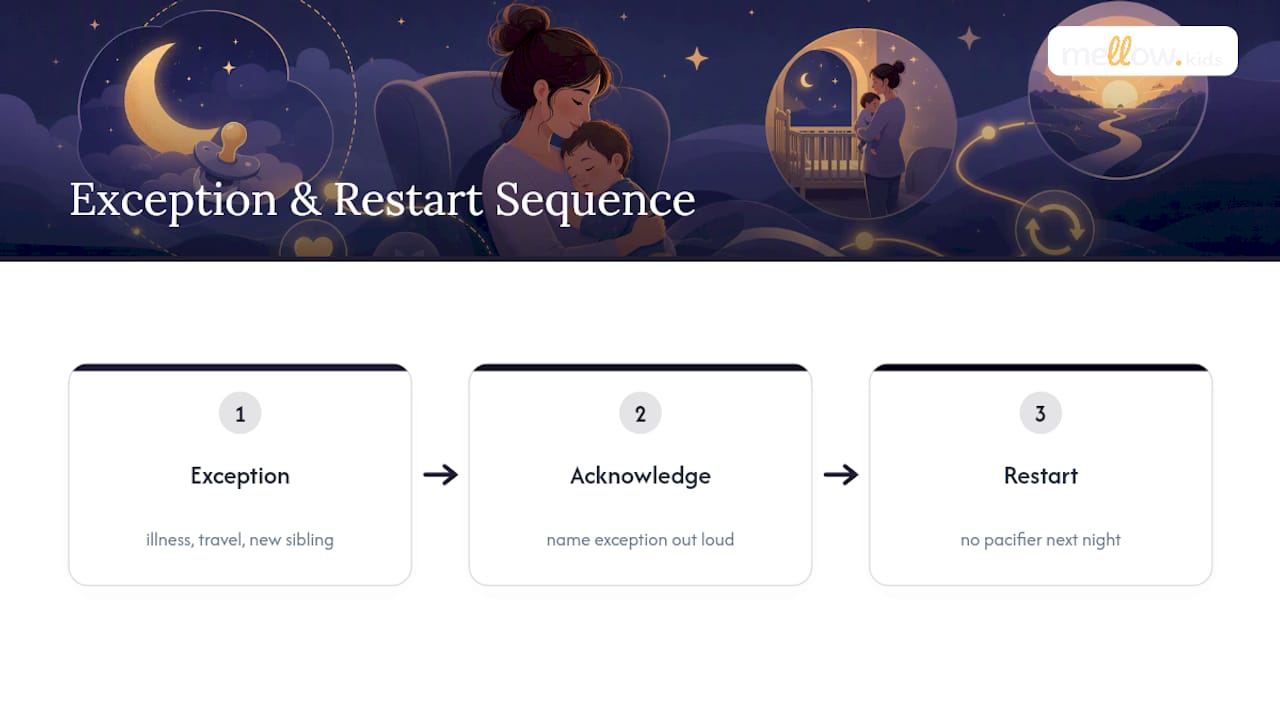
Regressions happen, often around illness, travel, or a new sibling. Name the exception out loud ("we're using the pacifier tonight because you're sick, back to no pacifier tomorrow") rather than pretending it isn't happening, then restart the plan the next night without extra fanfare.
Bring these red flags to your pediatrician or dentist rather than troubleshooting alone: recurrent ear infections, a noticeable dental change like an open bite, or speech sounds that seem consistently distorted.
What Do Clinical Experts Say About Pacifier Weaning?
The AAFP, Cleveland Clinic, and Children's Mercy converge on the same core advice: start limiting between 6 and 12 months, build your replacement sleep routine before pulling the pacifier, and lean on positive reinforcement over any negative tactic.
Mellow turns that guidance into something you can actually use at 9 p.m. with a tired toddler:
- A night-weaning schedule mapped to your child's exact age.
- Ferber method guidance for families using graduated check-ins alongside pacifier removal.
- Age-specific pages that track what's developmentally typical, so you know if your child's response is expected or worth a pediatrician's input.
This guide was written by Mauricio Vargas for Mellow.
Why "Perfect" Isn't the Goal With Pacifier Weaning
Nobody weans a toddler off a pacifier without a few rough nights, and chasing a tear-free exit is a setup for frustration. The realistic goal is steady reduction and a child who can settle without the pacifier most nights within a few weeks, not a magic switch that flips painlessly.
Give yourself permission to be exhausted and short-tempered on night four. That's not failure, it's the actual shape of this process. This approach is designed as less a script that promises zero tears, and more a companion for the messy middle where most families actually live.
— Mauricio Vargas
Get a Personalized Pacifier Weaning Plan With Mellow
General guidance can be turned into a plan built around your child's actual age, rather than a one-size-fits-all script. Age-specific milestones and sleep tools that adjust as your child grows may help determine whether your 14-month-old is ready for a planned removal day or a slower taper.

If your toddler is in the thick of the weaning window, the 15 to 24 months guide walks through what's typical for sleep and temperament at that stage, while the 11 to 14 months page covers the earlier edge of that range. Parents managing wakings that stretch beyond the pacifier itself can also check the sleep challenges resources for troubleshooting help. For a broader look at how toddler sleep needs shift year to year, the sleep-need breakdown from Baby Bare Essentials is a useful companion read.
Start by opening the Mellow app and entering your child's age to get a personalized starting point for your weaning plan tonight.
Sources
- Pacifiers: Common Questions and Answers | American Academy of Family Physicians (AAFP), 2025
- The Pacifier Dilemma: When to Start, When to Stop, and How to Transition | University of Utah Health
- Tips to wean your baby from pacifiers | Cleveland Clinic
- Helping children stop using a pacifier | Head Start
FAQ
What age should a baby stop sleeping with a pacifier?
Most clinical guidance points to weaning by 12 to 18 months, with some flexibility up to 36 months, when the American Academy of Pediatric Dentistry recommends nonnutritive sucking stop entirely.
My 3-year-old isn't sleeping through the night. What could be causing this?
At three, causes range from lingering pacifier or thumb dependence to nightmares, separation anxiety, or an inconsistent bedtime routine; if a consistent routine and limits haven't helped within a few weeks, it's worth consulting your pediatrician.
How long should I let my baby cry it out for naps?
There's no single universal number, and it depends heavily on the method and your pediatrician's guidance; many families using graduated approaches check in at short, increasing intervals rather than leaving a baby to cry unchecked for an extended stretch.
My nearly 2-year-old has never slept through the night. What can I do to help her?
Start by building one consistent pre-sleep routine and removing sleep props like the pacifier gradually, since inconsistent cues are one of the most common reasons toddlers wake repeatedly; Mellow's age-specific guides can help you map a plan suited to a toddler this age.