

For most toddlers eating regular meals, milk at night is not a nutritional necessity. It's a learned comfort, a sleep cue built over months of feeding-to-sleep. The immediate move: check that daytime meals and dairy are solid, stop bottles in bed, protect those new teeth, and follow a gentle, stepwise plan to phase out the nighttime pour. If something feels medically off, that's a pediatrician conversation, not a DIY fix.
TL;DR:
- Nighttime milk is unnecessary for toddlers who eat solid foods well during the day and have an established, varied diet; it is primarily a learned habit.
- Providing water in a cup instead of milk is the safest and most effective way to break the milk-sleep association and protect dental health.
- Most toddlers can stop night milk between 12 and 24 months once they regularly eat two meals and their growth is steady, but readiness varies by behavior and eating patterns.
- Gradual reduction methods, such as watering down milk or moving the feed earlier, are more successful and less stressful than abrupt stopping.
- Persistent dental decay, stalled weight gain, or excessive nighttime thirst signal the need for pediatric or dental consultation before attempting to wean off night milk.
Table of Contents
- What Do CDC and AAP Say About Toddler Milk at Night?
- Why Does Nighttime Milk Cause Problems?
- How Do You Know a Toddler Is Ready to Stop Milk at Night?
- Step-by-Step Plan to Wean Off Nighttime Milk
- What Should You Offer Instead at Night?
- When Should You Call a Pediatrician or Dentist?
- Practical test plans for night weaning
- A Realistic Word on Sleep Setbacks
- Get Guided Support for Your Toddler's Sleep Routine
- Sources
- FAQ
What Do CDC and AAP Say About Toddler Milk at Night?
The Centers for Disease Control and Prevention recommends introducing pasteurized, unflavored, unsweetened whole cow's milk (or an appropriately fortified alternative) once your child turns 12 months old, aiming for roughly two dairy servings a day for toddlers between 12 and 23 months. That's a daytime nutrition target, not a bedtime prescription. Milk counts as food, and the CDC is explicit that it "is not a substitute for food" once solids are established.
The American Academy of Pediatrics, through HealthyChildren.org, adds a second layer: avoid bottles at bedtime or naptime, start transitioning to a cup around 12 months, and offer milk with meals rather than as a between-meal filler. The goal is preventing milk from crowding out iron-rich foods and protecting emerging teeth.
Here's what surprises a lot of parents: the sleep science doesn't back milk as a sleep aid. A randomized trial reviewed in a broader analysis of dairy and sleep found that toddlers given low versus high glycemic-index milk showed no meaningful differences in how fast they fell asleep, how long they slept, or how often they woke overnight. If milk chemistry isn't driving the effect, something else is.
What the evidence actually supports:
- Whole cow's milk or a fortified alternative fits into a varied daytime diet starting at 12 months.
- Recommended daily dairy servings cover nutritional bases for children 12 to 23 months.
- No reliable trial shows nighttime milk improves toddler sleep quality or duration.
- Bottles at bedtime are discouraged regardless of what's inside them.
That last point matters because it reframes the whole conversation. If milk isn't fixing sleep, the reason toddlers wake and demand it isn't hunger. It's habit.
One caveat: infants under 12 months, or toddlers with diagnosed feeding or growth concerns, may still need nighttime milk as part of a medically guided plan. That's not the population this article is talking about.
Why Does Nighttime Milk Cause Problems?
Milk left sitting against teeth overnight, whether from a bottle, sippy cup, or nursing, feeds the bacteria that cause decay. Dental guidance calls the resulting damage "bottle mouth," and it can hit fast: putting a child to bed with a bottle of milk or any sugary liquid raises the risk of severe early cavities, because saliva flow drops during sleep and there's nothing washing sugar off enamel for hours.
The sleep piece works differently but causes just as much frustration. When a toddler falls asleep while feeding, their brain links the two events. Every time they surface from light sleep, which happens several times a night for every child, they look for the exact conditions they fell asleep in. No milk means no cue to fall back asleep, so they cry out for it. This is a learned association, not a medical need, and the same systematic review on milk and sleep points out that improvements after stopping nighttime feeds are most plausibly explained by breaking that association, not any nutritional shift.
There's a quieter issue too: toddlers who fill up on milk, day or night, often eat less of the iron-rich solids they need for growth and brain development. Milk is filling and easy. Meat, beans, and fortified grains take more effort to chew and accept.
Simple prevention steps that actually work:
- Never put a toddler to bed with a bottle, even one containing only milk.
- Switch bedtime drinks to an open cup or straw cup well before the weaning process starts.
- Brush or wipe teeth after the last milk of the night, not before.
- Offer water as the default nighttime response instead of automatically reaching for milk.
Pro Tip: If your toddler wakes and immediately asks for milk, wait 60 seconds before responding. That pause alone sometimes breaks the automatic association, and you'll see whether they're truly hungry or just running the old script.
How Do You Know a Toddler Is Ready to Stop Milk at Night?
Readiness isn't about a single birthday. It's a mix of age, daytime eating, and behavior.
Once your toddler has passed 12 months and is eating two solid meals plus snacks, with recommended dairy servings worked into the daytime diet, the nutritional foundation for dropping the night feed is already in place. From there, watch for behavioral signals rather than forcing a date on the calendar.
Signs your toddler is likely ready:
- They can fall asleep at nap time or bedtime without needing to feed first.
- Night wakings feel more like habit checks than genuine hunger, brief crying that settles fast if you don't reach for milk.
- Weight gain and growth have been steady at recent checkups.
- Daytime appetite is strong, and they're not skipping meals because they're full from milk.
If any of these don't apply, especially inconsistent weight gain or a toddler who genuinely seems hungry rather than just seeking comfort, loop in your pediatrician before changing the nighttime routine. Some toddlers, particularly younger ones still building daytime intake, need a slower runway. That's not a failure. It's just a different starting point.
Step-by-Step Plan to Wean Off Nighttime Milk
Every successful approach rests on four principles: protect daytime nutrition first, change one thing at a time, keep teeth clean through the transition, and expect some pushback without treating it as a crisis. Toddlers don't need dramatic interventions. They need consistency.
1. Pick your method based on temperament. Gradual dilution works well for toddlers who tolerate slow change. Mix a little more water into the milk each night over one to two weeks until it's essentially water. Volume reduction suits toddlers who respond better to a visible cue: pour less into the cup every few nights. Timing shift works for toddlers who wake at a predictable hour. Move the feed 15 to 20 minutes earlier each night until it lands before sleep onset instead of during a wake-up.
2. Swap the delivery method before cutting the amount. If you're still using a bottle at night, move to an open cup first. This alone weakens the sleep association because the physical ritual changes.
3. Build a replacement soothing routine. Before you remove the feed entirely, install what replaces it: a short back rub, a specific phrase, dim light, or a predictable bedtime routine that doesn't involve food. Toddlers accept change faster when something familiar fills the gap.
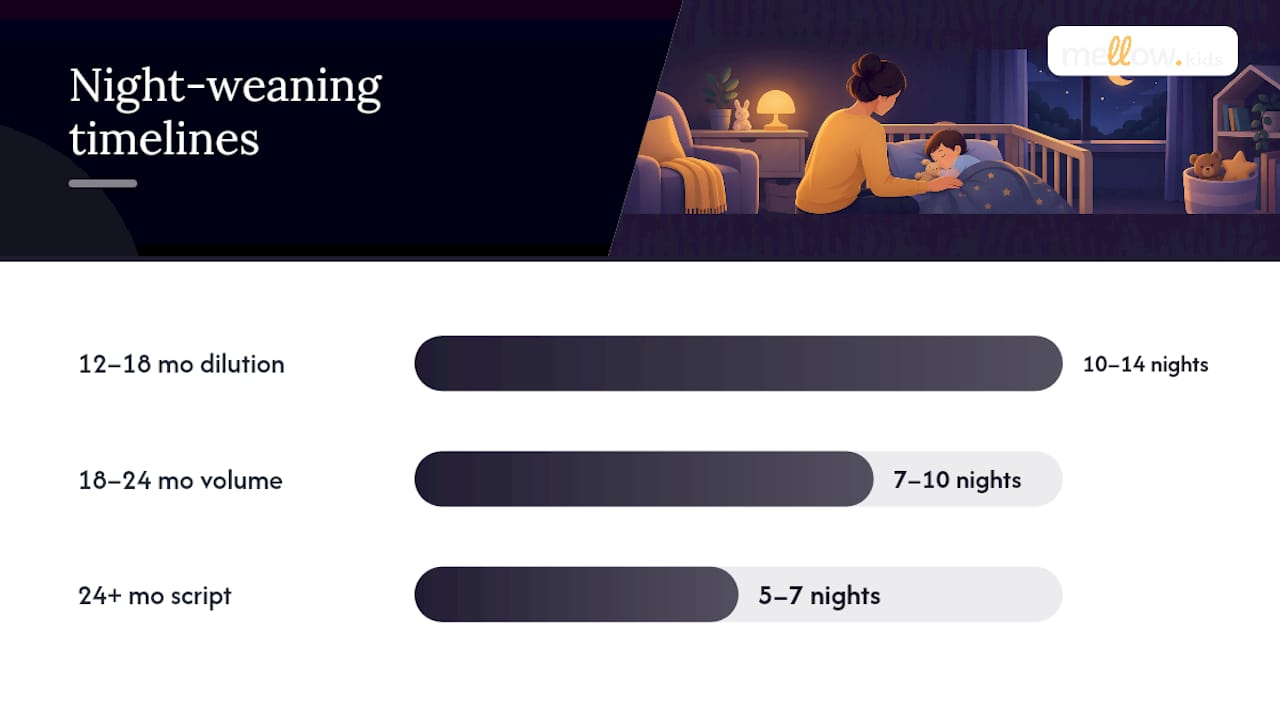
4. Follow an age-tailored timeline. For 12- to 18-month-olds, expect 10 to 14 nights of gradual dilution paired with reassurance rather than removal. For 18 to 24 month olds, a 7 to 10 night volume-reduction plan usually works, since verbal toddlers can be told the plan in advance ("Milk stays in the kitchen at night now"). For toddlers 24 months and up, most families see change within 5 to 7 nights once a consistent script and routine are in place.
5. Expect regressions and plan for them. Illness, travel, or a new sibling can bring the old habit roaring back. Don't restart from zero. Resume at the step you'd reached before the disruption.
Pro Tip: Write your chosen script on a sticky note by the crib. At 2 a.m., half-asleep parents default to whatever's easiest, and "just this once" undoes three nights of progress fast.
If two full weeks pass with no movement, or your toddler seems distressed beyond typical protest, that's a signal to pause and consult your pediatrician rather than push harder.
What Should You Offer Instead at Night?
Water is the safest default. It carries no calories, causes no tooth decay risk, and doesn't reinforce the milk-to-sleep habit you're trying to break. Offer it in a cup, not a bottle, from the very first night of the transition.

If you're not ready to remove milk completely, keep it in a cup rather than a bottle, and brush or wipe teeth immediately afterward. Skip flavored or sweetened milks entirely. The CDC is direct on this point: added sugar and flavoring have no place in a young child's regular drinks, and a "special" nighttime milk marketed for sleep doesn't change that.
Safe nighttime options, in order of preference:
- Plain water, offered in an open cup or straw cup.
- A small amount of unsweetened, pasteurized whole milk in a cup, if you're mid-transition.
- Fortified dairy alternatives, if your family avoids cow's milk, chosen for vitamin D and calcium content.
- A brief comfort routine with no drink at all, once you're fully weaned off the night feed.
Skip specialty toddler milk drinks marketed for sleep. Some small trials on tryptophan-enriched formulations found modest, inconsistent results at best, nothing strong enough to justify the extra sugar or cost these products often carry.
When Should You Call a Pediatrician or Dentist?
Don't attempt night-weaning on your own if your toddler is under 12 months old or has a diagnosed feeding, growth, or medical condition. That situation calls for a pediatrician's guidance first, since milk may still be filling a real nutritional gap.
Red flags that warrant a call, regardless of age:
- Poor or stalled weight gain at recent checkups.
- Persistent difficulty eating solids or a very narrow diet.
- Visible white or brown spots on teeth, a possible early sign of decay.
- Excessive thirst or unusually frequent urination, which can signal an unrelated medical issue.
- A toddler who seems distressed well beyond typical bedtime protest during weaning attempts.
A pediatric visit for any of these usually includes a growth check against your toddler's own curve, a review of daytime feeding patterns, and, if decay is suspected, a referral to a pediatric dentist. Catching a dental issue early is far easier than treating it later.
Practical test plans for night weaning
Evidence tells you why nighttime milk usually isn't necessary. It doesn't tell you what to say at 2 a.m. when your toddler is standing in the crib demanding it. That's the gap Mellow Kids focuses on: turning guidance into scripts you can actually use in the dark, half-asleep, without second-guessing yourself.
Three test plans worth trying, based on temperament:
- Gentle taper (best for sensitive toddlers): dilute the milk with a little more water every two nights, check in on night 3, 7, and 14 to gauge how they're tolerating the change.
- Cup switch (best for toddlers attached to the bottle ritual more than the milk itself): swap to an open cup immediately, keep the amount the same for the first week, then start reducing volume from night 8.
- Earlier-feed shift (best for toddlers who wake at a predictable time): move the feed 15 minutes earlier nightly, checkpoint at night 5 and night 10 to see whether the wake-up has moved with it.
A sample script for the moment of resistance: "Milk is a daytime drink now. Water is here if you're thirsty, and I'm staying right here with you." Repeating the same short phrase, night after night, does more than any lengthy explanation.
Anticipatory guidance means telling a parent what's coming before it happens, not just reacting once a toddler is already standing in the crib at midnight refusing to settle.
The core of this support includes age-tailored plans that prepare parents for the next developmental shift, plus a path to a personalized consultation when a general template isn't enough for a specific toddler.
A Realistic Word on Sleep Setbacks
Night weaning rarely goes in a straight line, and if you're three nights in feeling like nothing's changed, that's normal, not failure. Sleep transitions are exhausting precisely because they happen at the hour you have the least patience to spare.
Small, consistent changes beat dramatic overhauls almost every time. Most toddlers adapt within one to two weeks of a calm, low-conflict approach. If you're overwhelmed, that's not a sign to push harder alone. It's a sign to bring in support, whether that's your pediatrician, a partner taking over night duty for a few nights, or a more detailed guide built for exactly this stage.
— Mauricio Vargas
Get Guided Support for Your Toddler's Sleep Routine
Reading about night weaning and living through it at 2 a.m. are two different things, and most parents want more than a generic checklist once the crying starts. Mellow Kids builds age-specific, evidence-informed plans instead of one-size-fits-all advice, so the strategy actually matches where your toddler is developmentally right now.

If you want a plan built around your toddler's exact age, sleep history, and temperament, the Personalized Plan walks you through a tailored strategy from day one. Want a second set of eyes on a plan you've already started? The Plan + Consultation option pairs a personalized strategy with direct troubleshooting, and the standalone 45-minute consultation gives you focused, one-on-one time to work through scripts and sticking points with someone who's seen this exact struggle before. For families who'd rather have guided support than figure it out alone at midnight, this is the option built for that. Start with the personalized sleep support page to see which fits your situation.
Sources
- Cow's Milk and Milk Alternatives | Infant and Toddler Nutrition | CDC
- Systematic review: milk/dairy and sleep (PMC)
- Healthychildren
FAQ
How do you stop a 2-year-old from wanting milk at night?
Shift the routine gradually rather than cutting milk cold turkey: dilute it, reduce the volume, or move the feed earlier over one to two weeks. Pair the change with a consistent, food-free soothing routine so your toddler has something familiar to replace the feed.
Is it normal for a 3-year-old to drink milk at night?
It's common but usually driven by habit rather than nutritional need at this age. Most 3-year-olds eating regular daytime meals and dairy don't require milk overnight, and evidence on milk and sleep doesn't support it improving sleep quality.
Does a 2-year-old need milk at night?
Generally, no. A 2-year-old eating solid meals and getting roughly two daytime dairy servings has their nutritional bases covered without a nighttime feed.
At what age do toddlers typically stop having milk before bed?
There's no fixed age, but many families begin phasing it out between 12 and 24 months once daytime eating is established and bottles have been replaced with cups. Readiness depends more on eating patterns and sleep behavior than a specific birthday.
What should I offer if my toddler wakes asking for milk?
Water in an open cup is the safest first response, since it avoids added calories and protects teeth. If you're still transitioning, a small amount of milk in a cup, followed by a tooth wipe, works as a middle step.