

Newborns stay awake for roughly 30 to 60 minutes at a stretch, while babies between 6 and 9 months can often handle a couple of hours before their next nap. That range keeps stretching through toddlerhood. The single most reliable rule isn't a clock at all: watch your baby's sleepy cues and let the age range guide your timing, not dictate it. Try today's target window, watch how your little one responds, and adjust from there.
TL;DR:
- Properly timed wake windows for babies range from 30 minutes to 6 hours depending on age, with adjustments needed for individual cues and developmental stages.
- Signs a wake window is too short include short or disrupted naps, while overly long windows cause fussiness and difficulty settling; small, gradual adjustments are recommended.
- Consistent routines of feeding, purposeful play, and calm wind-down practices improve nap success and should be tailored as your baby develops.
- Tracking wake times and upcoming transitions helps avoid schedule guesswork, especially during developmental leaps or nap pattern changes.
- Using age-based planning tools can simplify scheduling, but flexibility and observation remain vital to accommodating your baby's unique sleep needs.
Table of Contents
- What Wake Windows Are and Why They Matter
- Wake Windows by Age: The Chart Parents Actually Need
- What to Do During Wake Windows: Feed, Play, Wind Down
- When to Adjust Wake Windows as Your Baby Grows
- Common Wake Window Mistakes and Quick Fixes
- How Mellow Kids Turns Wake Windows Into a Daily Plan
- Balancing Routine and Flexibility
- Try Mellow Kids for Guided Wake Window Planning
- Sources
What Wake Windows Are and Why They Matter
A wake window is simply the stretch of time between when your baby wakes up and when they're ready to sleep again, whether that's a nap or bedtime. It sounds simple, but getting it right shapes almost everything about your day.
Here's the biology behind it: every minute your baby is awake, a chemical called adenosine builds up in the brain. Sleep pressure, some call it. Too little of it, and your baby fights the nap because they're simply not tired enough yet. Too much, and you get an overtired baby who's wired, cranky, and paradoxically harder to settle.
- Window too short: Baby resists the nap or wakes after 20 to 30 minutes, unrested.
- Window too long: Baby becomes wired, weepy, or arches away from soothing. Falling asleep takes far longer than it should.
- Window just right: Baby shows calm sleepy cues and drifts off within 10 to 20 minutes of being put down.
These windows aren't arbitrary. They connect directly to how much total sleep your child needs across 24 hours. The Sleep Foundation puts newborns (0 to 3 months) at 14 to 17 hours total, infants (4 to 12 months) at 12 to 16 hours, and toddlers (1 to 2 years) at 11 to 14 hours, naps included. Wake windows are how you divide that daily sleep budget into workable chunks.
Wake Windows by Age: The Chart Parents Actually Need
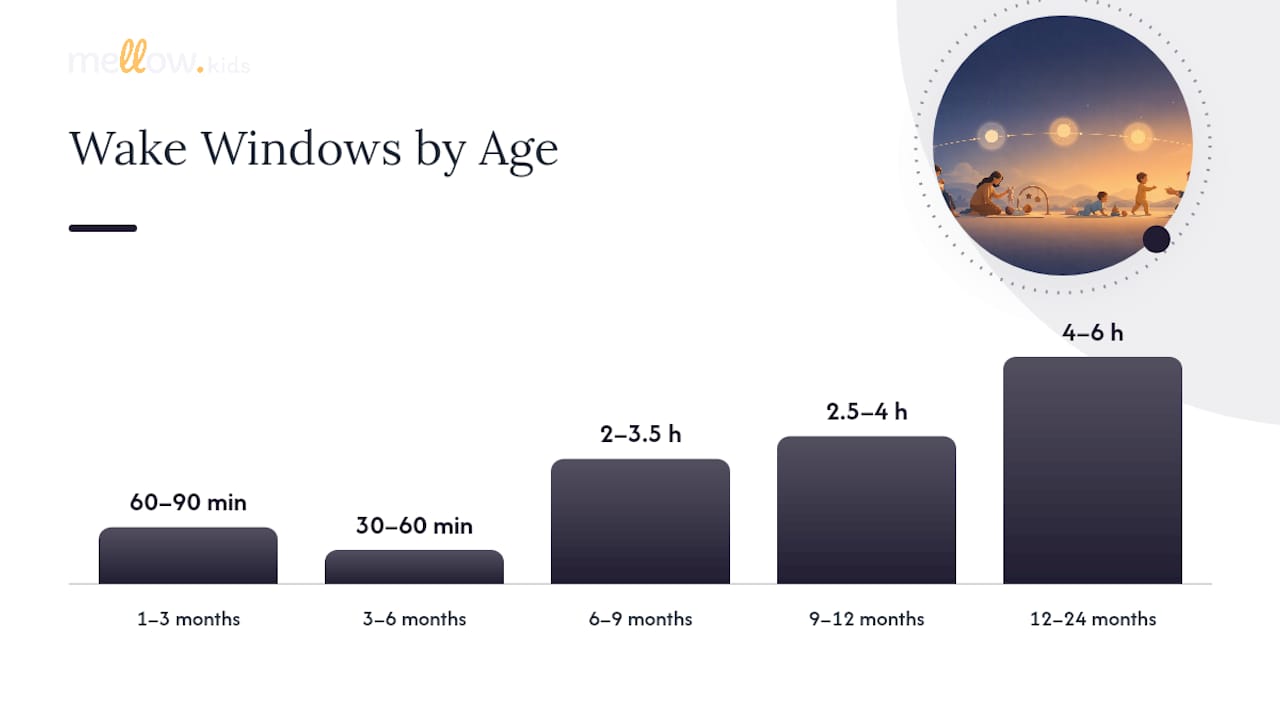
Every baby is a little different, and the CDC frames these numbers as ranges to support health and development, not rigid targets. Still, having a starting point saves you a lot of guesswork on the hard days.
| Age | Typical Wake Window | Typical Nap Count |
|---|---|---|
| Newborn (0–1 month) | 30–60 minutes | 4–6 short naps |
| 1–3 months | 60–90 minutes | 4–5 naps |
| 3–6 months | 30 to 60 minutes | 3–4 naps |
| 6–9 months | 2–3.5 hours | 2–3 naps |
| 9–12 months | 2.5–4 hours | 2 naps |
| 12–24 months | 4–6 hours | 1 nap (transitioning) |
Newborn (0 to 1 month): Don't expect consistency here. Wake windows can run as short as 30 to 45 minutes and occasionally stretch to 90, and that swing is completely normal at this age, according to the Sleep Foundation's newborn sleep research. Focus on feeding and safe sleep, not the stopwatch.
1 to 3 months: Windows start stretching a little as your baby's nervous system matures. You'll notice slightly longer stretches of alert, engaged awake time, especially in the morning.
3 to 6 months: This is where patterns start forming. Many parents find sample 3-month-old schedules helpful for mapping out a predictable day for the first time.
6 to 9 months: Windows widen noticeably, often to 2 to 3.5 hours, as babies drop from four naps to three, then eventually two. Separation anxiety can complicate things around 9 months, so expect some short term wobbles.
9 to 12 months: Most babies settle into two solid naps with windows around 2.5 to 4 hours. This stage tends to feel more predictable than the last.
12 to 24 months: Wake windows can stretch to 4 to 6 hours as toddlers move toward one nap. The transition from two naps to one is often the bumpiest schedule change since the newborn days.
What to Do During Wake Windows: Feed, Play, Wind Down
The time between sleeps isn't dead time. It's when your baby builds sleep pressure and gets the stimulation, movement, and connection that actually make naps and nights work better, a point echoed in Parents' guidance on wake-window activities.
A simple rhythm works at almost any age:
- Feed first. A baby who eats right after waking is less likely to fall asleep mid-feed and more likely to take a full, satisfying meal.
- Play with purpose. Tummy time and gentle sensory play work well for newborns; older infants benefit from crawling games, stacking toys, or supervised outdoor time.
- Wind down deliberately. In the last 10 to 15 minutes, dim the lights, lower your voice, and move into a calm activity like a book or a quiet cuddle.
Pro Tip: Watch for the first yawn or eye rub rather than waiting for full-blown fussiness. Starting your wind-down at the first cue, rather than the third, is usually the difference between a smooth nap and a battle.
When to Adjust Wake Windows as Your Baby Grows
Your baby will tell you when a window needs to change, usually before you'd think to check a chart.
- Signs a window is too short: short naps under 30 minutes, quick re-waking, or resistance to settling because sleep pressure hasn't built yet.
- Signs a window is too long: taking more than 15 to 20 minutes to fall asleep, sudden fussiness before the nap, or a second wind that looks like energy but is really overtiredness.
- The safe adjustment rule: shift timing by just 10 to 15 minutes every 3 to 5 days and watch how your baby responds before changing again, a pace Cleveland Clinic's sleep specialists recommend for steady, low-stress transitions.
Nap-count transitions, like moving from three naps to two or two to one, usually show up as a consistently long, cheerful stretch before the nap that used to trigger meltdowns. That's your cue the old window has outgrown its purpose.
Common Wake Window Mistakes and Quick Fixes
Most sleep struggles trace back to a window that's slightly off, not some deeper problem. Overtiredness shows up as bedtime resistance, frequent night wakings, or a baby who seems exhausted but still fights sleep. Under-tiredness looks like short naps, split naps, or a toddler who's wide awake at bedtime despite a full day.
- Fix for overtiredness: shorten the wake window slightly and try laying your baby down 5 to 10 minutes before you'd normally expect sleepiness, a tactic Cleveland Clinic points to as an easy way to catch the sweet spot.
- Fix for short naps: check if the window before that nap was too long, then trim it back gradually.
- Fix for early morning wakings: look at bedtime and the final wake window of the day rather than the morning itself.
- When to call your pediatrician: persistent night wakings past 6 months, snoring or breathing pauses, or sleep problems paired with feeding or growth concerns warrant a professional look, not just a schedule tweak.
Developmental leaps around 9 and 18 months often disrupt naps temporarily, and that's expected rather than a sign something's broken.
How Mellow Kids Turns Wake Windows Into a Daily Plan
Tracking wake windows by memory gets messy fast, especially when your baby's needs shift every few weeks. Mellow Kids was built around that exact problem.
- Age-based plans that update automatically as your baby moves through each developmental stage, so you're not manually recalculating windows every month.
- Tracking and reminders that log wake times and flag when a nap or bedtime window is approaching.
- Anticipatory guidance that flags upcoming transitions, like the shift toward one nap, before they catch you off guard.
A parent moving from three naps to two, for instance, can use the app's tracking to nudge wake windows by small increments over several days rather than guessing at the timing cold.
Balancing Routine and Flexibility
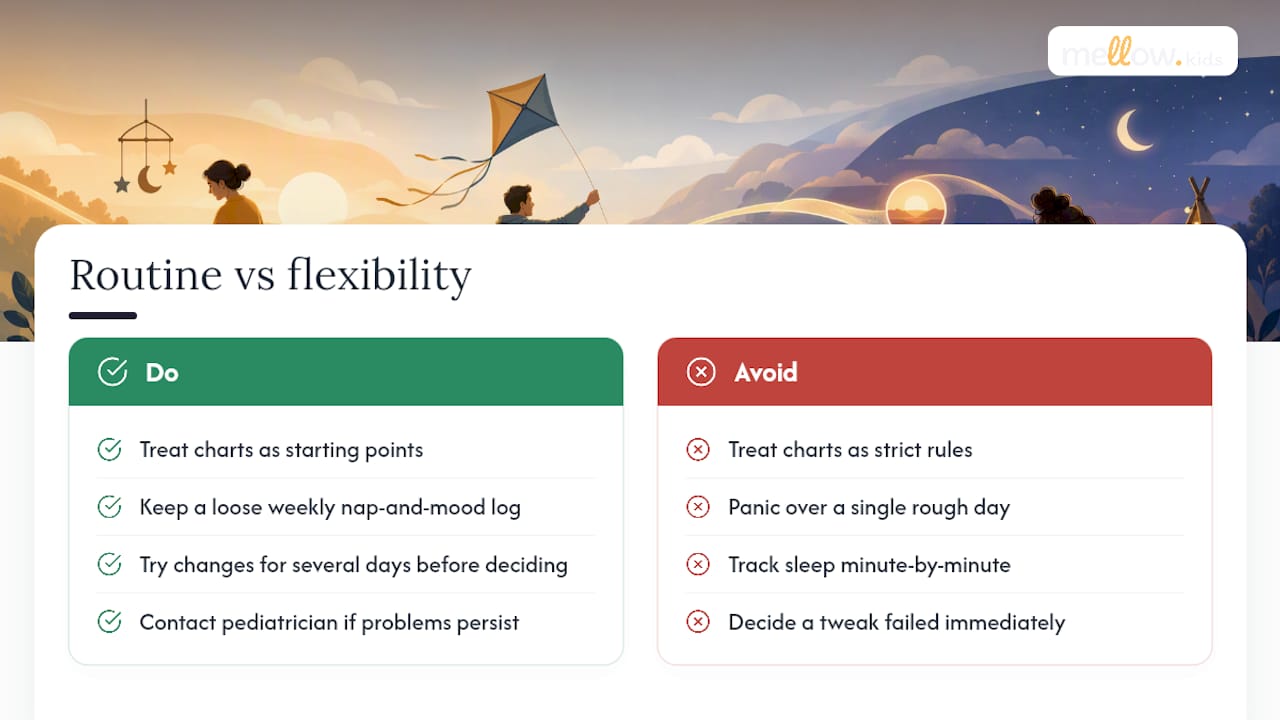
Charts help, but they're a starting point, not a verdict on how your week should go. Babies have off days, growth spurts, and entire weeks where nothing about their sleep matches the range you read online, and that's not a sign you're doing something wrong.
What actually helps is a simple log. Not minute by minute tracking, but a loose record of nap times and moods over a week, so you can spot a pattern instead of panicking over one rough day. Give any adjustment several days before deciding it isn't working, and don't hesitate to loop in your pediatrician when something feels persistently off rather than just occasionally messy.
— Mauricio Vargas
Try Mellow Kids for Guided Wake Window Planning
Skip the mental math of recalculating wake windows every time your baby hits a growth spurt. Mellow Kids builds age-based sleep plans that adjust automatically as your child moves through each stage, backed by tracking tools and expert content instead of another spreadsheet you have to maintain yourself.

If your baby is between 8 and 10 months and wrestling with nap consolidation, the 8-10 months guide walks through what to expect. Nearing the one-nap transition? The 11-14 months plan and 15-24 months plan cover that shift step by step, and toddler parents managing dropped naps and bigger feelings may also want the Toddler Behavior & Big Emotions resources. Not sure where your child fits yet? Start at Where to Begin with Child Sleep and explore a sample plan for your baby's exact age today.
Sources
- How much sleep do kids need? — Sleep Foundation
- About Sleep — CDC
- Wake windows by age — Cleveland Clinic
This article is general information, not a substitute for advice from a qualified doctor. Consult a qualified healthcare professional about your own circumstances before acting on anything here.