
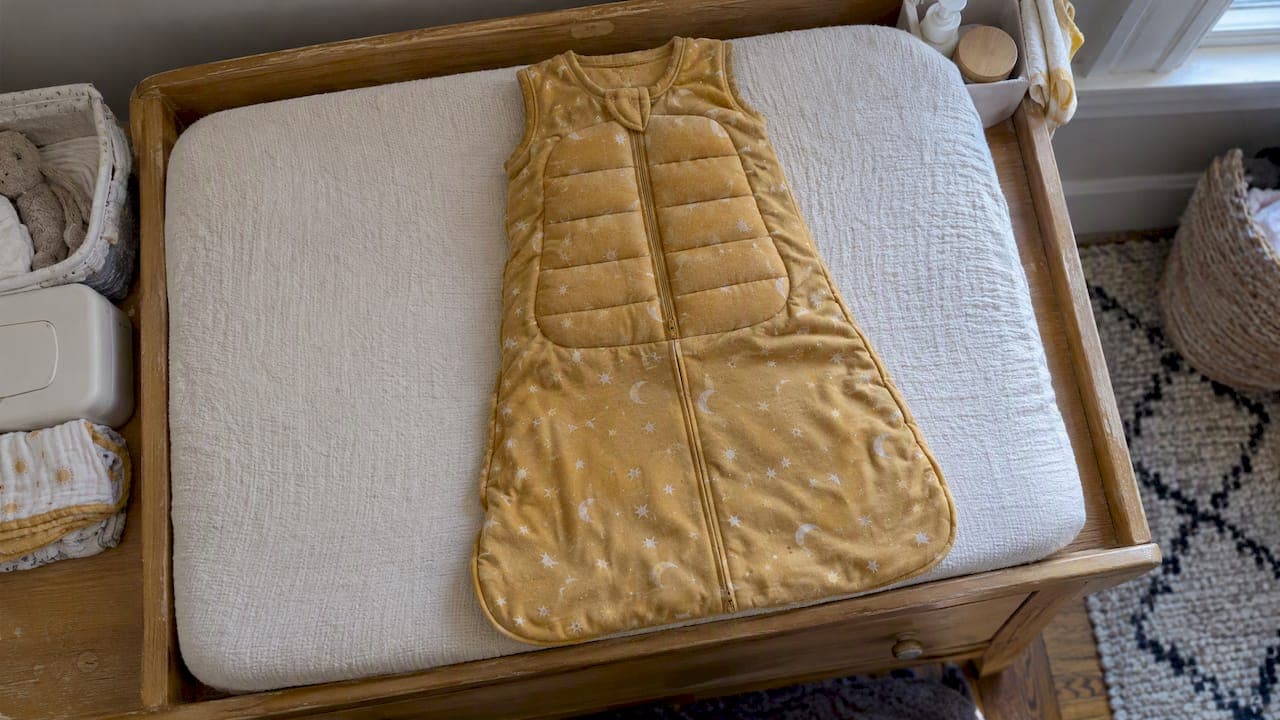
Weighted sleep sacks are not recommended for infants, according to the American Academy of Pediatrics, the CDC, and the Consumer Product Safety Commission. The added chest weight can lower oxygen levels, add pressure on a baby's ribcage, and blunt the natural arousal response that helps infants wake when breathing is restricted. If you are using one now, we encourage you to switch to a non-weighted wearable sleep sack and talk to your pediatrician about any concerns.
TL;DR:
- Weight can shift toward a baby's face or neck, while zipper or seam failures and restricted rolling can raise entrapment risk.
- Existing tests often involve small, awake groups observed briefly; no published peer reviewed study establishes safety during unsupervised overnight sleep.
- For warmth, use layers suited to room temperature and a sack without added weight, while keeping the crib free of loose bedding and toys.
- Stop swaddling when your baby shows rolling attempts, often around 3 to 4 months, and seek urgent care for breathing trouble, bluish skin, or unresponsiveness.
Table of Contents
- What Is a Weighted Sleep Sack and How Is It Supposed to Help?
- What the AAP, CDC, and CPSC Say About Weighted Sleep Products
- How Weighted Sleep Sacks Can Actually Harm Babies
- What the Research Actually Shows, and Where It Falls Short
- Safer Alternatives and Steps You Can Take Tonight
- When to Stop Swaddling and When to Call Your Pediatrician
- Where Mellow's Guidance on Sleep Safety Comes From
- A Parent's Honest Read on Weighted Sleep Claims
- How We Can Help You Navigate Safe Sleep Transitions
- FAQ
- Sources
What Is a Weighted Sleep Sack and How Is It Supposed to Help?
A weighted sleep sack is a wearable blanket with added material, usually small beads or dense fabric panels, sewn into the chest or body of the garment. Some versions are built into swaddles, which wrap the arms snugly, while sleep sack versions leave the arms free but still add weight across the torso.
Manufacturers typically market these products with claims that include:
- Calming effects similar to the pressure of a weighted blanket for adults
- A sensation meant to mimic being held or swaddled by a caregiver
- Longer stretches of sleep and fewer night wakings
None of these claims have been confirmed through peer-reviewed infant sleep research. Where the weight sits and how the fabric is constructed both affect how much pressure reaches a baby's chest, which is exactly why regulators have focused their concern there.
What the AAP, CDC, and CPSC Say About Weighted Sleep Products
Official guidance here is consistent across the agencies responsible for infant safety. The American Academy of Pediatrics states that weighted blankets, weighted sleepers, weighted swaddles, or any other weighted object should not be placed on or near a sleeping infant, citing the risk of reduced oxygen saturation and impaired arousal.
The Consumer Product Safety Commission has gone further than a policy statement. CPSC staff documented multiple incidents and a market scan showing that products marketed as "weighted" carried notably higher concentrated chest weights than standard wearable blankets, and the agency directly urged caregivers not to use weighted blankets or weighted swaddles for infants.
The CDC's safe-sleep guidance is just as direct: products labeled as weighted, including weighted sleepers, swaddles, sleep sacks, and blankets, are not safe for infants. The agency recommends layering clothing or using a plain wearable blanket instead.
A few points worth keeping in mind:
- Several retailers have pulled weighted infant sleep products from their shelves following regulator warnings.
- CPSC staff specifically recommended that voluntary safety standards consider limits on concentrated chest weight.
- Agency guidance applies to any product marketed as weighted, regardless of brand or design.
The agencies responsible for infant product safety in the United States, including the AAP, CDC, and CPSC, all advise against weighted sleep products for babies. This level of agreement across separate agencies is rare and reflects how seriously the physiological risk is taken.
How Weighted Sleep Sacks Can Actually Harm Babies
An infant's ribcage is far more flexible and compliant than an adult's, which means even modest pressure across the chest can restrict how fully the lungs expand. That matters because babies already breathe faster and with smaller reserves than older children.
- Added chest weight can reduce measured oxygen saturation during sleep.
- The same pressure can suppress the arousal reflex that normally wakes a baby when breathing is compromised.
- Weight inside a sack can migrate, a phenomenon sometimes called "submarining," shifting toward the face or neck.
- Zipper or seam failures and difficulty rolling over both raise entrapment risk.
CPSC incident reports tied to weighted infant sleep products include documented infant deaths, which is part of why the precautionary guidance exists even without long-term trial data.
Pro Tip: If you're unsure whether a sleep product counts as "weighted," check the manufacturer's product description. Any mention of added beads, pressure panels, or calming weight is a signal to avoid it for infant sleep.
What the Research Actually Shows, and Where It Falls Short
Some short, supervised studies and manufacturer-commissioned tests exist, but they are a poor stand-in for the overnight, unsupervised conditions where babies actually sleep. Reporting from NPR and a Consumer Reports investigation both found that existing manufacturer studies tend to involve small, awake samples observed for short windows, not the hours of unsupervised sleep that matter most.
- Short clinical or engineering tests do not reflect what happens during a full night of sleep at home.
- CPSC incident data includes infant deaths linked to weighted products, alongside market scans showing concentrated chest weights well above standard wearable blankets.
- Manufacturer-funded tests are rarely peer-reviewed and often measure conditions that differ from real-world use.
No published, peer-reviewed study has demonstrated that weighted sleep products are safe for unsupervised infant sleep, according to the evidence review behind the AAP's updated recommendations. Agencies lean toward caution here because the combination of plausible harm and documented incidents outweighs the absence of a large-scale trial proving danger beyond doubt.
Safer Alternatives and Steps You Can Take Tonight
Switching away from a weighted sleep sack does not mean giving up on comfort or warmth. It means choosing products and habits that give you the same reassurance without the added risk.
- Choose a wearable, non-weighted sleep sack with a snug but comfortable fit and no added chest material.
- Dress your baby in layers appropriate for room temperature rather than relying on extra weight for warmth.
- Follow safe swaddling practices and stop swaddling once your baby shows signs of trying to roll.
- Keep the crib free of loose bedding, bumpers, pillows, and soft toys.
- Stick to the ABCs of safe sleep: Alone, on their Back, in a bare Crib.
- Check for recalls or safety notices on CPSC's SaferProducts.gov or the manufacturer's own site before buying or continuing to use any sleep product.
Our guide to safe sleep for newborns covers this framework in more depth, and our comparison of sleep sacks and swaddles can help you figure out which product fits your baby's current stage. If you're trying to understand why your baby wakes as often as they do, this parent's guide to newborn sleep cycles is a useful companion read.
Pro Tip: Layering with a well-fitted, non-weighted sleep sack over a onesie usually solves the warmth concern that draws parents to weighted products in the first place.

When to Stop Swaddling and When to Call Your Pediatrician
Most babies show signs of trying to roll around 3 to 4 months, and that is the signal to stop swaddling and move to an arms-free sleep sack. Waiting past that point raises the risk of rolling into an unsafe position while still restricted.
- Watch for pushing up, rolling attempts, or increased leg and arm strength as cues to transition.
- Seek urgent medical attention for any apparent breathing difficulty, bluish skin color, or unresponsiveness.
- When speaking with your pediatrician, describe exactly what you observed: when it happened, what product was involved, and how your baby responded.
Where Mellow's Guidance on Sleep Safety Comes From
Our guidance on sleep transitions and safety draws on a proactive, milestone-based approach built around newborn through toddler development. Our content anticipates the moments parents face, like swaddle transitions and sleep sack choices, before confusion sets in. Personalized plans and consultation services map directly onto these transitions, offering tailored, safety-focused support when needed.
A Parent's Honest Read on Weighted Sleep Claims
We understand why weighted products are tempting. Every parent wants their baby to sleep longer, and the idea of a calming, hug-like weight sounds reasonable on the surface. But comfort claims are not safety data, and the agencies that study infant sleep closely have been clear about the risk. Choose the non-weighted option, watch your baby, and ask your pediatrician when something feels uncertain.
— Mauricio Vargas
How We Can Help You Navigate Safe Sleep Transitions
Figuring out safe sleep on your own, especially during a swaddle transition or a stretch of frequent night wakings, can leave you second-guessing every choice. We built our services to give you a clearer path through exactly these moments.
- Our Personalized Plan gives you a custom sleep strategy built around your baby's age and stage.
- Our Plan + Consultation pairs that plan with direct guidance from a sleep consultant.
- Our 45-minute consultation works well if you have specific questions about a transition or a recent safety concern.
If you're noticing frequent wakings, uncertainty about which sleep products are safe, or worry after reading about an incident, a consultation is a good next step. Explore our personalized sleep support options to get guidance built around your baby's actual needs.
This article is general information, not a substitute for advice from a qualified doctor. Consult a qualified healthcare professional about your own circumstances before acting on anything here.
FAQ
Why aren't you supposed to sleep with a weighted blanket as a baby?
Weighted blankets and sleep sacks add pressure across an infant's chest, which can reduce oxygen saturation and blunt the reflex that normally wakes a baby when breathing is restricted. The AAP and CDC both advise against any weighted sleep product for this reason.
When should a baby stop using a weighted sleep sack?
Agencies recommend not starting weighted sleep products at all rather than timing when to stop them. If you're currently using one, switch to a non-weighted wearable sleep sack now and talk to your pediatrician about your baby's sleep setup.
Are weighted sleep sacks safe for babies?
No major health or safety agency considers them safe. The CPSC has documented incidents and found higher concentrated chest weights in these products compared to standard wearable blankets.
How can I check if a sleep product has been recalled?
Search the product name on CPSC's SaferProducts.gov database, which lists official recalls and consumer-reported incidents. You can also check the manufacturer's website directly for safety notices before using any infant sleep product.
Sources
- Sleep-Related Infant Deaths: Updated 2022 — Pediatrics (AAP)
- Helping Babies Sleep Safely — CDC
- CPSC staff comments and retailer letters regarding weighted infant products — CPSC (PDF)
- Weighted infant sleepwear safety coverage — NPR
- Weighted baby blankets, sleep sacks, and swaddles are not safe — Consumer Reports