

Most 18-month-olds need 11 to 14 hours of total sleep across 24 hours, split into roughly 10 to 12 hours overnight and one afternoon nap lasting 1.5 to 3 hours. A simple anchor to build around: wake around 7:00 AM, nap from 1:00 to 3:00 PM, and settle into bed between 7:00 and 8:00 PM. This pattern lines up with AASM guidance and reflects common successful schedules among many toddler families.
TL;DR:
- Most 18-month-olds need 11 to 14 hours of sleep daily, with 10 to 12 hours overnight and a 1.5 to 3-hour afternoon nap; schedule adjustments should be made gradually.
- Wake windows typically range from 4 to 5.5 hours, so shifts in wake times should be accommodated by moving the entire daily schedule forward or backward.
- Short naps under 45 minutes indicate timing or environment issues, which can often be resolved by consistent cues, same location, and slight adjustments in nap timing.
- Bedtime between 7:00 and 8:00 PM, with a routine that lasts 20 to 30 minutes, supports independent sleep and aligns with circadian patterns for most toddlers.
- Persistent sleep disruptions beyond two weeks despite routine consistency should prompt consulting a pediatrician or sleep specialist for tailored support.
Table of Contents
- How Much Sleep Does an 18-Month-Old Need?
- Sample 18-Month Daily Schedules
- How Many Naps and How Long Should They Be?
- Building a Bedtime Routine That Actually Works
- Why Is My Toddler Suddenly Waking Up at Night?
- Should You Sleep Train an 18-Month-Old?
- How Mellow Helps You Build a Schedule That Fits Your Child
- Adjusting the Schedule as Your Toddler Approaches Two
- Handling Daycare Starts and Travel Without Losing the Schedule
- Does What My Toddler Eats Affect How They Sleep?
- A Quick Word on Getting This Right
- Get a Sleep Schedule Built Around Your Toddler
- Sources
- FAQ
How Much Sleep Does an 18-Month-Old Need?
The range parents hear most often, 11 to 14 hours in a 24-hour stretch, comes from consensus recommendations built by the American Academy of Sleep Medicine. For most toddlers this breaks down into 10 to 12 hours overnight plus one nap of 1.5 to 3 hours in the early afternoon. That single-nap window used to be a two-nap day, and if your child dropped that second nap only recently, some wobbliness in the schedule is normal.
Totals vary child to child, and that variation is expected, not a warning sign. A toddler on the lower end of the range who wakes cheerful and naps well is fine. What actually signals a sleep debt is behavior: persistent irritability, naps that shrink to 30 or 40 minutes, or waking before 6:00 AM day after day.
By the Numbers: 18-month-olds need 11 to 14 hours of sleep daily, with 10 to 12 hours overnight and a 1.5 to 3 hour nap making up the total.
Wake windows, the stretch of time your toddler can comfortably stay awake between sleep periods, typically run 4 to 5.5 hours at this age. That number matters more than the clock on the wall. If your child wakes at 6:30 AM instead of 7:00, shift the whole day's wake windows forward rather than forcing the same nap time regardless.
Sample 18-Month Daily Schedules
Every toddler's rhythm is a little different, so here are three adaptable templates. Pick the one closest to your child's current wake time, then nudge from there.
Early riser day (wake around 6:00 AM):
- 6:00 AM: Wake, morning milk or feed
- 8:00 AM: Breakfast
- 10:30 AM: Snack, outdoor play
- 12:00 PM: Lunch
- 12:30 to 2:30 PM: Nap
- 3:00 PM: Afternoon snack
- 5:30 PM: Dinner
- 6:15 PM: Wind-down routine begins
- 6:45 PM: Bedtime
Typical day (wake around 7:00 AM):
- 7:00 AM: Wake, milk or feed
- 8:30 AM: Breakfast
- 11:00 AM: Snack
- 12:00 PM: Lunch
- 1:00 to 3:00 PM: Nap
- 3:30 PM: Afternoon snack
- 6:00 PM: Dinner
- 7:00 PM: Wind-down begins
- 7:30 PM: Bedtime
Later riser day (wake around 7:30 to 8:00 AM):
- 7:45 AM: Wake, milk or feed
- 9:00 AM: Breakfast
- 11:30 AM: Snack
- 12:30 PM: Lunch
- 1:30 to 3:30 PM: Nap
- 4:00 PM: Snack
- 6:30 PM: Dinner
- 7:30 PM: Wind-down begins
- 8:00 PM: Bedtime
Adjust in small steps. Move nap or bedtime by 15 to 30 minutes every few days rather than jumping an hour at once, and let sleepy cues (eye rubbing, losing interest in toys, general fussiness) guide the exact minute more than the printed time.
How Many Naps and How Long Should They Be?
By 18 months, nearly every toddler has made the switch from two naps to one. If your child is still fighting that transition, a middle-ground schedule with an early, short second nap can bridge the gap for a few weeks.
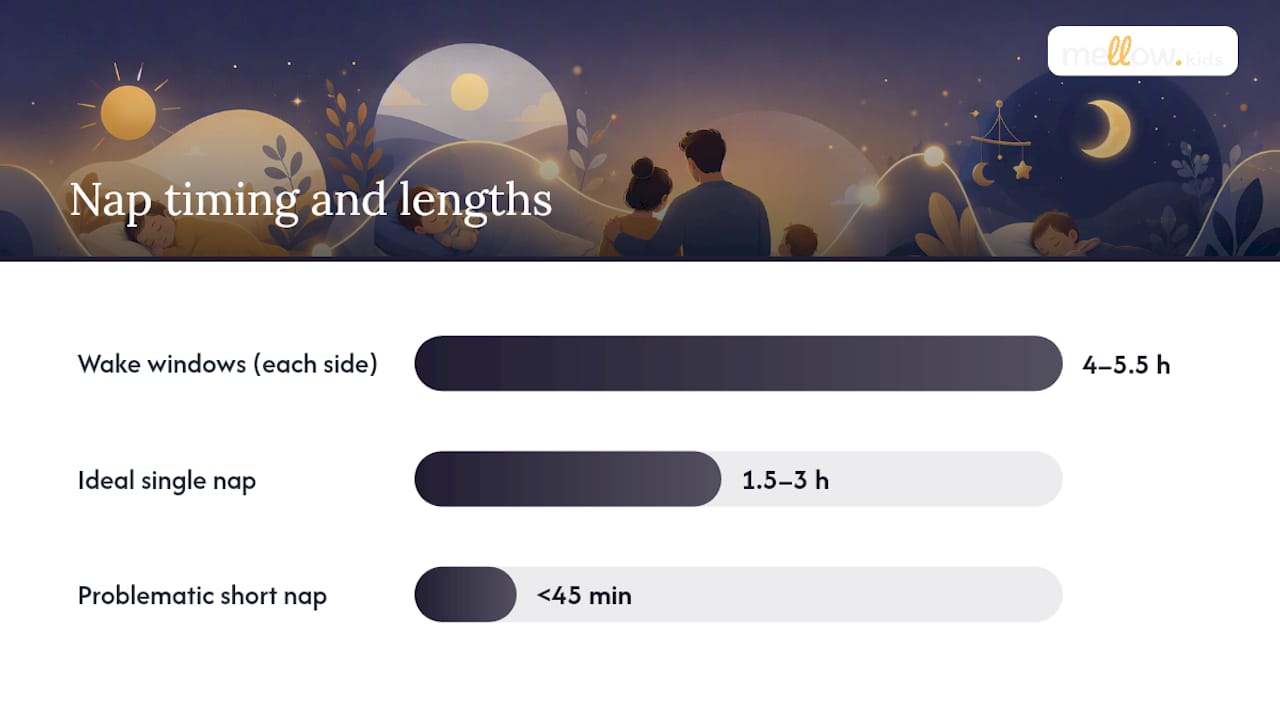
A single nap that runs 1.5 to 3 hours is doing its job. Anything under 45 minutes on a regular basis suggests the timing or environment needs adjustment. Wake windows of 4 to 5.5 hours on either side of the nap tend to produce the longest, most restorative stretch. A nap that starts too early often ends quickly because the child hasn't built enough sleep pressure; one that starts too late can make bedtime a battle because your toddler is overtired.
If naps keep coming up short, try these four steps in order:
- Watch for the cue window, not the clock: heavy eyes or a sudden drop in energy usually beats a fixed nap time.
- Nap in the same place every day, ideally the crib, so the brain associates that space with sleep.
- Run a five-minute wind-down before the nap, dim lights, a quiet book, something predictable.
- Give it ten extra minutes before ending a short nap. Toddlers often resettle into a second sleep cycle if given a brief window to fuss it out.
Pro Tip: If short naps persist for more than a week despite consistent timing, try shifting the nap 15 to 30 minutes earlier for three to five days before assuming your child is ready to drop it altogether.
Building a Bedtime Routine That Actually Works
Somewhere between 7:00 and 8:00 PM is the sweet spot for most 18-month-olds. It gives enough of a gap after the nap to build sleep pressure, while keeping bedtime early enough to hit that 10 to 12 hour overnight target before a typical morning wake time.
A bedtime routine doesn't need to be elaborate to work. It needs to be short, repeatable, and boring in the best sense, because predictability is what actually cues the brain toward sleep. A routine that fits inside 20 to 30 minutes usually looks something like this:
- Quiet play or tidy-up signaling the day is winding down
- Bath (optional, but a strong sleep cue for many toddlers)
- Pajamas and a diaper or bathroom check
- One or two books, read in the same dim, quiet space each night
- A consistent verbal cue ("time for sleep") paired with a brief cuddle
- Lights out while your toddler is still awake, not already asleep
The room itself matters almost as much as the routine. A dark space, a cool temperature, and steady white noise all support the kind of environment pediatric guidance points to for independent sleep onset. If your toddler still uses a pacifier or a lovey, keep safe-sleep basics in mind, avoiding loose bedding or anything that could pose a hazard once your child is mobile enough to move around the crib.
Why Is My Toddler Suddenly Waking Up at Night?
Night wakings, nap refusal, and a schedule that suddenly stops working are almost always tied to one of three things: a developmental leap, separation anxiety, or overtiredness from a schedule that's drifted. CDC milestone data for this age flags new walking skills and a language explosion, and both tend to show up as disrupted sleep for a week or two before settling back down.
A few fixes handle most of these bumps:
- Hold the routine steady even when the week feels chaotic, consistency is the anchor during a regression.
- Shift the nap or bedtime 15 minutes earlier if wakings are paired with obvious overtiredness.
- Use short, calm settling checks rather than long conversations or picking your child up immediately.
- Avoid a late nap or a bedtime pushed past 8:30 PM, both tend to backfire into worse overnight sleep.
Crib climbing often starts in this age window. Lower the mattress to its lowest setting, remove any bumpers, blankets, or stuffed animals that could act as a step, and if climbing continues, respond in a flat, low-key way rather than a big reaction, since toddlers quickly learn that climbing gets attention. Persistent climbing despite these changes is often the cue to start planning a transition to a toddler bed.
Should You Sleep Train an 18-Month-Old?
Gentle methods work well at this age, and they're worth trying before anything more intensive. Graduated retreat has you sit progressively farther from the crib each night until your presence isn't needed to fall asleep. Pick-up/put-down means comforting briefly when your toddler cries, then returning them to the crib awake. A consistent response plan, responding the same way every time, night after night, tends to work better than strict extinction methods, especially when separation anxiety is in the mix.
Before starting anything, check three boxes: a consistent routine is already in place, any illness or teething pain has been ruled out, and both parents are ready to follow the same plan for at least a week. If wakings persist past two weeks despite consistent effort, or if you're worried about snoring, breathing pauses, or a broader developmental concern, that's the moment to loop in your pediatrician or a certified sleep consultant.
How Mellow Helps You Build a Schedule That Fits Your Child
Sample schedules are a starting point, not a rulebook. Every toddler's temperament, nap history, and daycare demands shift the picture, which is exactly why Mellow builds a Personalized Plan around your child's actual rhythm instead of a generic template. A Plan + Consultation pairs that plan with direct guidance from a certified consultant, while a standalone 45-minute consultation works well for a single stuck problem, like a nap that's collapsed to 30 minutes. Families already on a plan can add an Upgrade your support option as new challenges come up. For parents who want a self-guided resource first, The Peaceful Sleeper series covers the same ground in book form.
Reviewed for accuracy by Mauricio Vargas.
Adjusting the Schedule as Your Toddler Approaches Two
The 18-month schedule isn't built to last forever, and most families see it shift again somewhere between 21 and 24 months. Wake windows stretch out gradually, often reaching close to 6 hours by age two, which means the nap creeps later and bedtime often follows suit.
Watch for three signals that it's time to adjust rather than sticking rigidly to the 18-month version. First, your toddler starts resisting the nap at its usual time but still seems tired later in the afternoon, a sign the wake window needs to stretch. Second, the nap consistently runs past 3:30 PM and starts crowding into what should be wind-down time before dinner. Third, bedtime starts taking longer to settle even though the routine hasn't changed, often meaning the day's total wake time no longer matches the schedule.
The adjustment itself should look familiar: small, incremental shifts rather than an overhaul. Push the nap 15 to 30 minutes later over several days, and let bedtime drift correspondingly later if the nap change means less afternoon tiredness has built up by evening. Some toddlers approaching two also start showing early signs of nap resistance that isn't really regression, it's the early edge of the eventual drop to zero naps, which for most children doesn't fully arrive until closer to age three or four. Don't rush to eliminate the nap based on one or two rough days; a short nap strike often resolves within a week if the routine stays consistent.
Handling Daycare Starts and Travel Without Losing the Schedule
Starting daycare is one of the biggest schedule disruptors at this age, mostly because daycare naps rarely match home naps in timing or length. Give it two to three weeks before judging whether the new pattern is working. In the meantime, protect the routine that's within your control: keep the wake time and bedtime steady at home even if the midday nap looks different five days a week.
Talk to the daycare directly about your child's usual nap window and ask them to log actual nap times, not just whether a nap happened. That data helps you see whether a short daycare nap is throwing off evening behavior, and it gives you the information to move bedtime 15 to 30 minutes earlier on daycare days if your toddler is coming home overtired.
Travel calls for a different kind of flexibility. Time zone shifts of an hour or less usually settle within two or three days if you follow local clock time immediately rather than trying to stay on the old schedule. For bigger time changes, shift the nap and bedtime by 30 minutes a day until you land on the new local schedule. Pack familiar sleep cues, the same sound machine, the same sleep sack, the same short book, since those cues do more to signal bedtime in an unfamiliar room than the actual clock time does. Expect one or two rough nights after any travel, and resist the urge to overhaul the whole schedule in response. A temporary blip after a real disruption is not the same as a schedule that's stopped working.
Does What My Toddler Eats Affect How They Sleep?
Feeding timing shapes sleep more directly than most parents expect. A toddler who's genuinely hungry at bedtime will fight sleep no matter how good the routine is, and a toddler who eats a heavy meal too close to bedtime can also struggle to settle. The dinner window in the sample schedules above, roughly 90 minutes to two hours before bedtime, gives food time to digest without leaving your child hungry again by lights-out.
A small bedtime snack matters more than most routines account for. Something with a bit of protein and complex carbohydrate, cheese and crackers, yogurt, half a banana with nut butter if there's no allergy concern, tends to support steadier overnight sleep than a sugary snack, which can cause a quicker energy spike and crash. Milk still plays a role for many 18-month-olds at this stage, but if your toddler is using a bottle or breastfeeding session purely as a sleep prop rather than for hunger, that's worth separating from the actual bedtime routine so falling asleep doesn't become dependent on it.

Daytime eating patterns matter just as much as the evening meal. A toddler who skips lunch because they're overtired or overstimulated often wakes from the nap hungry and cranky, which cascades into a rough afternoon and an early, overtired bedtime. Keeping meals and snacks roughly anchored to the same times each day, even as nap and bedtime shift, gives your toddler's whole system a steadier rhythm to work from.
A Quick Word on Getting This Right
Perfect schedules don't exist, and chasing one usually causes more stress than the actual sleep problem does. Small, consistent changes beat overhauls. Track patterns for a week or two before making a big shift.
— Mauricio Vargas
Get a Sleep Schedule Built Around Your Toddler
A sample schedule is a starting point, but your 18-month-old isn't a sample. Mellow's Personalized Plan takes your child's actual nap history, wake times, and temperament and turns them into a specific day-by-day plan, something a generic template can't do. If you've got one stuck problem, a nap that's collapsed or a bedtime that's turned into an hour-long negotiation, the standalone 45-minute consultation targets just that. Families who want both a plan and direct support from a certified consultant can go with Plan + Consultation, and anyone already using a plan can add Upgrade your support as new challenges come up.

If you're not sure which option fits, start with a look at Mellow's sleep support options and pick the level of guidance that matches where you're stuck.
Sources
- Sleep Education — Healthy Sleep: Infants & Toddlers (AASM resource)
- Healthychildren
- CDC — Important Milestones: Your 18-month-old
- AASM pediatric sleep duration consensus
FAQ
How Many Hours of Sleep Does an 18-Month-Old Need?
Most 18-month-olds need 11 to 14 hours total, split into 10 to 12 hours overnight and a 1.5 to 3 hour afternoon nap.
What Time Should an 18-Month-Old Go to Bed?
A bedtime between 7:00 and 8:00 PM works for most toddlers this age, since it lines up with the overnight sleep target and typical morning wake times.
How Long Should an 18-Month-Old's Nap Be?
A healthy nap runs 1.5 to 3 hours in one stretch; naps consistently under 45 minutes usually signal a timing or environment issue worth adjusting.
Is It Normal for an 18-Month-Old to Fight Naps?
Yes, nap resistance around this age is common and often tied to developmental changes rather than readiness to drop the nap entirely, and it usually resolves within a week or two of consistent routines.
When Should I Get Extra Help With My Toddler's Sleep?
If wakings or nap refusal persist for more than two weeks despite a consistent routine, a 45-minute consultation or a conversation with your pediatrician is a reasonable next step.