
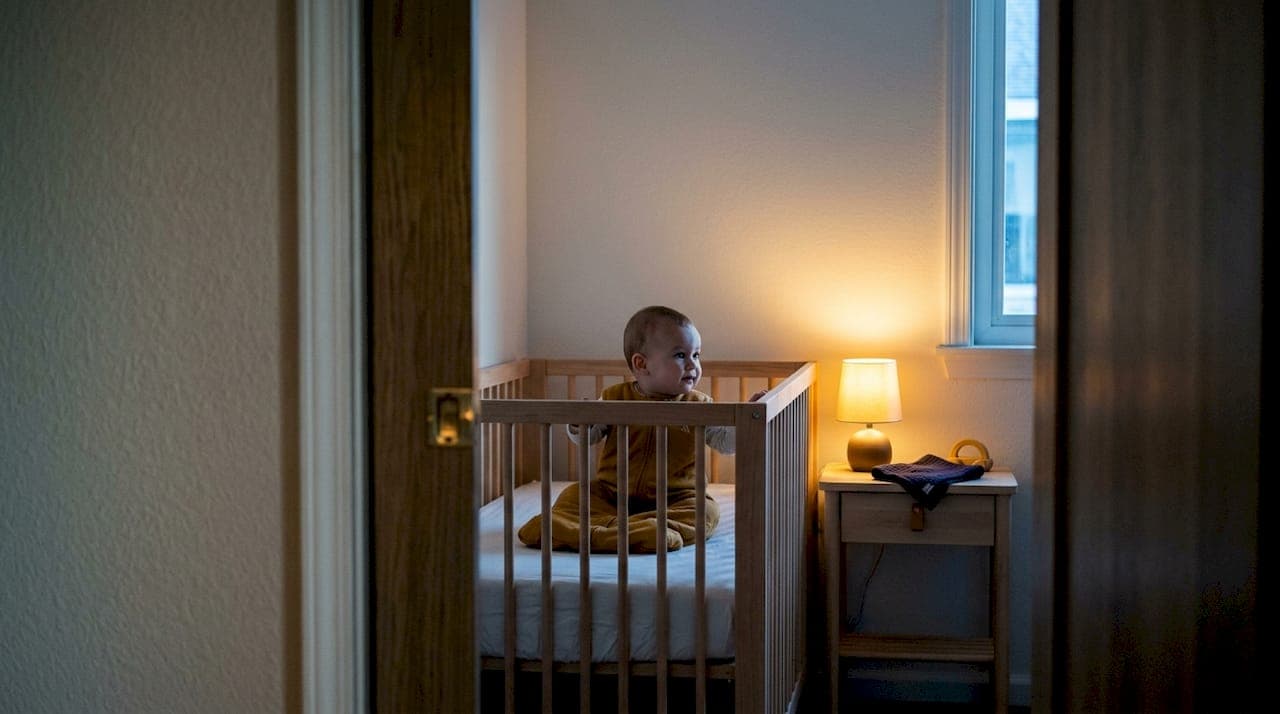
Most baby early waking comes down to three fixable things: too much light hitting tiny eyes before sunrise, a bedtime or nap schedule that no longer matches your child's age, or a sleep association that only works at 2 AM but collapses by dawn. Tonight, darken the room until it's genuinely cave-dark, treat any wake-up before 6 AM like a night waking (low light, quiet voice, minimal engagement), and check that naps and bedtime still fit your child's current age. The rest of this guide walks through the age-specific wake windows and a realistic multi-week plan to shift the clock later.
TL;DR:
- Proper room darkening with blackout shades is crucial, as even minimal light can trigger early wake-ups by suppressing melatonin.
- Adjusting wake windows gradually, by 10 to 15 minutes every few days, helps reset your child's biological clock without causing overtiredness or nap issues.
- Environmental factors like room temperature, noise, and light leaks significantly influence early waking, so controlling these can extend sleep duration.
- If early waking persists after three weeks of schedule and environment changes, personalized support from a sleep expert may be necessary.
- Never rush schedule shifts; patience over multiple weeks is vital, as circadian rhythms and sleep patterns adjust slowly based on individualized signals.
Table of Contents
- What Causes Early Morning Waking in Babies?
- Quick Troubleshooting Steps to Try Tonight
- How Do Wake Windows Change by Age?
- Environment and Circadian Factors That Lock In Early Waking
- When Should You Call the Pediatrician About Early Waking?
- A Realistic 2 to 4 Week Plan to Shift Wake Time Later
- What I Want Tired Parents to Understand About This
- How Mellow Can Help When Early Waking Won't Budge
- Sources
- FAQ
What Causes Early Morning Waking in Babies?
Early waking rarely has one single cause. It's usually a mix of biology, habit, and environment working against each other at the exact moment your child's sleep is naturally lightest.
The first thing to understand is the difference between an overtired baby and an undertired one. An overtired baby has built up too much cortisol and adrenaline by bedtime, which paradoxically leads to fragmented, early-ending sleep rather than deeper rest. An undertired baby, on the other hand, simply hasn't accumulated enough sleep pressure during the day to stay asleep through the biologically lighter sleep stages that dominate the early morning hours.
Several other factors compound the problem:
- Bedtime and nap timing drift. As babies grow, their wake windows lengthen, and a nap schedule that worked at four months can start pushing bedtime too early or too late by six months.
- Sleep associations tied to specific conditions. A baby rocked or fed to sleep at bedtime often expects the same input during the early morning's lighter sleep phase, and cries out for it rather than resettling alone.
- Light and noise creeping into the room. Even a sliver of dawn light through a curtain gap can act as a wake-up signal.
- Hunger or developmental leaps. Growth spurts, teething, and new motor skills (rolling, crawling, standing) can all disrupt sleep temporarily.
- Reflux or illness. Physical discomfort tends to show up as choppy, early-ending sleep rather than one dramatic symptom.
Sleep researchers note there's rarely a single fix that works in isolation. Combining environmental, schedule, and behavioral changes and moving gradually tends to be the more reliable route than chasing one variable at a time.
Quick Troubleshooting Steps to Try Tonight
Before touching the whole schedule, run through this checklist. These are the highest-impact, lowest-effort changes most families haven't fully tried yet.
- Block every trace of morning light. Blackout curtains or shades need to eliminate light around the edges, not just dim the room. Even low-intensity light can suppress melatonin and act as a circadian cue, which is exactly the signal you don't want firing at 5 AM.
- Treat any wake-up before 6 AM as a night waking. Keep the room dark, your voice low, and interactions brief. Turning on lights or starting the day's routine tells your child's brain that this is, in fact, morning.
- Recheck bedtime and nap timing against current age. A schedule that fit two months ago may now be creating too much or too little sleep pressure.
- Start reducing sleep props gradually. If your baby only falls asleep while being rocked or fed, try placing them in the crib drowsy but not fully asleep. Infants put down this way are more likely to resettle independently after both nighttime and early-morning wakings.
- Separate hunger from habit. A quick feed that consistently extends sleep by an hour or more suggests real hunger; a feed that only buys ten minutes suggests habit.
- Check temperature and background noise. A room that's too warm or too quiet (letting outside noise startle a light sleeper) can both trigger early rising.
Pro Tip: Keep a phone flashlight set to the lowest red or amber setting for early wake-ups. Bright white or blue light exposure, even for thirty seconds while you find a pacifier, can signal "daytime" to your baby's circadian clock.
How Do Wake Windows Change by Age?
Age-appropriate wake windows are the single most overlooked lever in fixing early rising. A schedule that's technically "full" of naps and feeds can still be wrong if the gaps between them don't match your child's current stage.
Here's how typical wake windows and total sleep needs shift over the first two years:
Newborns don't yet have organized sleep cycles, which is part of why 0 to 3 month wake-ups don't follow adult logic. Regular day/night rhythms typically don't settle in until around four months of age, so chasing a strict wake-window schedule before that point usually backfires.
Past four months, the direction you adjust matters as much as the amount. If your baby is waking early and seems tired all day, wake windows are probably too long, and shortening the last one before bedtime (moving bedtime slightly earlier) often helps, counterintuitive as that sounds. If your baby wakes early but seems fully rested and cheerful, the wake windows may be too short, and lengthening the last stretch before bed, or trimming a nap, can push the morning wake time later.

Watch for these signals that a schedule change is working: bedtime protests ease within a few nights, the early wake time creeps 10 to 15 minutes later each week, and daytime naps stay consolidated rather than fragmenting. Mellow's own wake window guidance by age breaks these ranges down further with month-by-month detail, which helps when your baby sits right on the edge of two age bands.
Environment and Circadian Factors That Lock In Early Waking
Light is the most powerful circadian signal your baby's brain receives, and it's also the easiest one to control. Even a sliver of dawn light through a curtain gap can be enough to suppress melatonin and start the wake-up cascade, well before you'd choose to start the day.

An actigraphy study of infant sleep found that babies sleeping in a non-dark room got about 28 minutes less nighttime sleep than those in fully dark rooms. That's not a minor difference. It's often the exact gap between a 5:15 AM wake-up and a 5:45 AM one.
A few practical steps make the biggest difference:
- Use blackout shades or blinds that cover the entire window frame, not just the glass, since light leaks through gaps far more than most parents expect.
- If your toddler needs a night-light for reassurance, choose a dim red or amber bulb rather than white or blue light, which more strongly suppresses melatonin.
- Remove or cover any device with an LED indicator, including baby monitors, humidifiers, and chargers.
- Keep the room cool, ideally between 68 and 72 degrees Fahrenheit, and consider a sound machine to mask early street or household noise.
- If mornings are unpredictable, a timed smart shade that delays natural light by even 30 to 45 minutes can buy real extra sleep. Mellow's guide on room darkening for better sleep covers setup details for different window types.
When Should You Call the Pediatrician About Early Waking?
Most early waking is behavioral or environmental, not medical. But a few patterns deserve a call to your pediatrician rather than another week of schedule tweaks.
Watch for a sudden, dramatic change in sleep after a long stretch of consistency, noisy breathing, snoring, or pauses in breathing, feeding difficulties or stalled weight gain, signs of significant reflux (arching, frequent spit-up paired with distress), or waking that seems inconsolable rather than simply early. Any of these warrants a conversation, especially if they showed up abruptly.
Before the appointment, track wake times, nap lengths, feeding times, and any symptoms for about a week. Bringing a clear log turns a vague "she's been waking early" into data your pediatrician can actually use. And as a standing safety reminder, the AAP's safe-sleep guidance recommends room-sharing without bed-sharing, and always placing babies on their backs to sleep.
A Realistic 2 to 4 Week Plan to Shift Wake Time Later
Shifting a deeply set wake time takes patience, not a single dramatic change. Here's a plan that respects how slowly circadian rhythms actually adjust.
- Week 1: Baseline tracking. For three to seven days, record wake times, nap start and end times, and feeds without changing anything yet. Patterns that seemed random usually reveal a clear cause once they're on paper.
- Week 1 to 2: Small, incremental shifts. Move bedtime or the first wake-up of the day by just 10 to 15 minutes every three to four days. Researchers studying infant sleep interventions found that small, incremental adjustments succeed more often than large jumps, which tend to create mismatched sleep pressure and backfire within days.
- Week 2: Adjust naps to match. If bedtime moves later, the last nap of the day may need to shift too, so your baby isn't overtired by the new bedtime. Keep nap changes just as gradual as the bedtime shift.
- Checkpoint after week 1. Has the wake time moved at all, even by five or ten minutes? Small progress means stay the course. No movement means recheck total sleep hours and consider whether a nap is too long or too close to bedtime.
- Week 2 to 3: Reduce sleep props alongside the schedule shift. Pair the timing changes with placing your baby in the crib drowsy but awake, since props like feeding-to-sleep tend to undercut schedule changes if left unaddressed. This is also where bedtime fading and similar behavioral methods show real, attachment-safe results.
- Checkpoint after week 3. If a growth spurt, illness, or a developmental leap hits mid-plan, pause the shifting (don't reverse it) and resume once your baby is back to baseline.
Pro Tip: Don't judge the plan by day three. Circadian rhythms shift in minutes, not hours, and a plan that looks like it's failing on day four often shows clear movement by day ten.
Mellow's guide to toddler bedtime routines has more detail on sequencing these changes for older toddlers, whose protests tend to be louder and more negotiable than an infant's.
What I Want Tired Parents to Understand About This
Early waking wears parents down in a specific way. It's not just lost sleep. It's lost sleep at the exact hour you'd finally get a stretch of rest yourself, night after night, with no clear end date. That grinds differently than a single bad night ever could.
Give any schedule change two full weeks before deciding it isn't working. Babies don't read our calendars, and a real circadian shift often looks like nothing for the first several days before it clicks. If you're running on fumes, that's not a personal failure. It's a sign to get support, whether from your pediatrician or a structured plan, before exhaustion starts affecting your own health.
— Mauricio Vargas
How Mellow Can Help When Early Waking Won't Budge
When you've darkened the room, adjusted the schedule, and given it three full weeks with no real movement, the problem usually isn't effort. It's that a generic plan doesn't account for your specific child's temperament, feeding pattern, or the particular sleep association that's keeping them stuck. Individualized guidance built around exactly that gap can be more effective than a generic checklist for every family.

The Personalized Plan gives you a custom sleep strategy built around your child's age and history for a one-time cost of 199 EUR, and the Plan + Consultation option (349 EUR one-off) pairs that plan with direct guidance from a certified consultant. If you just need a focused conversation to troubleshoot one stubborn issue, the 45-minute consultation runs 69 EUR one-off. Already working with Mellow and need more support mid-plan? Upgrade your support for 179 EUR one-off. If chronic early waking has outlasted every change you've tried on your own, book a plan and get a strategy built around your actual child.
Sources
- Behavioral Interventions for Infant Sleep Problems (Pediatrics)
- Sleep environment and parental practices associated with infant sleep (PMC)
- Sleeping through the night: a developmental perspective (Pediatrics)
- Healthychildren
- Light exposure, circadian timing, and sleep in infants (PMC)
This article is general information, not a substitute for advice from a qualified doctor. Consult a qualified healthcare professional about your own circumstances before acting on anything here.
FAQ
How Do I Stop My Baby From Waking at 5 AM?
Start by fully blacking out the room and treating any wake-up before 6 AM as a night waking, with low light and minimal interaction. If that doesn't shift things within a week, recheck your child's wake windows for their age and consider gradually removing sleep props like feeding or rocking to sleep.
My 7-Month-Old Wakes Up at 5 AM. What Should I Do?
At seven months, check whether naps or bedtime have drifted out of the typical 2 to 3.5 hour wake window range for this age, since outgrown schedules are a common trigger. Combine that check with full room darkening and a consistent, calm response to the early wake, and give any change about two weeks before judging results.
My Baby Wakes Up at 4 AM Every Morning. Is This Normal?
A wake-up this early usually points to either an overtired schedule, light leaking into the room, or a sleep association that stops working once sleep gets lighter near dawn. It's common enough to troubleshoot rather than alarming on its own, though a sudden onset paired with feeding or breathing concerns is worth mentioning to your pediatrician.
My 11-Month-Old Woke Up at 5 AM. What Should I Do?
Treat it as a night waking rather than the start of the day: dim lights, a brief calm response, and no stimulating interaction. If this becomes a consistent pattern rather than a one-off, work through the 2 to 4 week schedule shift plan and confirm naps still match an 11-month-old's typical 2 to 3 nap range.
Does Mellow Offer Help Specifically for Early Waking?
Yes. Mellow's Personalized Plan builds an individualized schedule around your child's exact age and sleep history, and pairing it with a consultation gives you direct troubleshooting support when early waking doesn't resolve on its own.