

Most 6-month-olds need about 14 to 15 hours of sleep in a 24-hour stretch, split between roughly 10 to 11 hours at night and 2.5 to 3.5 hours across naps. Many babies at this age still take three naps, though some are ready for two. Aim for a bedtime between 6:30 and 8:00 PM, and pick whichever sample schedule below matches your baby's current nap count.
TL;DR:
- Most 6-month-olds need around 14 to 15 hours of sleep in a 24-hour period, with at least 10 to 11 hours at night and 2.5 to 3.5 hours during naps.
- The common schedule includes either three naps with shorter wake windows or two naps with longer stretches, depending on the baby's readiness to consolidate.
- Wake windows generally range from 1.75 to 3 hours, which parents should observe alongside sleep cues to optimize nap length and bedtime.
- Sleep disruptions through early waking or night waking often result from environmental factors, overtiredness, or developmental leaps rather than schedule issues alone.
- Transitioning from three to two naps typically occurs when a baby consistently resists or skips nap 3, and gradual adjustments can ease this shift over time.
Table of Contents
- Sample 6 Month Old Schedules: 3-Nap and 2-Nap Templates
- What Are the Right Wake Windows at 6 Months?
- How Much Sleep Does a 6-Month-Old Actually Need?
- Why Does My 6-Month-Old Suddenly Wake Up at Night?
- Do Solids Help Babies Sleep Through the Night?
- Safe Sleep and Pacifier Basics for This Stage
- How Do I Know When to Drop a Nap?
- Quick Fixes for Common 6-Month Sleep Problems
- Why Flexible Templates Beat Rigid Schedules
- Getting Personalized Support for Your Baby's Schedule
- Sources
- FAQ
Sample 6 Month Old Schedules: 3-Nap and 2-Nap Templates
Every 6-month-old routine bends around one thing: your baby's wake time. If your child wakes at 6:00 AM instead of 7:00 AM, shift every block below by the same amount. The times aren't sacred. The order and spacing are what matter.
The 3-nap template
This is still the more common six month old schedule, especially for babies who haven't consistently stretched wake windows past two and a half hours.
- 7:00 AM: Wake and first feed
- 9:00 AM: Nap 1 (about 1 to 1.5 hours) (typical nap duration)
- 10:30 AM: Wake, feed, playtime
- 12:30 PM: Nap 2 (about 1 to 1.5 hours) (typical nap duration)
- 2:00 PM: Wake, feed
- 4:00 PM: Nap 3 (short, around 30 to 45 minutes)
- 4:45 PM: Wake, feed, wind-down activities begin
- 7:00 PM: Bedtime routine starts
- 7:30 PM: Asleep for the night
The 2-nap template
Babies ready to consolidate usually show it by resisting nap 3 or by stretching that last wake window without falling apart. Here's what a two-nap six month old schedule looks like:
- 7:00 AM: Wake and first feed
- 9:30 AM: Nap 1 (1 to 1.5 hours)
- 11:00 AM: Wake, feed, midday activity
- 2:00 PM: Nap 2 (1.5 to 2 hours)
- 3:45 PM: Wake, feed
- 7:00 PM: Bedtime routine starts
- 7:30 PM: Asleep for the night
Notice the gap between nap 2 and bedtime is longer in the two-nap version, roughly 3.5 to 4 hours. That's the trickiest window in this schedule, and it's where a lot of parents see early bedtime meltdowns during the transition.
If your baby wakes earlier or later than 7:00 AM, don't scrap the template. Just slide the whole day. A 6:15 AM riser follows the same spacing, just 45 minutes earlier across the board, landing bedtime closer to 6:45 PM.
For evenings when the schedule can't hold, a few quick swaps keep things from unraveling completely:
- Traveling or visiting family: keep the bedtime routine (bath, book, feed) even if the location changes, and treat that consistency as the anchor.
- A late event: allow one shortened nap window rather than skipping a nap outright, since an overtired baby at bedtime is harder to settle than one who napped slightly off-schedule.
- A skipped nap: move bedtime up by 30 to 45 minutes that same night to head off overtiredness.
What Are the Right Wake Windows at 6 Months?
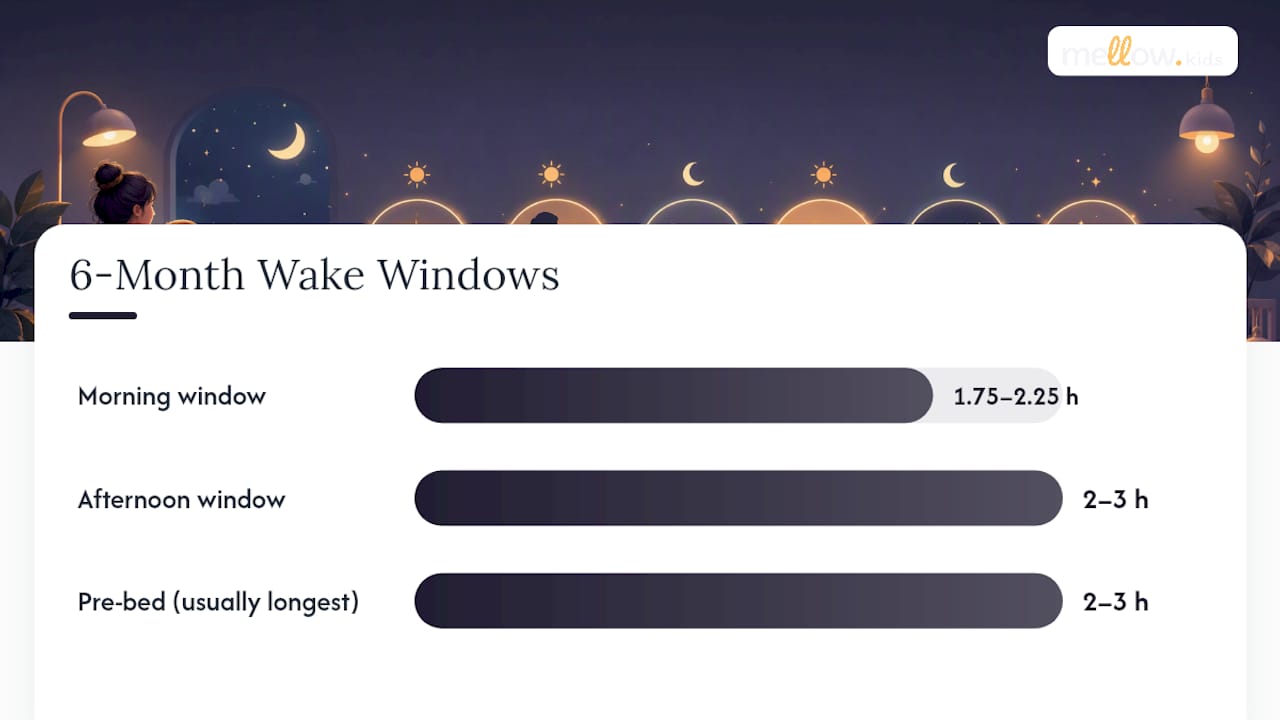
Wake windows at this age typically run 2 to 3 hours, with the first window of the day usually the shortest and the window right before bedtime usually the longest. A practical breakdown looks like this: 1.75 to 2.25 hours after the morning wake-up, stretching to 2 to 3 hours by the afternoon and evening stretches.
The clock gets you close. Your baby's cues get you the rest of the way. Watch for eye rubbing, zoning out, fussiness, or a sudden loss of interest in toys that were fascinating five minutes earlier. When a cue shows up near the low end of the expected window, trust the cue over the clock.
Pro Tip: Keep a simple log of wake and sleep times for a week. Patterns that feel invisible day to day, like a nap that reliably shortens after a 2-hour-15-minute window, become obvious once they're written down.
If naps are consistently short, a maxed-out wake window usually isn't the problem. Check these first:
- Room darkness: even dim daylight can cut a nap short by triggering an early wake-up.
- White noise consistency: the same sound machine at the same volume every nap builds a reliable cue.
- Pre-nap routine: a two-minute version of the bedtime routine (dim lights, same phrase, same feel) signals sleep is coming.
- Temperature: a room that's slightly too warm disrupts sleep more often than parents expect.
Tracking wake windows over several days makes it easier to spot whether a short nap is a timing issue or an environment issue, since the pattern usually repeats.
How Much Sleep Does a 6-Month-Old Actually Need?
Pediatric sleep-duration consensus puts most infants in a 12 to 16 hour range across 24 hours, with 14 to 15 hours serving as a practical target for many babies at this stage.
By the numbers: A typical 6-month-old sleeps 10 to 11 hours at night and 2.5 to 3.5 hours across daytime naps, adding up to roughly 14 to 15 hours total.
That night stretch doesn't have to include a feed. Many healthy 6-month-olds are physiologically capable of sleeping 6 to 8 hours without a caloric feed, though every baby's nutritional needs differ, and any change to night feeding is worth discussing with your pediatrician first.
A few signs it's worth a call to your pediatrician rather than a schedule adjustment:
- Total sleep consistently falls under 11 to 12 hours despite a calm routine.
- Your baby seems chronically exhausted, cranky, or falls asleep instantly wherever they're placed.
- Weight gain or feeding volume has changed alongside the sleep changes.
Why Does My 6-Month-Old Suddenly Wake Up at Night?
Night waking at this age often gets lumped under "the 6-month sleep regression," but the label hides more than it explains. Rolling, sitting practice, and a new awareness that you exist in another room can all interrupt sleep temporarily, and developmental leaps like these commonly show up as disrupted nights. Teething adds another layer, arriving unpredictably and rarely on the schedule a parenting book promises.
Not every waking is developmental, though. Some are habit. A baby who's always nursed or rocked fully to sleep may wake at every natural sleep-cycle transition looking for the same conditions that started the night.
A few approaches tend to help more than they hurt:
- Keep the bedtime routine identical every night: bath, book, feed, crib. Predictability is doing real work here, not just ritual.
- Put your baby down drowsy but still awake when you can, giving them practice falling asleep independently.
- If you respond to a waking, wait a beat before rushing in. Some babies resettle within a minute or two on their own.
- Avoid introducing a new sleep prop (a specific song, a bounce pattern) that you can't sustain at 3:00 AM every night for weeks.
UCSF Benioff Children's Hospital's guidance specifically warns against building habits during a rough patch that become harder to unwind later. That's the trap: the fix that works tonight sometimes becomes the problem in three weeks.
Pro Tip: If night wakings spike suddenly after weeks of good sleep, check for a new skill first (rolling to a new position, pulling to sit) before assuming something's gone wrong with the schedule.
Reducing night feeds is sometimes appropriate at this age, but it depends on your baby's growth, feeding volume, and your pediatrician's read on their individual needs. That's a conversation worth having directly rather than guessing from a general schedule.
Do Solids Help Babies Sleep Through the Night?
Public health guidance recommends introducing solid foods around 6 months, but starting solids rarely fixes night waking on its own. Parents often start solids expecting an immediate payoff at 2:00 AM. It usually doesn't work that way, since night wakings at this age are more often developmental or habit-driven than calorie-driven.
A few practical notes on timing:
- Offer the last milk feed 30 to 60 minutes before the bedtime routine starts, so it doesn't compete with the wind-down.
- Keep solids earlier in the day at first, since a full belly right before a nap can go either way depending on the baby.
- Watch for genuine hunger cues at night (rooting, persistent crying that settles with a feed) versus habit wakings that settle with a pat or a few minutes of waiting.
- If night feeds are dropping off naturally as solids increase, that's a normal progression, not something to force.
Safe Sleep and Pacifier Basics for This Stage
Schedule changes are a good moment to double-check the basics. AAP guidance still applies at 6 months: back to sleep, a firm surface, no loose bedding or soft toys in the crib, and room-sharing without bed-sharing.
Pacifier use at naptime and bedtime carries a protective association with reduced SIDS risk, according to AAP guidance, even as babies eventually outgrow the need for one.
If your baby uses a pacifier, build it into the routine consistently, offered at the start of sleep rather than replaced repeatedly through the night. That distinction matters for avoiding a pattern where every wake-up requires you to walk in and reinsert it. Some families phase pacifier use out around this age for exactly that reason; others keep it and just let their baby learn to find it or fall back asleep without it.
How Do I Know When to Drop a Nap?
A baby who's fighting nap 3 most days, or who can comfortably stretch past typical wake windows without overtiredness, usually shows readiness signs before parents consciously notice them. Consistent nap resistance over time is a clear signal.
- Stretch the wake window before the third nap by 15 minutes every few days rather than cutting the nap outright.
- Once the gap between nap 2 and bedtime comfortably fills without a third nap, try the two-nap template for 5 to 7 days straight.
- Watch bedtime and overnight sleep closely during that trial. A rough transition sometimes shows up there before it shows up at naptime.
- If night sleep falls apart or your baby becomes visibly overtired by late afternoon, go back to three naps for another week or two before trying again.
Pro Tip: Nap transitions rarely go in a straight line. Expect a few days of three naps and a few days of two naps mixed together before the two-nap pattern holds consistently.
Quick Fixes for Common 6-Month Sleep Problems
Short naps, early wake-ups, and bedtime resistance tend to have the same handful of causes, and most respond to small adjustments rather than a schedule overhaul.
For short naps, check room darkness, white noise consistency, and whether the wake window before that nap ran too long. For early-morning waking (anything before 6:00 AM), a later or inconsistent bedtime is often the hidden cause, along with too much light creeping into the room before dawn. For bedtime battles, an overtired baby is usually the culprit. Moving bedtime 30 minutes earlier for a few nights often resolves resistance faster than any new routine tweak.
A temporarily earlier bedtime, paired with less stimulation in the final hour before sleep, resets an overtired baby faster than most parents expect. Give it three or four nights before judging whether it worked.
A few signs belong in front of your pediatrician, not just a schedule adjustment:
- Poor weight gain alongside sleep or feeding changes.
- Breathing that sounds labored, noisy, or pauses during sleep.
- A sudden, unexplained shift in sleep that doesn't respond to any routine change after a week or two.
Why Flexible Templates Beat Rigid Schedules
Every sample schedule in this guide is a starting point, not a contract. Mellow builds its guidance around what actually happens developmentally at each stage, because a 6-month-old in week one of the stage and a 6-month-old in week three can have genuinely different nap needs, even a week apart.
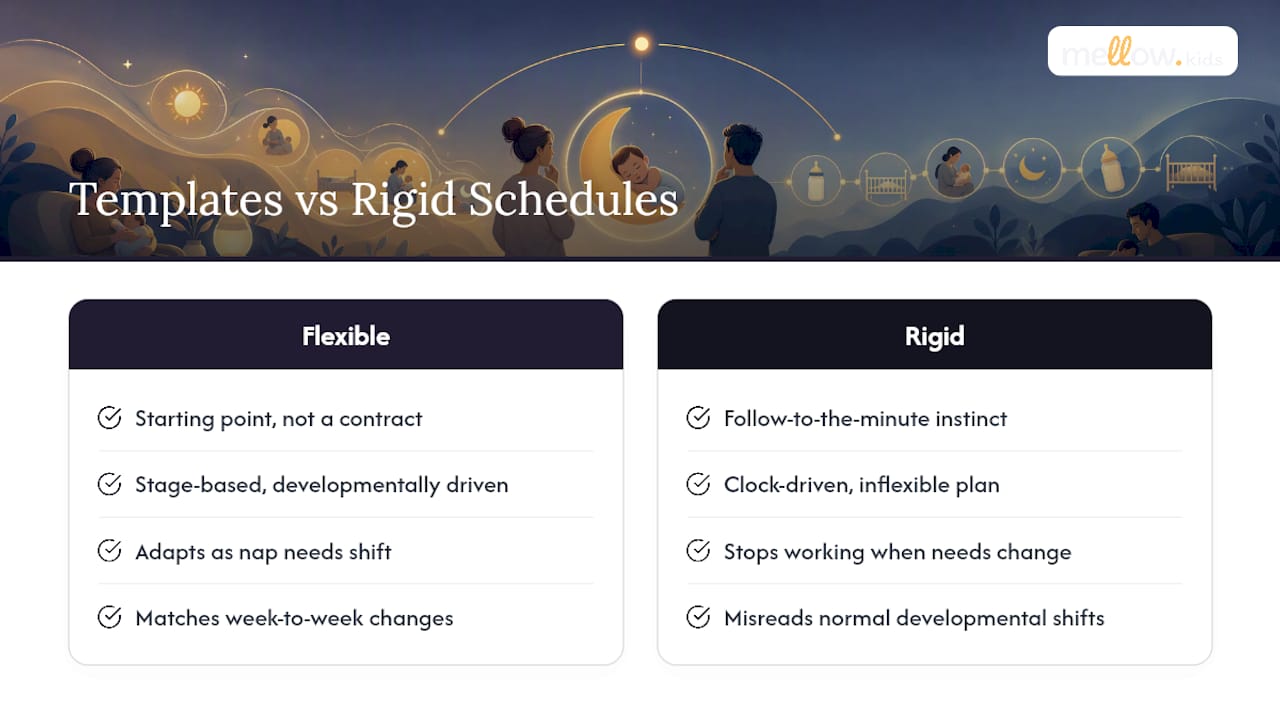
The instinct to follow a schedule to the minute is understandable. It's also usually the wrong instinct. Wake windows, nap counts, and bedtime all shift as a baby's brain and body develop, sometimes within the same month. What worked reliably for three weeks can stop working overnight, and that's not a failure of the schedule. It's just what six-month development looks like in practice.
Parents who want a tracked, personalized version of this rather than a general template can find that structure through Mellow's age-specific resources, built around exactly this kind of stage-based shift.
— Mauricio Vargas
Getting Personalized Support for Your Baby's Schedule
A generic template gets you close. It can't account for your baby's specific wake windows, nap resistance patterns, or how a growth spurt is reshaping their needs this week. Some apps build tailored schedules that adjust as your child moves through developmental stages, tracking wake windows and nap timing so you're not guessing whether a rough night is a phase or a pattern.

If your baby is approaching 6 months or already there, Start Here walks you through setting up a plan matched to your child's actual stage, not just their age in months. Parents managing the shift toward 8 to 10 months can also preview what's coming next through the 8 to 10 months program page. For families who want daily tracking alongside the schedule guidance, the Mellow app offers a free trial before any subscription commitment. If you're curious how sleep needs continue evolving well past this stage, this overview of toddler sleep changes is a useful next read.
Sources
- Your Baby at 6 Months | UCSF Benioff Children's Hospitals
- Pediatric Sleep Duration Consensus | AASM
- Wake window: age chart and tips | The Bump
Individual medical questions, especially around feeding, growth, or persistent sleep disruption, belong with your pediatrician.
FAQ
What Is a Good Sleep Routine for a 6-Month-Old?
A solid routine includes a consistent bedtime between 6:30 and 8:00 PM, two to three naps spaced by 2 to 3 hour wake windows, and a repeatable wind-down sequence like bath, book, and feed before sleep.
What Time Do 6-Month-Olds Usually Go to Bed?
Most 6-month-olds do best with a bedtime between 6:30 and 8:00 PM, timed so the final wake window of the day doesn't stretch into overtiredness.
Can a 6-Month-Old Sleep 12 Hours Without Eating?
Many healthy 6-month-olds can sleep 6 to 8 hours without a caloric feed, but a full 12-hour stretch without any feed is less common and depends on the individual baby's growth and nutrition needs, which is worth discussing with your pediatrician.
Can I Let My 6-Month-Old Take a 3-Hour Nap?
A 3-hour nap is longer than typical for this age and can push subsequent wake windows and bedtime off track; most daytime totals for 6-month-olds land around 2.5 to 3.5 hours split across two or three separate naps rather than one long one.