
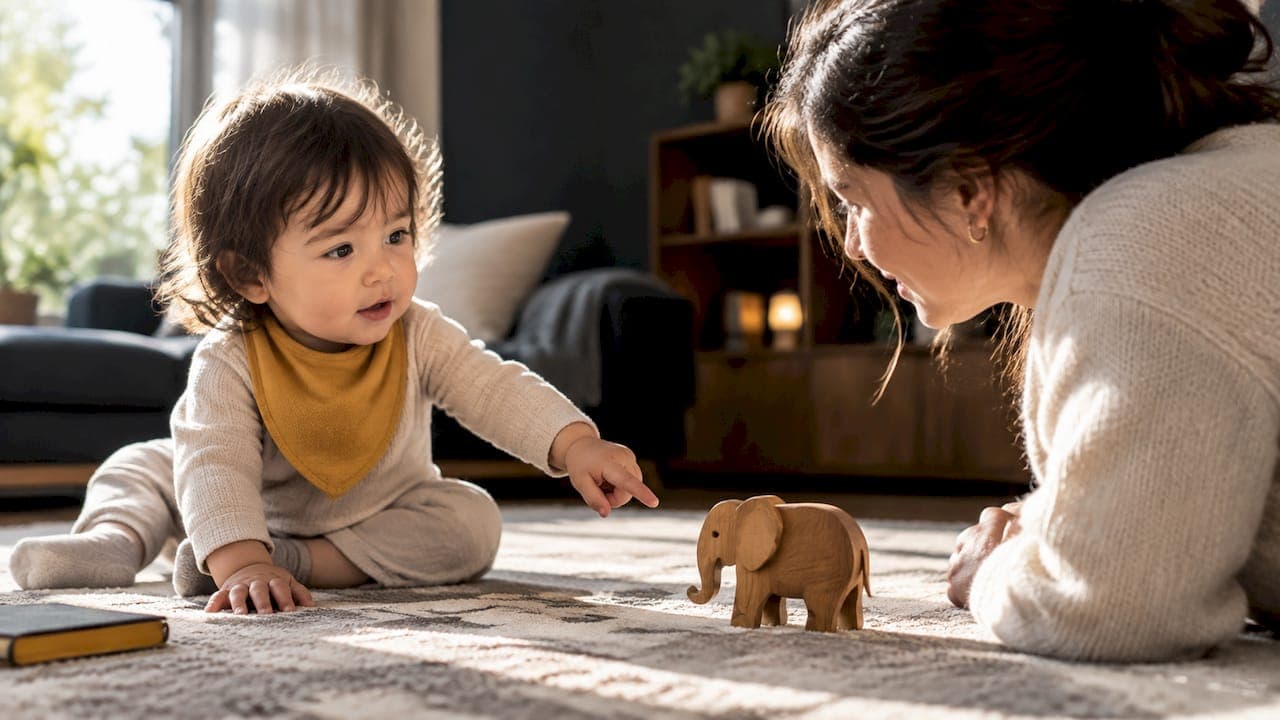
Most babies say their first meaningful word between 10 and 14 months, with many landing right around the 12-month mark. But talking is only half the story: understanding almost always comes first, and some babies grasp dozens of words before they ever speak one. Wide variation is normal here, and a few clear red flags (covered below) tell you when it's worth a closer look.
TL;DR:
- Most babies say their first meaningful words between 10 and 14 months, but some may start earlier or later without concern.
- Joint attention skills at 12 and 18 months strongly predict vocabulary development at 24 months.
- Responding to voice and gestures before speaking, like following gaze or pointing, indicates strong language foundation.
- Simple caregiver activities such as narrating routines, playing copying games, and offering choices boost early word learning.
- Persistent lack of babbling or responses after age 9 to 12 months may warrant a hearing check and a consultation with a speech therapist.
Table of Contents
- First Words Timeline: What Happens Month by Month
- Why Joint Attention Matters More Than the First Word Itself
- Simple Ways to Encourage Early Words
- When Speech Delay Signs Mean It's Time to Ask for Help
- Why Watching Patterns Beats Watching the Calendar
- Track Milestones Without the Guesswork
- Sources
First Words Timeline: What Happens Month by Month
Speech doesn't start with a word. It starts with listening, and that listening begins earlier than most parents realize. Babies show measurable sensitivity to speech sounds even before birth, which is part of why a newborn already turns toward a familiar voice within days of arrival, according to University of Washington research on prenatal language learning.
From there, the first words timeline unfolds in fairly predictable stages, even though the exact week each baby hits them will vary.
- Birth to 3 months: Cooing, vowel-like sounds, and vocal turn-taking. Your baby is watching your mouth, locking eyes, and practicing the rhythm of conversation long before any actual words show up.
- 4 to 6 months: Canonical babbling begins. Consonant and vowel sounds combine into strings like "ba" or "da," and babies start distinguishing between different syllable patterns they hear.
- 7 to 9 months: Babbling becomes more intentional and varied. Babies respond to their own name, start pointing at objects, and use gestures like reaching or waving to communicate before words arrive.
- 10 to 12 months: This is when many babies produce that first meaningful word, whether it's "mama," "dada," or a clear "hi." According to ASHA's communication milestones, imitation of sounds and gestures becomes stronger here too, and words start carrying real, repeatable meaning rather than random babble.
- 12 to 18 months: Vocabulary builds steadily. By 18 months, many toddlers can say 10 or more words, though the range across healthy kids is genuinely large.
- 19 to 24 months: For many toddlers, this is the "language explosion" window, when new words seem to appear daily rather than weekly. Parenting research describes a rapid acceleration in vocabulary size during this stretch, often catching parents off guard with how fast it moves.
If your baby's timing looks a little different from this list, that's expected. What matters more than hitting an exact month is whether the pattern of communication, gestures, sounds, and responsiveness keeps moving forward.
Why Joint Attention Matters More Than the First Word Itself
Long before a baby says a word, they're doing something quietly powerful: sharing attention with you. When your baby follows your gaze to look at what you're looking at, that's called responding to joint attention. When your baby points at something and then checks your face to see if you noticed, that's initiating joint attention. Both are strong predictors of vocabulary growth to come.
A peer-reviewed study tracking infants found that joint attention skills measured at 12 and 18 months predicted language ability at 24 months, even after researchers controlled for general cognitive development. In other words, the social habit of sharing focus with a caregiver isn't just cute. It's laying groundwork for spoken language itself.
Statistic to remember: Infants who scored higher on joint attention measures at 12 and 18 months went on to show stronger language outcomes at 24 months, independent of overall cognitive ability, per the study above.
This is also why receptive language, understanding words before saying them, deserves more attention than it usually gets. A baby who reliably turns to their name, follows a pointed finger, or looks at "the dog" when you say it is showing real language competence, even with zero words spoken yet.
Simple Ways to Encourage Early Words
You don't need flashcards or a curriculum. Language grows fastest in ordinary moments, when you follow your baby's lead, label what they're already interested in, narrate routines out loud, and then pause and wait for a response instead of filling every silence yourself. Caregiver responsiveness like this, paired with shared book reading, is consistently recommended by early language specialists as one of the most reliable ways to boost word learning.
Three things you can try today:
- Narrate the diaper change or bath. Say what you're doing in short, simple phrases ("wet washcloth," "all done") and pause afterward to see if your baby vocalizes back.
- Play the copying game. When your baby babbles a sound, copy it back exactly, then wait. This turn-taking rhythm is one of the earliest forms of real conversation.
- Offer choices instead of statements. Around 10 to 18 months, hold up two toys and ask "ball or block?" This nudges toward single-word attempts without any pressure.
Pro Tip: Get down to your baby's eye level before you talk. Joint attention works best face to face, where your baby can watch your mouth shape sounds while also checking your expression for meaning.
When Speech Delay Signs Mean It's Time to Ask for Help
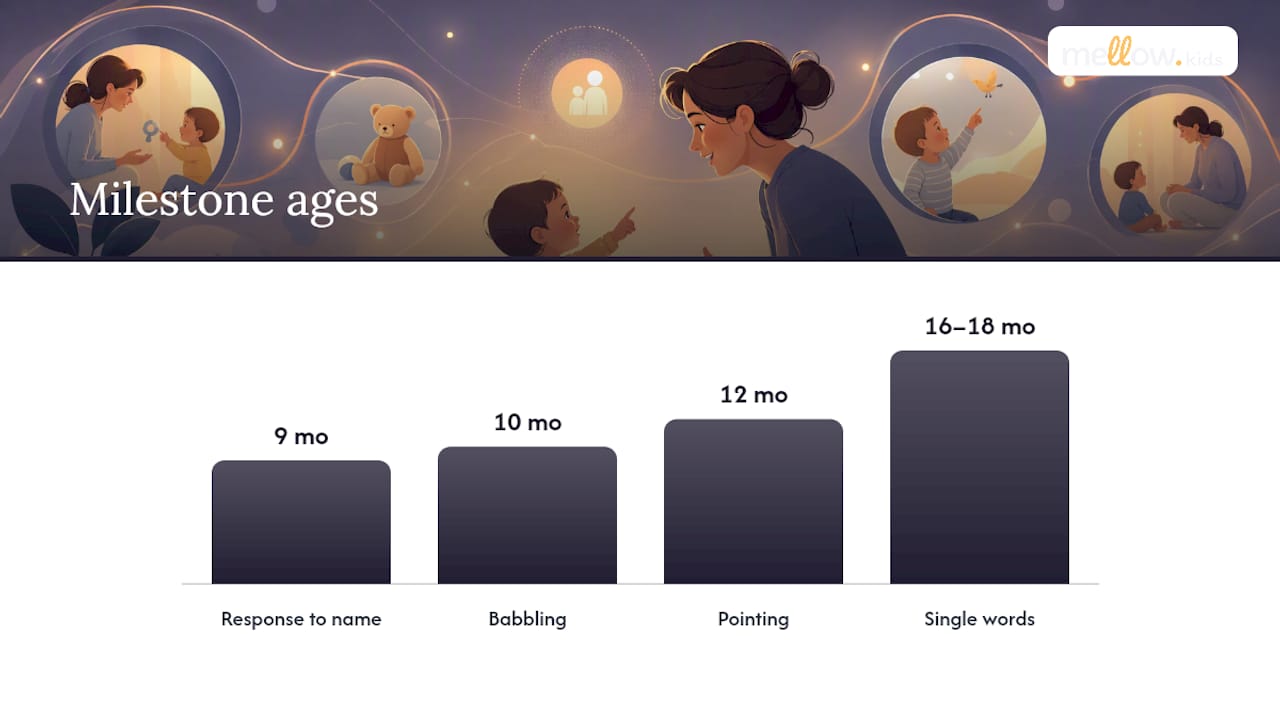
A quiet week isn't a red flag. A consistent pattern of missed milestones is. Watch for no babbling at 10 months, no response to name by 9 months, no pointing at 12 months, or no single words by 16 to 18 months.
Some clinicians use roughly 10 words by 18 months as a reference point worth discussing with a pediatrician, though they're quick to stress how much normal variation exists around that number.
If something feels off, the practical sequence is:
- Start with a hearing check, since even mild hearing loss can quietly limit speech development.
- Talk to your pediatrician about what you're seeing.
- Ask for a referral to a speech-language pathologist if concerns continue.
Before the appointment, jot down which words your baby actually uses with meaning, take a few short video clips of daily play, and note how your baby responds to their name and to simple requests. Clinicians often find brief home videos more useful than a verbal description alone.
Why Watching Patterns Beats Watching the Calendar
Milestone charts are useful, but they can also turn one quiet afternoon into a source of dread. What actually tells you something is the pattern over weeks: is your baby pointing more, babbling more, responding more, even if the first word itself hasn't landed yet? Age-based guides for 8 to 10 months and 11 to 14 months are built around exactly this kind of pattern tracking, mapped to the same developmental windows covered above. Most babies who start slow catch up fully. Early attention to language isn't about worry. It's about giving yourself options sooner rather than later.
— Mauricio Vargas
Track Milestones Without the Guesswork
Watching for first words is easier when you know exactly what to look for at each stage, and age-specific pages can help close that gap. Instead of scrolling through generic charts, you get prompts and activities matched to where your baby actually is right now.
The 11 to 14 months guide walks through the window when most first words emerge, with daily prompts tied to the joint attention and turn-taking habits covered above. The 8 to 10 months guide covers the babbling and gesture stage that precedes it, and the 15 to 24 months guide addresses the vocabulary increase once words start arriving in bunches. For more activity ideas outside the app, this parent's guide to supporting language milestones is worth a read too. Open the Mellow Kids app and start with the age range that matches your baby today.
This article is general information, not a substitute for advice from a qualified doctor. Consult a qualified healthcare professional about your own circumstances before acting on anything here.
Sources
- Language development (Mayo Clinic)
- Individual differences in joint attention skill development in the second year
- When Do Babies Start Talking? (Cleveland Clinic)
- Communication milestones: birth to 1 year (ASHA)