
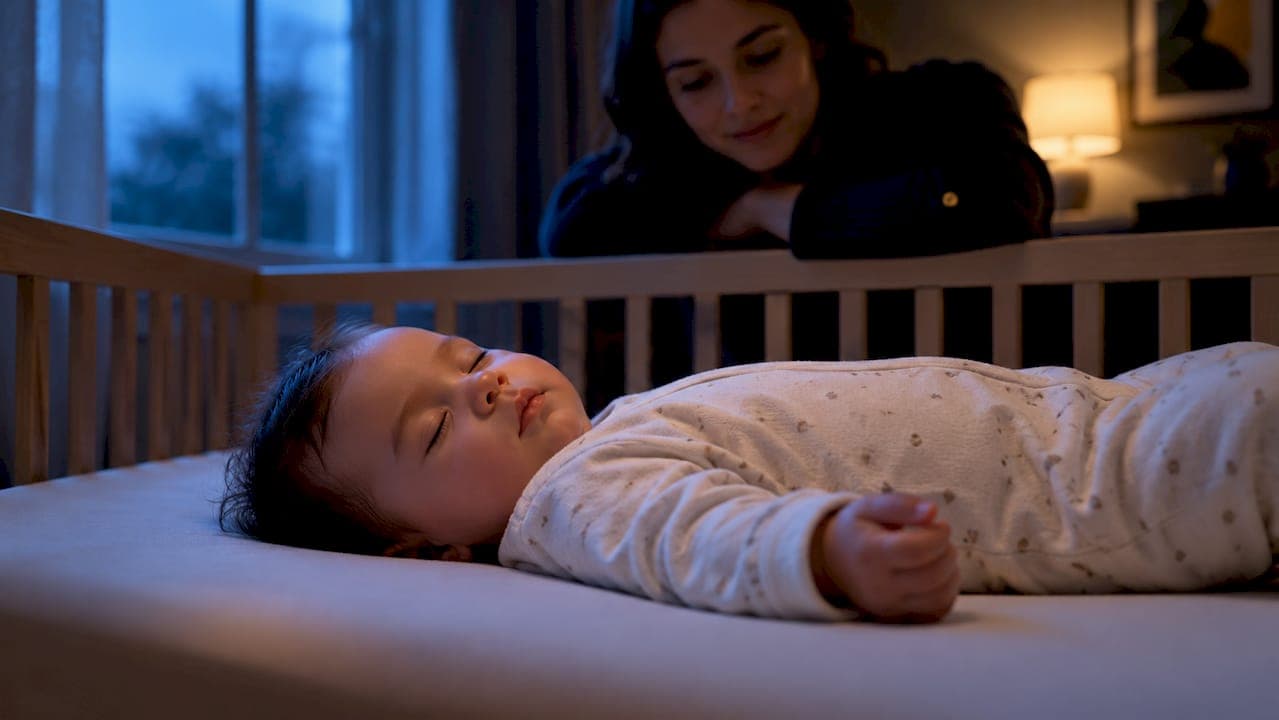
Prioritize safe sleep boundaries, a consistent low-stimulation soothing progression, and predictable routines: these are the three moves that help most with high need baby sleep. Tonight, check your baby's sleep surface, try one calm soothing method for a few minutes before switching to another, and build a simple pre-sleep cue you repeat every time. Safe sleep guidance from the American Academy of Pediatrics is not optional, even when your baby resists settling.
TL;DR:
- Most high need babies respond better to consistent, low-stimulation routines and calm, staged soothing over rapid technique switching.
- Safe sleep guidelines, including placing the baby on their back on a firm surface and room-sharing without bed-sharing, are non-negotiable.
- Adjusting nap and bedtime schedules by 15 to 30 minutes based on the baby's cues can significantly improve sleep consolidation over time.
- Sensory sensitivity in high need infants affects sleep differently at various ages, making patience and tailored environments essential.
- Personalizing sleep plans based on your baby's temperament and sleep history is more effective than standardized schedules or quick fixes.
Table of Contents
- Quick wins you can try tonight
- Why high need babies sleep differently
- Hard safety rules parents must follow
- Step-by-step soothing progression to reduce overstimulation
- Routines and age-appropriate wake windows to improve consolidation
- Red flags and professional referrals
- Author perspective: how evidence and practice guide Mellow Kids' approach
- The role of feeding routines in high need baby sleep
- What the research actually supports and what parents get wrong
- How Mellow Kids can help you personalize this approach
- Sources
- FAQ
Quick wins you can try tonight
When a baby is intense, sensitive to change, and quick to wake, the instinct is often to try everything at once: rocking, shushing, feeding, and walking, all within a minute. That instinct usually backfires because it adds sensory input instead of reducing it. A slower, more deliberate approach tends to work better for sensitive babies.
- Confirm the sleep surface is firm and flat, with nothing loose in the crib or bassinet.
- Dim the lights about 20 to 30 minutes before sleep and turn on safe, steady white noise.
- Dress your baby in breathable layers appropriate for the room, avoiding heavy blankets.
- Start with one calming technique, such as a low, steady shush, and give it about five minutes before switching to another.
- Repeat the same short sequence of cues (dim lights, white noise, a specific phrase or song) every time you begin the wind-down.
- If a nap ran short or long today, shift the next nap or bedtime by 15 to 30 minutes rather than forcing the usual schedule.
This staged approach mirrors guidance from Healthychildren, which recommends trying a single calming method for several minutes before moving to the next one rather than cycling rapidly through options. Repeated method-switching tends to raise arousal instead of lowering it, especially in babies who are already sensitive to stimulation.
A consistent bedtime cue, even something as simple as a short song, can also anchor the routine. For ideas on building that kind of cue, this practical guide to music-based bedtime routines offers a low-effort starting point.
Pro Tip: Pick one phrase, one song, or one specific shushing sound and use it every single time you start winding your baby down. The repetition itself becomes the signal that sleep is coming.

Why high need babies sleep differently
Some babies are simply wired to react more strongly to the world around them, and that reactivity shows up at night. Research following infants over their first year found that higher Negative Affectivity, the temperament trait behind intense and frequent crying, is consistently associated with shorter sleep duration and more frequent night awakenings. This is not a parenting failure. It is a documented link between temperament and sleep architecture.
Separately, objective actigraphy studies tracking infants at 3, 6, and 12 months found that both under-reactive and over-reactive babies can struggle with sleep quality, with the relationship between sensitivity and sleep shifting as babies age. Sensory sensitivity, in other words, cuts both ways.
What parents can influence:
- The sleep environment: light, noise, temperature, and surface.
- The routine: consistent cues that signal what comes next.
- The response pattern: a steady, low-stimulation approach rather than rapid switching.
What tends to be maturational rather than something you caused: sleep cycles become more regular around 4 months, described in detail in Mellow Kids' overview of sleep pattern development, and some of that consolidation is driven by biology more than by anything a parent does differently.
Hard safety rules parents must follow
Soothing strategies matter, but they operate inside limits that are not negotiable. The American Academy of Pediatrics' 2022 safe-sleep recommendations set out the baseline every caregiver should follow, regardless of how fussy or hard to settle a baby is.
- Place your baby on their back for every sleep, every time, including naps.
- Use a firm, flat sleep surface with a tightly fitted sheet and nothing else in the space.
- Room-share without bed-sharing for at least the first several months.
- Remove pillows, blankets, bumpers, and stuffed animals from the sleep area.
- Keep the room at a comfortable temperature and avoid overdressing your baby.
- Offer a pacifier at sleep time once breastfeeding is established, per AAP guidance.
Each year in the United States, thousands of infants die of sleep-related causes, and room-sharing without bed-sharing can substantially reduce that risk. That single practice is one of the most protective steps available to any family.
If you doze off while nursing or rocking your baby, the safest move is to return your baby to their own firm, flat sleep surface as soon as you notice you have woken up, rather than continuing to sleep together on a couch or in an adult bed. For a fuller walkthrough of setting up a safe space from day one, see Mellow Kids' guide to safe sleep for newborns. The triple-risk model used by researchers explains why: a safe environment reduces outside triggers even when a baby has other vulnerabilities you cannot control.
Step-by-step soothing progression to reduce overstimulation
A calming sequence works best when it adds as little extra input as possible at each step, moving from the gentlest option to something more involved only if needed.
- Start with your voice: a low, steady shush or hum, close to your baby's ear, without touching yet.
- If crying continues after about five minutes, add gentle touch, a hand resting on the chest or back.
- Offer a pacifier or complete a swaddle if your baby is not yet rolling, keeping motion minimal.
- Move to holding, using a contained hold with your baby's limbs drawn in rather than an open, swinging position.
- Add gentle rocking or swaying only if stillness and holding have not settled your baby after several minutes.
This order follows the practical rule described by HealthyChildren.org: give each technique a real chance, roughly five minutes, before adding or switching, since rapid changes tend to increase sensory load rather than resolve it.
Watch for signs of overstimulation as you go: a turned-away face, arched back, or splayed fingers usually mean it is time to reduce input rather than add more. An arm-drape position across your forearm can work well for babies with reflux, since it keeps them more upright without much additional handling. For babies born early or those with strong feeding cues, the same steady, low-input sequence still applies, though pacing may need to slow further and feeding needs addressed before sleep pressure builds.
Pro Tip: If a technique isn't working after about five minutes, add one new element rather than switching entirely. Layering calms; jumping between methods tends to escalate crying.
Routines and age-appropriate wake windows to improve consolidation
Sleep consolidates faster when naps and bedtime are sized to a baby's actual capacity to stay awake, not a fixed clock time. According to AAP-adapted wake window guidance, newborns typically sleep 16 to 17 hours a day in short stretches, wake windows run roughly 1.5 to 2.5 hours by 4 months, and stretch to about 2 to 3 hours by 6 months.
- Newborns (0 to 8 weeks): expect very short wake windows, often under an hour, with frequent brief naps.
- 2 to 4 months: wake windows generally lengthen toward 1.5 to 2 hours as sleep cycles start to regularize.
- 4 to 6 months: wake windows of roughly 1.5 to 2.5 hours support the more regular sleep cycles that typically emerge around this age.
- 6 to 12 months: wake windows extend to about 2 to 3 hours as naps consolidate to two or three a day.
Putting your baby down drowsy but not fully asleep gives them practice falling asleep in the same place they will wake up, which reduces the jolt of a full-wake transfer. A consistent pre-sleep sequence supports this: for a step-by-step example, see Mellow Kids' guide to building a bedtime routine.
If naps or bedtime are consistently off, small experiments work better than big overhauls. Shift timing by 15 to 30 minutes for a few days and watch how night sleep responds, since even modest schedule adjustments can measurably change consolidation in sensitive babies. During regressions, keep the routine steady rather than abandoning it. Regressions tend to pass faster when the surrounding structure stays predictable.
Red flags and professional referrals
Most high need baby sleep struggles are behavioral and respond to consistent routines over time. Some signs, though, call for medical attention rather than more soothing techniques.
- Medical red flags: poor weight gain, labored or noisy breathing during sleep, choking or gagging episodes, or unusual lethargy that is hard to rouse.
- Behavioral red flags: inconsolable crying that persists well beyond what is typical for your baby's age, or a sudden, steep drop in feeding, alertness, or engagement.
- Who to ask: start with your pediatrician, who can refer to a pediatric gastroenterologist, sleep clinic, occupational therapist, or infant mental health specialist as needed.
- What to bring: a few days of sleep and feeding logs, video of concerning episodes if possible, and a clear timeline of when the pattern changed.
Medical red flags warrant a same-day or next-day call to your pediatrician. Behavioral concerns that are not improving after a couple of weeks of consistent effort are worth raising at your next visit.
Author perspective: how evidence and practice guide Mellow Kids' approach
The guidance here reflects how Mellow Kids' consultants translate research on temperament, sleep maturation, and safe sleep into daily plans for individual families. Wake windows get adjusted to the baby in front of them, not a generic chart, and calming progressions get sequenced to that baby's specific triggers.
Families who apply a consistent, low-stimulation approach for several weeks often report their baby settling faster and waking less, even when the underlying temperament stays intense. That pattern lines up with what the research on toddler sleep behaviors suggests: steadier sleep tends to support better regulation over time, not the other way around. None of this replaces medical evaluation when a red flag appears.
The role of feeding routines in high need baby sleep
Feeding and sleep are tightly linked in the first year, and high need babies often feed with more intensity or frequency than their peers, which can blur the line between hunger cues and general fussiness. A predictable feeding rhythm, spaced appropriately for age rather than rigidly timed, helps parents tell the two apart and reduces the number of times a baby is soothed with a feed when they actually need rest.
Cluster feeding in the evening is common and can front-load calories before a longer sleep stretch, which is one reason many families see slightly longer first stretches after an evening cluster. Feeding right before the final wind-down, rather than in the middle of the soothing sequence, also helps avoid the pattern where a baby learns to associate falling asleep with actively feeding rather than with the calming cues around it.
For babies with reflux or strong feeding cues, keeping some upright time after feeds and building a short buffer between the last feed and the sleep routine can reduce discomfort that would otherwise disrupt settling. None of this requires strict scheduling, just enough structure that feeding and sleep support each other instead of working against each other.

What the research actually supports and what parents get wrong
The biggest misconception about high need baby sleep is that it is a problem to be fixed quickly with the right trick. The research points somewhere else: temperament is real, sleep maturation follows its own timeline, and the best available lever is consistency applied patiently, not a single clever technique.
Where conventional advice often falls short is in treating every fussy baby the same way, pushing rigid schedules or aggressive sleep training onto babies whose nervous systems need a gentler, more repeated approach. The evidence on Negative Affectivity and sleep suggests some babies genuinely need more time and steadier input, not less structure.
If you take one thing from this, prioritize the low-stimulation soothing progression and the safe sleep boundaries first. Routines and wake windows matter, but they work best once your baby is calming through a predictable, unhurried sequence rather than a scramble of competing techniques.
— Mauricio Vargas
How Mellow Kids can help you personalize this approach
Every baby's version of high need baby sleep looks a little different, which is where general guidance runs out of road. Mellow Kids builds age-specific, evidence-based plans around your baby's actual temperament and sleep history rather than a generic template.

- The Personalized Plan suits parents who want a tailored sleep and routine strategy without a live session, built around your baby's age and patterns.
- Plan + Consultation adds a session with a certified consultant for families who want their plan explained and adjusted in real time.
- The 45-minute consultation fits parents with a specific, urgent question, such as a sudden regression or a soothing technique that has stopped working.
Each option starts from where your family actually is, not a one-size schedule. You can review current sleep-challenge patterns on the Mellow Kids topic page or go straight to personal-sleep-support to choose the option that matches what you need right now.
Sources
- AAP policy: Sleep-Related Infant Deaths: Updated 2022 Recommendations
- Healthychildren
- Longitudinal associations between temperament and sleep
This article is general information, not a substitute for advice from a qualified doctor. Consult a qualified healthcare professional about your own circumstances before acting on anything here.
FAQ
What does it mean to have a high sleep need baby?
A high need baby typically wakes often, cries intensely, and resists standard soothing methods more than average, which researchers link to a temperament trait called Negative Affectivity. Studies following infants across their first year found this trait consistently predicts shorter sleep duration and more frequent night wakings, not a lack of good parenting.
How do you soothe a high needs baby?
Start with the gentlest input, a low steady voice or shush, and give it a few minutes before adding touch, a pacifier, or holding, following the staged approach described by HealthyChildren.org. Repeating the same calm sequence every time, rather than switching techniques quickly, tends to work better for sensitive babies.
What are signs of high IQ in babies?
There is no reliable way to identify intelligence in infancy, and no established link between fussiness or high sleep needs and cognitive ability. Intense temperament reflects sensitivity and reactivity, documented in temperament research, not intellectual potential.
Why do I have a high needs baby?
Temperament traits like high reactivity and intense crying appear to be inborn rather than something caused by parenting choices, based on longitudinal temperament studies. Some of it is genetic, and some reflects normal variation in how a developing nervous system processes stimulation.
When should I worry about my high needs baby's sleep?
Persistent poor weight gain, labored breathing during sleep, or extreme lethargy call for a prompt call to your pediatrician. Behavioral struggles that do not improve after a few weeks of a consistent, low-stimulation routine are worth discussing at your next scheduled visit.