

Yes, attachment parenting and sleep training can coexist. The research is consistent on this point: what shapes a baby's attachment security is how responsive you are during the day, not whether you use a structured method to help them sleep at night. A randomized controlled trial with a five-year follow-up found no lasting attachment or emotional harm connected to behavioral sleep interventions, even the more structured ones.
That doesn't mean every method fits every family. It means the tension so many parents feel, between wanting their baby to feel safe and wanting everyone to sleep, is largely a false choice once you know what the evidence actually supports.
Two things you can do tonight, regardless of which method you eventually choose:
- Start a short, predictable bedtime routine (10 to 15 minutes, same order every night) — consistency itself is soothing to an infant's nervous system.
- Pick a responsive method you can actually sustain for a couple of weeks, not the one that sounds fastest. Follow-through matters more than the label on the method.
Pro Tip: If you're torn between two approaches, choose the one that lets you sleep too. A depleted, anxious parent is harder on attachment than almost any bedtime method.
Key Takeaways
Attachment security depends primarily on daytime responsiveness, which means a well-chosen, consistently applied sleep method will not undermine your bond with your baby.
| Point | Details |
|---|---|
| Coexistence is evidence-backed | RCTs with five-year follow-up show no lasting attachment harm from structured sleep interventions. |
| Consistency beats method choice | A gentle method used inconsistently confuses babies more than a structured one applied reliably. |
| Responsive settling bridges both goals | It keeps caregiver presence constant while gradually building independent sleep skills over weeks. |
| Better sleep supports better parenting | Improved infant sleep is linked to reduced maternal stress, which supports daytime responsiveness. |
| Mellow Kids matches guidance to stage | Its milestone-tracking app offers age-specific routines and method suggestions for 8 to 24 month-olds. |
Table of Contents
- What Does the Research Say About Attachment and Sleep Training?
- What Are the Main Sleep Training Methods and How Do They Differ?
- How Do You Choose the Right Sleep Method for Your Baby?
- When Should You Start Sleep Training at Each Age?
- Can You Co-Sleep and Still Sleep Train?
- Does Better Infant Sleep Improve Parental Mental Health?
- How Mellow Kids Supports Attachment-Friendly Sleep Changes
- Editorial Take: What the Research Actually Supports
- Get Age-Specific Sleep Guidance Without the Guesswork
- Key Studies and Resources Worth Reading
- Sources
What Does the Research Say About Attachment and Sleep Training?
The strongest evidence here doesn't come from parenting blogs. It comes from randomized trials and multi-year follow-ups that tracked what actually happened to kids after their families used structured sleep approaches.
The clearest picture: multiple RCTs and a five-year follow-up found no measurable differences in attachment security or behavioral outcomes between children whose families used behavioral sleep interventions and those who didn't. Researchers tracked cortisol levels, maternal reports, and behavioral markers years later, not just whether the crying stopped in week one.
On the responsive-parenting side, the INSIGHT trial tested something different: coaching parents on responsive practices like recognizing tired cues, encouraging self-soothing, and setting earlier bedtimes. Infants in the responsive-parenting group were more likely to fall asleep independently and had longer night sleep. By 40 weeks, the combination of self-soothing plus an earlier bedtime predicted meaningfully longer stretches of night sleep. That's not a sleep training study in the traditional sense. It's evidence that responsiveness and better sleep aren't competing goals.
A few caveats matter before you apply any of this to your own baby:
- Most trials focused on infants in the first year, so the findings say less about newborns or toddlers.
- "Sleep training" meant different things across studies, ranging from gentle graduated check ins to full extinction, which makes blanket claims about "sleep training" as a single category shaky.
- Attachment was typically measured through validated tools like the Strange Situation Procedure or caregiver report, not simple crying counts, which is why short-term protest crying gets misread as long-term harm.
Here's the part that tends to get lost in the debate: short-term increases in protest crying during training don't predict long-term attachment problems. A hard few nights is uncomfortable to witness, but it isn't the same as a wound that lingers. Pediatric voices echo this too. As one widely read explainer puts it, secure attachment forms from consistent daytime responsiveness, not from a single nighttime intervention, however structured.
The practical takeaway isn't "pick the right ideology." It's that implementation and consistency predict outcomes better than which camp a method claims to belong to. A gentle method applied inconsistently can leave a baby more confused than a structured method applied with warmth and follow-through.
What Are the Main Sleep Training Methods and How Do They Differ?
Every method on this list falls somewhere on a spectrum of how much physical presence you maintain and how fast results typically show up. None of them are inherently "attachment friendly" or "not," despite how they get marketed. What matters is whether you can execute the method calmly and consistently.
-
Responsive settling. You respond to your baby's cues, offer brief reassurance through voice or touch, and gradually reduce how much help you give as your baby matures. Raising Children Network's guidance on responsive settling frames it as three moving parts: recognize the cue, apply a calm settling step, then pull back your involvement over time. You stay present the entire time. It usually takes several weeks rather than days, since the pace is set by gradual reduction, not sudden withdrawal.
-
Pick-up-put-down. You put your baby down drowsy but awake, and if they cry, you pick them up briefly to soothe, then put them back down once calm. Repeat as many times as needed. Night one might involve a dozen repetitions. By week two or three, most babies need far fewer. This method demands high physical stamina from caregivers but keeps contact constant.
-
The chair method. You sit in a chair near the crib, offering your presence and occasional verbal reassurance without picking your baby up, then move the chair progressively farther from the crib every few nights. A typical arc runs 10 to 14 nights depending on how quickly your baby adapts to each new distance.
-
Bedtime fading. You temporarily set bedtime later, matching it to when your baby is actually showing sleepy cues, then gradually shift it earlier once they're falling asleep quickly. This sidesteps a lot of the crying other methods provoke, because you're not fighting a baby who isn't tired yet. Expect one to a couple of weeks to fully shift bedtime to your target.
-
Graduated extinction (the "Ferber method"). You put your baby down awake and check in at set, gradually lengthening intervals if they cry, offering brief verbal comfort without picking them up. Most families see meaningful change within about one week, though the first few nights are typically the hardest.
-
Extinction ("cry it out"). You put your baby down and don't return until morning or the next scheduled feed, aside from safety checks. It's among the fastest methods, often showing results within about a week, and current evidence doesn't show it causes different attachment outcomes than gentler approaches when used appropriately for a baby's age.
Picture night one with the chair method: you sit beside the crib as your baby fusses, murmur reassurance every few minutes, resist the urge to pick them up, and stay until they fall asleep, even if that takes 40 minutes. By night four, you've moved your chair to the doorway. That gradual, visible progress is often what makes this method easier on caregivers who feel the pull of attachment principles most strongly.
Compare that to graduated extinction: night one, you check in at 3, 5, and 10 minute intervals, your baby cries hard for 25 minutes before falling asleep, and you feel awful. By night four, they're asleep within 8 minutes of being put down. The intensity is front loaded, which is exactly why some parents find it more sustainable, less total crying over the course of a week, even if a single night feels rougher.

How Do You Choose the Right Sleep Method for Your Baby?
There isn't a single best method. There's a best method for your baby's temperament and your family's actual capacity to follow through night after night, and figuring that out takes a short, honest inventory.
Start with your infant's side of the equation:
- Age and developmental stage (a 4-month-old isn't ready for the same approach as a 10-month-old).
- Current sleep associations (does your baby need feeding, rocking, or holding to fall asleep?).
- Feeding needs and whether night feeds are still developmentally necessary.
- Temperament (some babies protest hard for a short burst; others escalate slowly and stay upset longer).
Then look at your own side:
- Emotional bandwidth, honestly assessed, not aspirational. Can you tolerate 20 minutes of crying without it wrecking your night, or does that level of distress make gentler pacing the better fit?
- Partner or co-caregiver support, since consistency across two adults matters more than either adult's individual technique.
- Work and schedule constraints that determine whether you can commit to a consistent bedtime for the two to three weeks most methods need to take hold.
Before starting, sit down with your co-parent and answer three questions out loud: How much crying can we tolerate before we'd stop and try something else? Are we continuing night feeds, and if so, at what age do we plan to drop them? Are we room-sharing or bed-sharing, and does our chosen method require changing that first?
A few situations call for a pediatrician conversation before any sleep method, gentle or otherwise: unexplained weight or growth concerns, ongoing feeding difficulties, reflux, or any medical condition affecting comfort at night. Sleep training assumes a baby who is medically well; when that's in question, get that answered first.
If you're still unsure, default to this: choose the gentlest method you can realistically implement with total consistency for a couple of weeks straight. A structured method executed inconsistently, some nights extinction, some nights caving and rocking to sleep, confuses a baby more than a slower method applied reliably every single night.
When Should You Start Sleep Training at Each Age?
Timing changes what's developmentally reasonable to expect, and a routine that works at 4 months looks completely different from one that works at 15 months.
Newborn to 3 months. This isn't a sleep training window at all. Focus entirely on safe sleep practices and cue-based care, feeding on demand, responding to every cry, and building simple pre-nap associations like dimming lights or a specific swaddle. A workable wind-down here is barely a routine: feed, swaddle, white noise, into the crib drowsy. Two or three minutes is plenty.
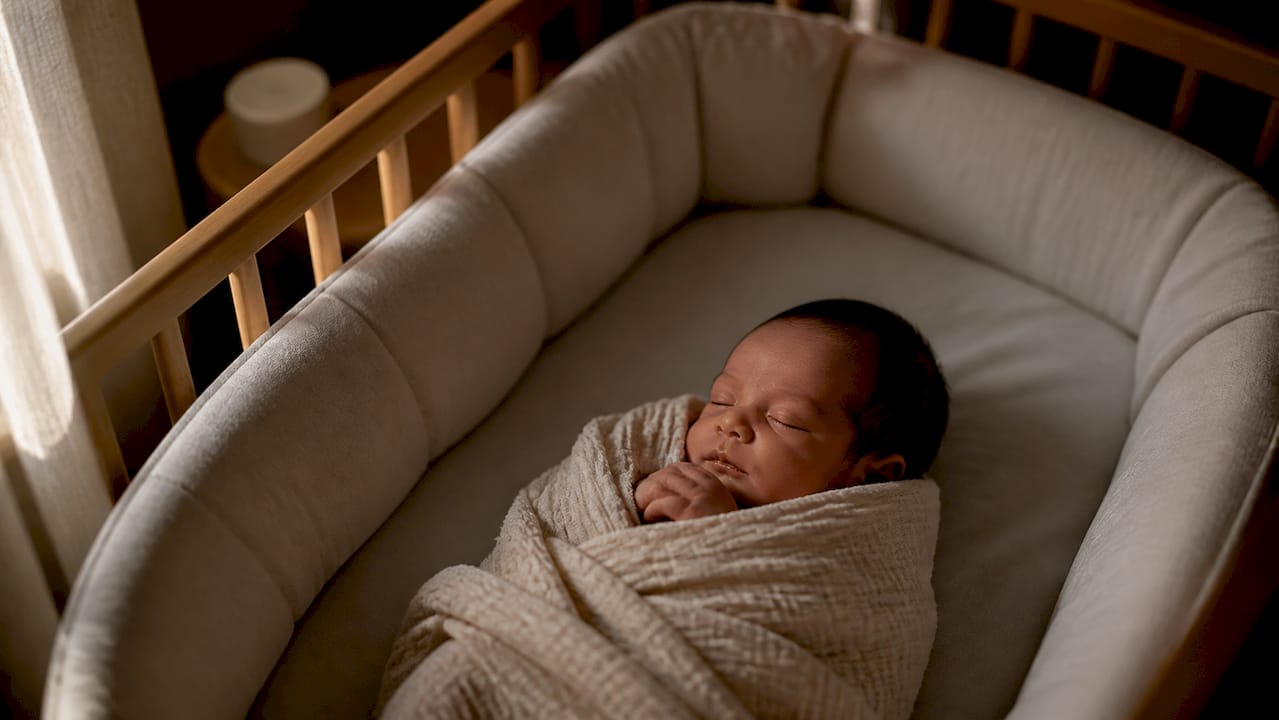
3 to 6 months. This is typically when a predictable short bedtime routine starts paying off, and when many families begin gentle responsive settling. A sample 10-minute routine: bath or wipe-down, pajamas, a short book, dim the lights, into the crib awake but drowsy. Watch wake windows, usually 1.5 to 2.5 hours by 5 to 6 months, since an overtired baby fights sleep harder than a well-timed one.
6 to 12 months. Night sleep typically consolidates during this window, and this is where most structured methods, from bedtime fading to graduated extinction, tend to start if a family chooses to use them. Reinforce an earlier bedtime, INSIGHT trial data links bedtimes around 8 pm with longer night sleep, and lean into self-soothing over feeding to sleep where age and pediatric guidance allow. A 12 to 15 minute routine works well: bath, feed (moved earlier in the sequence rather than right before crib), book, song, into the crib awake.
12 to 18 months. Expect a possible sleep regression tied to separation anxiety, walking milestones, or teething. The routine that worked at 9 months may suddenly meet resistance. Keep the sequence predictable, add a consistent goodbye phrase, and resist the urge to overhaul the whole approach during a regression. Most regressions resolve within several weeks with steady routines rather than method changes.
A general checklist across all stages:
- Keep the sequence identical every night, order matters more than content.
- Move feeding earlier in the routine once your baby is developmentally ready to separate feeding from falling asleep.
- Watch wake windows, not just the clock, to avoid the overtired spiral.
- Expect regressions around 4, 8 to 10, and 12 to 18 months, and treat them as temporary, not a sign your method failed.
A detailed bedtime routine guide can help you build a sequence specific to your baby's stage, and Mellow Kids' developmental milestone resources explain why certain ages line up with regressions in the first place.
Can You Co-Sleep and Still Sleep Train?
Room-sharing and bed-sharing aren't the same decision, and that distinction matters for how you approach training. Room-sharing, your baby in a separate crib or bassinet in your room, is what the American Academy of Pediatrics recommends for at least the first six months as a SIDS-risk reduction measure. Bed-sharing carries different safety guidance and is a separate conversation entirely from anything covered here.
Co-sleeping in either form changes the mechanics of sleep training, mainly because your presence is already the sleep association you're working with or against. Families moving toward independent sleep usually do better with a gradual approach: start by having your baby fall asleep in their own space for naps before tackling nighttime, then introduce a transition object or consistent phrase that travels with them from your room to their own.
A realistic stepwise plan:
- Weeks 1 to 2: Move naps to the crib or bassinet while keeping nighttime sleep as is.
- Weeks 2 to 4: Start bedtime in the separate sleep space, staying close by (chair method works well here) as your baby adjusts to the new environment.
- Weeks 4 to 6: Gradually reduce your physical presence at bedtime once your baby is reliably falling asleep in their own space.
Attachment Parenting International's sleep resources frame room-sharing and gentle nighttime parenting as fully compatible with training goals, not obstacles to them. Our guide to moving from co-sleeping to sleep training walks through this transition in more depth if your family is mid-shift right now.
Pro Tip: If your baby has only ever slept next to you, expect the first sleep space transition to take longer than the actual training itself. Budget two full weeks just for that adjustment before you introduce any new method.
Does Better Infant Sleep Improve Parental Mental Health?
Often, yes, and the connection runs in a direction many parents don't expect: better infant sleep tends to precede improvements in parental mood, not just result from a happier household. Chronic sleep deprivation is one of the strongest predictors of maternal stress and depressive symptoms in the first year, and research tracking sleep interventions alongside maternal mood has found reduced depressive symptoms in some trials following improved infant sleep.
That matters for attachment more than it might seem to on the surface. A parent running on four broken hours of sleep has less emotional bandwidth to read cues, respond warmly, and stay patient during the countless small interactions that build security during the day. Sleep isn't separate from attachment. It's often one of the conditions that makes daytime responsiveness sustainable in the first place.
A few things that help during the adjustment period:
- Split night shifts with a partner if possible, even unevenly, so no single adult absorbs every wake-up.
- Lower your daytime standards temporarily. The dishes can wait; the sleep routine can't, not during the two-week window that matters most.
- Pace changes to your own capacity, not a stranger's timeline. A slower method you can sustain beats a faster one that burns you out by night three.
- Watch for signs of persistent low mood beyond ordinary exhaustion, and talk to your pediatrician or a mental health provider if it doesn't lift as sleep improves.
How Mellow Kids Supports Attachment-Friendly Sleep Changes
Mellow Kids builds its guidance around the same principle this article keeps returning to: responsiveness and structure aren't opposites, they're partners, and the right combination shifts as your baby grows. The app tracks developmental milestones alongside sleep patterns, so the routine suggestions you get are matched to where your baby actually is, not a generic age bracket.
That looks like:
- Milestone-linked routine templates that update as your baby moves through regressions, feeding changes, and sleep consolidation windows.
- In-app prompts that flag when a wake window or bedtime shift is likely to help, before frustration sets in rather than after.
- Temperament-aware suggestions that lean toward responsive settling for babies who need more presence and structured options for families ready for faster timelines.
If your baby falls in a specific window right now, Mellow Kids has stage-specific programs for 8 to 10 month-olds, 11 to 14 month-olds, and 15 to 24 month-olds, each built around what's developmentally realistic at that age rather than a one-size timeline.
Editorial Take: What the Research Actually Supports
The loudest voices in this debate tend to treat sleep training as a referendum on how much you love your baby. The evidence doesn't support that framing, and I think continuing to frame it that way does real damage to exhausted parents who are already doing their best.
What the research supports is narrower and more useful: daytime responsiveness drives attachment security, structured nighttime methods don't measurably change that, and the method you choose matters far less than whether you can execute it consistently. That's not a permission slip to ignore your baby's distress. It's a corrective to the idea that any crying at all signals a rupture that needs repairing.
Where I think conventional advice fails parents is in treating "gentle" and "effective" as synonyms. Sometimes the gentlest method for your baby is also the slowest one available, and that's fine if you have the bandwidth for it. But if a three-week timeline is quietly wrecking your mental health, a faster method executed with warmth isn't a betrayal of attachment principles. It's often what makes attachment principles sustainable again.
Prioritize consistency over ideology, then choose the fastest method within your comfort zone rather than the slowest method that sounds most virtuous.
— Mauricio Vargas
Get Age-Specific Sleep Guidance Without the Guesswork
Piecing together sleep advice from forums, books, and well-meaning relatives means constantly translating generic tips into what your specific baby, at their specific age, actually needs this week. Mellow Kids does that translation for you: milestone tracking paired with sleep guidance means the routine and method suggestions you see are matched to your baby's exact developmental stage, not a broad age range that might be months off.

If you've read this far because you're trying to figure out where your baby fits in everything above, that's exactly what the app is built to answer. Explore age-tailored routines, temperament-based method suggestions, and milestone tracking starting at the Mellow Kids app, or head to Start Here if you're not sure which stage-specific program fits your baby right now.
Key Studies and Resources Worth Reading
- Nighttime maternal responsiveness and infant attachment at one year: peer-reviewed research examining how nighttime caregiving relates to attachment security at 12 months.
- Responsive parenting intervention (INSIGHT) and infant sleep outcomes: the randomized trial behind the earlier bedtime and self-soothing findings cited throughout this guide.
- Baby Sleep Strategies — Attachment Parenting International: practical, attachment-aligned guidance on room-sharing and gentle nighttime parenting.
- Responsive settling — Raising Children Network: step-by-step explanation of the responsive settling technique referenced in the methods section.
- Role of Routine for Newborns: 2026 Parent Guide: a supplementary look at why routine matters so much in the newborn stage.
Sources
- Nighttime maternal responsiveness and infant attachment at one year
- Responsive parenting intervention (INSIGHT) and infant sleep outcomes
- Baby Sleep Strategies — Attachment Parenting International
- Responsive settling - Raising Children Network