
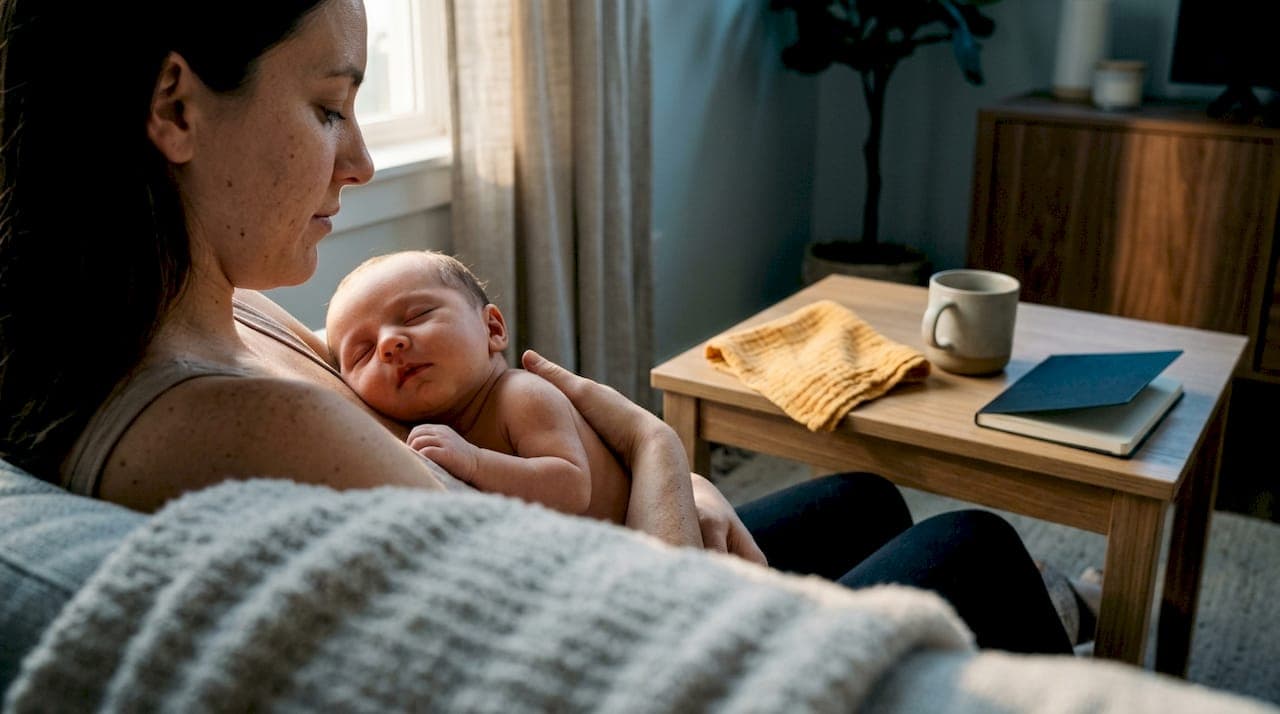
Contact naps are developmentally normal and often the easiest way to get a newborn to sleep at all, but they only stay safe when the caregiver is fully awake and alert for the entire nap. If you are exhausted, move to a firm, flat surface instead of pushing through on a sofa or in a recliner. Reach out to your pediatrician if feeding, weight gain, or breathing ever feels off during or after a contact nap.
TL;DR:
- Caregivers must remain fully awake and alert during contact naps to prevent falls and ensure safety, especially when on soft furniture or recliners.
- Transitioning from contact naps to crib sleep should be gradual, starting with one nap at a time, using consistent routines, and watching for signs your baby is ready.
- Contact naps offer significant benefits for newborn stability, bonding, and breastfeeding, but can cause exhaustion and dependency on contact for sleep.
- Sleep regressions at around 4 and 8 to 10 months can temporarily increase contact naps, which is normal and not a setback if safety rules remain strict.
- Using a baby monitor during contact naps is only helpful once the baby is transferred to a flat sleep surface, not as a substitute for close supervision while on your body.
Table of Contents
- What Is a Contact Nap, and How Is It Different From Bed-Sharing?
- Are Contact Naps Safe? Rules, Risky Situations, and When to Move Baby
- What Contact Naps Actually Do for Newborns (and What They Cost You)
- How Long Do Contact Naps Usually Last, and When Should You Change Course?
- How to Move Naps From Your Arms to the Crib Without a Fight
- A Quick Safety Checklist for Every Contact Nap
- How Mellow Approaches Safe Nap Transitions
- Handling Caregiver Fatigue and Sharing the Load With a Partner
- Sleep Regressions and Contact Naps: What to Expect
- Should You Use a Baby Monitor During Contact Naps?
- Why the "Just Put Them Down" Advice Misses the Point
- Get a Nap Plan Built Around Your Baby's Actual Age
- Sources
- FAQ
What Is a Contact Nap, and How Is It Different From Bed-Sharing?
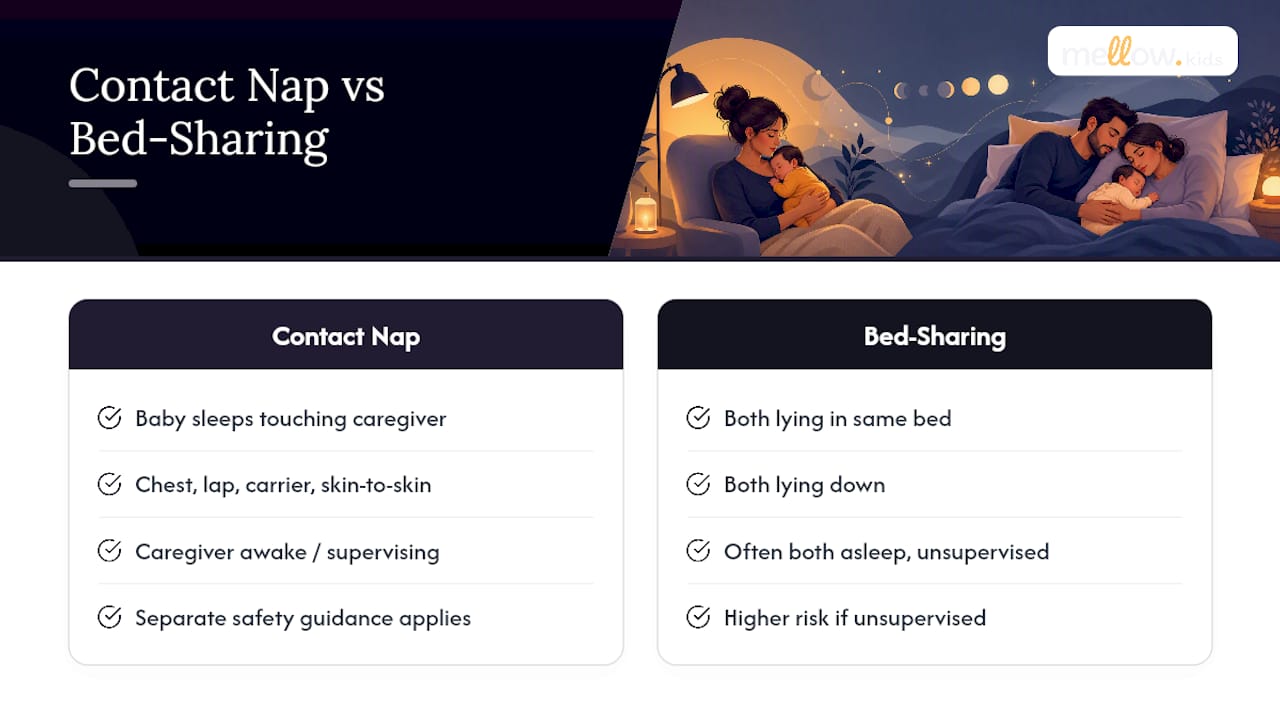
A contact nap is any nap where your newborn sleeps while touching your body: against your chest, on your lap, in a carrier, or skin-to-skin on your bare chest. It is not the same as bed-sharing, where both of you are lying down, often at night, and both may fall asleep unsupervised. That distinction matters because the safety rules are different for each.
The most researched version of a contact nap is skin-to-skin care, sometimes called kangaroo care, where a bare newborn rests directly on a caregiver's chest. This practice started in neonatal intensive care units for premature infants and has since become standard advice for healthy full-term newborns too. Skin-to-skin contact stabilizes a newborn's temperature, heart rate, and breathing, which is part of why it feels so calming for both of you.
Beyond skin-to-skin, most parents experience contact naps in a few familiar forms: the post-feed doze where a baby falls asleep mid-latch and you don't dare move, the frantic 2 p.m. meltdown that only resolves against your shoulder, and the carrier nap that saves a grocery run or a flight. Babywearing for naps falls into this category too, and it's one of the most practical versions because it frees your hands while keeping your baby close.
Newborns lean on contact so heavily because their sleep cycles are still immature. They spend more time in active, lighter sleep than adults do, and they wake easily between cycles. Your heartbeat, warmth, and movement mimic the environment they just left, so contact naps aren't a bad habit forming. They're your baby's nervous system asking for something it isn't yet equipped to provide for itself.
Are Contact Naps Safe? Rules, Risky Situations, and When to Move Baby
Contact naps can be safe, but the safety hinges on one nonnegotiable rule: the caregiver holding the baby must stay awake, alert, and unimpaired for the entire nap. The moment you feel yourself drifting off, the nap needs to end, and your baby needs to go to a firm, flat surface right away.
This rule exists because falling asleep while holding an infant is a documented risk, not a hypothetical one. Hospital incident reports and clinical reviews have found that a substantial share of neonatal falls happen when a caregiver dozes off while holding the baby, and sofas and armchairs show up again and again as the setting. Soft cushions let a baby's face sink in, and a sleeping adult's arms relax exactly when the baby needs them most alert.
Where contact naps become unsafe:
- Sitting or reclining on a sofa, recliner, or armchair, where you could nod off and slump
- Lying down together to nap, since that shifts into unsupervised bed-sharing
- Holding your baby while on medication, alcohol, or extreme sleep deprivation that impairs alertness
- Letting a baby sleep unmonitored in a carrier for an extended stretch without checking positioning
- Napping with the baby's face pressed into your chest, clothing, or a blanket where breathing could be restricted
Standard safe-sleep guidance from the American Academy of Pediatrics acknowledges that skin-to-skin contact is beneficial, but it's clear that a baby's routine, unsupervised sleep should happen on a separate, firm, flat surface, not in your arms overnight or during any nap where you might fall asleep too.
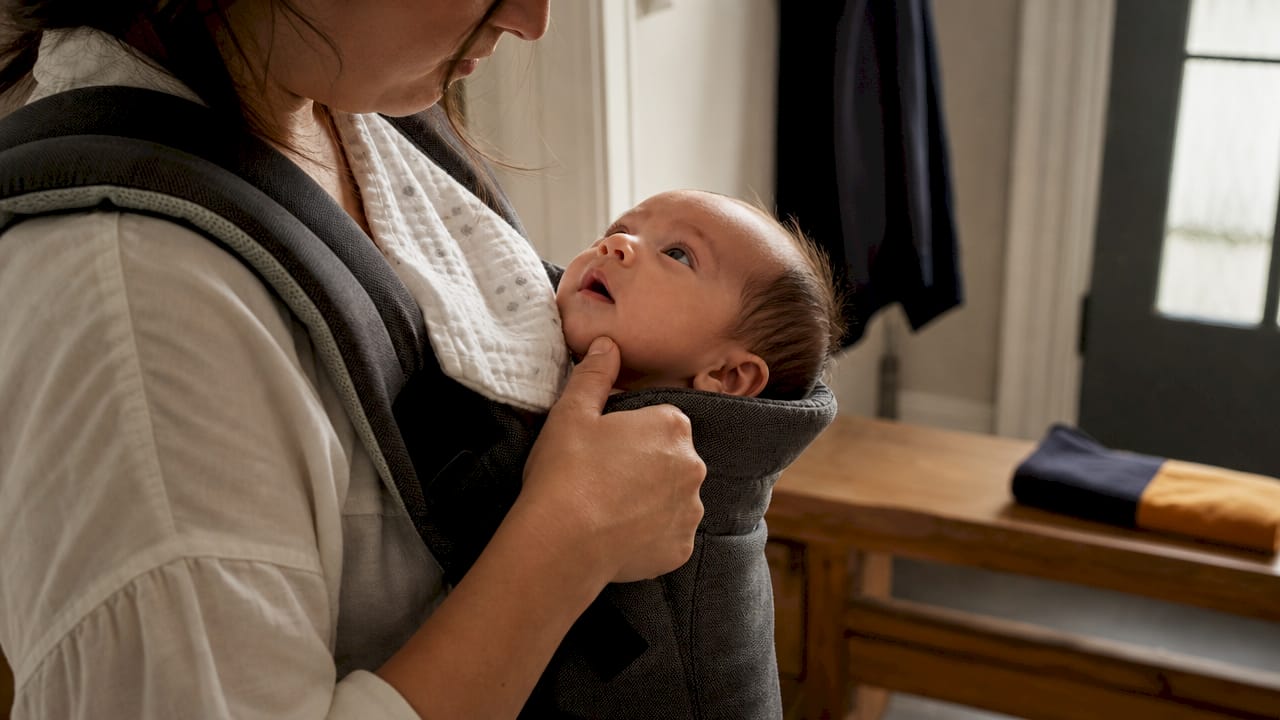
Carriers, strollers, and car seats deserve their own caution. A carrier can be a genuinely useful tool for daytime naps, but it isn't designed as a long-term sleep space. If your baby sleeps while worn, check frequently that the face is visible, the chin isn't pressed to the chest, and the airway is completely clear, then transfer to a bassinet as soon as you reasonably can.
Pro Tip: Set a phone alarm for 20 minutes into any contact nap where you're seated. If the alarm catches you already dozing, that's your signal the nap needs to end now, not after "just five more minutes."
Certain situations call for a pediatrician's input rather than a general safety checklist: premature babies, babies with reflux severe enough to affect breathing, poor weight gain, or any nap that ends with your baby seeming unusually limp, pale, or hard to wake. Those are medical questions, not sleep-routine ones.
What Contact Naps Actually Do for Newborns (and What They Cost You)
Contact naps offer real, measurable benefits for a newborn's body, and they come with a real cost to yours. Both things are true at once, and neither cancels out the other.
The benefits are physiological, not just emotional:
- Better temperature regulation, since your body heat helps a newborn who can't yet regulate their own core temperature well
- More stable heart rate and breathing patterns, documented in studies of skin-to-skin contact in the neonatal period
- Support for breastfeeding, since proximity and skin contact encourage feeding cues and let-down
- Stronger early bonding, which matters for both of you during a stretch that can otherwise feel disorienting
- Often longer, deeper naps than a baby will take alone in a bassinet during those first weeks
The drawbacks land almost entirely on the caregiver. You can't easily eat, shower, answer email, or lie down yourself while your baby is on your chest. Over weeks, that adds up to real exhaustion, and it can leave you feeling physically stuck in one spot for hours at a stretch. There's also a fair question about sleep associations: if contact becomes the only way your baby will nap, every single nap becomes dependent on a person being available and awake.
The research doesn't force you to choose one extreme. Skin-to-skin contact shows clear short-term benefits, and some studies also link it to longer initial sleep episodes and stronger breastfeeding starts, but evidence on whether it shapes long-term sleep habits is still limited. In plain terms: contact naps aren't harming your baby's future sleep, and you don't need to worry that a few weeks of chest naps will haunt you at 18 months. The goal isn't to eliminate contact naps. It's to keep them safe and keep them from becoming the only nap that works.
How Long Do Contact Naps Usually Last, and When Should You Change Course?
Most families see contact naps at their peak in the first few weeks, when a newborn's sleep is disorganized and closeness genuinely helps regulate their system. Many parents start easing away from constant contact naps somewhere between three and six months, though that range is wide for a reason: every baby and every household is different.
There's no fixed deadline that means you're doing something wrong if you cross it. A baby who mostly naps on you at 10 weeks is on a completely normal path. What matters more than the calendar is watching for signals that the current setup has stopped working for your family.
Signs it's time to start shifting the routine:
- You feel constantly behind on basic tasks, or you can't get uninterrupted rest yourself
- Your baby wakes within minutes every time you attempt a crib or bassinet nap
- Feeding schedules are getting harder to track because naps happen unpredictably in your arms
- You're physically depleted in a way that's affecting your mood or your ability to function
Those are family-fatigue signals, and they're valid reasons to start a gradual transition even if your baby seems perfectly happy on your chest. Separately, watch for signals that need a pediatrician rather than a sleep adjustment: poor weight gain, labored or noisy breathing during naps, or a baby who seems unusually hard to rouse or unusually limp. Those symptoms point to a medical conversation, not a scheduling one.
How to Move Naps From Your Arms to the Crib Without a Fight
Transitioning off contact naps works best as a slow handoff, not a cold switch. Newborns and young infants respond to gradual change; an abrupt shift from constant holding to solo crib naps usually backfires into more crying and more resistance, not less.
- Pick one nap to convert first. Choose the nap where your baby seems the most naturally drowsy, often the first nap of the day, and commit to trying the crib there before touching any other nap.
- Build a short, repeatable pre-nap routine. A dim room, a swaddle, white noise, and the same two or three steps every time teach your baby's body to recognize what's coming next.
- Use the wake-and-sleep technique. Get your baby drowsy through your usual method, then set them down while still awake but sleepy, so they practice the last stretch of settling on their own. This gradual practice is one of the more reliable bridges between contact sleep and independent sleep.
- Step your holding down in stages. Move from chest contact to lap contact, then to hovering with a hand resting on your baby's chest in the crib, then to hand withdrawal once they're settled. Each stage removes a little support without removing all of it at once.
- Time the attempt around feeds and sleepy cues, not the clock. A baby who's overtired or under-fed will fight any transfer, no matter how gently you do it.
- Expect setbacks and treat them as normal. A growth spurt, a cold, or a rough week can send you back to more contact naps temporarily. That's not a failure of the method. It's just where you are that week.
Pro Tip: Keep a small piece of your worn clothing, like a soft T-shirt, near your baby's crib. Your scent can substitute for some of the reassurance that skin contact provides, and it costs you nothing to try.
The goal of this sequence isn't to eliminate contact naps overnight. It's to make sure your baby has at least one nap a day that doesn't require a person, so you get a real block of time back, and so naps aren't all riding on your ability to stay awake and available.
A Quick Safety Checklist for Every Contact Nap
Run through this list every time, not just the first few times. Fatigue makes people skip steps they know matter, which is exactly when risk creeps in.
- Your baby's face is fully visible and never pressed into your chest, clothing, or a blanket
- Their chin is off their chest, with the airway in a straight, open line
- You're upright, not reclined, and definitely not on a sofa or in a recliner
- No loose blankets, pillows, or soft bedding anywhere near your baby's face or body
- You're checking in on yourself, not just your baby: if you feel sleepy, the nap ends now
- In a carrier, positioning is tight and upright with the face visible, and you check it every few minutes
One detail from hospital incident data deserves real weight here: reviews of neonatal falls found that caregivers falling asleep while holding infants, particularly on couches and armchairs, is a recurring pattern behind these incidents, not a rare fluke. That single data point is why "just this once on the sofa" is the exact scenario worth avoiding, every time, no exceptions.
If you ever catch yourself drifting, the move is simple and immediate: transfer your baby to a firm, flat, empty sleep surface, on their back, right away. Healthychildren backs this same instruction for any moment positioning or alertness becomes uncertain, and it applies just as much to a five-minute doze as a longer stretch.
How Mellow Approaches Safe Nap Transitions
Generic advice tells you to "just put the baby down." An effective approach to contact naps starts from your baby's actual developmental window instead, because a two-week-old and a five-month-old need very different transition plans even though both are technically doing "contact naps."
A thoughtful plan typically starts by tracking wake windows and current nap patterns, then flags the single nap most likely to succeed in a crib first, based on your baby's age and temperament. From there, the plan builds in one trial crib nap, checks how your baby actually responds over a few days, and adjusts before moving to the next step. That loop of trying, observing, and adjusting matters more than any fixed script, since two babies at the exact same age can respond completely differently to the same method.
This is the same evidence-forward, age-tailored thinking behind resources like Mellow's guide to wake windows by age, which anchors nap timing to your baby's developmental stage rather than a generic clock. Safe-sleep rules stay fixed no matter what. The pacing around them is what should flex to your baby.
Handling Caregiver Fatigue and Sharing the Load With a Partner
Contact naps put a physical ceiling on how much you can get done, and that ceiling gets lower the more tired you are. If you're the only person doing contact naps, fatigue compounds fast, and it becomes harder to notice the exact moment you should hand your baby off or set them down.
Splitting contact naps between two caregivers, when that's an option, isn't just about fairness. It's a genuine safety strategy, since a rested caregiver is a more alert one. Trade off by nap rather than by day, so neither of you carries an entire day's worth of stationary holding. If one of you works outside the home, consider assigning the first nap of the day, when everyone tends to be freshest, to whoever needs it most.
If you're parenting solo or your partner isn't available during the day, build in permission to set your baby down the moment you feel your own alertness slipping, even if that means a shorter nap than you'd hoped for. A 20 minute crib nap that lets you rest safely beats a 45 minute contact nap where you're fighting to stay awake.
Talk through the handoff moments in advance, not in the middle of one. Decide together what signals mean "take the baby now," whether that's a yawn, heavy eyelids, or simply saying it out loud. Removing the need to negotiate in real time, while you're both running on no sleep, prevents the kind of hesitation that turns into an unsafe five extra minutes on the sofa.
Sleep Regressions and Contact Naps: What to Expect
Sleep regressions can make contact naps feel like they've suddenly stopped working, even when nothing about your baby's underlying needs has changed. A baby who napped fine in the crib for two weeks might suddenly refuse anything but your chest during a regression, and that's a normal, temporary shift rather than a step backward in progress.
Common regression windows show up around 4 months, tied to a real change in sleep-cycle structure, and again around 8 to 10 months alongside developmental leaps like crawling or standing. During these stretches, babies often wake more frequently and settle less easily, which naturally pushes families back toward more contact naps simply because it's the fastest way to get anyone any rest.
The most useful response is to let contact naps flex back up temporarily without treating it as a failure of whatever transition plan you were following. Hold steady on the safety rules exactly as strictly as always, since fatigue during a regression is exactly when corners get cut. Once the regression passes, usually within two to six weeks, you can pick the transition plan back up roughly where you left off. Babies don't lose the progress they made before a regression; they just need the support turned back up for a while.
If a "regression" drags on far longer than that window, or comes with other red flags like poor feeding or weight loss, that's worth mentioning to your pediatrician rather than waiting it out.
Should You Use a Baby Monitor During Contact Naps?
A baby monitor adds a genuine layer of reassurance during contact naps, but it cannot replace an alert caregiver watching positioning in real time. Monitors are built to supervise a baby who's alone in a crib or bassinet, not one resting on your body, so their real value during contact naps is different from their usual job.
Audio monitors can help you hear a partner or sibling in another room signaling they need you, letting you stay put with the baby rather than getting up and disrupting the nap. Video monitors, including wearable clip-on versions some parents use while babywearing, can offer a second set of eyes on positioning if you're moving around the house rather than sitting still and watching directly.
Where a monitor genuinely earns its place is the moment you do transfer your baby to a crib or bassinet, whether that's mid-nap because you got sleepy or as part of a planned transition. That's precisely when a firm, flat sleep surface paired with monitoring gives you the most peace of mind, since you can step away for a shower or a task while still keeping an eye on your baby.
Don't let a monitor create false confidence during the contact nap itself, though. No camera or app substitutes for your own hand on your baby's back and your own eyes on their face. Treat a monitor as a tool for the moments your baby is on a flat surface, not as permission to relax your attention while they're on you.
Why the "Just Put Them Down" Advice Misses the Point
Most generic sleep advice treats contact naps as a problem to be solved fast, and that framing does new parents a disservice. The research doesn't support urgency here. It supports safety, and it supports patience.
What gets underestimated is how much contact naps are doing physiologically in those early weeks, not just emotionally. Newborns aren't manipulating anyone by needing to be held. Their systems are still learning to regulate temperature, heart rate, and breathing on their own, and proximity to a caregiver measurably helps that process along. Treating every contact nap as a bad habit to break as fast as possible ignores what the evidence actually shows.
At the same time, I'd push back hard on any framing that treats contact naps as risk-free simply because they're natural. The single rule that matters more than any other piece of advice in this entire topic is caregiver alertness. Everything else, the babywearing, the couch versus the chair, the carrier positioning, is secondary to that one nonnegotiable line. Get that right, and almost everything else becomes a matter of family preference and pacing rather than safety.
If you take one thing from this guide, prioritize building a transition plan that matches your baby's actual age and temperament rather than a generic timeline you saw online.
— Mauricio Vargas
Get a Nap Plan Built Around Your Baby's Actual Age
If contact naps have started feeling less like a phase and more like the only thing keeping your household running, that's exactly the situation Mellow's personalized sleep support was built for. Instead of a one-size-fits-all schedule, Mellow ties every recommendation to your baby's developmental window, so a transition plan for a 6-week-old looks nothing like one for a 5-month-old, and neither leaves safety as an afterthought.

Mellow offers a few ways to get that tailored support depending on how much guidance you need right now. The Personalized Plan (199 EUR one-off) builds a nap and sleep strategy specific to your baby's age and current patterns. If you'd rather talk through your situation directly, the Plan + Consultation (349 EUR one-off) pairs that plan with expert guidance, and a standalone 45-minute consultation (69 EUR one-off) works well if you just need targeted answers to a specific sticking point, like short crib naps or a rough regression stretch.
Persistent short naps, feeding concerns tangled up with nap timing, or plain caregiver exhaustion are all good reasons to bring in outside support rather than troubleshooting alone at 3 a.m. Start by visiting Mellow's personal sleep support page to see which option fits where you are right now.
Sources
For deeper reading beyond this guide, a few sources carry particular weight on contact naps and newborn safe sleep. The American Academy of Pediatrics' safe-sleep and skin-to-skin guidance lays out the core clinical position balancing benefits against risk. HealthyChildren.org's skin-to-skin care pages translate that guidance into parent-facing language.
For the physiology behind why contact naps feel so effective, the kangaroo care review on PMC and the cardiorespiratory stability study on PMC both document measurable newborn benefits. The review of caregiver sleep-related fall incidents is worth reading in full if you want the data behind the sofa and recliner warnings.
This article is general information, not a substitute for advice from a qualified doctor. Consult a qualified healthcare professional about your own circumstances before acting on anything here.
- Kangaroo mother care and skin-to-skin contact: a review (PMC6949952)
- Safe Sleep and Skin-to-Skin Care in the Neonatal Period (AAP patient education / Pediatrics)
- Reports of neonatal falls and caregiver sleep-related incidents (PubMed 37277198)
- Skin-to-skin contact benefits for neonatal stability (PMC7502223)
- Healthychildren
FAQ
Are Contact Naps Okay for Newborns?
Yes, contact naps are okay for newborns and are considered a normal part of the fourth trimester, as long as the caregiver stays awake and alert for the entire nap. The risk isn't the contact itself; it's falling asleep while holding the baby, particularly on soft furniture like sofas and recliners.
How Long Do Newborns Typically Do Contact Naps?
Contact naps are most common in the first few weeks of life, when a newborn's sleep cycles are still disorganized. Many families begin easing toward crib naps somewhere between three and six months, though the exact timing varies widely from baby to baby.
What Is the Hardest Week of the Newborn Period?
There's no single universal "hardest week," but many parents describe the second through sixth weeks as especially demanding, when feeding, sleep, and contact-nap needs are all intense at once and the fourth-trimester adjustment feels most unpredictable. That stretch also tends to be when caregiver fatigue peaks, which is exactly when following the awake-and-alert safety rule matters most.
How Do I Know When to Move a Contact Nap to the Crib?
Signs it's time include caregiver burnout, a baby who wakes almost instantly on a flat surface, or feeding schedules that are getting harder to track. Starting with one crib nap per day and using a gradual method, like the wake-and-sleep technique, tends to work better than switching all naps at once.
Can a Baby Monitor Replace Watching My Baby During a Contact Nap?
No, a monitor cannot replace direct supervision while your baby is on your body; it's meant for babies sleeping alone on a flat surface. Once you transfer your baby to a crib or bassinet, a monitor becomes a genuinely useful extra layer of reassurance.