

Put simply: drowsy but awake means placing your baby in the crib calm, heavy-lidded, and still conscious, not fully asleep, so they get a small chance to practice settling themselves. It helps many infants build self-soothing skills once they're developmentally ready, usually past the newborn stage, but it isn't universal and it isn't magic. Pediatric guidance from Healthychildren and programs like Mellow frame it as a skill you teach gradually, with a Plan B ready for the nights it doesn't click.
TL;DR:
- The success of the drowsy but awake technique depends heavily on timing, with most babies requiring placement during a narrow, developmental window between alertness and sleep.
- Babies under about 4 months generally benefit more from responsive soothing rather than structured settling attempts, which become more effective after 4 months.
- The method is more likely to work if parents wait 60 to 90 seconds after placing the baby down before intervening, allowing for self-settling.
- Consistency and tailoring routines according to the baby’s age, cues, and wake windows significantly improve success rates over rigid or generic schedules.
- Most challenges arise from mistimed placement, overtiredness, discomfort, or temperament, not from a failure of the technique itself.
Table of Contents
- What Does Drowsy but Awake Actually Look Like?
- Does the Drowsy-but-Awake Method Actually Work?
- When Should You Start, and How Do Wake Windows Help?
- How to Put Your Baby Down Drowsy but Awake, Step by Step
- What to Do When Drowsy but Awake Doesn't Work
- Safe Sleep Rules That Apply No Matter the Method
- A Note on Why This Method Frustrates So Many Parents
- Get a Sleep Plan Built Around Your Baby's Age and Stage
- Where to Learn More
- Sources
What Does Drowsy but Awake Actually Look Like?
Sleepy yet conscious isn't a precise medical state. It's a narrow window between "wide awake and alert" and "already unconscious," and it usually lasts only a few minutes. Miss it, and you're either putting down a baby who protests because they're not tired enough, or one who's already tipped into overtired and wired.
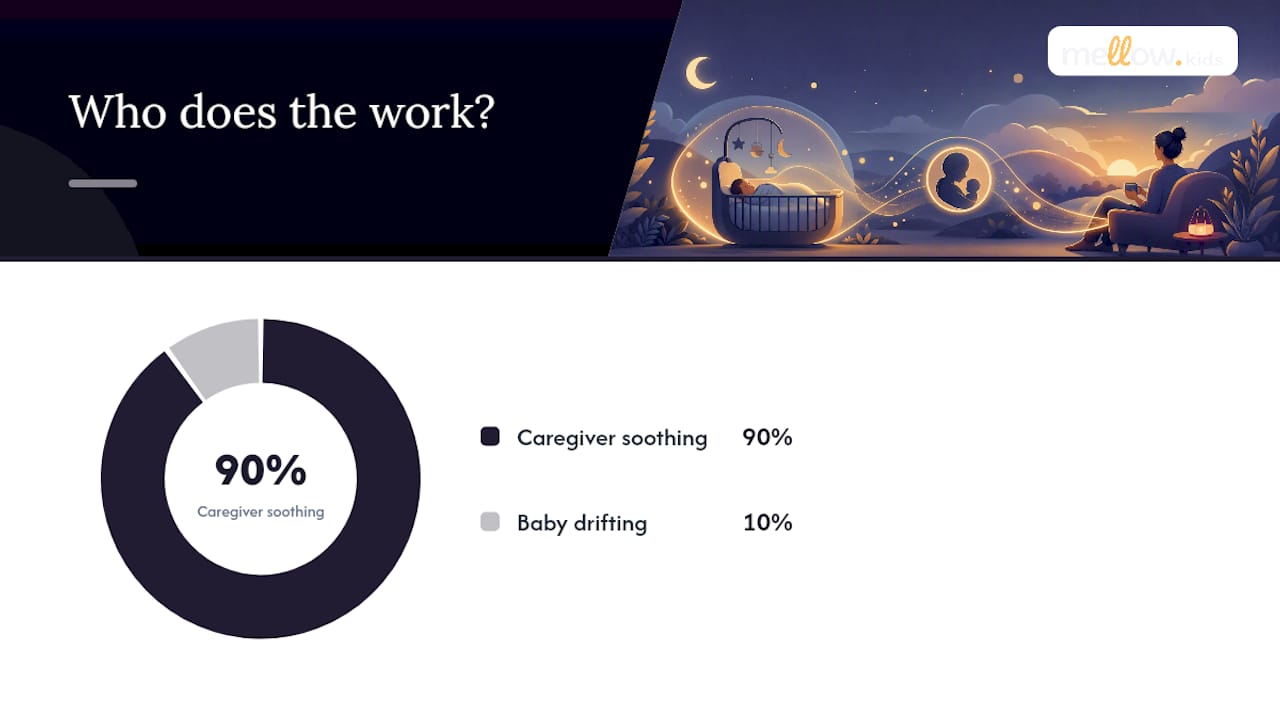
Mount Sinai's Parenting Center describes the method as the caregiver doing most of the soothing work while the baby practices the final step of drifting off, roughly 90 percent parent, 10 percent baby. That framing matters because it removes the pressure to get your child fully calm before they touch the mattress. You're aiming for mostly settled, not silent.
Early sleepy cues tend to be subtle, and late ones are impossible to miss:
- Early cues: slower blinking, reduced eye contact, quieting down, staring blankly, pulling at an ear, or a slight glassy look.
- Late (overtired) cues: arching the back, crying that escalates fast, rubbing eyes hard, jerky arm movements, or a second-wind burst of fussy energy.
Temperament changes the picture too. A laid-back baby might show a long, easy drowsy window. A more intense or colicky infant might swing from alert to screaming in under a minute, with barely a warning sign in between. Watching your own baby for a few nights, rather than following a generic checklist, tells you more than any chart. Our guide to newborn sleepy cues breaks down what those signals look like at different ages.
Does the Drowsy-but-Awake Method Actually Work?
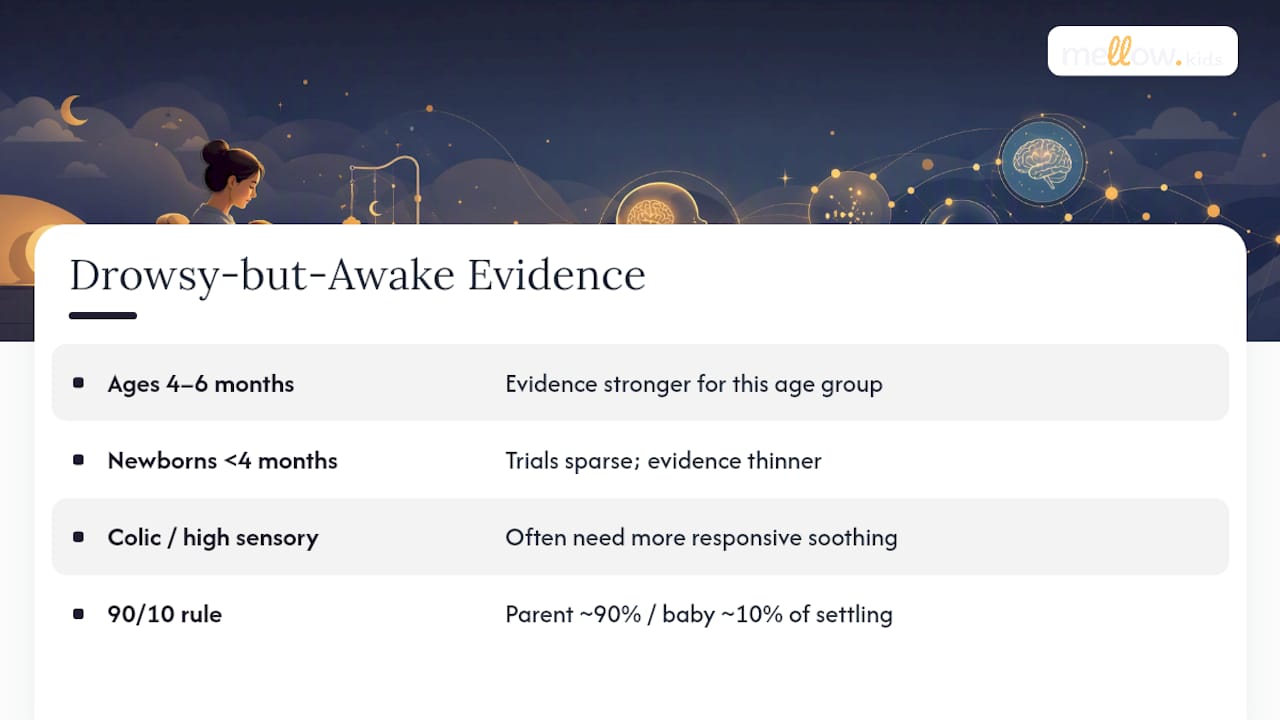
The honest answer: it works for many babies, but the evidence is stronger for some ages than others. A review published by The Conversation found that sleep-training approaches, including putting infants down tired but awake, can improve settled sleep and parental well-being. Most of that research centers on babies around 4 to 6 months and older. Trials specifically testing the technique in newborns are much thinner on the ground.
The reason it helps: association, not obedience. Babies who fall asleep only while nursing, rocking, or being held tend to need that same input every time they wake between sleep cycles, which is normal and happens several times a night for everyone. A baby who has practiced falling asleep independently in the crib has more tools to resettle without a full wake-up call to a caregiver.
The 90/10 rule: Mount Sinai's clinicians describe the method as the parent handling roughly 90 percent of the soothing, feeding, dimming lights, rocking briefly, while the baby practices only the last 10 percent, the actual drift into sleep. That framing exists specifically so parents don't feel they've failed if their baby still needs help getting most of the way there.
Where the evidence gets thinner: newborns under about 4 months and infants dealing with colic or high sensory needs. Clinical critiques of the approach point out that these babies often do better with more responsive soothing early on, with independent settling attempts introduced later. If your baby falls into that group, slower isn't failure. It's appropriate pacing.
When Should You Start, and How Do Wake Windows Help?
Timing determines success more than technique does. A baby put down five minutes too late is often a baby who's already overtired, and no amount of technique fixes that once the cortisol spike hits.
Here's the general age-based picture:
- Newborn (0 to 6 weeks): Focus on responsive comfort, not independent settling. The drowsy window exists but is unpredictable, and most guidance discourages structured sleep training this early.
- 6 weeks to 4 months: You can start noticing and naming the drowsy window, but expect wide variability night to night.
- 4 to 6 months and beyond: This is where most sleep-training research clusters, and where readiness for structured settling tends to solidify.
Wake windows, the stretch of awake time between sleep periods, give you a rough map. A 2 month old might handle 60 to 90 minutes awake before needing sleep again; a 6 month old might stretch to 2 to 3 hours. Watching the clock alongside your baby's cues, rather than either alone, catches the drowsy window more reliably.
Once your baby is down, resist the urge to intervene at the first squirm. Waiting 60 to 90 seconds, sometimes up to 2 to 3 minutes, before you check in gives your baby a real chance to self-settle rather than escalate a normal transition noise into a full wake-up.
How to Put Your Baby Down Drowsy but Awake, Step by Step
Struggling to stay awake yourself at 8 PM while trying to get this right? You're not alone. Here's a routine you can actually follow tonight.
Before you start:
- Run a quick safe-sleep check: firm mattress, no loose blankets, no pillows, back-sleeping position.
- Begin a short wind-down, 10 to 20 minutes of dim lights, a feed if it's due, and one calm activity like a book or quiet song.
- Watch for early sleepy cues rather than the clock alone, though the two together work best.
At the crib:
- Soothe your baby to roughly 90 percent calm, not fully asleep, using whatever combination of rocking, feeding, or holding gets them there.
- Place your baby down on their back while they're still awake but heavy-lidded.
- Step back and pause. Give it 1 to 3 minutes of quiet observation before deciding whether to intervene, a technique What to Expect describes as one of the most useful bedside tools for new parents.
- If fussing escalates rather than settles, offer graduated support: a hand on the chest, a soft shush from the doorway, or a brief pick-up-put-down before trying again.
Three sample routines by age:
Newborn (0 to 8 weeks): Feed, swaddle if your pediatrician approves, rock until nearly asleep, place down. Expect to finish the last stretch yourself most nights, and that's appropriate for this age.
2 to 4 months: Feed earlier in the wind-down rather than right before crib time, dim lights, short song, place down drowsy, pause 60 to 90 seconds before responding.
4 to 6 months: Full wind-down with bath or book, feed, place down clearly awake but calm, pause 2 to 3 minutes, use graduated check-ins if needed rather than immediate pick-up.
Pro Tip: Consistency beats perfection. Trying the same sequence, feed, dim, song, crib, most nights teaches your baby's brain to recognize the pattern faster than any single "perfect" attempt ever will.
For babies already past the newborn stage, our piece on teaching independent sleep walks through how to fade your involvement gradually rather than all at once.
What to Do When Drowsy but Awake Doesn't Work
Most failed attempts trace back to one of a handful of causes: mistimed placement (too late, into overtired territory), hunger sneaking in before the next feed, an early cold or teething discomfort, or simply a temperament that needs more scaffolding right now. Overtiredness in particular creates a wired-but-exhausted state that makes falling asleep harder, not easier, which is why pushing through a late bedtime almost always backfires.
When a specific night isn't working, a few Plan B options keep things humane without abandoning the goal entirely:
- Responsive settling: pick up briefly, calm to baseline, place back down, repeat as needed.
- Camping out: sit near the crib, offering voice or touch without full pick-up, fading your presence over several nights.
- Earlier bedtime: shift the whole evening 15 to 30 minutes earlier if overtiredness is the recurring pattern.
- Short holding session: for colicky or high-need infants, a few minutes of holding before another settling attempt often works better than repeated failed placements.
If nothing is working after a genuine week of consistent effort, pause the approach entirely rather than grinding through nightly frustration. Some babies, especially colicky ones, simply aren't ready yet, and waiting a few more weeks tends to work better than forcing it.
Safe Sleep Rules That Apply No Matter the Method
Any settling technique has to sit inside safe-sleep basics, no exceptions. The American Academy of Pediatrics recommends:
- Always place babies on their back, on a firm, flat surface.
- Keep the crib bare: no pillows, blankets, bumpers, or stuffed animals.
- Room-share without bed-sharing for at least the first 6 months.
- Keep the room at a comfortable temperature and avoid overdressing.
None of this changes because you're practicing drowsy but awake. If your baby is young enough to need overnight feeds, don't skip or delay them to force a settling attempt. Feeding schedules come first; self-soothing practice happens around them, not instead of them. Mellow's approach to sleep guidance is built on this same order of priorities: safety and nutrition first, skill-building second. Our safe sleep guide for newborns covers the full checklist in more depth.
A Note on Why This Method Frustrates So Many Parents
Here's what gets lost in most advice on this topic: drowsy but awake was never meant to work every single night, and treating a rough patch as proof that "it doesn't work" misses the point entirely. The 90/10 framing exists precisely because most nights will lean more toward 90 than most parents expect, and that's not failure, it's just where your baby is developmentally right now.
What frustrates parents most isn't the technique itself. It's the assumption baked into a lot of sleep advice that consistency should produce results within days. Some babies take two weeks. Some take two months. Some, particularly colicky infants, aren't ready until the colic itself resolves, and pushing the method during that window usually just adds stress for everyone in the house.
Give yourself permission to adapt the routine to your specific baby rather than the other way around. If you want a more structured, age-specific version of this rather than piecing it together from general advice, that's exactly the kind of tailored planning worth exploring.
— Mauricio Vargas
Get a Sleep Plan Built Around Your Baby's Age and Stage
Generic advice treats a 6 week old and a 6 month old the same way, and that's usually where drowsy-but-awake attempts stall. Age-stage plans can adjust wind-down routines, wake windows, and settling techniques as your baby's development shifts, so you're not reapplying newborn advice to a baby who's outgrown it.

Apps can track feeding, naps, and developmental milestones alongside sleep, so you can see patterns instead of guessing why last night went sideways. If your baby is between 8 and 10 months and still resisting independent settling, the 8 to 10 months plan walks through age-appropriate adjustments. For a broader starting point, visit the Mellow app and try a free plan to see how a tailored routine compares to general guidance.
Where to Learn More
For deeper reading beyond this guide, a few sources stand out. HealthyChildren.org covers the full AAP safe-sleep checklist in detail. Mount Sinai's Parenting Center offers a clinician's framing of the 90/10 soothing split. For the research angle on effectiveness and age limits, The Conversation's review is worth the full read. On building consistent evening structure, the routine guide from Baby Bare Essentials adds practical detail on why newborns respond to predictable patterns even before they can follow a clock.
Sources
- Why are parents told to put their baby to bed ‘drowsy but awake’? Does it work? — The Conversation
- Drowsy but Awake | Mount Sinai Parenting Center
- A Parents' Guide to Safe Sleep — HealthyChildren (American Academy of Pediatrics)
- How Do You Actually Put Your Baby Down Drowsy but Awake? — What to Expect