
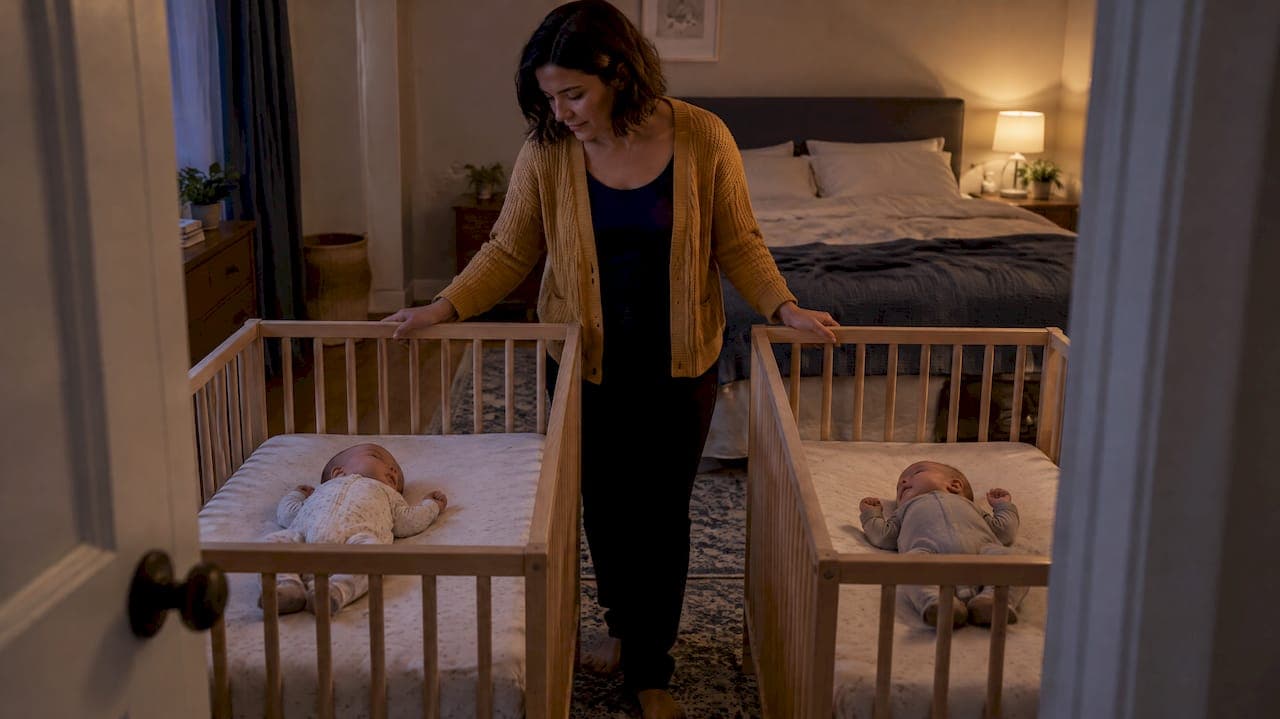
Tonight's move is simple: sync your twins' daytime cycles, put each baby on a separate, flat sleep surface, and commit to one consistent training method instead of improvising. Follow AAP safe-sleep basics first, since behavioral sleep methods have research support for easing night wakings. A starter plan follows below.
TL;DR:
- Newborns often manage only 45 to 60 minutes awake, while babies around 6 to 12 weeks may reach 60 to 90 minutes; adjust naps accordingly.
- A randomized trial found graduated extinction and bedtime fading shortened settling and reduced night wakings, with no adverse attachment outcomes measured at 12 months.
- Place separate cots beside each other, and use one white noise machine per crib to reduce waking when a sibling stirs.
- The AAP recommends room sharing for at least the first six months, with pillows, blankets, bumpers, and toys kept out of both cribs.
- Consult a pediatrician before training if either twin was premature, gains weight slowly, has sleep breathing concerns, or needs medical monitoring.
Table of Contents
- How to sync both twins' cycles and why it unlocks sleep training
- Practical sleep-training methods and how to adapt each for twins
- Non-negotiable AAP-aligned safe-sleep rules for twins before and during training
- How to set up the sleep space to reduce cross-waking and support training
- A compact night-by-night starter plan parents of twins can follow
- Quick fixes for the most likely twin-specific setbacks
- Research summary and clear red flags for professional help
- A note on twin temperament and what actually helps parents cope
- How Mellow Kids can help you build a plan that fits your twins
- FAQ
- Sources
How to sync both twins' cycles and why it unlocks sleep training
Twins who drift onto different schedules make every nap and bedtime a negotiation. The fix most families swear by: when one twin wakes for a daytime feed, gently wake the other too, even if it feels counterintuitive. Keeping both babies on the same feed-wake-sleep rhythm is a core strategy highlighted by Twins Trust, and it is the single change that makes the rest of training possible.
Wake windows shift quickly as babies grow:
- Newborns typically tolerate 45 to 60 minutes awake before overtiredness sets in.
- Babies around 6 to 12 weeks often stretch to 60 to 90 minutes.
- Older babies may manage longer stretches between sleeps.
A twin nursing pillow or pre-measured bottles staged on a nightstand can shave real minutes off a tandem feed, which matters when you are racing the clock before one baby melts down. Coordinating feeds this way is also something Healthychildren points to as a way to support more predictable sleep cycles.
Pro Tip: Feed the hungrier twin first at night, then top off the second; it keeps both feeds roughly equal in length without one baby waiting too long.
Practical sleep-training methods and how to adapt each for twins
No single method is required, but picking one and sticking with it beats switching strategies every few nights. Each of these can work with two babies in the room.
- Chair method: One parent sits near the cribs, gradually moving farther away over several nights; with twins, either parent covers both babies from one seat, or two caregivers take turns on alternating nights.
- Timed checks (graduated extinction): You check in at set intervals, offering brief verbal comfort without picking up; stagger your checks slightly between babies so you are not hovering over both at once, and use a monitor to judge which twin needs you first.
- Pick-up, put-down: You lift a crying baby, soothe briefly, then return them to the crib awake; this suits higher-need babies but takes more stamina with two, so many parents assign one twin per caregiver on tough nights.
- Graduated extinction: A randomized controlled trial found this approach, along with bedtime fading, reduced the time it took babies to fall asleep and cut night wakings, with no adverse attachment outcomes at the 12-month follow-up. With twins, run it consistently for both babies on the same schedule so one isn't being comforted while the other cries alone.
Non-negotiable AAP-aligned safe-sleep rules for twins before and during training
Before you touch a training method, the sleep setup itself has to be safe. The American Academy of Pediatrics recommends room-sharing on separate sleep surfaces for at least the first six months, and this applies just as firmly to twins as to single babies. Bed-sharing and crib-sharing (sometimes called cobedding) are discouraged because they raise suffocation risk, even for siblings who seem to settle better touching each other.
The AAP recommends flat, non-inclined sleep surfaces, so choose a safe sleep surface for each twin.
Run through this checklist before night one:
- Both babies sleep on their backs, on separate firm, flat surfaces.
- No pillows, blankets, bumpers, or stuffed animals in either crib.
- Dress each baby for room temperature rather than piling on blankets.
- A pacifier at sleep times is fine and may offer added protection.
- A monitor helps you respond faster, but it is not a substitute for a safe crib setup.
Our guide to safe sleep for newborns walks through these basics in more depth if you want a refresher before you start.
How to set up the sleep space to reduce cross-waking and support training
Twins sharing a room will wake each other occasionally, but smart placement cuts down how often. Side-by-side cribs with a small gap, or a low divider between them, let both babies sense their sibling's presence without one's thrashing jostling the other's mattress. The NHS specifically recommends separate cots placed next to each other over shared surfaces.
- Run one white-noise machine per crib rather than a single unit for the whole room, so each baby's sound buffer travels with them.
- Blackout curtains help naps stick, especially as babies become more aware of daylight.
- Stage diapers, a spare swaddle, and feeding supplies within arm's reach so night checks stay quiet and quick.
Pro Tip: Point each white-noise machine toward its own crib instead of the room's center; it masks a sibling's fussing more effectively than one shared speaker.
A compact night-by-night starter plan parents of twins can follow
A consistent plan gives both babies time to adjust without you second-guessing the method every night.
- Start: Use the same bedtime routine for both twins, coordinate daytime feeds and sleep, and apply one chosen method consistently at naps and bedtime.
- Continue: If you are using timed checks, gradually lengthen the intervals. Keep daytime naps and feeds on a consistent schedule.
- Adjust as needed: Watch for longer stretches between wakings, faster settling, and less overlap in crying. Keep tracking sleep patterns so you can spot changes early.
Daytime habits matter as much as the nighttime method: tandem feed on the same clock, get both babies some daylight exposure in the morning, and make sure the last feed before bed is a full one. Some families notice a shift relatively quickly, while other twins take longer.
Quick fixes for the most likely twin-specific setbacks
Expect a few bumps. Here is how to handle the common ones without abandoning the plan.
- Babies keep waking each other: Try short-term nap separation in different rooms, stagger bedtime slightly, or shift the cribs farther apart for a few nights.
- One twin resists while the other adapts fast: Keep the shared daytime schedule intact, but allow small, temporary soothing exceptions for the slower adapter rather than scrapping the whole plan.
- Teething or a cold hits mid-training: Rough nights can happen. Pause graduated checks temporarily, comfort as needed, and resume the method once the illness passes.
Research summary and clear red flags for professional help
The evidence on behavioral sleep methods is reassuring. Beyond the graduated extinction trial mentioned earlier, a randomized controlled trial of a cognitive-behavioral group intervention found that a short teaching session plus follow-up support calls reduced parent-reported severe sleep problems and improved parental mood, fatigue, and sleep quality.
Graduated extinction and bedtime fading reduced sleep latency and night wakings with no significant differences in attachment at follow-up.
Randomized controlled trial, PubMed
Contact your pediatrician before starting, or pause training, if either twin was born prematurely, is gaining weight slowly, shows breathing concerns during sleep, or has another medical condition that needs monitoring. If you have tried a method consistently without seeing a change, consider seeking extra support.
A note on twin temperament and what actually helps parents cope

Twins are not interchangeable, even when they share a birthday. One baby might settle in minutes while the other needs the full chair-method taper, and that gap in temperament is normal rather than a sign you are doing something wrong. The instinct to apply identical pressure to both babies on an identical timeline often backfires: a slower-adapting twin needs the same bedtime and the same safe-sleep basics, but not necessarily the same pace through a method's later stages.
What we see matter just as much as the method itself: involve your partner or a grandparent in the routine early, so the babies associate the wind-down steps with more than one caregiver, and protect your own rest wherever you can. Sleep training twins is a two-person job most nights, and burnout undoes consistency faster than any bad night does.
— Mauricio Vargas
How Mellow Kids can help you build a plan that fits your twins

Every twin household has its own logistics, from feeding setups to who handles which 2 AM wake-up, and a generic schedule rarely fits both babies equally well. Our Personalized Plan, Plan + Consultation, and standalone consultation are built around your twins' actual ages and temperaments rather than a one-size template.
- A consultation walks through your current routine and adapts a method to each baby's needs.
- You get a concrete troubleshooting path for the setbacks that come up mid-week.
- Our mini-guides offer a lighter starting point if you want quick, age-specific strategies first.
If you want hands-on help turning this plan into something that fits your household, explore personal sleep support and book a consultation.
FAQ
How to get twin babies to sleep through the night?
Sync their daytime feeds and wake windows so both babies run on the same internal clock, then apply one consistent training method at bedtime for both, as outlined in the role of routine for newborns guide. A randomized trial found that graduated extinction or bedtime fading reduced the time it took babies to fall asleep and cut night wakings.
Is it too late to sleep train a 2.5 year old?
No, toddlers can still learn new sleep habits, though the approach shifts toward verbal explanations, a consistent bedtime routine, and tools like a reward chart rather than infant-style checks. Consistency matters more than the exact method at this age.
What is the 10 5 3 2 1 rule for sleep?
This is a general wind-down framework some families use, designed mainly for adults rather than infants or toddlers. It is not a pediatric sleep-training guideline, so it does not directly apply to twin sleep schedules.
What is the hardest night with a newborn?
There is no single "hardest night" that applies to every baby, but many parents describe the early weeks before a feeding and sleep rhythm forms as the toughest stretch, especially with two newborns waking on different schedules. Coordinating feeds, as Twins Trust suggests, may help ease this period.
Sources
- Safesleep
- Behavioral Interventions for Infant Sleep Problems: A Randomized Controlled Trial
- A randomized controlled trial of an intervention for infants’ behavioral sleep problems - PMC