
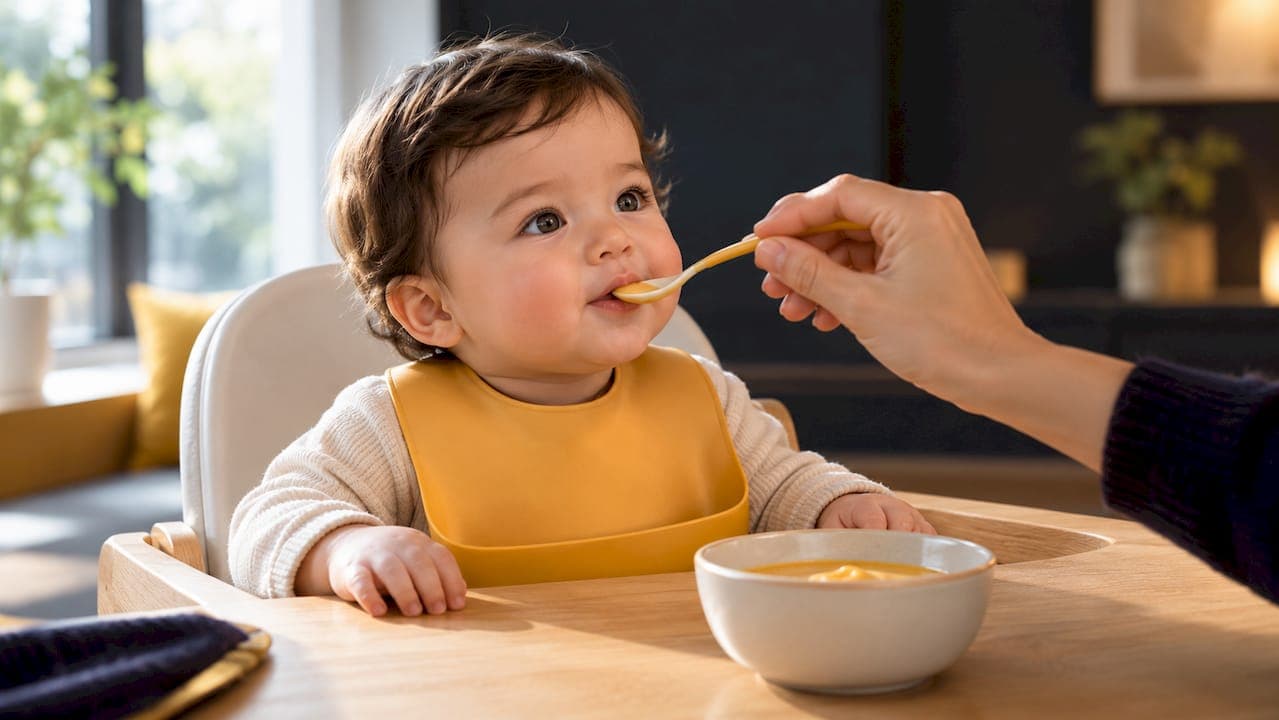
Starting solids can produce a small average improvement in nighttime sleep for some infants, but the effect is modest and inconsistent across studies. The strongest randomized trial found gains that peaked around 6 months, worth roughly 16.6 extra minutes of sleep per night in babies who followed the feeding protocol closely. That's not a guaranteed fix. If you're considering solids partly for sleep, start for nutrition first, watch readiness cues, and track changes over a week or two rather than expecting an overnight transformation.
TL;DR:
- Early introduction of solids can lead to small sleep improvements, with about 16.6 additional minutes of sleep at 6 months in closely followed protocols.
- Most studies show no consistent link between feeding timing and sleep duration; individual responses and parental sleep practices heavily influence results.
- The benefits of solids on sleep depend on adherence and individual factors, not just the age or decision to start solids, so expectations should be modest.
- Introducing solids around 6 months based on developmental readiness signs minimizes risks and aligns with most official guidance.
- Iron-rich first foods are most likely to influence sleep by preventing iron deficiency-related sleep disruptions, rather than increasing calorie intake.
Table of Contents
- What the Research Shows About Solids and Sleep
- How to Try Solids for Sleep: A Safe Step-By-Step Plan
- When Should Babies Start Solids, and What Does Readiness Look Like?
- Which Foods and Nutrients Actually Matter for Sleep
- Why Do Studies Disagree on Solids and Sleep?
- Sleep Got Worse After Starting Solids: What's Going On?
- How Mellow Turns This Research Into a Personal Plan
- A Note on Managing Expectations Around Solids and Sleep
- Get Personalized Help With Feeding and Sleep Changes
- Key Studies and Guidance Worth Reading Next
- Sources
- FAQ
What the Research Shows About Solids and Sleep
The single most rigorous piece of evidence on solids and sleep comes from a secondary analysis of the EAT trial (Enquiring About Tolerance), a large randomized clinical trial originally designed to study food allergy prevention. Researchers randomized infants to either early introduction of allergenic solids starting at 3 months, alongside breastfeeding, or to standard introduction closer to 6 months. Sleep wasn't the trial's original focus, but the data turned out to say something useful for tired parents everywhere.
Infants in the early-introduction group slept better on average. In the per-protocol analysis, meaning babies whose families actually followed the early feeding schedule as assigned, the sleep benefit peaked at 6 months with about 16.6 more minutes of nocturnal sleep per night. Across the full intention-to-treat group, which includes families who didn't strictly follow the protocol, the average gain was smaller but still present. Parents in the early-solids group also reported fewer night wakings and fewer cases of what researchers classified as "very serious" sleep problems.
That gap between the two numbers matters more than either number alone. Adherence changed the outcome substantially. Babies who got the full early-feeding protocol slept meaningfully better than babies who were assigned to it but didn't follow through consistently. This tells you something practical: if solids are going to move the needle on sleep at all, consistency in how and when you offer them probably matters as much as the decision to start.
Here's where it gets more complicated. A systematic review pulling together 21 studies and more than 6,225 infants found something far less tidy. Most of the studies it examined reported no consistent association between the timing of complementary feeding and infant sleep duration under 12 months. Breastfeeding status showed mixed results, too, sometimes linked to more night wakings, sometimes to fewer, depending on the infant's age and the study's design.
Why the disconnect between one strong trial and a pile of murkier studies? Methodology. Most of the observational research relied on parent-reported sleep logs and retrospective recall of feeding timelines, both of which are notoriously imprecise. A parent exhausted at 3 a.m. is not a reliable data-logging instrument, and asking someone to recall exactly when they introduced pureed carrots six months ago invites error. The EAT trial's strength is that it randomized the exposure and tracked it prospectively, which is why its findings carry more weight than any single cohort study.
Cohort data add another layer. The nationwide ELFE cohort study in France tracked infant feeding and sleep at 1 year and found that breastfeeding past 6 months was sometimes associated with shorter nighttime sleep or more wakings. But once researchers adjusted for parental sleep-related practices, like feeding a baby to sleep or staying in the room until the baby drifted off, some of that association shrank. In other words, part of what looked like a feeding effect was actually a parenting-practice effect.
Here's the pattern across all this research, boiled into plain terms:
- A large randomized trial shows a real, small average benefit for early solids, with sleep gains peaking around the 6-month mark.
- Adherence to a feeding protocol influences how much that benefit shows up for an individual baby.
- Systematic reviews of dozens of smaller studies mostly find no consistent link between feeding timing and sleep duration.
- Breastfeeding status shows inconsistent associations with sleep that shift depending on infant age and study design.
- Parental sleep habits, like feeding to sleep or room-sharing, often confound the picture and deserve just as much attention as feeding choices.
The average effect is small, and it is not universal. A group-level finding of "16 more minutes of sleep" describes what happened on average across hundreds of babies. It does not describe what will happen to your baby. Some infants in the EAT trial slept substantially better after early solids. Others showed no change at all. If someone tells you starting solids will fix your baby's sleep, they're overselling a modest, inconsistent finding as if it were a guarantee.
Sleep itself is influenced by far more than calories in a highchair. One consistent theme across the research is that sleep is multifactorial. Developmental stage, sleep associations (how a baby learns to fall asleep), room environment, and daytime nap timing often carry more weight than what's on the spoon at dinner. Solids can be one lever among several, not the lever.
How to Try Solids for Sleep: A Safe Step-By-Step Plan
If you're weighing whether to introduce solids partly in hopes of better sleep, treat it as one input in a larger plan rather than a standalone fix. Here's how to approach it without rushing your baby past what their body is ready for.
Step 1: Confirm readiness before you confirm age. Calendar age matters less than developmental signals. Look for your baby sitting with minimal support, holding their head steady and upright, and losing the tongue-thrust reflex that used to push solid objects back out of their mouth. Most pediatric guidance advises against starting before 4 months for any infant, with many organizations, including the World Health Organization, recommending closer to 6 months as the general target.
Step 2: Start slow during the first week. Offer a single new food once a day, in a small spoonable amount, ideally earlier in the day rather than right before a nap or bedtime, so you can watch for any digestive reaction without it colliding with sleep. A reasonable starter week looks like this:
- Days 1 to 2: iron-fortified infant cereal or a single-ingredient iron-rich puree, one to two teaspoons.
- Days 3 to 4: same food, slightly larger portion, to confirm tolerance before adding variety.
- Days 5 to 6: introduce a second single-ingredient food, like mashed avocado or sweet potato.
- Day 7: assess digestion and appetite before adding a third food.
Step 3: Keep portions modest and expectations modest, too. A 6-month-old's stomach is roughly the size of their fist. Solids at this stage supplement breast milk or formula; they don't replace it. Don't expect a few tablespoons of puree to function like a nightcap.
Step 4: Decide where solids fit relative to bedtime. Some families offer a modest dinner an hour or two before the bedtime routine starts, giving digestion time to settle before lying down. Others find no clear pattern either way. There's no universal rule here, so treat your own baby's response as the deciding data point, not a blog's opinion.
Step 5: Watch for signs to pause or slow down. Increased gas, harder or less frequent stools, or a sudden spike in night wakings after adding a new food are all reasons to hold off on new introductions for a few days. This doesn't mean solids were a mistake. It often means digestion needs a beat to catch up.
Pro Tip: Keep a simple two-week log with three columns: what was offered, when it was offered, and how the night went. Patterns that feel invisible in the moment, like a food that reliably coincides with a rough night, often jump out once they're written down.
For a fuller readiness breakdown and age-by-age expectations, this introducing solids timeline walks through what to expect at each stage.
When Should Babies Start Solids, and What Does Readiness Look Like?
Official guidance is more consistent than the sleep research, which helps simplify the decision. The World Health Organization recommends introducing complementary foods at around 6 months, while other pediatric bodies, including ESPGHAN, allow a window of roughly 4 to 6 months depending on individual readiness. Nobody in mainstream pediatric guidance recommends starting before 4 months.
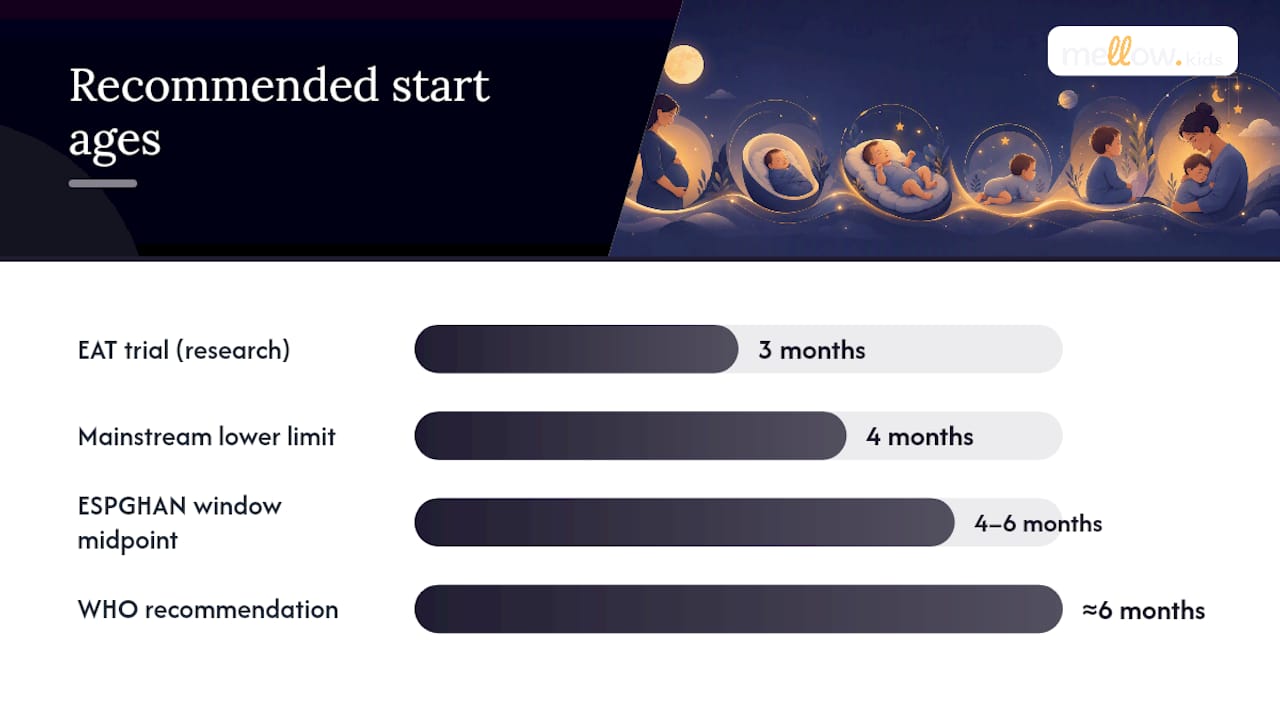
The EAT trial itself introduced allergenic solids at 3 months, which sits earlier than most standard guidance. That detail matters for how you read the trial's results: it was studying a specific, tightly monitored protocol for allergy prevention research, not issuing a general recommendation for all babies to start solids at 3 months. The sleep findings emerged as a secondary result within that context, so parents shouldn't read them as license to start earlier than their pediatrician advises.
Developmental readiness should always outrank the calendar. Prioritize these signs over your baby's exact age in weeks:
- Sitting upright with good head and neck control, either independently or with minimal support.
- Loss of the tongue-thrust reflex, so food stays in the mouth instead of being pushed out automatically.
- Showing interest in food, like watching you eat or reaching for your plate.
- Opening the mouth when a spoon approaches, rather than turning away or gagging repeatedly.
Introducing solids too early carries real risks worth taking seriously. An immature digestive system may struggle to process solid food, and early solids have been linked in some research to higher rates of obesity later on and to displacing breast milk or formula before a baby's nutritional needs shift. Waiting too long carries its own risks, including iron deficiency and delayed acceptance of textures. The sweet spot most guidance converges on, around 6 months with individual flexibility, exists precisely because it balances both sides of that risk.
Which Foods and Nutrients Actually Matter for Sleep
If solids influence sleep at all, the most plausible mechanism isn't "more food equals more sleep." It's iron. Babies are born with iron stores that start depleting around 6 months, right when solids typically begin. Low iron has been linked to disrupted sleep patterns and irritability in infants, which makes iron-rich first foods a more defensible sleep-focused choice than simply adding calories.
Good iron-rich starter options include:
- Iron-fortified infant cereal (oat or multigrain, not just rice).
- Pureed or mashed meats like chicken, turkey, or beef.
- Lentils and beans, well mashed for texture safety.
- Iron-fortified formula continued alongside solids, if you're not exclusively breastfeeding.
Realistically, solids contribute very little to a young infant's overnight caloric needs at first. A few tablespoons of puree at 6 months is a fraction of daily intake compared to breast milk or formula. That's part of why baby rice or infant cereal added to a bedtime bottle, an old trick some grandparents swear by, isn't backed by meaningful evidence and isn't recommended by pediatric organizations. It also raises choking risk when thickened liquids are given in a bottle rather than by spoon.
Pro Tip: If iron status is a concern, ask your pediatrician about a simple blood test rather than guessing based on sleep behavior alone. Iron deficiency doesn't always show up as obviously as you'd expect, and a spoonful of pureed lentils won't fix a deficiency a lab test would catch faster.
Why Do Studies Disagree on Solids and Sleep?
Reading conflicting headlines about diets for better sleep in infants gets frustrating fast, and the disagreement usually traces back to how the studies were built, not to some genuine mystery in infant biology.
Observational studies, which make up most of the research base, can show correlation without proving cause. If babies who slept worse also happened to start solids later, that doesn't mean late solids caused the poor sleep. It might mean something else entirely, like a fussier temperament that also delayed both feeding milestones and sleep consolidation. The ELFE cohort illustrated this directly: some of the association between breastfeeding duration and night wakings shrank once researchers accounted for parental habits like feeding to sleep.
Parent-reported sleep data introduces its own noise. A parent counting wakings from memory the next morning, after being awake at 2 a.m., 4 a.m., and 5:30 a.m., is not going to produce lab-grade precision. Retrospective feeding recall works the same way. Ask a parent when they started solids four months ago and you'll get an approximation, not a timestamp.
A short rule of thumb helps here: trust randomized trial data over observational associations, trust group averages less than you'd like to, and trust your own baby's two-week pattern more than either. The EAT trial's per-protocol finding of 16.6 minutes more sleep is a real, replicated-in-analysis signal. It is also an average built from hundreds of babies, some of whom gained far more sleep and some who gained none.
When you see a headline claiming solids are "proven" to fix infant sleep, or conversely that they do "nothing at all," both are oversimplifying. The honest version is quieter: a modest average benefit exists in the best-designed trial, the broader evidence is mixed, and your baby's individual response is the only data point that actually applies to your household.
Sleep Got Worse After Starting Solids: What's Going On?
A rough patch after introducing solids doesn't necessarily mean solids were the wrong call. It often means one of a few common, fixable things is happening.
Digestive adjustment. New foods can cause temporary gas, harder stools, or mild constipation as a baby's gut adjusts to something other than milk. This can genuinely disrupt sleep for a few nights. Slow down on new introductions, offer water in small amounts if your pediatrician approves it for your baby's age, and give it a week before assuming solids are the problem.
Teething, not eating. The age range for starting solids overlaps heavily with the age range for the first teeth arriving, and it's easy to blame the wrong culprit. If gum swelling, drooling, or chewing on everything in sight shows up alongside the sleep disruption, teething is a more likely explanation than the sweet potato.
Developmental leaps. Sleep regressions tied to new motor skills, like learning to roll, sit, or pull to standing, cluster around the same months as early solids. This overview of sleep patterns and milestones breaks down which developmental windows tend to disrupt sleep independent of anything happening at mealtime.
Sleep hygiene worth double-checking alongside feeding changes:
- Consistent bedtime routine and wake windows appropriate for age.
- Room temperature, darkness, and white noise consistency.
- Avoiding new sleep associations introduced accidentally during a rough week, like a new habit of rocking to sleep that sticks around after the original problem resolves.
Contact your pediatrician if you notice signs of a food allergy (rash, swelling, vomiting, or difficulty breathing after a new food), if weight gain seems to be slowing, or if distress and night wakings persist for more than two weeks without any clear pattern. Persistent, severe symptoms deserve a medical evaluation rather than another week of guessing.
How Mellow Turns This Research Into a Personal Plan
Mellow Kids approaches solids and sleep the way the evidence actually supports: safety and development first, sleep tracking second, and no promises that a single food swap will fix a rough week. Because iron needs, readiness signs, and sleep patterns shift by the week during this stage, generic advice tends to arrive either too early or too late to be useful.
The platform personalizes pacing to your baby's actual developmental stage rather than a fixed calendar date, flags iron-first food choices consistent with the pediatric guidance outlined above, and tracks feeding changes alongside sleep data so you can see whether a new food genuinely coincides with a rough night or whether something else, like teething or a nap transition, is the real driver. That kind of side-by-side tracking is what turns a confusing week into a pattern you can actually act on, instead of a guessing game at 3 a.m.
A Note on Managing Expectations Around Solids and Sleep
Exhausted parents want a fix, and I understand the appeal of believing a spoonful of oatmeal at dinner will buy back an hour of sleep. The research doesn't support that as a reliable promise, but it does support something more useful: paying attention to your own baby's patterns instead of chasing a headline.
Babies vary enormously, even within the same family. One sibling might show a clear sleep improvement after starting iron-rich solids, and another might show nothing at all despite an identical approach. That's not a failure on your part. It's just how modest average effects work when applied to one individual baby instead of a study group of hundreds.
The most reliable path combines sensible feeding choices with consistent sleep habits, tracked together rather than treated as separate problems. If you want structured help pairing the two, the guidance and support options below are built for exactly that kind of combined approach.
— Mauricio Vargas
Get Personalized Help With Feeding and Sleep Changes
Mellow gives you a direct alternative to piecing together advice from forums and outdated hand-me-down tips: a plan built around your baby's actual developmental stage, not a generic age bracket. Instead of guessing whether a rough night is about a new food, a growth leap, or a sleep habit that needs adjusting, you get pacing and tracking designed to show you the difference.

The Personalized Plan walks you through feeding timeline decisions and sleep troubleshooting tailored to your baby's stage, for $199 one time. If you want a real conversation alongside the written plan, the Plan + Consultation option adds direct access to a consultant for $349 one time, covering feeding pacing, individualized readiness assessment, and sleep pattern review together. Parents who just need a focused conversation on a specific issue, like whether a food is genuinely behind a sleep regression, can book a 45-minute consultation for $69.
If you're mid-plan and want more support, upgrading your support is available for $179. Start by reviewing the Personalized Plan details and choosing the option that matches how much guidance you need right now.
Key Studies and Guidance Worth Reading Next
The EAT trial secondary analysis is the single most rigorous source on solids and sleep, since it's a randomized clinical trial rather than an observational study. Read it if you want to understand exactly how the 16.6-minute figure was calculated and why adherence changed the result so much.
The systematic review of milk feeding and complementary foods is worth reading for the opposite reason: it shows how inconsistent the broader research base is once you move beyond a single trial, and it explains the methodological weaknesses common across smaller studies.
The ELFE cohort study adds real-world nuance, particularly around how parental sleep practices can confound feeding-related conclusions. For official age and readiness guidance, the complementary feeding overview from NCBI summarizes WHO and pediatric society positions in one place. Bring any specific concerns about your baby's readiness or growth to your pediatrician, since these sources describe group-level evidence, not your individual child.
This article is general information, not a substitute for advice from a qualified doctor. Consult a qualified healthcare professional about your own circumstances before acting on anything here.
FAQ
Can starting solids affect sleep?
Yes, but modestly. The EAT trial found early solids introduction linked to a peak average gain of 16.6 minutes of nocturnal sleep at 6 months in babies who followed the protocol closely, along with fewer night wakings. Broader reviews find the effect is inconsistent across the general population, so treat it as a possible small benefit rather than a guaranteed change.
What is the 5-3-3 rule for babies?
The 5-3-3 rule isn't an established pediatric or research-backed standard, and definitions circulating online vary widely and aren't consistent with major guidance bodies like the WHO. Rather than following an informal rule, prioritize the developmental readiness signs covered above (sitting with support, head control, loss of tongue-thrust) and your pediatrician's individual recommendation.
Do babies sleep better when they eat solid food?
Systematic reviews of the broader research find no consistent association between feeding timing and sleep duration in babies under 12 months, so individual results vary considerably.
Is it okay to feed baby solids before bed?
There's no official guidance against offering a modest dinner an hour or two before bedtime, as long as portions stay age-appropriate and the food is texture-safe. Solids shouldn't replace breast milk or formula at this stage, and thickened cereal in a bottle as a sleep aid isn't recommended due to choking risk and lack of supporting evidence.