
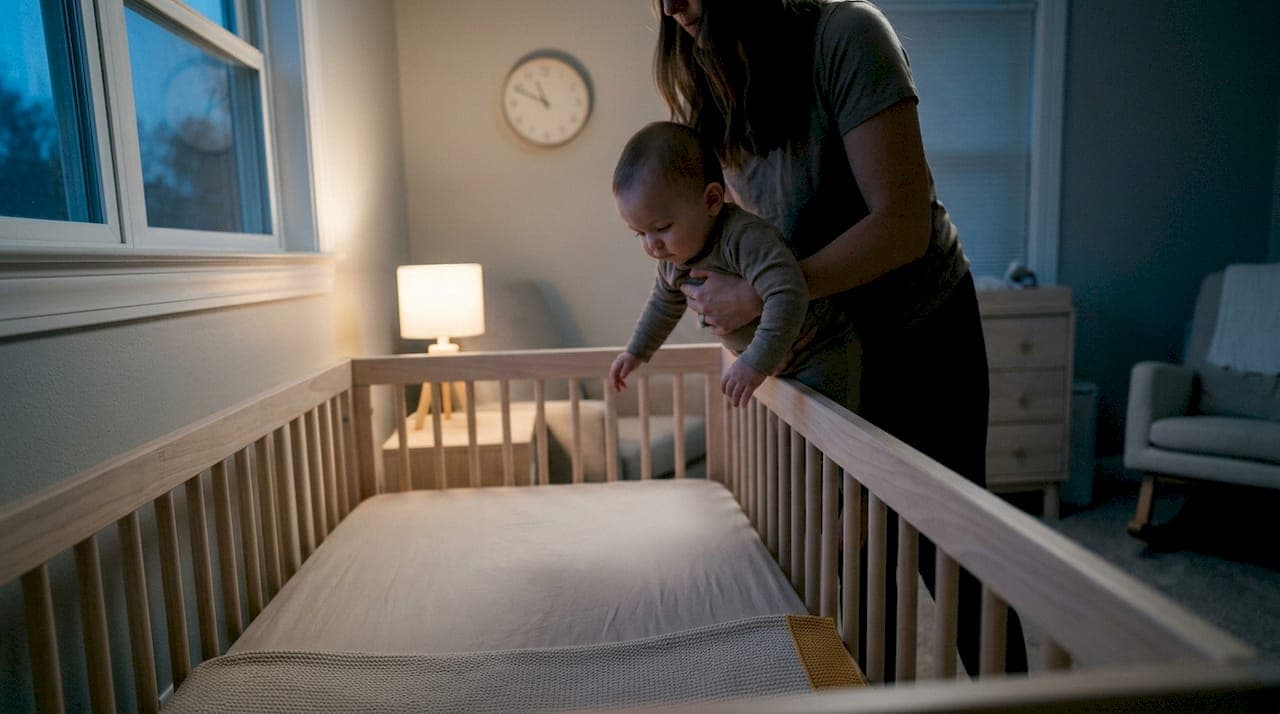
Most 9-month-olds need about 14 hours of sleep across 24 hours, split between two daytime naps totaling 2 to 3 hours and roughly 11 to 12 hours at night. A sample day might look like this: wake at 7:00 a.m., nap around 9:00 a.m. and again in early afternoon, then bedtime near 7:00 p.m. That's the target. Getting there is the interesting part.
TL;DR:
- Most 9-month-olds sleep around 14 hours daily, with 11 to 12 hours at night and 2 to 3 hours split over two daytime naps.
- Babies are often capable of sleeping through the night without feeding by this age, though habits may not have caught up yet.
- A consistent bedtime between 6:00 and 8:00 p.m. and a simple routine help signal sleep readiness and improve settling.
- Night waking is usually due to developmental milestones like teething or separation anxiety, not sleep problems, and can resolve in a few weeks with proper routines.
Table of Contents
- How Much Sleep Should a 9-Month-Old Get?
- Sample 9-Month Sleep Schedules You Can Try Tonight
- Wake Windows and When to Drop the Third Nap
- A Calming Bedtime Routine That Actually Helps
- Why Do 9-Month-Olds Wake at Night?
- Sleep Training Options for a 9-Month-Old
- Safe Sleep Basics for a 9-Month-Old
- Quick Fixes for Common 9-Month Sleep Problems
- How Mellow Kids Supports a 9-Month Sleep Schedule
- A Note on Variability and Patience
- Get a Personalized 9-Month Schedule With Mellow
- Sources
- FAQ
How Much Sleep Should a 9-Month-Old Get?
Pediatric sleep experts don't hand parents one magic number. The AASM's pediatric sleep duration consensus sets a range of 12 to 16 hours for infants this age, and that range exists because babies genuinely vary. Still, most families find success aiming for a practical midpoint. A common working target is about 14 hours total, split between nighttime and naps.
Of that 14 hours, night sleep should make up the bulk, usually 11 to 12 hours, with daytime naps filling in the remaining 2 to 3. Short awakenings are normal and don't necessarily mean anything is wrong. What matters more is whether your baby resettles without much help.
Here's something many parents don't expect: most full-term 9-month-olds are physically capable of sleeping through the night without a feeding. That doesn't mean every baby does it yet, but the biological green light has usually turned on by now, even if the habit hasn't caught up.
Sample 9-Month Sleep Schedules You Can Try Tonight
By 9 months, many babies have shifted from three naps down to two. Here's a two-nap sample schedule that works for a large share of families:
- 7:00 a.m. Wake and morning feeding
- 9:15 a.m. to 10:30 a.m. Nap 1 (about 1 to 1.25 hours)
- 12:30 p.m. Lunch
- 1:30 p.m. to 3:00 p.m. Nap 2 (about 1 to 1.5 hours)
- 5:00 p.m. Dinner
- 6:45 p.m. Bath and wind-down routine
- 7:00 p.m. Bedtime
Some babies aren't quite ready to drop the third nap. If yours still seems worn out by late afternoon, a brief transitional schedule adds a short 20 to 30 minute catnap around 4:30 p.m., pushed early enough that it doesn't crowd bedtime.
Don't force either version onto a baby who's clearly resisting. If naps are running short or bedtime keeps sliding late, shift the whole day by 10 to 15 minutes at a time rather than making a big jump. Small adjustments protect the naps you already have while you test what actually works for your family's routine.
Wake Windows and When to Drop the Third Nap
Wake windows at 9 months generally last a few hours between sleep periods, and they influence whether naps go smoothly. Too short a window and your baby fights the nap out of low sleep pressure. Too long, and you get an overtired baby who fights it for the opposite reason.
Watch for tired cues before the window closes: eye rubbing, staring off, fussiness, or losing interest in toys. Overtired babies tend to look wired instead of drowsy, arching their backs or getting suddenly clingy or shriek. That's a signal you waited too long, not a signal your baby doesn't need sleep.
If you're wondering whether it's time to consolidate from three naps to two, run a short test. For 3 to 7 days, stretch wake windows toward the 3 to 3.5 hour range and drop the shortest, latest nap. If your baby handles the longer stretches without falling apart and night sleep stays intact or improves, the transition has likely already happened. For a deeper breakdown of how wake windows change by age, it helps to see the full progression rather than guessing at just one stage.
A Calming Bedtime Routine That Actually Helps
Bedtime somewhere between 6:00 and 8:00 p.m. tends to work best at this age. Push it much later and babies often get a second wind that makes settling harder, not easier. Push it too early, relative to the last nap, and you risk an early morning wake-up nobody asked for.
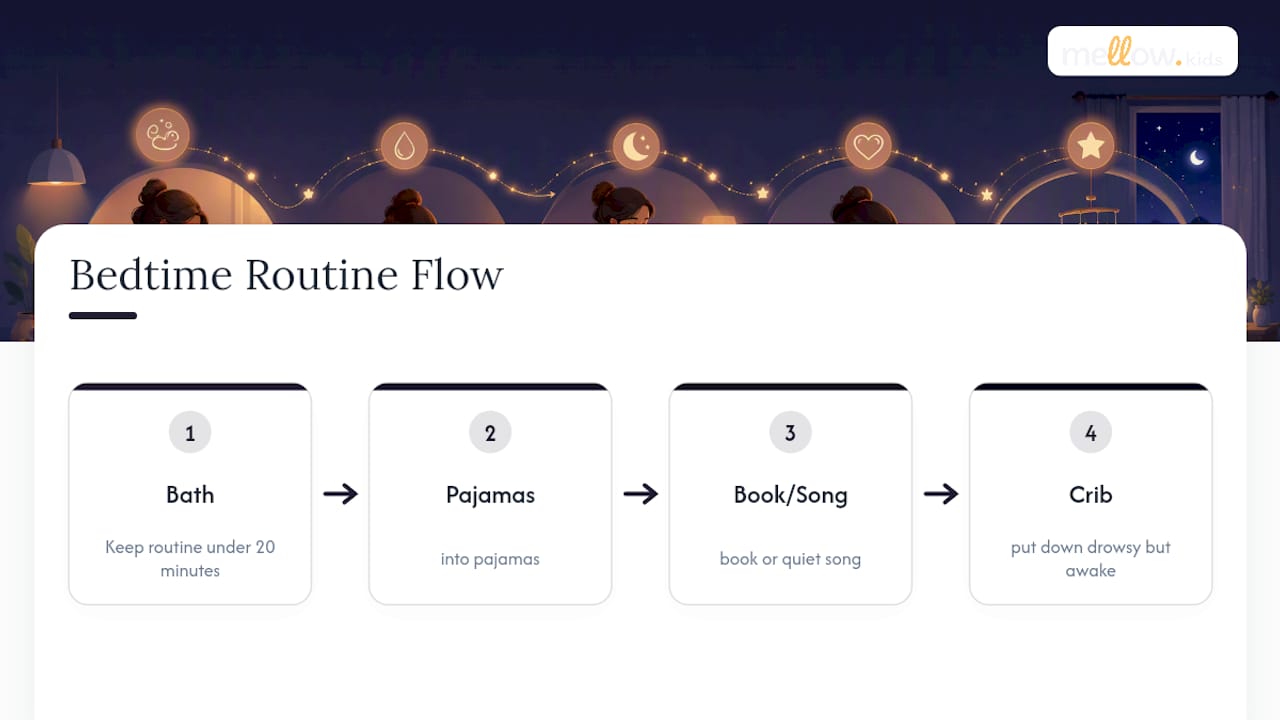
A short, repeatable routine does more work than most parents expect — establishing a predictable routine for infant sleep helps the brain settle for rest. Four steps are usually enough: bath, into pajamas, a book or quiet song, then into the crib. Keep it under 20 minutes and do it in the same order every night. Predictability is what tells a 9-month-old's brain that sleep is coming next, not the specific activities themselves.
The most useful habit to build now is putting your baby down drowsy but still awake, rather than fully asleep. It feels counterintuitive when a sleepy baby is right there in your arms, but it's how babies learn to close the final gap into sleep on their own. Start with just the last few minutes of drowsiness if full awake placement feels like too big a leap.
Why Do 9-Month-Olds Wake at Night?
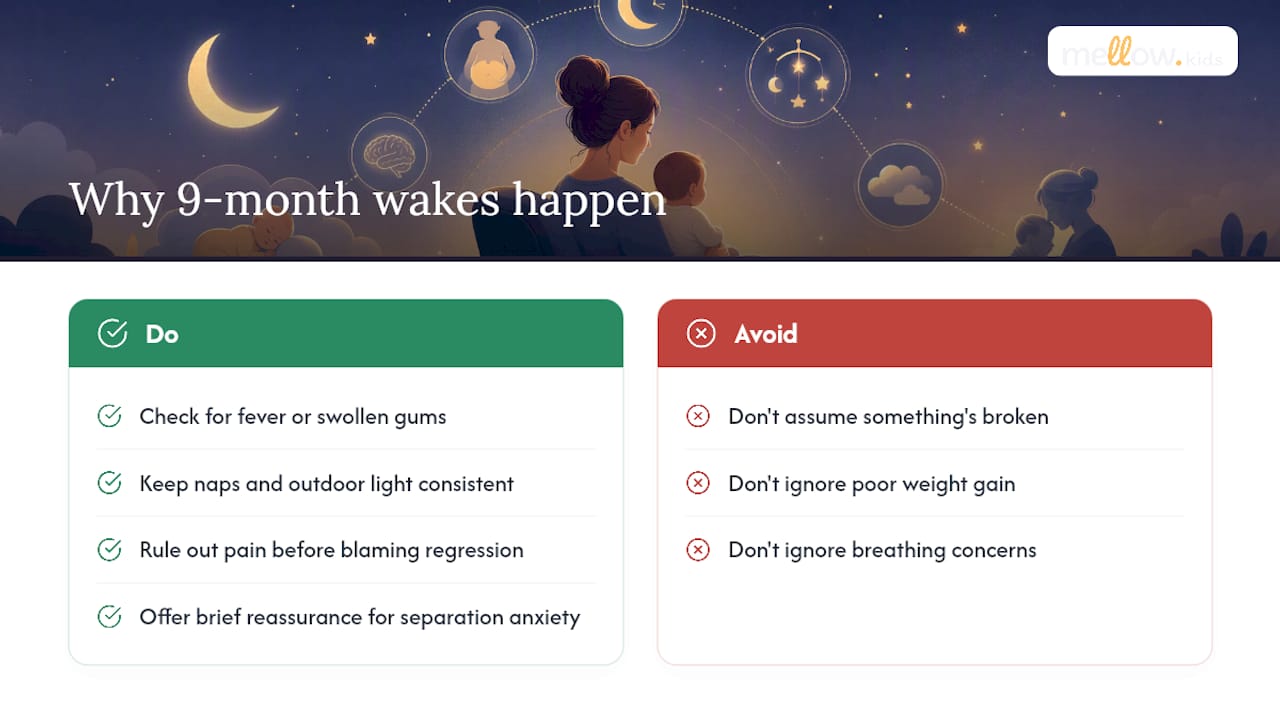
Night waking at this age rarely means something is broken. Several things converge right around 9 months: rapid motor development, teething discomfort, separation anxiety, and sometimes sleep habits that formed earlier and are simply due for an update.
The CDC's 9-month developmental milestones include new mobility skills like sitting independently and pulling up, which often show up in the crib as practice sessions at 2:00 a.m. Separation anxiety peaks around this window too, and a baby who suddenly needs to see you at night, when they were sleeping through fine last month, is a textbook version of that. Mellow's guide to sleep regressions walks through how these developmental waves tend to resolve within a few weeks.
Before assuming it's developmental, rule out pain. Check for fever or swollen gums, and keep daytime naps and outdoor light exposure consistent, since both support nighttime consolidation. Contact your pediatrician if waking comes with poor weight gain, unusual lethargy, or any breathing concerns. Those go beyond a normal sleep hiccup.
Sleep Training Options for a 9-Month-Old
If your baby's night wakings have settled into a pattern that isn't working for your family, a handful of approaches can help build stronger self-soothing skills.
Graduated extinction has you check in at increasing intervals, giving your baby space to try settling before you step in. It tends to work faster but asks more tolerance for crying upfront. Pick-up-put-down keeps you hands-on, comforting your baby just enough to calm them before laying them back down awake. It's gentler but can take longer, especially with a baby who gets more riled up once picked up. The chair method has you sit near the crib and gradually move farther away over several nights, offering reassurance through presence rather than touch.
Whichever method fits your family, a simple 5 to 7 day starter plan works well: lock in a consistent bedtime routine, place your baby down drowsy but awake, and respond with the same calm, brief check every time rather than escalating your response. Responsive, consistent parenting has been linked to measurable improvements in infant sleep outcomes, and consistency matters more than which specific method you pick. Expect some nights to go better than others. A rough night after three good ones isn't a failed plan, just a normal wobble.
Safe Sleep Basics for a 9-Month-Old
Your baby should still go down on their back for every sleep, though once they can roll independently both directions, you don't need to flip them back over during the night. Keep the crib bare: no loose blankets, pillows, bumpers, or stuffed animals until at least 12 months, per AAP safe-sleep guidance.
Pacifiers are fine, and some babies settle noticeably faster with one. Offer it at the start of naps and bedtime, but don't stress about reinserting it if it falls out once your baby's asleep, and avoid putting it back in with unwashed hands.
Quick Fixes for Common 9-Month Sleep Problems
A few small adjustments solve most sleep complaints at this age faster than a full schedule overhaul.
- Keep wake, nap, and bedtime within 15 minutes of the same time daily, including weekends.
- Get your baby outside or near bright light in the morning; it anchors the body's internal clock.
- Avoid rowdy, high-stimulation play in the hour before bedtime, even if it seems like it should tire them out.
- If a nap runs short, try shifting the next wake window slightly longer rather than immediately assuming it's a regression.
- Late-afternoon dozing past 4:30 p.m. usually eats into bedtime sleep pressure; wake your baby gently if a catnap runs long.
For night checks, keep it boring on purpose: quiet voice, minimal light, no play, back in the crib quickly. Anything more stimulating teaches your baby that waking up is worth staying awake for.
Pro Tip: Change one variable at a time when adjusting a schedule, whether it's a wake window or a nap length, and give it 3 to 7 days before judging whether it worked. Changing everything at once makes it impossible to know what actually helped.
How Mellow Kids Supports a 9-Month Sleep Schedule
Mellow's 8 to 10 month resources take the ranges pediatric groups publish and turn them into a schedule built around your baby's actual wake times, not a generic chart. The app maps AASM guidance onto real wake windows, flags upcoming developmental milestones before they hit your nights, and adjusts sample days as your baby's needs shift.
Inside the app, parents get sample daily schedules, alerts when a milestone like new mobility might disrupt sleep, and stepwise plans for nap transitions instead of a single static routine. It's the same logic behind Mellow's 3-month sleep guide, adapted for a baby who's crawling, teething, and testing boundaries at bedtime.
A Note on Variability and Patience
No two babies hit these milestones on the same night, and that's normal, not a warning sign. If you try something new, give it two full weeks before deciding it isn't working. Change one thing at a time, and if anything about your baby's sleep worries you medically, call your pediatrician rather than troubleshooting alone.
— Mauricio Vargas
Get a Personalized 9-Month Schedule With Mellow
Sample schedules get you most of the way there, but your baby's exact wake windows, nap lengths, and developmental timing are unique to them. Mellow's 8 to 10 month plan takes the guesswork out of adjusting for real, translating the ranges pediatric groups publish into a routine that updates as your baby's needs shift, instead of leaving you to recalculate every schedule change by hand.

Inside, you'll find milestone alerts that flag upcoming sleep disruptions before they hit, stepwise nap transition plans, and tracking that shows you patterns across weeks rather than isolated bad nights. If you're navigating separation anxiety or a nap transition right now, the 8 to 10 month page is the place to start building a plan around your baby's actual patterns rather than a generic chart.
Sources
- Learning to Sleep (9 Months) | Mount Sinai Parenting Center
- What Should a 9-Month-Old Sleep Schedule Look Like? | The Bump
- Pediatric Sleep Duration Consensus Statement | AASM
- CDC: Milestones for 9 months
FAQ
What Time Should I Put My 9-Month-Old to Sleep?
Bedtime between 6:00 and 8:00 p.m. tends to work best, with 7:00 p.m. as a common starting point that leaves room for two naps earlier in the day.
How Much Daytime Sleep Should a 9-Month-Old Get?
Most 9-month-olds need about 2 to 3 hours of daytime sleep across two naps, on top of roughly 11 to 12 hours at night.
Is It Normal for a 9-Month-Old to Still Take 3 Naps?
Yes, some babies briefly hold onto a short third nap while transitioning from three naps to two, especially if the middle nap has been short or bedtime is creeping earlier than usual.
My 9-Month-Old Keeps Waking Up at Night. Is This Normal?
Yes, night waking at 9 months is common and usually tied to new motor skills, teething, or separation anxiety rather than a sign that something is wrong; consistent routines and brief, calm check-ins typically help it resolve within a few weeks.