

Randomized controlled trials and five-year follow-up studies confirm that evidence-based sleep training improves infant sleep and parental mood in the short and medium term, with no consistent long-term harms to attachment or emotional development. The caveat that matters most: rule out medical causes for night wakings, like reflux or illness, before starting any method.
TL;DR:
- Most sleep training methods take one to two weeks to show consistent improvements in infant sleep and lack long-term harm to emotional or attachment development.
- Graduated extinction and bedtime fading are the most supported methods, with graduated extinction often requiring check-ins at increasing intervals over several nights.
- Parents should rule out medical causes like reflux or illness before starting sleep training and establish a consistent, predictable pre-sleep routine.
- Results are most reliable when sleep training begins around 4 to 6 months of age, with progress often seen faster in older infants.
- If no improvement occurs after two to three weeks or if health concerns arise, consult a pediatrician to adapt or pause the training.
Table of Contents
- What Does the Research Actually Show?
- What Are the Main Evidence-Based Sleep Training Methods?
- When Should You Start, and What Should You Check First?
- How Do You Put Evidence-Based Sleep Training Into Practice?
- How Long Does It Take to See Results?
- How Mellow Turns This Research Into a Plan for Your Family
- Choosing What's Right for Your Family
- Ready to Build a Plan Around Your Baby's Stage?
- Primary Sources and Further Reading
- Sources
What Does the Research Actually Show?
The evidence here is stronger than most parenting advice you'll encounter. This isn't a handful of opinion pieces. It's cluster-randomized trials, systematic reviews, and multi-year tracking of the same families.
In one well-known trial, behavioral sleep interventions reduced parent-reported sleep problems at 10 months from 68% in the control group to 56% in the intervention group, a number needed to treat of roughly nine families for one to see a clear benefit, according to a systematic review of infant sleep training. Other trials measured faster sleep onset and fewer awakenings per night. The Pediatrics randomized controlled trial on graduated extinction and bedtime fading found both approaches cut sleep latency and night waking versus controls, with small to moderate drops in salivary cortisol in the intervention groups, not a spike.
The long-term question is where parents worry most, and it's also where the data is most reassuring:
- A five-year follow-up study found no measurable differences in child behavior, emotional development, or parent-child attachment between sleep-trained children and controls.
- Maternal mental health showed no negative divergence at the five-year mark either.
- Improvements in maternal depressive symptoms and parental sleep tend to show up within weeks of starting.
The trials do have limits. Most samples are drawn from Western, English-speaking populations, and sample sizes in individual studies are modest. That's worth keeping in mind, though it doesn't undercut the consistency of the findings across multiple independent research teams.
What Are the Main Evidence-Based Sleep Training Methods?
Every method with real trial support shares one mechanism: creating repeated chances for your baby to fall asleep independently, without you stepping in at the first sign of fussing. The differences are mostly about pacing and how much crying you're prepared to tolerate along the way.
- Graduated extinction: You put your baby down awake, then check in at increasing intervals (say, 3, 5, then 10 minutes) if crying continues. This has strong RCT support and tends to take one to two weeks.
- Unmodified extinction (cry it out): No check-ins after the routine. Often works within three to five days, but requires the highest tolerance for crying and isn't right for every family.
- Bedtime fading: You temporarily push bedtime later to match your baby's natural sleep pressure, then gradually shift it earlier once falling asleep gets easier. Slower, gentler, and well-supported in the same Pediatrics trial as graduated extinction.
A 2025 review of sleep consolidation approaches classifies extinction-based methods, in general, as the most empirically supported first-line options, though it notes they work best when matched to what a given family can actually sustain night after night.
Pro Tip: If you're not sure which method fits your household, start with bedtime fading. It's the gentlest entry point, and you can always tighten the check intervals later if progress stalls.

When Should You Start, and What Should You Check First?
Most trial protocols enroll infants starting around 4 to 6 months, once babies are developmentally able to stretch longer between feeds and self-soothing skills are starting to emerge. Younger babies aren't excluded from all approaches. A BMC Pediatrics trial found that a brief sleep-education session at 4 months more than doubled the odds of prolonged nighttime sleep by 6 months (adjusted odds ratio of 2.39), which suggests routine-building and parent education pay off even before formal extinction methods make sense.
Before you begin, work through this short checklist:
- Talk to your pediatrician if your baby has reflux, a growth concern, or any condition that could explain night wakings. Clinical guidance consistently points to this as step one.
- Confirm your baby's sleep space follows current safe sleep guidelines.
- Rule out situations where training should wait, like recent illness, a major routine disruption, or travel.
If your baby has a medical or developmental need, your pediatrician can help you adapt the timeline and intervals rather than skip training altogether.
How Do You Put Evidence-Based Sleep Training Into Practice?
The mechanics matter less than the consistency behind them. Trials that paired a behavioral technique with a predictable pre-sleep routine saw better adherence and better outcomes than technique alone.
- Build the routine first. Same order, same cues, every night: bath, dim lights, a short book, then crib. Give this three or four nights to settle in before layering on a formal method. A nap and daytime routine guide can help you extend the same consistency into daytime sleep.
- Put your baby down drowsy but awake. This is the core mechanic behind nearly every method with trial support. It gives your baby the repeated practice of falling asleep without you already in the room.
- Use structured check intervals if you're using graduated extinction. A common pattern is checking at 3, 5, then 10 minutes, extending slightly each night. Keep check-ins brief: a hand on the chest, a few quiet words, then leave again.
- Track what's happening. A simple sleep log, noting bedtime, time to fall asleep, and number of wakings, helps you see progress that's easy to miss when you're exhausted.
- Expect setbacks. Teething, travel, and growth spurts routinely disrupt progress for a few nights. Go back to basics rather than abandoning the plan.
Pro Tip: Write down your check-in schedule on paper before night one. Decision fatigue at 2 a.m. is real, and having the plan already set removes the temptation to improvise.
How Long Does It Take to See Results?
Timelines vary by method, and knowing what's normal helps you avoid quitting too early or too late.
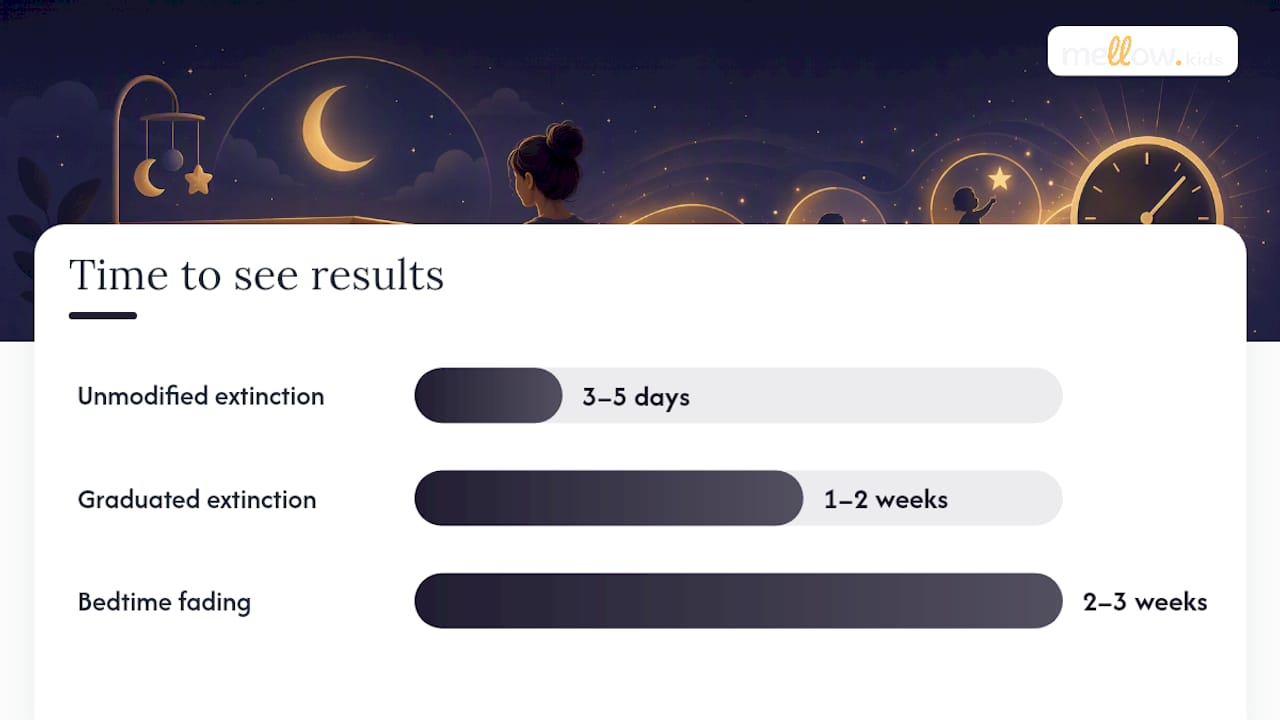
- Unmodified extinction: often shows change within three to five days.
- Graduated extinction: typically one to two weeks for consistent improvement.
- Bedtime fading: slower, usually two to three weeks, but with less protest along the way.
Track progress using concrete measures: minutes to fall asleep, number and length of night wakings, and how you and your partner are sleeping. Reviews of parental outcomes show mood and sleep-quality improvements for parents often arrive alongside, or even before, big changes in the baby's sleep.
If nothing shifts after two to three weeks of consistent effort, or if you notice signs of illness, feeding problems, or excessive distress, pause and check in with your pediatrician before continuing.
How Mellow Turns This Research Into a Plan for Your Family
Reading the trials is one thing. Applying them at 9 p.m. with an overtired baby is another. Mellow translates trial-tested principles, drowsy-but-awake placement, consistent routines, and age-appropriate check intervals, into staged plans built around your child's actual developmental window, not a generic timeline. The 8 to 10 month guidance and companion mini-guides walk you through what to expect at each stage, so you're applying the research instead of guessing at it.
Choosing What's Right for Your Family
There's no universal right answer here, and you shouldn't feel pressured toward one. The research supports sleep training as safe and effective when done thoughtfully, and it equally supports families who choose a different pace. What matters most is checking with your pediatrician first and leaning on routines and tools you actually trust.
— Mauricio Vargas
Ready to Build a Plan Around Your Baby's Stage?
Generic advice tells you to "try graduated extinction." Mellow tells you what that looks like for a baby who's exactly your child's age this week, then adjusts the plan as your child grows into the next stage. The 8 to 10 month plans and 11 to 14 month plans turn the trial evidence covered above into nightly steps, check intervals, and troubleshooting built for that specific window, and the Mellow app tracks your progress alongside it so you can see what's actually working. If you want something you can start tonight without committing to a subscription first, the mini-guides are a low-lift way to test the approach. Pediatric consultation still matters before you begin, especially if your baby has any medical or feeding concerns. Once you've got the green light, open the app and pick the plan that matches your child's age.
Primary Sources and Further Reading
- Five-year follow-up randomized trial: long-term safety data.
- Pediatrics RCT: graduated extinction and bedtime fading.
- Systematic review, PMC: short-term outcomes summary.
- BMC Pediatrics RCT: early sleep education intervention.
- Sleep consolidation review: method evidence comparison.
- Role of routine for newborns: practical routine building.
Sources
- Five-Year follow-up of Harms and Benefits of Behavioral Infant Sleep Intervention: Randomized Trial
- Infant sleep training: rest easy? (Can Fam Physician / PMC)
- Behavioral Interventions for Infant Sleep Problems: A Randomized Controlled Trial | Pediatrics | AAP
- Early sleep intervention for improving infant sleep quality: a randomized controlled trial (BMC Pediatrics)